
Germany · Restored
Hohenzollern Castle
Burg Hohenzollern
Hohenzollern Castle is the 19th-century Gothic Revival reconstruction of a medieval hilltop fortress, sited on the summit of Mount Hohenzollern above Hechingen in Baden-Württemberg, Germany. The current castle was completed in 1867 and serves as an ancestral seat and museum for the House of Hohenzollern.
Its prime
1867
Today
Restored
Ranked among Europe’s castles
As it stood in 1867
What Hohenzollern Castle looked like in its prime.
Sitting on an isolated rocky promontory, the castle fills almost the entire summit with successive outer curtain walls and bastions. The palatial core is U-shaped, faced in warm beige masonry and capped by steep slate roofs, conical and pyramidal towers, pinnacles and a taller square keep-like tower; crenellated parapets and a multi-turn zwinger connect the bastions. The silhouette shows clustered towers and spires above a broad defensive terrace, set against the rolling plain below.
Its story
The story of Hohenzollern Castle.
Castro Zolre and the Swabian League's Siege, 1422-1423
Nothing has been excavated on the isolated 855-metre cone above Hechingen to date its earliest occupation: an Alemannic settlement is presumed on the strategic summit, and the Counts of Zollern are thought to have raised a castle there in about 1040. The house is first named in 1061, the castle only in 1267, as "Castro Zolre", a record giving nothing beyond the name, though contemporaries called it the "crown of all castles in Swabia". The name is taken from Söller, a terrace, by way of the Latin solarium.
Its own count brought it down. Friedrich XII of Zollern, called der Oettinger, had made enemies of the Swabian imperial cities and had the imperial ban laid on him; the cities allied with Count Eitel Friedrich of Zollern and with Württemberg, and Augsburg, Ulm, Reutlingen, Rottweil and Ravensburg were among those that sent men. The siege opened in the summer of 1422 and ended on 15 May 1423, when the Swabian League of Cities took the castle and destroyed it completely.
Faber's Wagon-Fort and the Fall of the Castle, 1633–1635
A second, stronger castle was begun in 1454. All that survives of it is the medieval portion of the Catholic Chapel of St Michael, dated 1454-1461.
Its war came with the Swedish advance into Bavaria. Gustavus Adolphus had promised Duke Julius Friedrich of Württemberg the Swabian territory he took or might yet take, and in early 1632 the duke marched into the county of Hohenberg under the pretext of "protecting the abandoned [Catholic] lordships". Rottweil fell that October, and in July 1633 the blockade of Hohenzollern began. Lieutenant-Colonel Jost Faber, given 500 armed Württemberg peasants and 100 mounted men for the job, got nowhere: for eight months a Württemberg wagon-fort sat below the fortress while its soldiers plundered the food stores, to no military effect.
In the spring of 1634 the young Duke Eberhard of Württemberg took the siege in hand, replacing Faber with Lieutenant-Colonel Helmstädt, an officer operating with the Swedes. Helmstädt took Hechingen on 25 March 1634 and on 3 April the castle capitulated for want of supplies, the garrison under Captain Weinmann marching out free; Hohenzollern-Hechingen then had to pay homage to Eberhard and lost all its officials. After Nördlingen swung the war back to the Emperor, the fortress was recovered on 1 November 1635 by a ruse: the Württemberg captain Albert Schmidlapp was handed a forged letter carrying his duke's supposed order to surrender it to the imperial Lieutenant-Colonel Karthausen. Fifty local countrymen were left to hold it.
French Winter Quarters and the Last Austrian, 1744-1798
The castle then passed largely into Habsburg hands, interrupted by French soldiers who occupied it in the winter of 1744-45 during the War of the Austrian Succession. Returned to Habsburg control, it was rarely occupied, judged by the end of the century to have lost its strategic value, and stripped of several dilapidated buildings. The last Austrian occupant left in 1798; by the beginning of the 19th century only the Chapel of St Michael remained usable.
Frederick William IV's Family Memorial, 1819-1867
In 1819, travelling through southern Germany on his way to Italy, Crown Prince Frederick William of Prussia climbed the mountain to learn where his family had come from. Writing in 1844 as king, he recalled "the sunset we saw from one of the castle bastions" and named the ambition plainly: "Now is a desire, a dream of [my] youth, to see Hohenzollern Castle again made habitable."
He engaged Friedrich August Stüler, pupil and heir of Karl Friedrich Schinkel and Architect of the King since 1842, who began work in 1846 on a design drawing on English Gothic Revival architecture and the châteaux of the Loire; the approach works and entryway were by Moritz Karl Ernst von Prittwitz, then reckoned Prussia's leading fortifications engineer. The foundation stone was laid in 1850, the Brandenburg-Prussian and Hohenzollern-Sigmaringen lines paying for the whole between them, an arrangement bitter enough that a furious exchange between Otto von Bismarck and Georg von Vincke in the second Prussian chamber on 22 March 1852 ended in a duel three days later. The castle was completed and dedicated on 3 October 1867 under Frederick William IV's brother, King William I.
The castle was occupied before it was even finished: in the German War of 1866 Württemberg troops took it without a fight and renamed it the Olgaburg after their queen; Prussia's victory obliged them to leave.
A Showpiece No Kaiser Occupied
The rebuilt castle was never lived in for long, and none of the German Emperors occupied it. When Wilhelm II had Gabriel von Seidl look at remodelling it in a purist historicist manner, Seidl visited in 1894 and judged the place so botched that he could do nothing short of building it anew ("and then it is simply no longer an old castle"), and the scheme was dropped.
The one Hohenzollern to live there did so in flight: the last Prussian Crown Prince, Wilhelm, stayed several months after leaving Potsdam ahead of Soviet forces in the closing stage of the Second World War. He and Crown Princess Cecilie are buried at the castle, the family's Brandenburg estates being under Soviet occupation when they died. From 1952 Prince Louis Ferdinand of Prussia brought in Prussian memorabilia from the family collections and the former Hohenzollern Museum at Schloss Monbijou, among them the crown of Wilhelm II.
An earthquake of magnitude Ms 5.7 on 3 September 1978 brought down some of the turrets and toppled knightly figures; repairs ran on into the mid-1990s. The castle is still the private property of the House of Hohenzollern.
Step inside
12 places to explore in 1867.
The record describes 12 distinct spots at Hohenzollern Castle, including 5 interiors: count's hall (grafensaal), old castle kitchen / treasure chamber, watch tower staircase / library entrance and more. Create your own photoreal reconstruction and explore every one, more scenes means more rooms, more angles, and more of the place to stand in.
Build Your Own Castle
Recreate Hohenzollern Castle with AI to explore it.
The artist rebuilds it as it stood in 1867, a photoreal reconstruction that belongs to you alone. Pay with coins, no subscription needed.
Recreate this castle →Defend this castle →Whose castle
Clans who held Hohenzollern Castle.
The families that held Hohenzollern Castle for a decade or more across its history, follow a name to its clan.
Hohenzollern
The ancestral seat of the House of Hohenzollern; the present castle was raised 1846–67 as a family memorial.
From the archive
Hohenzollern Castle on paper: the measured plan and period views.
The survey plan and photographs below are the ground truth this page's reconstructions are checked against, drawn and photographed while the castle was still a working garrison. Every image is public-domain or openly licensed, with its source named.
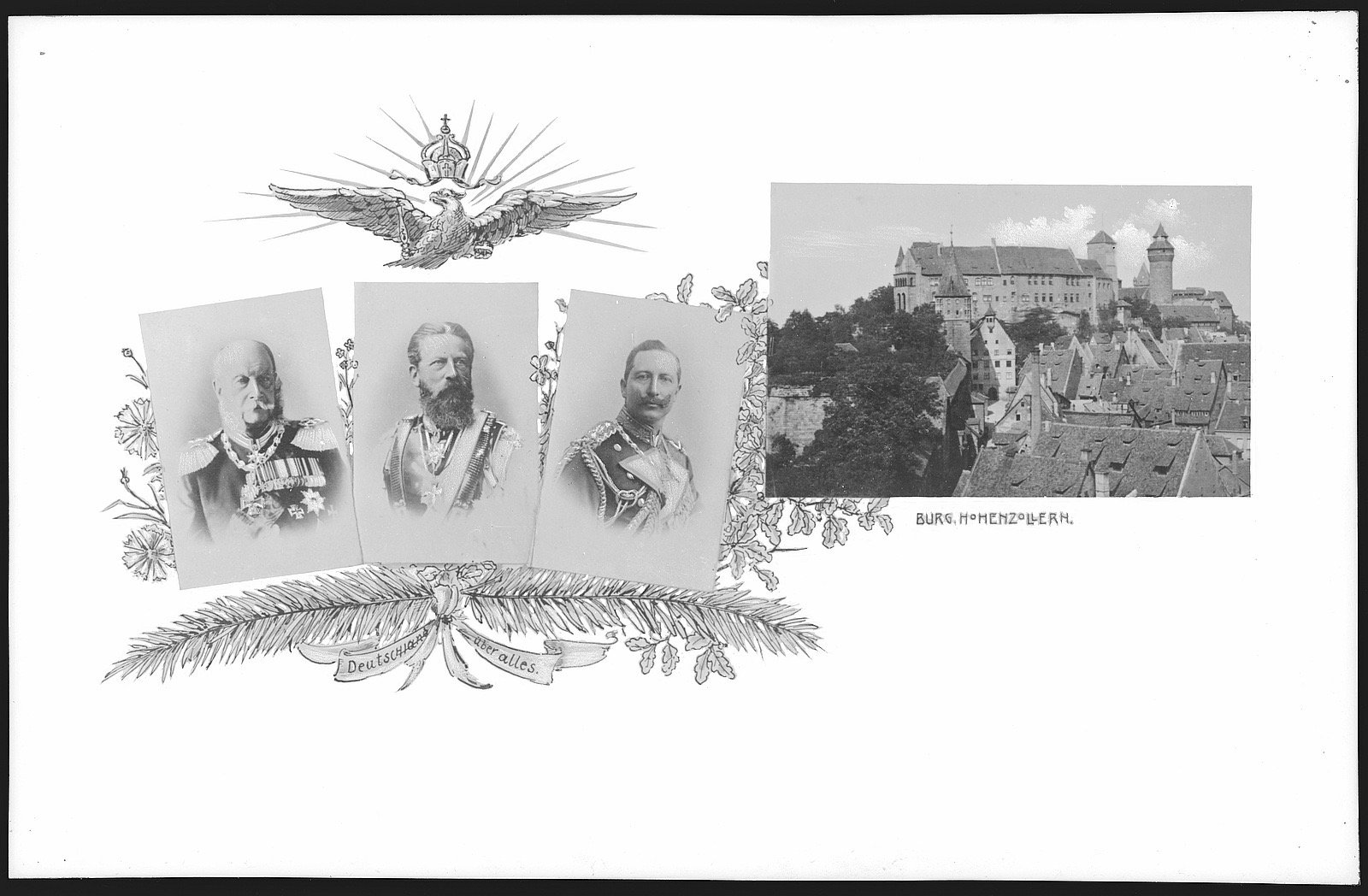
Bisingen. Hohenzollern Castle and imperial portraits
· Deutsche Fotothek (via Europeana)
Public domain
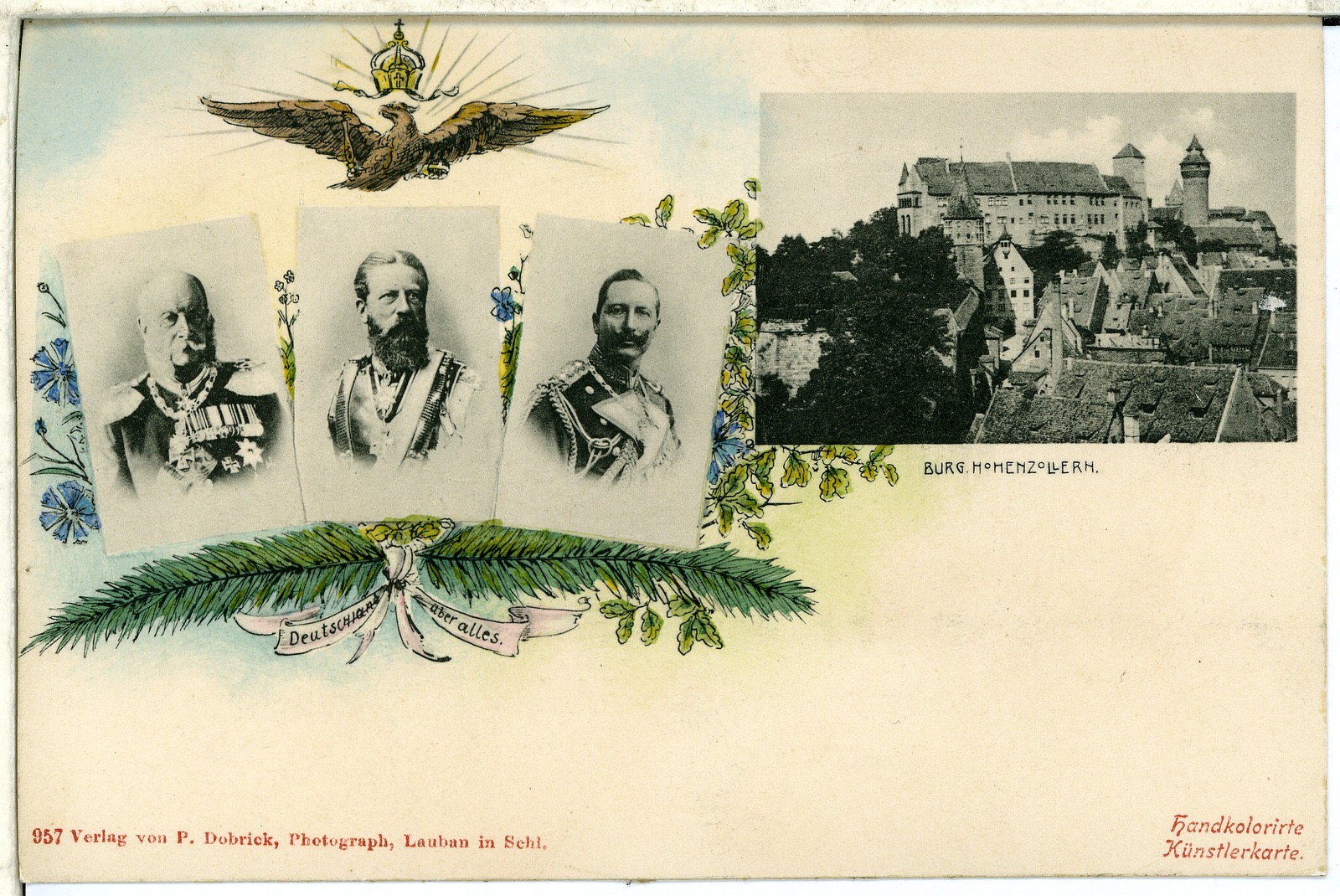
Bisingen. Hohenzollern Castle and imperial portraits
· Deutsche Fotothek (via Europeana)
Public domain


