Clan Rising
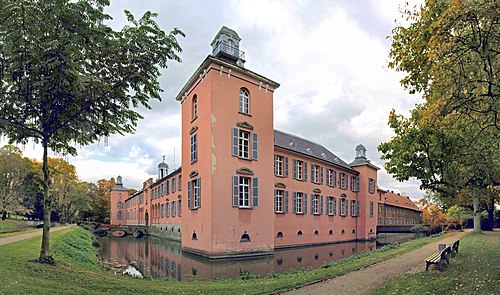
Wenzelschloss today

Germany · Still standing

Wenzelschloss

Wenzelburg

Lauf Castle (Wenzelschloss) is a 14th‑century stone castle in the town of Lauf an der Pegnitz, built by Emperor Charles IV in 1356. Its most famous interior feature is the hall of arms, which preserves a large painted collection of Bohemian, Moravian and Silesian coats of arms; a statue of Saint Wenceslas adorns the entrance gate façade.

Photograph via Wikimedia Commons

Its prime

1356

Today

Still standing

As it stood in 1356

What Wenzelschloss looked like in its prime.

A compact stone watercastle standing at the Pegnitz in the town of Lauf, formed of solid masonry curtain walls enclosing an inner courtyard. The primary external focus is the main entrance gate whose façade bears a surviving statue of Saint Wenceslas above the gateway; beyond the gate a single large hall (the Wappensaal or hall of arms) fills much of the interior. Exterior surfaces are exposed stone; interiors of the hall are painted with rows of heraldic shields.

Its story

The story of Wenzelschloss.

Lauf Castle, the Wenzelschloss, was built in 1356 by the Emperor Charles IV on the road between Prague and Nuremberg, on the ruins of an older castle. Its German name, "Saint Wenceslas' Castle", comes from the statue of the patron saint of the Czechs that survives to this day on the façade of the entrance gate.

Lauf lay in the Bohemian Palatinate, an area once part of the Bohemian crown lands. In 1373 Charles IV ceded the castle with parts of the Palatinate to Otto V, Duke of Bavaria, in exchange for the Margraviate of Brandenburg; Charles's son Wenceslaus IV lost the rest of the Palatinate in 1401.

The castle's dominant feature is its hall of arms: in 1934, under a layer of old paint, 112 coats of arms of noblemen of the Crown of Bohemia were discovered, the most precious collection of Bohemian, Moravian and Silesian secular and ecclesiastical heraldry.

Step inside

6 places to explore in 1356.

The record describes 6 distinct spots at Wenzelschloss, including 2 interiors: hall of arms (wappensaal), wide interior view, detail of the painted coats of arms in the hall. Create your own photoreal reconstruction and explore every one, more scenes means more rooms, more angles, and more of the place to stand in.

Exterior approach from the town street toward the entranceRiverside view across the PegnitzClose-up of the entrance gate façade with Saint Wenceslas statueHall of arms (Wappensaal), wide interior viewDetail of the painted coats of arms in the hallInner courtyard looking toward the hall

Build Your Own Castle

Recreate Wenzelschloss with AI to explore it.

The artist rebuilds it as it stood in 1356, a photoreal reconstruction that belongs to you alone. Pay with coins, no subscription needed.

Recreate this castle →

Castle Siege

Play Castle Siege at Wenzelschloss.

A strategy game played on Wenzelschloss’s real ground plan: the same surveyed walls shown in the archive below. Post your finite garrison on the battlements between assaults, then hold out as rams, siege towers, trebuchets and sappers arrive in ever-worse waves.

Sign in free to see the garrison muster. One castle costs 150 Clan Coins and is yours forever.

Sign in to take command →

See every castle’s leaderboard →

From the archive

Wenzelschloss on paper: the measured plan and period views.

The survey plan and photographs below are the ground truth this page's reconstructions are checked against, drawn and photographed while the castle was still a working garrison. Every image is public-domain or openly licensed, with its source named.
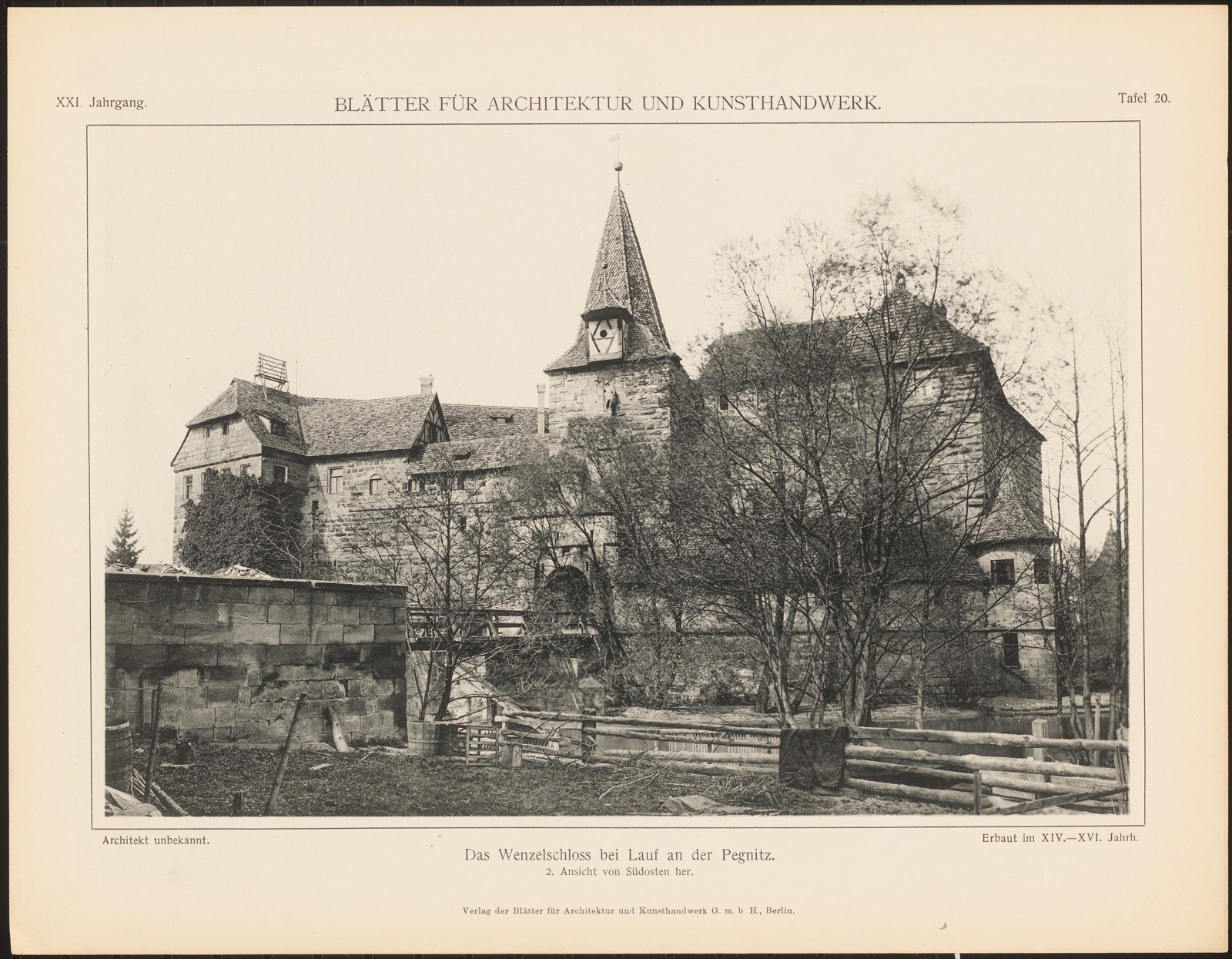
Wenzelschloss, Lauf: Ansicht von Südosten (aus: Blätter für Architektur und Kunsthandwerk, 21. Jg., 1908, Tafe, Wenzelschloss

Wenzelschloss, Lauf: Ansicht von Südosten (aus: Blätter für Architektur und Kunsthandwerk, 21. Jg., 1908, Tafe

· Museum of Architecture at Berlin Institute of Technology (via Europeana)

CC0 (no rights reserved)
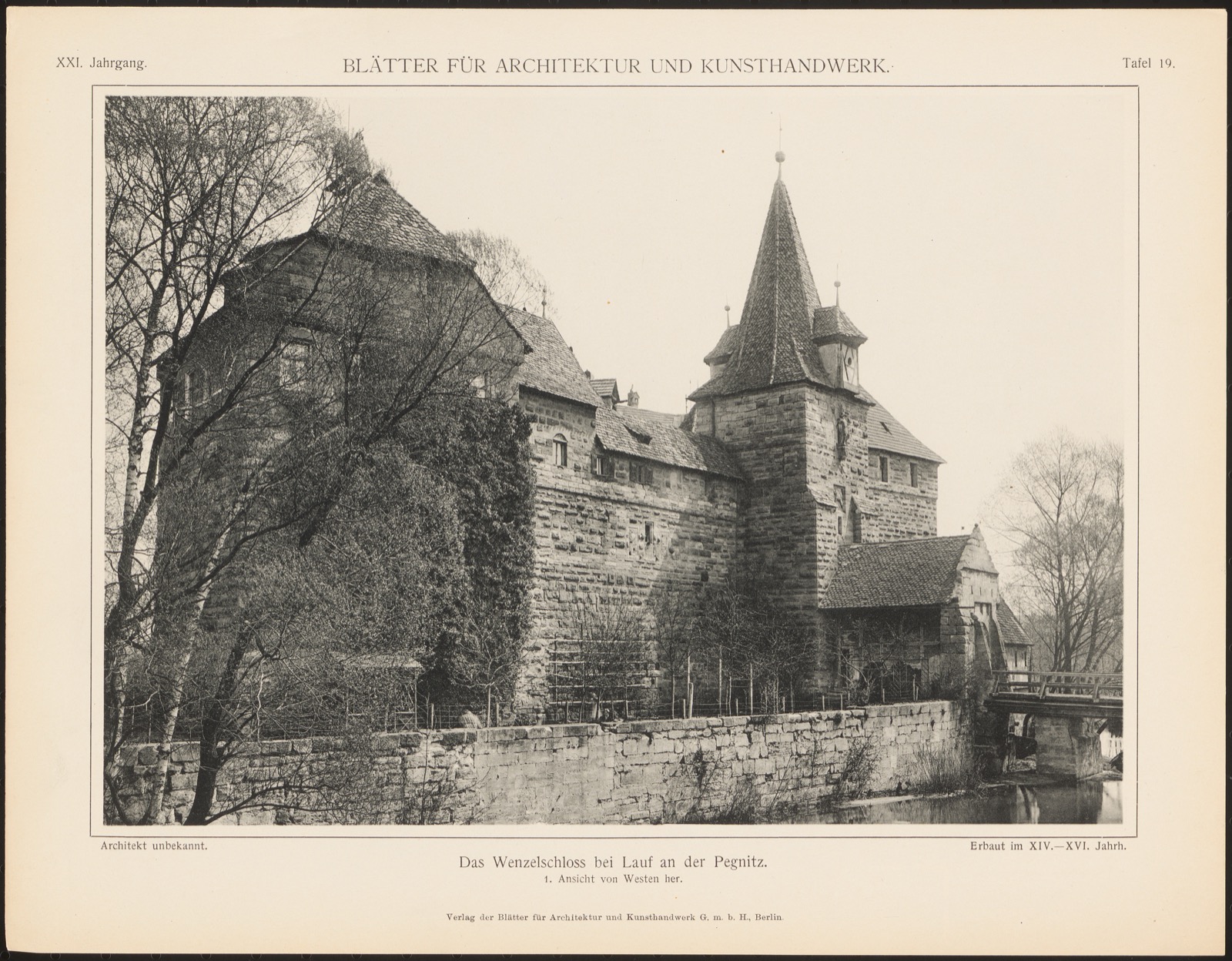
Wenzelschloss, Lauf: Ansicht von Westen (aus: Blätter für Architektur und Kunsthandwerk, 21. Jg., 1908, Tafel , Wenzelschloss

Wenzelschloss, Lauf: Ansicht von Westen (aus: Blätter für Architektur und Kunsthandwerk, 21. Jg., 1908, Tafel

· Museum of Architecture at Berlin Institute of Technology (via Europeana)

CC0 (no rights reserved)

Questions about Wenzelschloss

What is the history of Wenzelschloss?

Wenzelschloss was built in the 14th century as a castle on the road between Prague and Nuremberg. Charles IV raised it in 1356 on the ruins of an older castle. It later passed to the Wittelsbachs in 1373, and the Nürnberger carried out several alterations between 1504 and 1736.

What is inside Wenzelschloss?

Inside Wenzelschloss is the hall of arms, or Wappensaal, which occupies much of the interior. It contains 112 painted or colour-inlaid coats of arms belonging to noble families of the Crown of Bohemia, including Bohemian, Moravian and Silesian heraldry. The entrance gate also bears a statue of Saint Wenceslas.

Why was Wenzelschloss built, and what was it used for?

Wenzelschloss was built as a royal castle and overnight stop on the route between Prague and Nuremberg. It stood on newly acquired Bohemian crown territory before entry into the imperial city of Nuremberg. The hall of arms may have served Charles IV as a bedchamber, although its precise purpose is not stated as certain.

Where is Wenzelschloss?

Wenzelschloss is in the town of Lauf an der Pegnitz, near Nuremberg. It stands on an island in the Pegnitz, in the Franconian town of Lauf an der Pegnitz. The castle was formerly associated with the Bohemian Palatinate, an area once part of the Bohemian crown lands.

When was Wenzelschloss built?

Wenzelschloss was built in 1356, placing its construction in the 14th century. It replaced an older castle on the same site. The hall of arms was created around 1360, during the early period of the new castle's construction.

What did Wenzelschloss look like in its prime?

Wenzelschloss is a compact stone watercastle beside the Pegnitz. Solid masonry curtain walls enclose an inner courtyard, while the main entrance gate has a surviving statue of Saint Wenceslas above the gateway. The hall of arms fills much of the interior and has painted rows of heraldic shields.

Is Wenzelschloss still standing, or is it a ruin?

Wenzelschloss is still standing and is described as intact. It underwent comprehensive restoration between 1985 and 2013, when it was used as an external branch of the Nuremberg Academy of Fine Arts. It has stood empty since that restoration period.

Who built Wenzelschloss?

Wenzelschloss was built by Charles IV, Holy Roman Emperor, in 1356. The supplied material does not name a separate architect. Construction began on the site of a destroyed predecessor castle and produced a new royal castle on Bohemian crown territory.

Can you visit Wenzelschloss?

Wenzelschloss can be visited partially as part of town tours. It is not described as a fully open public attraction, and it has stood empty since 2013. The hall of arms and other interior views are documented, while access is stated only in connection with guided city tours.
All castles of Germany · Castles of Europe · the best castles in Europe · explore the finished reconstructions.