
Greece · Partial ruin
Assos Castle
Assos Castle is a Venetian fortification occupying the summit and ridge of the Assos peninsula on Kefalonia, Greece. Built in the late 16th century, the fortress encloses a small settlement, chapel and administrative buildings and overlooks the bay of Agia Kyriaki.
First raised
1593
Its prime
1600
Today
Partial ruin
As it stood in 1600
What Assos Castle looked like in its prime.
The fortress crowns the entire 170 m rocky Assos peninsula, its light-beige stone curtain wall running along the ridge for roughly 2,000 m and enclosing about 44,000 m². The ramparts form broad, angular bastions and a flat-topped citadel at the summit; an arched principal gate bears the carved Venetian Lion of Saint Mark. From the outer faces the walls descend to steep coastal cliffs and inside the enclosure a compact group of stone houses, a small chapel and administrative buildings fill the courtyard.
Its story
The story of Assos Castle.
A Second Fortress for Kefalonia, 1584–1596
Assos Castle was raised because Kefalonia's existing stronghold, St George's Castle, could no longer be trusted to defend the whole island against Ottoman raids and piracy. In 1584 the island's nobles petitioned the Venetian Senate for a new fortress, and Venice, which planned to found a town within its walls and shift its island administration there from St George's, began building in 1593 under the supervision of Ambrosius Cornelius. The castle itself was designed by the Venetian architect Marino Gentillini and completed by 1596, its walls running some 2,000 metres around a hilltop 170 metres above the sea, taking in the whole of the Assos peninsula and overlooking the bay of Agia Kyriaki north of Paliki. Gentillini married and settled on Kefalonia, was recorded in the Venetian nobility's Libro d'Oro, and his descendants still run the island's Gentillini winery.
Capital of the North, Then a Fortress Without a Role, 1596–1797
Assos itself never held more than a small population: its position meant that under siege its supplies, water included, could be cut off. Even so, the fortress became the administrative capital of northern Kefalonia, a large defensive circuit around a modest settlement. Its strategic value fell away in 1684, once Venice took Lefkada from the Ottomans, and by 1757, with piracy and the Turkish threat both reduced, the Venetians founded Argostoli as the island's new main town. Assos nonetheless remained the seat of the Venetian provveditore until the fall of the Republic of Venice ended Venetian rule over Kefalonia in 1797.
Refuge, Prison and Depopulation, 1822–1963
In 1822 refugees from Souli arrived to shelter within the fortress (put at about 1,700 by one account, 7,000 by another), and the site was made a quarantine area, giving its name to a settlement, Souli, inside the walls. For the following century Assos carried on as a fortress with no military function. A prison opened there in the late 1920s and, after the Second World War, held political prisoners who worked vineyards and grew cereals inside the walls. The 1953 Ionian earthquake badly damaged the islands; most of the castle's remaining residents left afterwards and the prison closed. The 1961 census counted only six people still living inside the walls, and the last of them left in 1963, families who had cultivated olives and grapes there and were known locally as the "Kastrinoi".
The Lion Gate and the Ruins Today
Alongside St George's Castle, it is a fine example of the island's military architecture; the British general Charles James Napier described it as "stronger than Gibraltar". The ruins of a Venetian building belonging to the Gentillini family stand near the church inside the walls. The site is designated an archaeological site and a protected building in Greece, and is open daily with no entry fee, reached along a renovated stone path; an arched gate bearing the Venetian Lion of Saint Mark and sections of the walls survive, along with the small church of St Mark and the former house of the Venetian high commissioner.
Step inside
8 places to explore in 1600.
The record describes 8 distinct spots at Assos Castle, including 3 interiors: inner courtyard and streets, small church of st. mark, house of the venetian provveditore. Create your own photoreal reconstruction and explore every one, more scenes means more rooms, more angles, and more of the place to stand in.
Build Your Own Castle
Recreate Assos Castle with AI to explore it.
The artist rebuilds it as it stood in 1600, a photoreal reconstruction that belongs to you alone. Pay with coins, no subscription needed.
Recreate this castle →Defend this castle →From the archive
Assos Castle on paper: the measured plan and period views.
The survey plan and photographs below are the ground truth this page's reconstructions are checked against, drawn and photographed while the castle was still a working garrison. Every image is public-domain or openly licensed, with its source named.
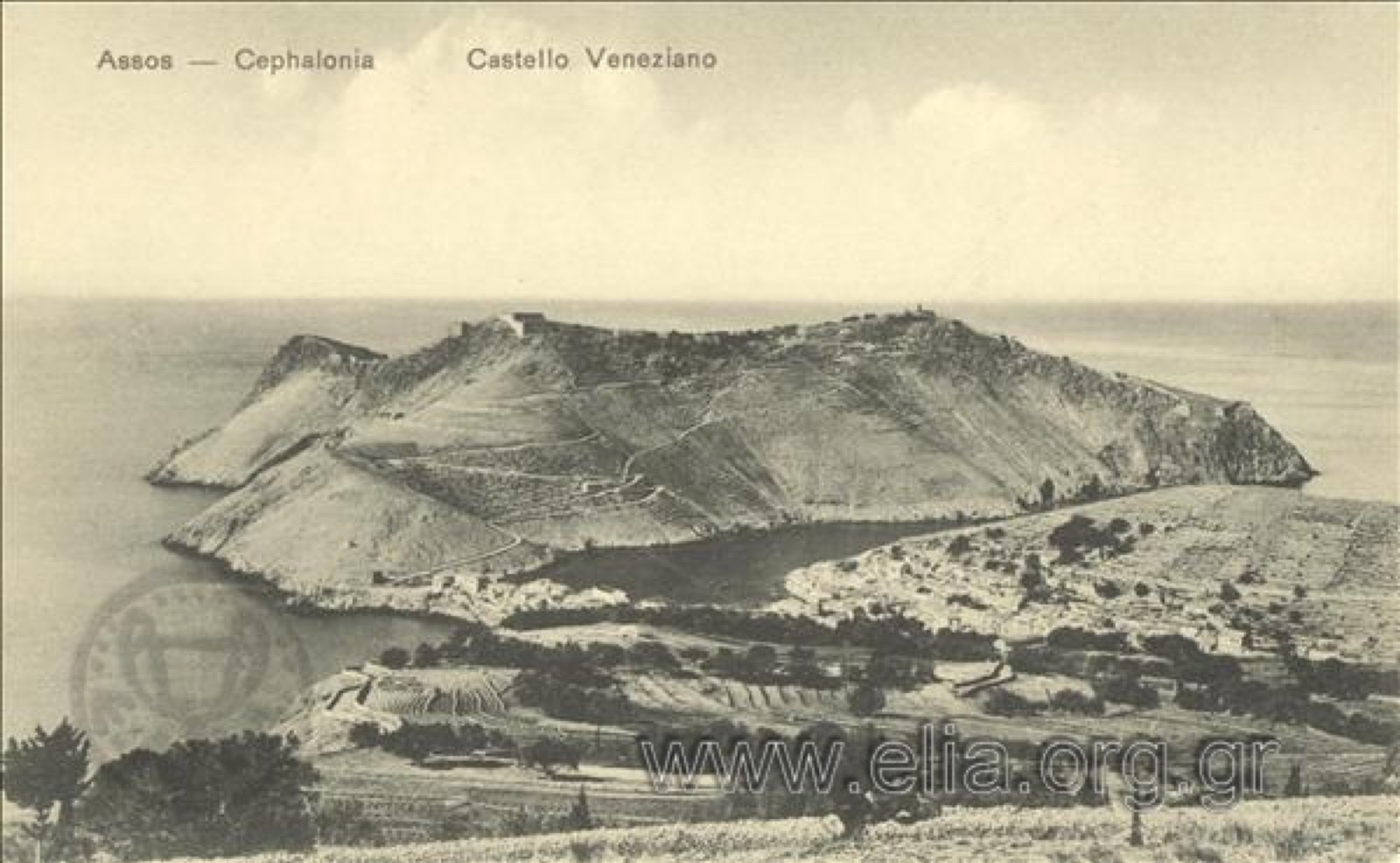
Assos - Cephalonia. Castello Veneziano.
· Hellenic Literary and Historical Archive - Cultural Foundation of the National Bank Of Greece (via Europeana)
CC BY
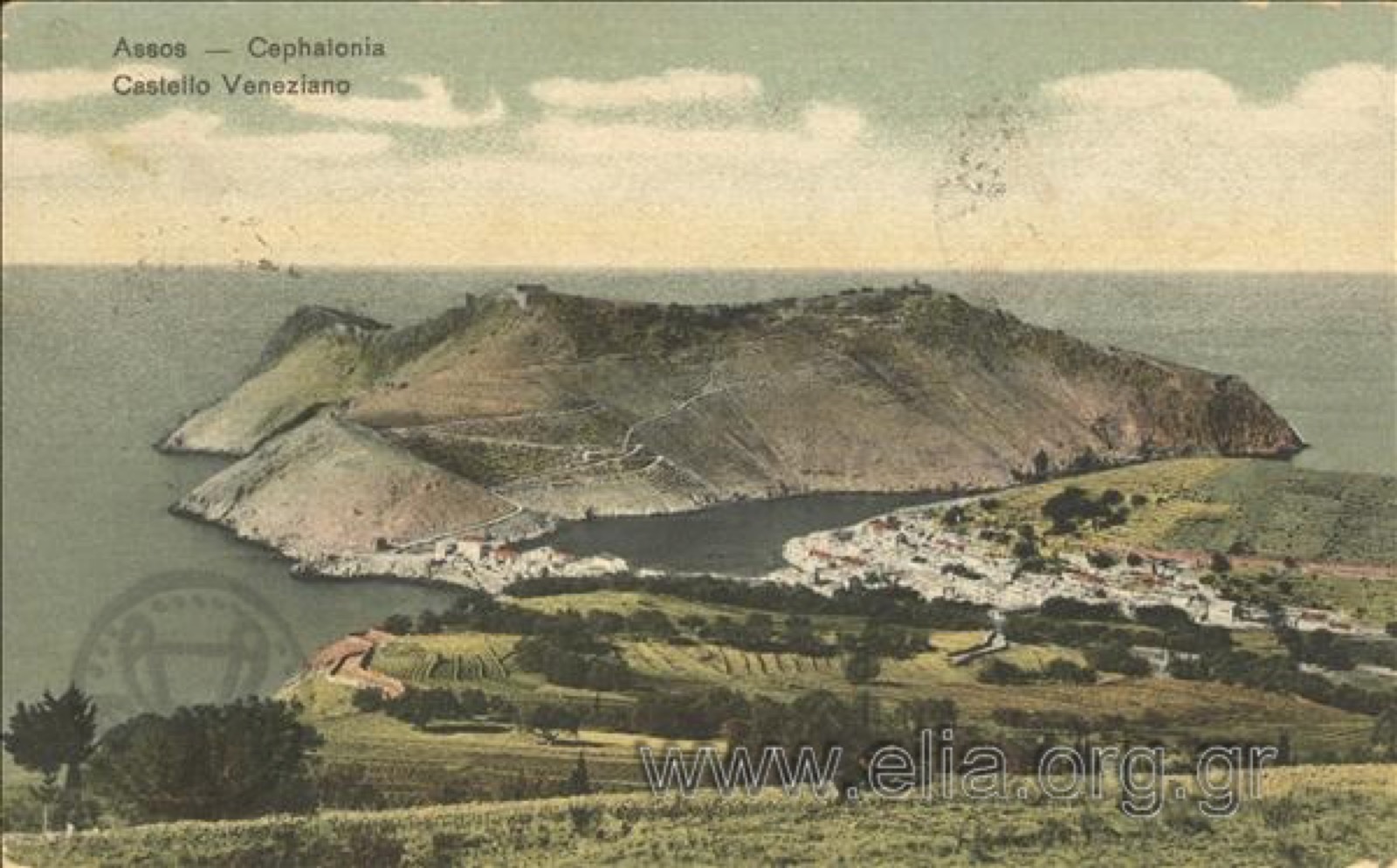
Assos - Cephalonia. Castello Veneziano.
1920 · Hellenic Literary and Historical Archive - Cultural Foundation of the National Bank Of Greece (via Europeana)
CC BY


