
Greece · Partial ruin
Acrocorinth
Acrocorinth is the fortified acropolis that crowns the monolithic rock overlooking the ancient city of Corinth in Greece. The site was continuously occupied from archaic times through the early 19th century and contains multiple concentric circuit walls, towers and reused religious buildings reflecting Greek, Byzantine, Frankish, Venetian and Ottoman phases.
First raised
-700
Its prime
1700
Today
Partial ruin
Ranked among Europe’s castles
As it stood in 1700
What Acrocorinth looked like in its prime.
A single steep, rocky monolith rises above the plain, wrapped by multiple concentric stone curtain walls and terraces that step up the slope. Solid square and round towers punctuate crenellated ramparts; an arched main gate sits partway up the east face. Walls are built of warm beige limestone rubble with ashlar dressings. Vegetation grows on terraces and in gaps; paths and retaining walls trace the steep ascent to the summit.
Its story
The story of Acrocorinth.
One of the Fetters of Greece
A steep rock 575 metres high dominates the plain of Corinth, with the ancient city built along its northern foot, and from its summit any raid coming out of central Greece or in off the sea could be watched. Kypselos and his son, the tyrant Periander, fortified the height in the seventh and sixth centuries BC, and it grew into the city's acropolis. The Macedonians repaired and strengthened the walls in the fourth century BC and put a garrison in: with Demetrias and Chalcis it was one of the so-called Fetters of Greece, the three fortresses by which they held the Greek city-states. In 146 BC the Roman general Lucius Mummius destroyed Corinth and its acropolis and Greece passed formally to Rome; Julius Caesar had the castle repaired in 44 BC.
Byzantine Command and the Fall of Leo Sgouros, 1210
Justinian's men repaired the fortress in the sixth century, and additions were still being made to it in the twelfth. Under the Byzantines it became the seat of the strategos of the thema of Hellas and later of the Peloponnese. What made the rock usable as a last line of defence was water: the Upper Peirene spring lies inside the circuit, by legend the price Sisyphus extracted from Asopus for telling him that Zeus had carried off his daughter. A garrison that could not be thirsted out commanded the Isthmus, and an enemy who did not hold Acrocorinth could not safely enter the Peloponnese by land.
Leo Sgouros held the rock against the Crusaders until 1210, when the Franks took it and Sgouros killed himself, riding his horse off the walls. The Franks carried out extensive repairs and Acrocorinth became a fortress of the Principality of Achaea.
Latin Lords, Hospitallers and Mehmed II, 1259-1715
The castle changed hands repeatedly after that, granted in turn to the Latin lords John of Gravina and Niccolo Acciaioli, whose Florentine family held the rock for a century from 1259. In 1395 it came to Theodore Palaiologos, who sold it for financial reasons to the Knights Hospitaller; they kept it until 1404, when it returned to him. In 1458 Mehmed II took the castle from its Byzantine defender Matthaios Asanes. The Venetians held it from 1687 and repaired it into much the form it has kept since, and in 1715 the Ottomans besieged and retook it. The temple of Aphrodite that stood on the highest peak was converted into a church, and the church in turn into a mosque.
Kolokotronis and the Surrender of 26 October 1823
The fighters of 1821, who called the rock Akrokorthos, took it from the Ottomans that year but held it only until July 1822, when Dramalis reoccupied it without a fight, its defenders having already abandoned the place. After the disaster he suffered at Dervenakia he came back to Acrocorinth and died there a few months later. Early in 1823 the Greek revolutionary forces besieged it for the third time. The National Assembly of Astros gave command of the siege to the Corinthian Ioannis Notaras; Staikos Staikopoulos, who had stormed the Palamidi, joined in June, and in October the Executive appointed Gennaios Kolokotronis to press the blockade harder still.
With every hope of escape or relief cut off, a Turkish official of the garrison, Halil Agha, put forward terms. The besieged asked to surrender specifically to Theodoros Kolokotronis, judging him alone a man who would keep his word and see that the prisoners were not slaughtered. He and the fortress commander Abdullah Bey signed the treaty on 19 October 1823, but the Turco-Albanians did not march out until the 26th, an inventory of what would pass to the Greeks having to be taken first. At midday on St Demetrios's day, 300 Turco-Albanians and 60 women left Acrocorinth in Greek hands.
Step inside
8 places to explore in 1700.
The record describes 8 distinct spots at Acrocorinth, including 2 interiors: site of the temple/church/mosque, upper pirene spring. Create your own photoreal reconstruction and explore every one, more scenes means more rooms, more angles, and more of the place to stand in.
Build Your Own Castle
Recreate Acrocorinth with AI to explore it.
The artist rebuilds it as it stood in 1700, a photoreal reconstruction that belongs to you alone. Pay with coins, no subscription needed.
Recreate this castle →Defend this castle →From the archive
Acrocorinth on paper: the measured plan and period views.
The survey plan and photographs below are the ground truth this page's reconstructions are checked against, drawn and photographed while the castle was still a working garrison. Every image is public-domain or openly licensed, with its source named.
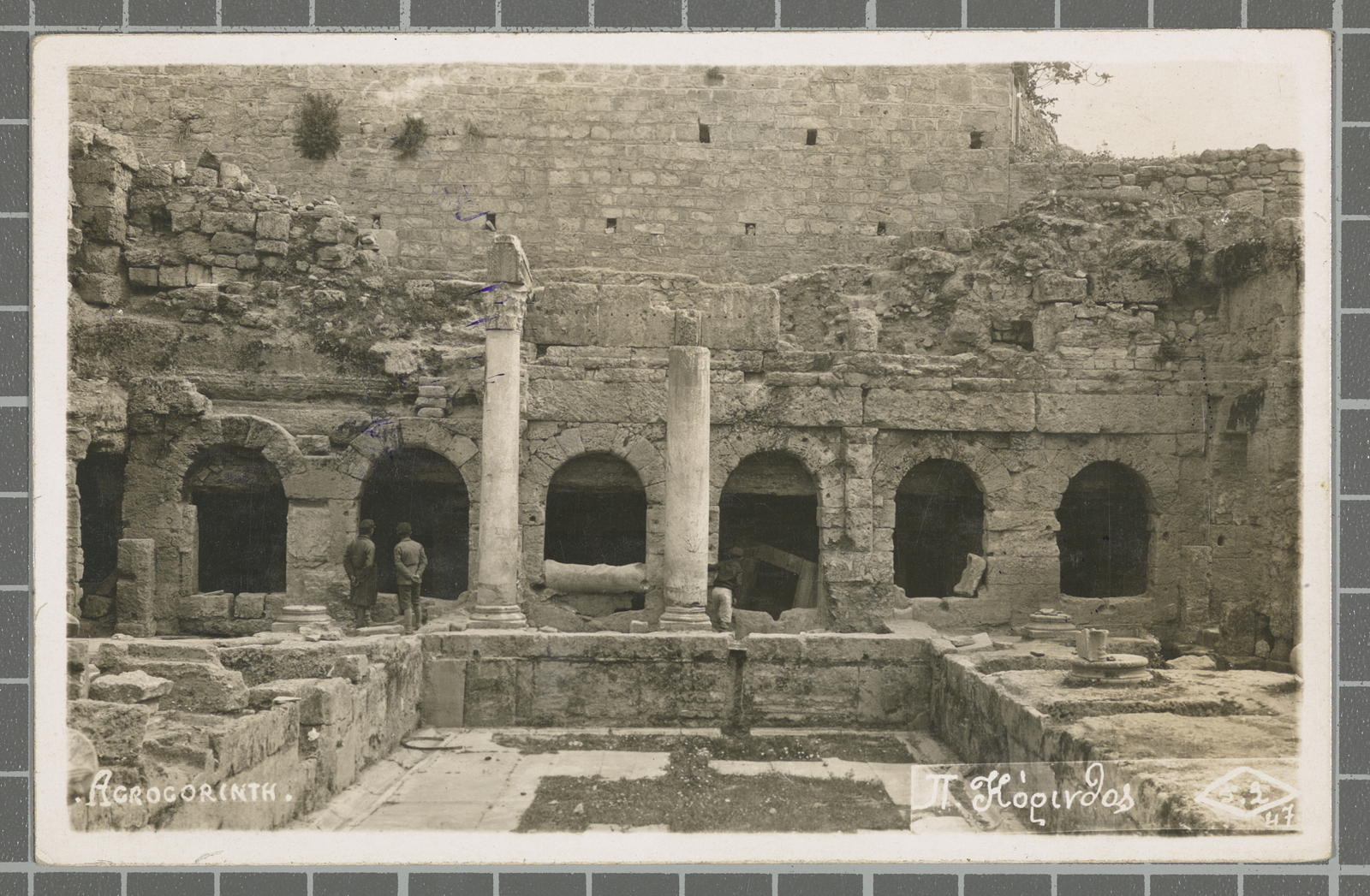
Acrocorinth
· Ajuntament de Girona (via Europeana)
Public domain
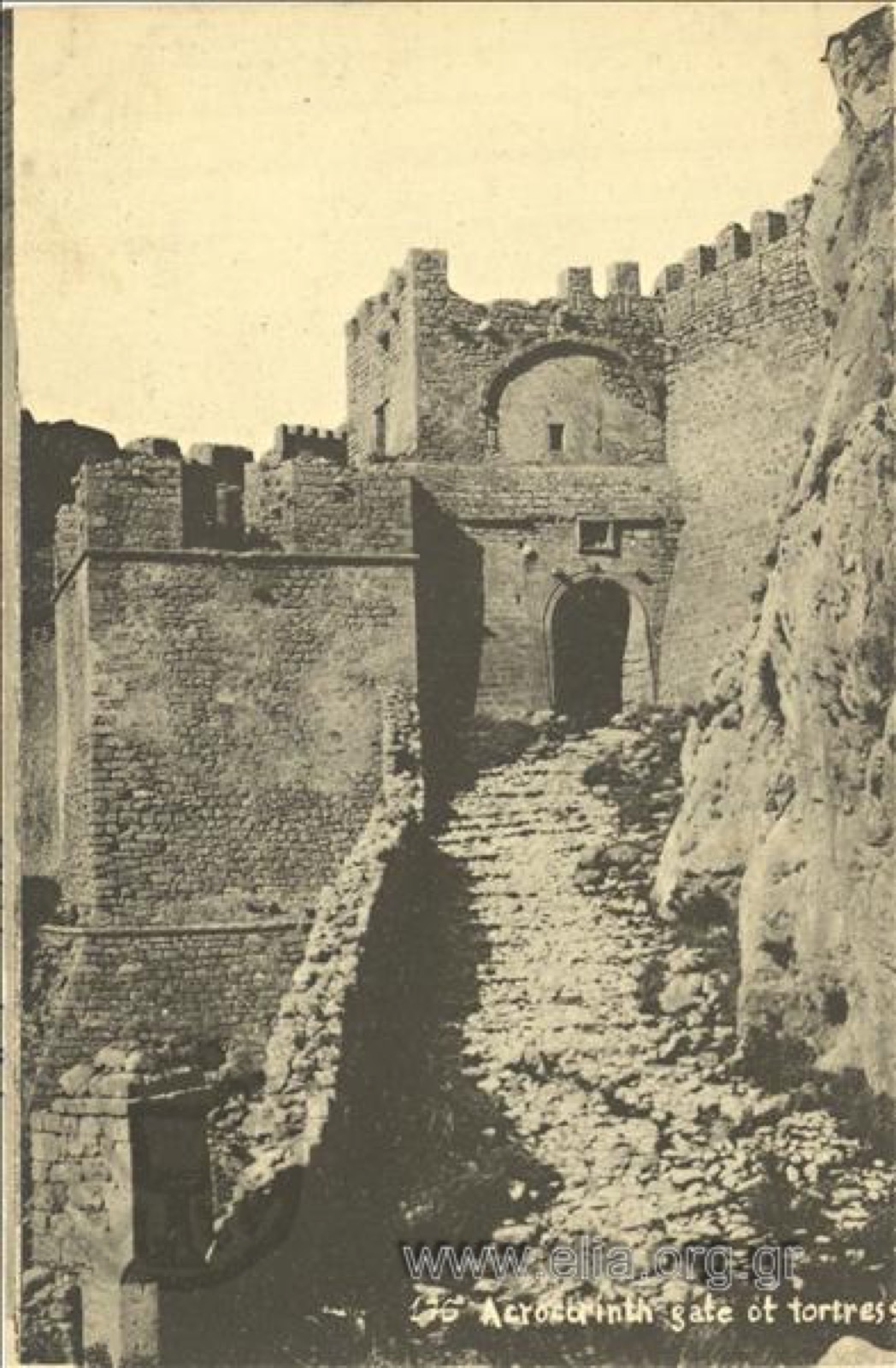
Acrocorinth gate of fortress.
1924 · Hellenic Literary and Historical Archive - Cultural Foundation of the National Bank Of Greece (via Europeana)
CC BY
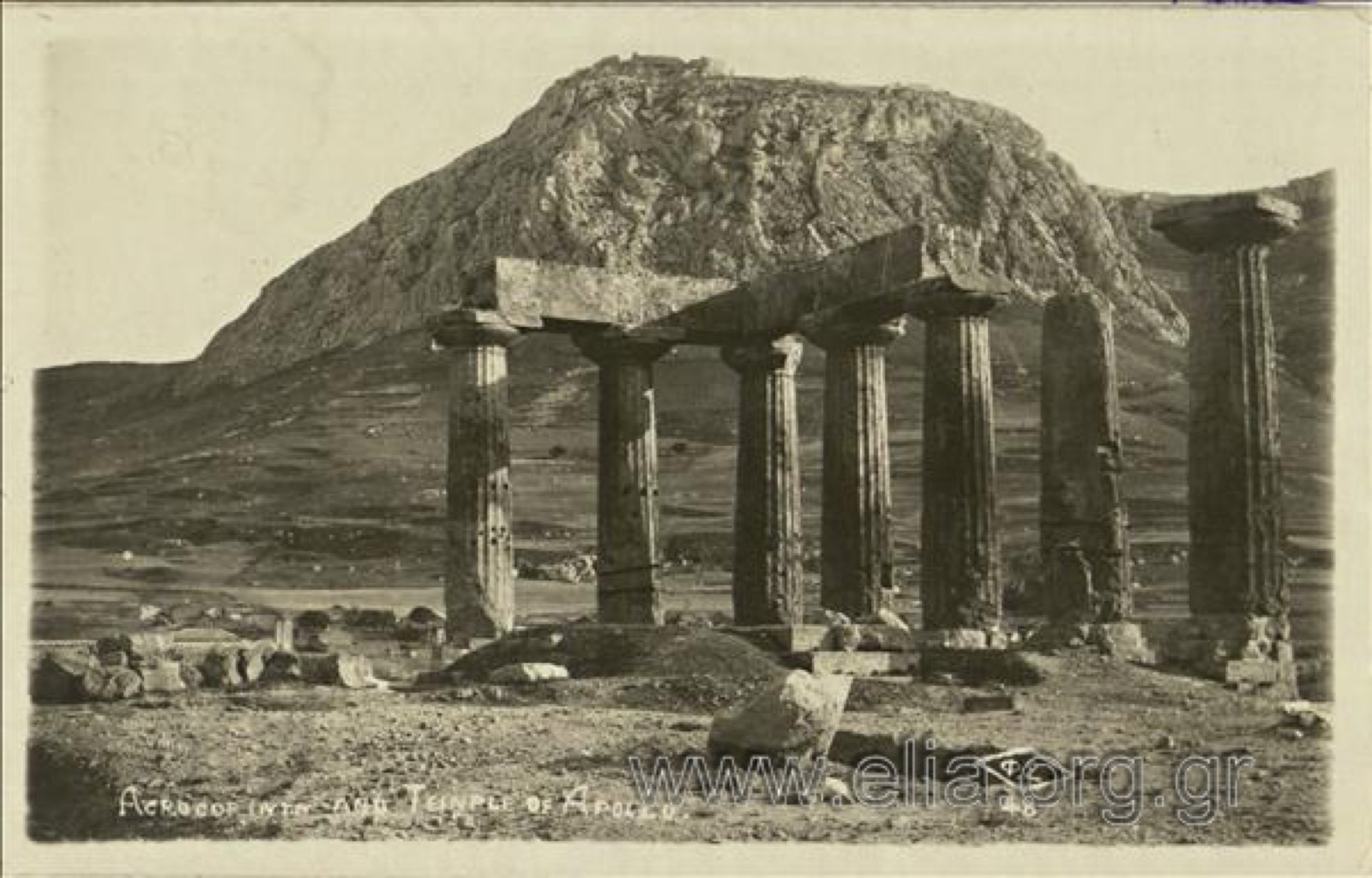
Acrocorinth and Temple of Apollo.
· Hellenic Literary and Historical Archive - Cultural Foundation of the National Bank Of Greece (via Europeana)
CC BY
Nearby


