
Greece · Partial ruin
Castle of Santa Maura
The Castle of Santa Maura is a coastal fortress on the northeastern tip of Lefkada that developed from an early medieval fort into an irregular hexagonal artillery fortress. Rebuilt and enlarged by the Ottomans in the 16th century, by the late 17th century it contained a densely built walled town with stone houses and multiple suburbs outside the walls. The site changed hands several times thereafter and many internal buildings and sections of the walls were later demolished in the 19th–20th centuries.
Its prime
1670
Today
Partial ruin
As it stood in 1670
What Castle of Santa Maura looked like in its prime.
An irregular hexagonal fortress on a narrow coastal spit, surrounded by sea on most sides and connected to the island by a long aqueduct-footpath causeway. Thick masonry curtain walls punctuated by nine large rounded cannon bastions form a low rampart silhouette; a medieval citadel occupies the northeastern corner as a compact older keep. Inside the walls a dense grid of roughly two‑storey stone houses and narrow streets fills the enclosed town; the main gate faces the causeway and shallow coastal waters.
Its story
The story of Castle of Santa Maura.
Orsini, Brienne and the Tocco Dukes, 1300–1479
The castle sits on a long, narrow spit reaching towards the Epirote mainland, placed to guard the island's approaches from the coast opposite. The first fortification was probably raised here around 1300 by John I Orsini, Count palatine of Cephalonia and Zakynthos, who had received the island, then called Santa Maura, in 1295 from his father-in-law, the Despot of Epirus Nikephoros I Komnenos Doukas; it probably stood in what is now the north-eastern corner. The Orsini lost Lefkada in 1331 to Walter VI of Brienne, who in 1343 ceded the castrum Sancte Maure and the island to the Venetian Graziano Giorgio, and in 1360/62 Leonardo I Tocco seized it and took the title of duke.
Carlo I Tocco, who ruled from 1376 to 1429, made the castle the capital of a domain that took in the county palatine of Cephalonia and Zakynthos and much of mainland Epirus, and enlarged the fortified town, though the settlement seems already to have spread beyond the walls. In 1413 Centurione II Zaccaria, Prince of Achaea, attacked island and castle with Albanian mercenaries and was beaten off with help from Venice. An Ottoman raid in 1430 led the Tocchi to weigh ceding Lefkada to the Venetians, but it stayed in their hands until the Ottomans took it in 1479.
Aya Mavra and Kılıç Ali Pasha's Rebuilding, 1479–1671
Venice held the island briefly in 1502–03, during the Second Ottoman–Venetian War, before returning it at the peace. The walled town inside the castle, Aya Mavra, was the island's capital: a register compiled between 1523 and 1536 counts 194 households, around 1,000 inhabitants, all of them Greek Christians, with a garrison of 111 soldiers and nine artillerymen. A shortage of water brought a three-kilometre aqueduct from the island's interior in 1564, serving the walled town and the far larger open town of 700–800 houses that had grown around it; a footpath ran along its top, the only way onto the island other than by sea.
After the Ottoman defeat at Lepanto the castle was besieged without success by the forces of the Holy League, and the Kapudan Pasha Kılıç Ali Pasha rebuilt and enlarged it in 1572–74 on lines resembling the older Castle of the Morea at Rio. The new fortress was an irregular hexagon, some 220 metres by 150 at its widest, with nine large round gun bastions, the medieval castle kept as a citadel at the north-eastern corner. When Evliya Çelebi came in 1670/71 only Muslims lived in its roughly 200 stone houses, the Christians in two suburbs against the walls and one on the island itself, every building in the suburbs deliberately built of wood. Evliya put the garrison at 1,085 men; an Ottoman budget document of the same year lists 285.
Morosini's Sixteen-Day Siege and the Venetian Works, 1684–1769
The Venetians took the fortress after a sixteen-day siege in 1684, during the Morean War. Francesco Morosini cleared the walled town and demolished it along with the two suburbs directly outside the walls, turning the ground into the castle's glacis, and the island's capital moved to the surviving suburb on the site of the modern city of Lefkada. Under the Venetians the castle became a purely military post. By 1713 the remains of the medieval citadel had been removed, the eastern ramparts facing the Ottoman-held mainland thickened and strengthened with two bastions, a ravelin and a couvreface, and outworks raised on the flanks.
When the Ottomans swept back into the Morea in 1715, in the Seventh Ottoman–Venetian War, the Venetians gave up Lefkada to concentrate on the defence of Corfu, and the castle was abandoned and partly demolished. After the siege of Corfu ended in Venetian victory the island was reoccupied and the fortifications restored; they were repaired again after a rising of the local Greek population in 1769.
French, Russians and the British Protectorate, 1797–1864
The fall of the Republic of Venice in 1797 brought a French occupation, ended in 1799 by a Russo-Turkish expedition under Ushakov. Ali Pasha of Ioannina, who coveted the Ionian Islands, besieged Lefkada in 1807, and the local Russian and Greek forces of the Septinsular Republic held the fortress against him. French rule was restored later that year under the Treaty of Tilsit, and in 1810 the British captured the island; their troops garrisoned the castle through the protectorate and modernised some of its facilities.
Greek Garrison, Asia Minor Refugees and the 1938 Demolition
After the union of the Ionian Islands with Greece in 1864 the castle was garrisoned by the Greek army until 1922, when refugees from Asia Minor were housed there. The fortress was abandoned in the end, and in 1938 most of the buildings within its walls were demolished. What is left is protected as an archaeological site.
Step inside
8 places to explore in 1670.
The record describes 8 distinct spots at Castle of Santa Maura, including 3 interiors: inner walled town street, northeastern medieval citadel, eastern wooden suburb outside the walls. Create your own photoreal reconstruction and explore every one, more scenes means more rooms, more angles, and more of the place to stand in.
Build Your Own Castle
Recreate Castle of Santa Maura with AI to explore it.
The artist rebuilds it as it stood in 1670, a photoreal reconstruction that belongs to you alone. Pay with coins, no subscription needed.
Recreate this castle →Defend this castle →Whose castle
Clans who held Castle of Santa Maura.
The families that held Castle of Santa Maura for a decade or more across its history, follow a name to its clan.
Orsini
First fortified around 1300 by John I Orsini; held by the Orsini until 1331.
Brienne
Held by Walter VI of Brienne from 1331 until ceded to the Venetian Graziano Giorgio in 1343.
Tocco
Seized by Leonardo I Tocco in 1360/62, who assumed the title of duke; held until the Ottoman conquest of 1479.
From the archive
Castle of Santa Maura on paper: the measured plan and period views.
The survey plan and photographs below are the ground truth this page's reconstructions are checked against, drawn and photographed while the castle was still a working garrison. Every image is public-domain or openly licensed, with its source named.
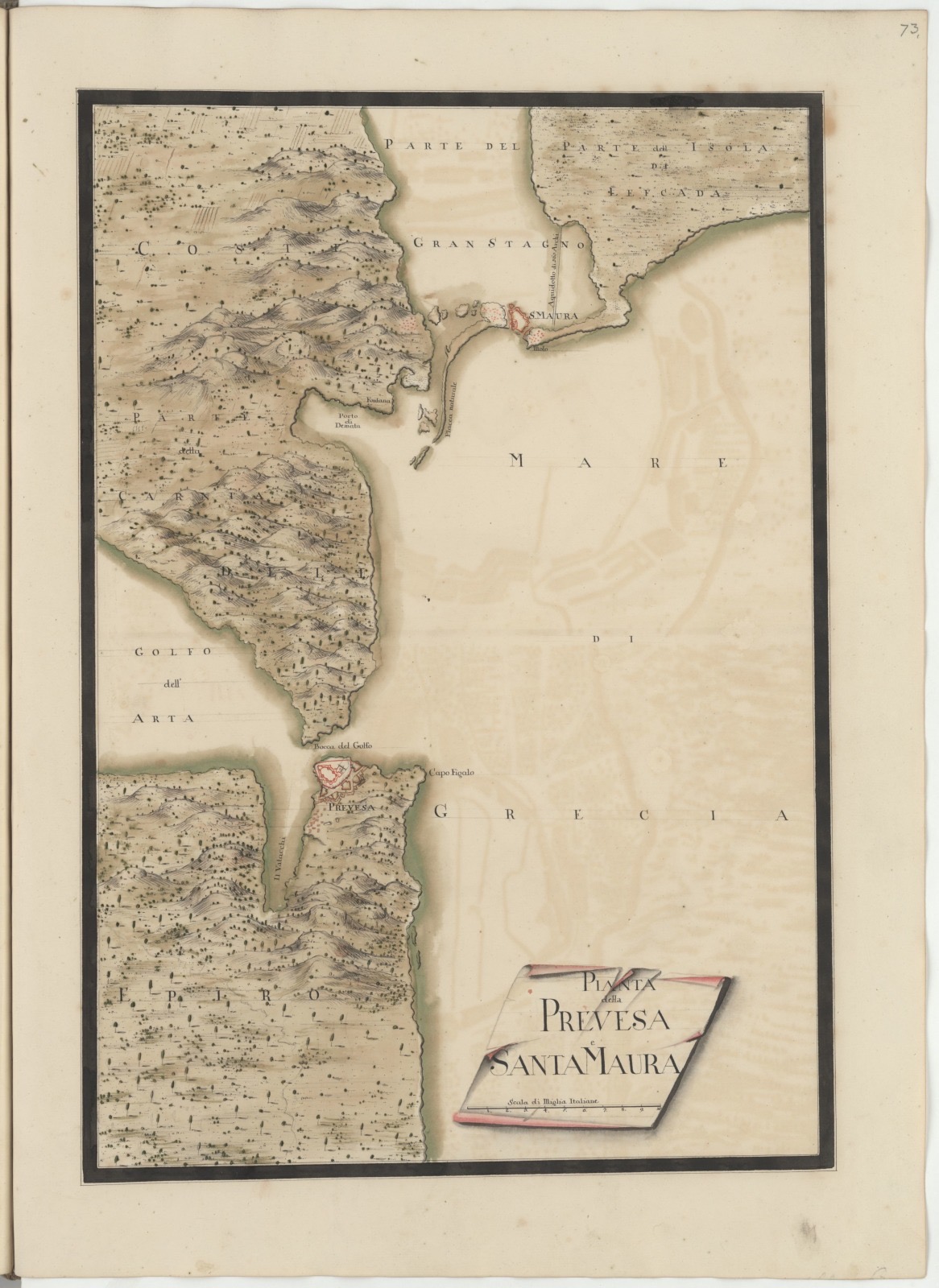
Pianta della Prevesa e Santa Maura
· Deutsche Fotothek (via Europeana)
Public domain
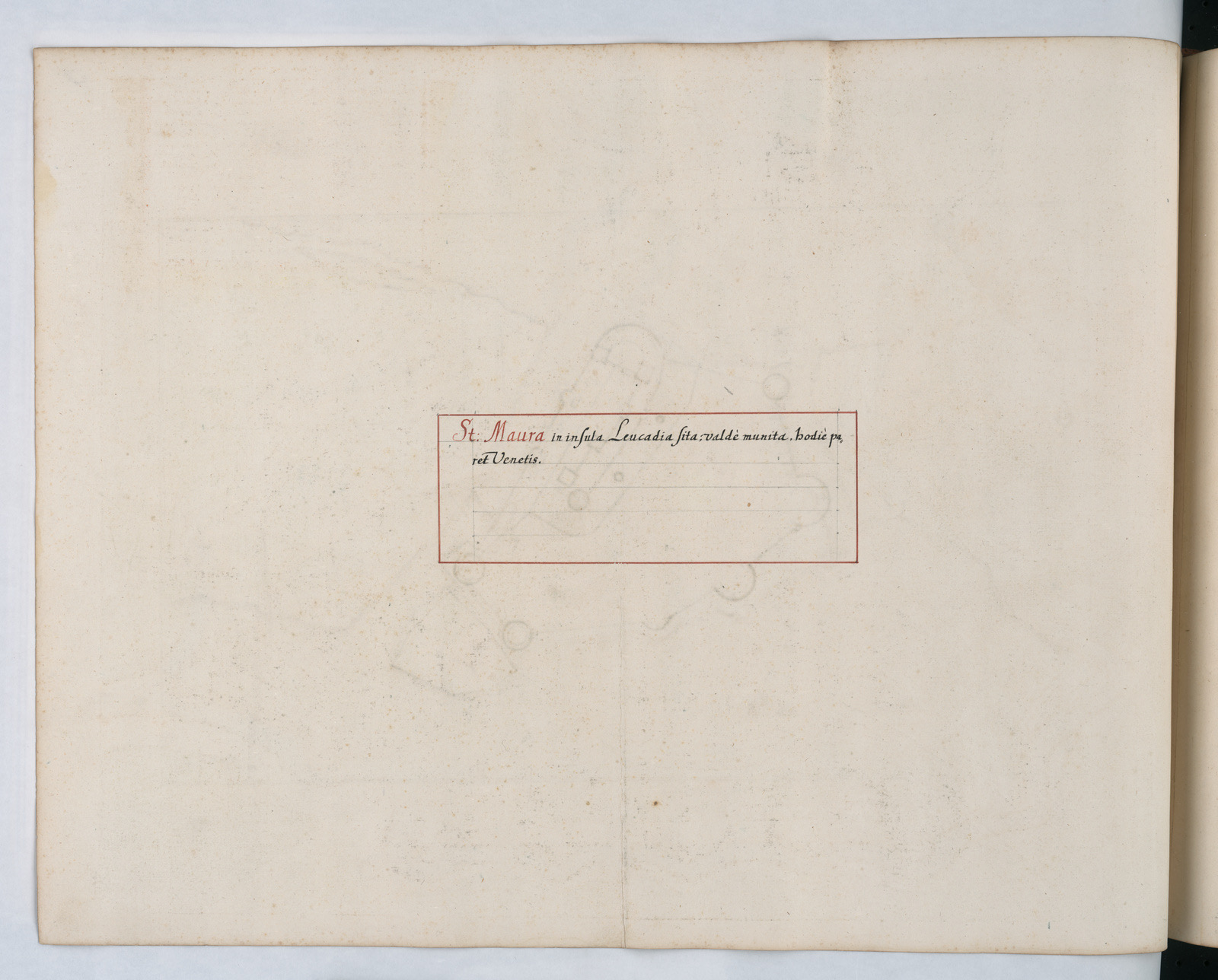
Fortification plan of Lefkada, Greece (it: Santa Maura), hand drawing, before 1695
· Deutsche Fotothek (via Europeana)
CC BY-SA


