
Greece · Partial ruin
Ioannina Castle
Ioannina Castle is the fortified old town of Ioannina on a rocky promontory projecting into Lake Pamvotis. Its visible fabric combines medieval Byzantine walls and towers with large-scale early 19th-century Ottoman rebuilding under Ali Pasha; parts now house museums and cultural buildings. The site is organised around two citadels, the smaller northeastern citadel with the Aslan Pasha Mosque and the larger southeastern Its Kale with palace and tower remains.
First raised
1378
Its prime
1815
Today
Partial ruin
Ranked among Europe’s castles
As it stood in 1815
What Ioannina Castle looked like in its prime.
A compact fortified town sited on a rocky promontory into Lake Pamvotis, dominated by two citadels linked by continuous curtain walls of roughly hewn grey-beige stone. Walls rise as terraced ramparts with arched galleries and broad flat surfaces for artillery; several large rectangular and circular towers punctuate the line, including a prominent central circular tower in the inner citadel. Within the walls lie clustered multi-storey palace buildings, mosque domes and service ranges; many roofs are low-pitched and tiled.
Its story
The story of Ioannina Castle.
Hellenistic Walls and the Tower of Bohemond
Ioannina is first definitely mentioned in a decree of the Byzantine emperor Basil II in 1020, though it clearly existed for centuries before. Tradition places its foundation in the 6th century on the strength of Procopius, who records Justinian I raising a new, “well-fortified” city for the inhabitants of ancient Euroia; no concrete archaeological evidence supports it. Excavations in the early 21st century have brought to light Hellenistic fortifications of the 4th and 3rd centuries BC, whose course was largely followed by the later Byzantine and Ottoman rebuildings.
The archaeologist K. Tsoures dated the Byzantine city walls and the north-eastern citadel to the 10th century. Additions of the late 11th century, among them the south-eastern citadel, are traditionally ascribed to the short-lived Norman occupation under Bohemond of Taranto in 1082, and the great circular tower at the centre of that citadel is still known as the Tower of Bohemond, though recent excavations there have also turned up Hellenistic foundations.
Despots, Serbs and the Ottoman Capture of 1430
After the Fourth Crusade broke the Byzantine Empire in 1204 the town passed through a run of masters: it became part of the Greek successor state of Epirus, fell to the restored empire under the Palaiologos dynasty in 1319, and was taken by the Serbian ruler Stefan Dušan in 1346. The Florentine adventurer Esau de' Buondelmonti captured it from its Serbian rulers in 1385, and from 1411 the Tocco family, rulers of Cephalonia and Zakynthos, held it until the Ottoman capture on 9 October 1430. The city walls and the north-eastern citadel were rebuilt in the years immediately after 1204, and rebuilding was taken up again in 1367–84 under Thomas Preljubović.
Anna Komnene's Alexiad records both citadels as established by the late 11th century. In the north-eastern circuit the monumental southern gate was flanked by the circular tower the Byzantines called the Upper Tower, seat of the local governor and later of the Despots of Epirus; a palace and a church of St John stood within. The far larger south-eastern citadel held the houses of the city's archontes, the cathedral church of the Taxiarches and the church of the Pantokrator.
Dionysius the Philosopher's Rising and the Mosque of 1618
Following the failed uprising of Dionysius the Philosopher in 1611 and the expulsion of the Christian population from the walled town that came after it, the church of St John was torn down and replaced in 1618 by the Aslan Pasha Mosque complex: mosque, founder's türbe, madrasah and kitchen, all of which survive, and the citadel became the Muslim religious centre of the city. On the highest ground of Its Kale the Fethiye Mosque had been built on the site of the Byzantine cathedral after the conquest of 1430, and was rebuilt in grander style in the 17th century.
Ali Pasha's Fortress and Saray, 1787–1870
Ali Pasha, who from 1787 ruled a large semi-autonomous state covering much of modern Greece and Albania, gave the castle the form it largely keeps. Repairs by earlier Ottoman governors are no longer discernible: he began a wide-ranging reconstruction of the walls in the early 19th century, completed in 1815, which took in the Byzantine fortifications as far as was possible and threw a new wall in front of them. The interval was packed with rubble or given arched galleries, forming a broad terraced surface on which cannon could be installed.
Its Kale he rebuilt completely as his own residence, beginning his palace, the saray, in 1788. He reconstructed the Fethiye Mosque about 1795, and the Soufari Sarai, a cavalry barracks outside the citadel, went up in the last years of his rule, 1815–20. The palace was badly damaged in the siege of 1821–22 by the Sultan's troops that brought about Ali's downfall and his execution in 1822; it served on as the city's administrative centre until it was torn down in 1870.
Museums in the Citadel, 1913 to the Present
Greece took Ioannina in the First Balkan War in 1913, ending Ottoman rule that began in 1430. The site of the main palace was given over to the city's military hospital, replaced in 1958 by a building designed by V. Harisis as a royal pavilion; since 1995 it has housed the Byzantine Museum of Ioannina. Ali Pasha's tomb and that of one of his wives lie beside the Fethiye Mosque.
The Aslan Pasha Mosque now holds the Municipal Ethnographic Museum, and the square building known as the Treasury, the main surviving part of Ali's palace, was restored in 1989–90 for an exhibition on the silversmithing for which the region was famous in Ottoman times. The fortified old town is a designated archaeological site in the care of the Greek state.
Step inside
10 places to explore in 1815.
The record describes 10 distinct spots at Ioannina Castle, including 5 interiors: aslan pasha mosque and northeastern citadel gate, fethiye mosque and ali pasha's tomb (highest point), ali pasha's palace, the treasury building and more. Create your own photoreal reconstruction and explore every one, more scenes means more rooms, more angles, and more of the place to stand in.
Build Your Own Castle
Recreate Ioannina Castle with AI to explore it.
The artist rebuilds it as it stood in 1815, a photoreal reconstruction that belongs to you alone. Pay with coins, no subscription needed.
Recreate this castle →Defend this castle →Whose castle
Clans who held Ioannina Castle.
The families that held Ioannina Castle for a decade or more across its history, follow a name to its clan.
Buondelmonti
Esau de' Buondelmonti captured the city in 1385; followed by the Tocco family from 1411.
Tocco
Held by the Tocco family, rulers of Cephalonia and Zakynthos, from 1411 until the Ottoman capture of 1430.
From the archive
Ioannina Castle on paper: the measured plan and period views.
The survey plan and photographs below are the ground truth this page's reconstructions are checked against, drawn and photographed while the castle was still a working garrison. Every image is public-domain or openly licensed, with its source named.
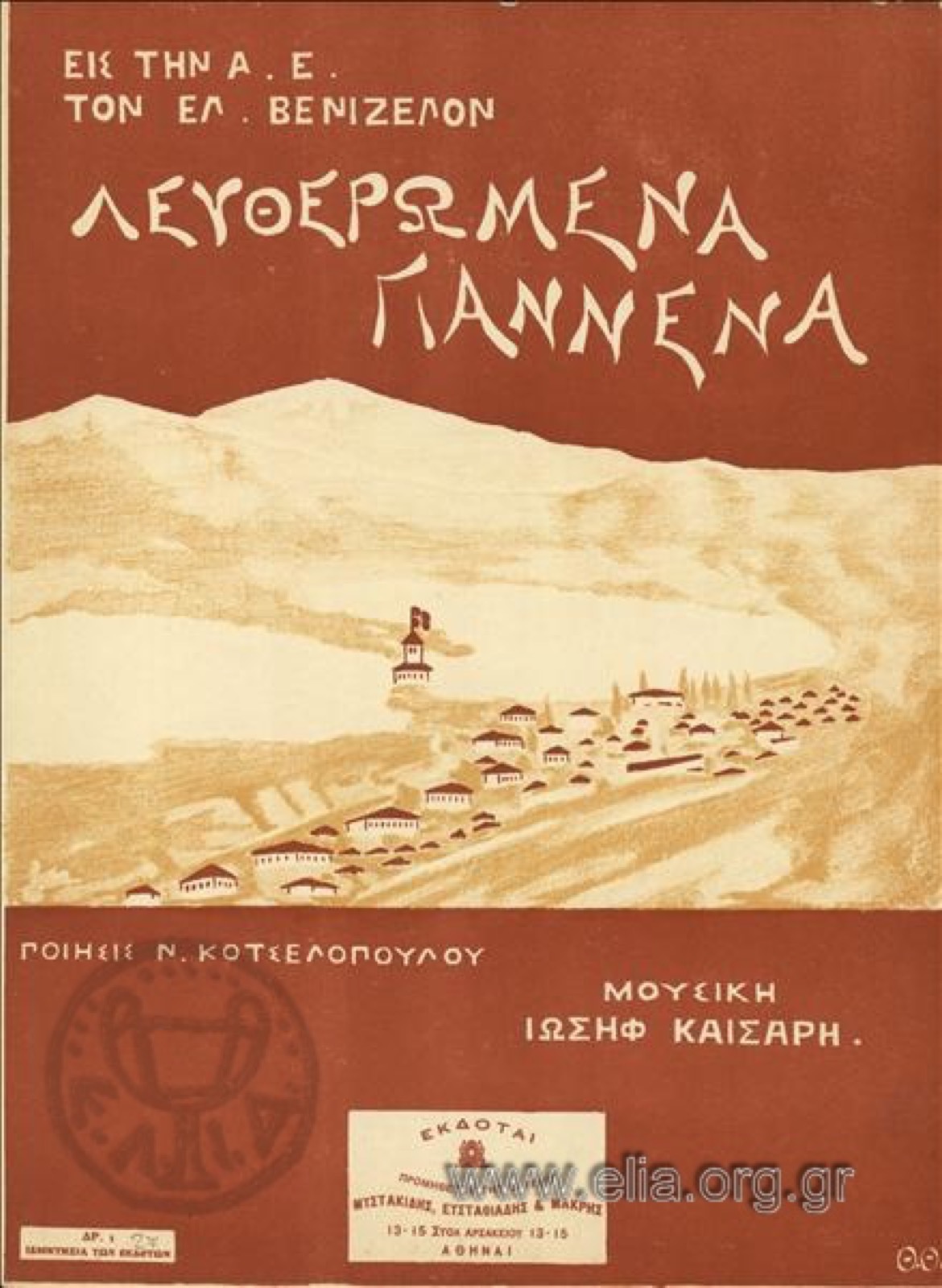
Λευθερωμένα Γιάννενα
· Hellenic Literary and Historical Archive - Cultural Foundation of the National Bank Of Greece (via Europeana)
CC BY


