
Italy · Restored
Aragonese Castle
Castello aragonese
Aragonese Castle sits on a small volcanic tidal islet off the east coast of Ischia in the Gulf of Naples, connected to the larger island by a stone causeway (Ponte Aragonese). The complex combines massive seaward fortifications, clustered residential and ecclesiastical buildings and a prominent domed cathedral; it remains the island's principal historic monument and visitor attraction.
First raised
1442
Its prime
1700
Today
Restored
As it stood in 1700
What Aragonese Castle looked like in its prime.
Perched on a volcanic islet linked to Ischia by a narrow stone causeway, the castle shows a tiered silhouette: thick rectangular curtain walls and bastions at sea level rising from sheer dark rock, terraces of masonry, and clustered multi-storey stone buildings above. A squat square keep crowns the summit and a large domed church (the Cathedral of Assunta) punctuates the roofline near the centre. Arched loggias and vaulted openings puncture facades; the masonry reads as pale to warm grey local stone with patches of vegetation on the cliffs.
Its story
The story of Aragonese Castle.
Hiero of Syracuse's Rock, 474 BC
The first castle on the tidal islet rose in 474 BC as Castrum Gironis, named for its founder: that year Hiero I, tyrant of Syracuse, brought his fleet to the aid of Cumae in its war against the Tyrrhenians, and the grateful Cumaeans rewarded him with the whole island of Ischia. The fortress later passed to the Parthenopeans, the ancient inhabitants of Naples, and in the fourth century BC the Romans wrested it from them; watch-towers stood on the rock to track the movement of enemy fleets.
Over the centuries that followed, the fortress served as a refuge for the islanders against the raids of Visigoths, Vandals, Ostrogoths, Arabs, Normans and Angevins. The Arso eruption of 1301 destroyed the town of Geronda on the main island and drove its people onto the rock to live; in 1306 they raised the Cathedral of the Assunta there as an ex-voto, replacing the cathedral the eruption had destroyed.
Alfonso of Aragon's Citadel, 1441
The castle owes its modern shape to the Aragonese. In 1441 Alfonso V of Aragon rebuilt the old Angevin keep into a quadrangular stronghold with four towers, modelled on the Maschio Angioino in Naples. Until the mid-fifteenth century the only way in had been by sea, up an external stair on the north side of the islet; Alfonso linked the rock to Ischia by bridge and drove a tunnel some 400 metres through the living rock, lit by tall shafts that doubled as murder-holes through which boiling oil and stones could be dropped on an attacker.
Behind the strengthened walls almost the whole population of Ischia found shelter during pirate raids. The castle held royal apartments and quarters for courtiers, troops and servants, with a casemate at its foot housing the garrison that worked the drawbridge.
Vittoria Colonna and the Crowded Rock
The castle's greatest splendour came at the end of the sixteenth century, when 1,892 families lived on the islet alongside the convent of the Poor Clares (founded in 1575 by Beatrice Quadra, widow of Muzio d'Avalos) an abbey of Greek Basilian monks, the bishop with his chapter and seminary, and the prince with his garrison. There were thirteen churches, among them the cathedral where, on 27 December 1509, Fernando Francesco d'Avalos, marquis of Pescara and commander of the imperial troops of Charles V, married the poet Vittoria Colonna.
Colonna lived at the castle from 1501 to 1536, and her residence drew the finest artists and writers of the age to Ischia: Michelangelo Buonarroti, Ludovico Ariosto, Jacopo Sannazaro and Bernardo Tasso among them. The rock stayed crowded long after: around 1700 some 2,000 families still lived there.
The British Bombardment of 1809
In the second half of the eighteenth century, with the pirate danger past, the inhabitants began drifting back to the main island to farm and fish. Then in 1809 British troops besieged the islet, which lay under French command, and shelled the castle to almost complete destruction. The Cathedral of the Assunta was wrecked by the cannonade and left a roofless shell, its high altar, font and thirteenth-century wooden crucifix later carried off to the present cathedral.
Bourbon Prison to Private Hands, 1823–1912
In 1823 Ferdinand I, the Bourbon king of the Two Sicilies, expelled the last thirty inhabitants and turned the fortress into a prison for convicts serving life sentences. From 1851 it held political prisoners: conspirators against the kingdom, among them Carlo Poerio, Luigi Settembrini, Michele Pironti and Pasquale Battistessa. With Garibaldi's arrival in 1860 Ischia was annexed to the Kingdom of Italy and the political prison was suppressed; the gaol was revived in 1874, but the islanders petitioned for its closure, which came in 1890.
On 8 June 1912 the state put the castle up for auction, and it passed into private hands. Its owners have carried the restoration forward room by room ever since, and the castle, still reached by Alfonso's tunnel, is today the most visited monument on the island.
Step inside
7 places to explore in 1700.
The record describes 7 distinct spots at Aragonese Castle, including 2 interiors: access tunnel through the rock, tunnel chapel (san giovan giuseppe della croce). Create your own photoreal reconstruction and explore every one, more scenes means more rooms, more angles, and more of the place to stand in.
Build Your Own Castle
Recreate Aragonese Castle with AI to explore it.
The artist rebuilds it as it stood in 1700, a photoreal reconstruction that belongs to you alone. Pay with coins, no subscription needed.
Recreate this castle →Defend this castle →From the archive
Aragonese Castle on paper: the measured plan and period views.
The survey plan and photographs below are the ground truth this page's reconstructions are checked against, drawn and photographed while the castle was still a working garrison. Every image is public-domain or openly licensed, with its source named.
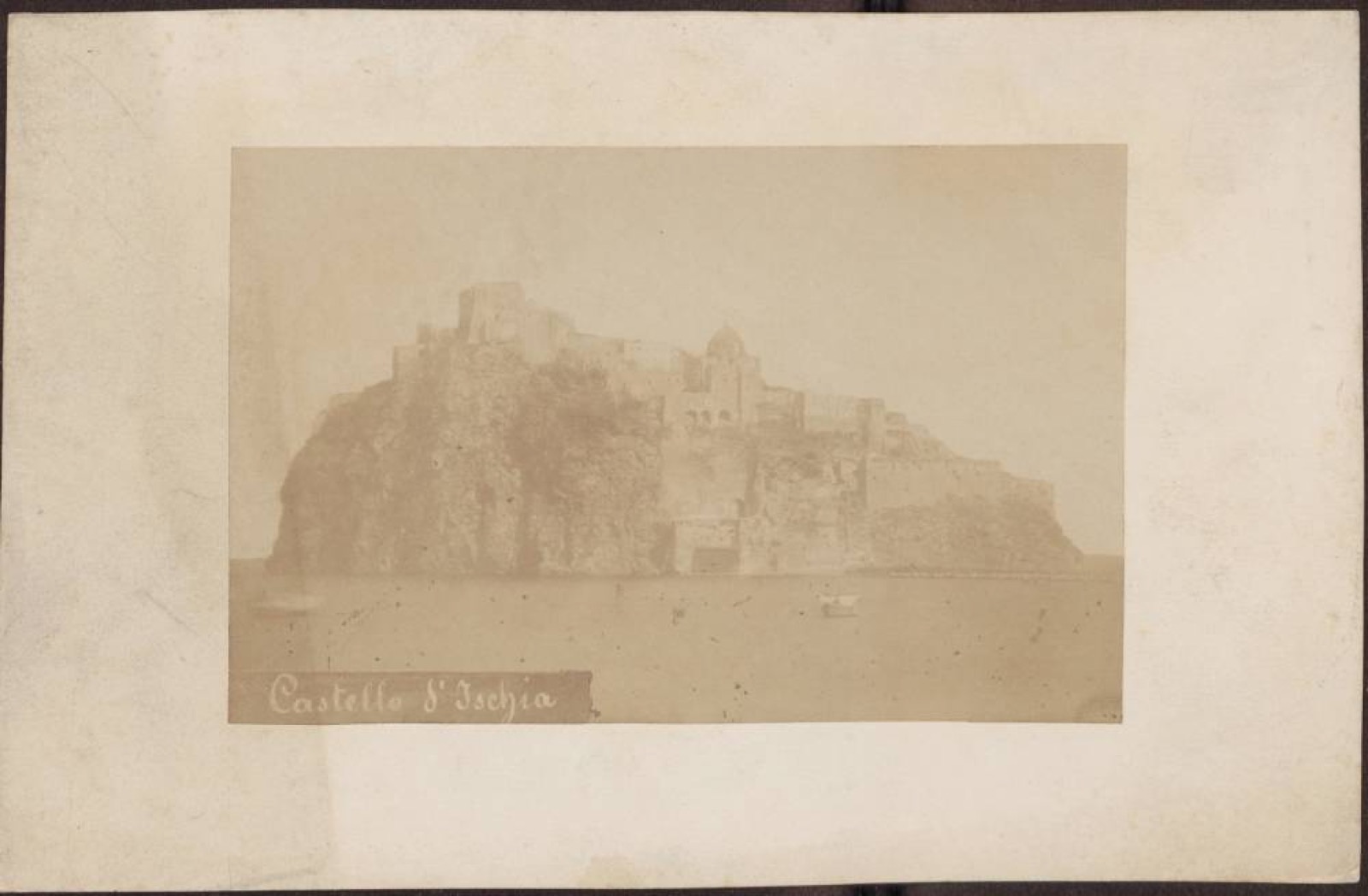
Ischia, Castello Aragonese.
· State Archives of Baden-Württemberg (via Europeana)
CC BY
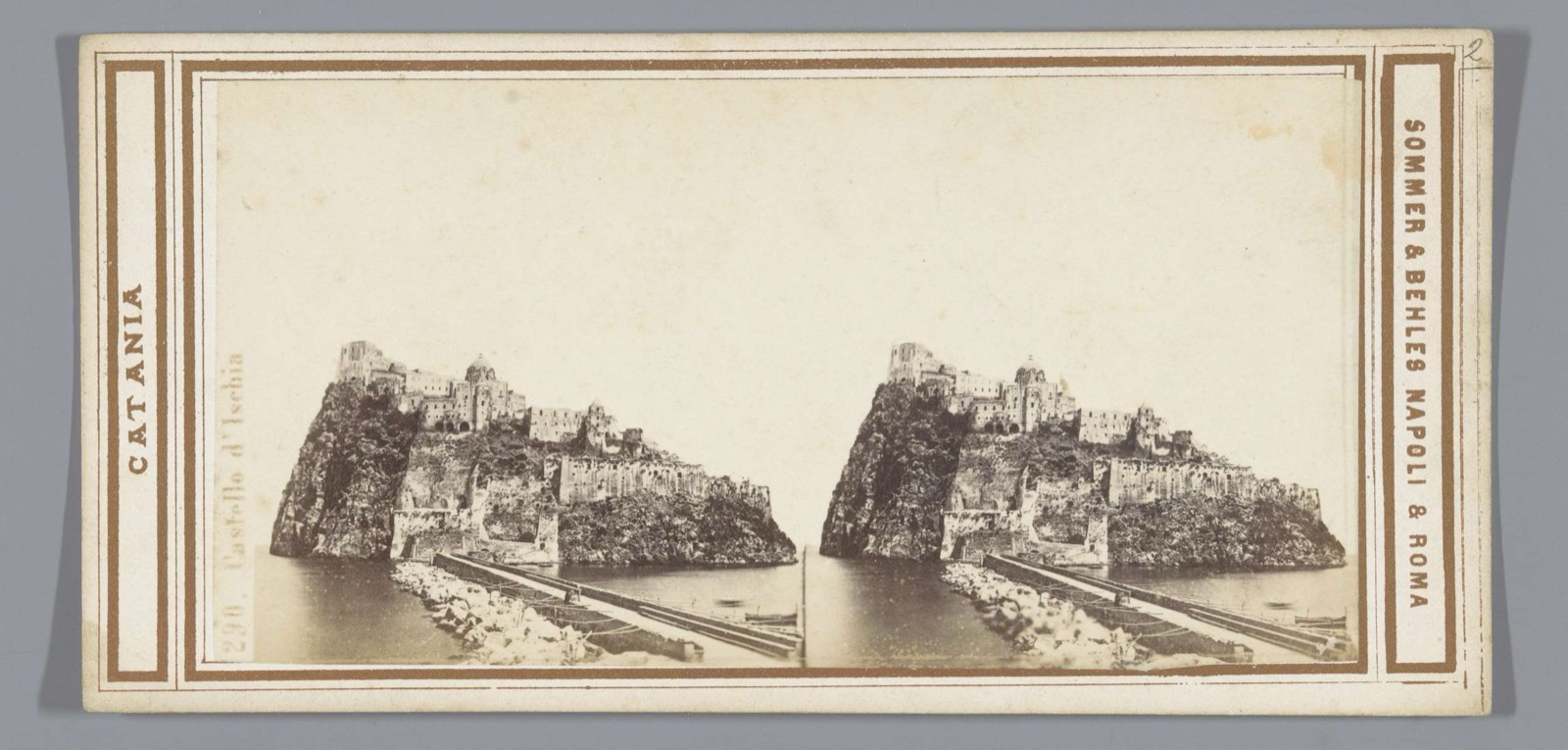
Gezicht op het Castello Aragonese bij Ischia
· Rijksmuseum (via Europeana)
Public domain
Nearby


