
Italy · Restored
Castelvecchio
Castelvecchio is a 14th-century red-brick castle in Verona built by the Scaliger dynasty as a compact fortified residence and defensive complex. It consists of a square compound with multiple towers, a raised keep, and a fortified bridge across the Adige, now housing the Castelvecchio Museum and other uses after 20th-century restorations.
First raised
1356
Its prime
1376
Today
Restored
Ranked among Europe’s castles
As it stood in 1376
What Castelvecchio looked like in its prime.
A compact square compound of red brick with a long curtain wall topped by distinctive M-shaped merlons, pierced by narrow slit windows and punctuated by multiple square towers including a clock-faced tower and a superelevated keep (maschio). Tiled hipped roofs cap the towers and a wooden enclosed gallery projects from one tower face. The castle originally sat beside and controlled a water-filled ditch fed from the Adige, and a fortified brick bridge connected it across the river.
Its story
The story of Castelvecchio.
Cangrande II's Escape Route, 1354–1376
Castelvecchio stands on the probable site of a Roman fortress outside the ancient city, and it began life under another name entirely: the castle of San Martino in Aquaro, after an eighth-century church that stood where the Corte d'Armi was later laid out. A defensive nucleus may already have existed here by the end of the thirteenth century: in 1298 Alberto I della Scala raised the 'regaste', the embankment wall holding back the Adige, and together with the communal walls along the Adigetto canal it enclosed an irregular trapezoid fit to become the western strongpoint of Verona's circuit.
The castle proper was the work of Cangrande II della Scala from 1354. It was built as a deterrent to powerful neighbours (Venice, the Gonzaga, the Sforza), but its most telling feature pointed inward: the fortified bridge thrown across the Adige at the same time was reserved for the castle's exclusive use, so that the lords, allies of the Holy Roman Empire, could escape north towards the Tyrol if rebellion or a coup broke out in their own city. Cangrande died in 1359; Antonio and Bartolomeo II della Scala completed the complex in 1376 with the raising of the great keep, conceived as the visual command post of the whole city on both banks of the river.
The Old Castle of the Venetian Republic
When the Visconti took Verona from the della Scala they built a new stronghold at Castel San Pietro, and the fortress of San Martino became simply 'Castel Vecchio', the old castle. Once the Scaligeri lost their hold on the city for good, the surviving members of the family left Italy and founded a German branch of the line.
Under Venice the bridge was further fortified with cannon and the castle settled into centuries of garrison work: residence of the castellan and his chaplain, barracks, artillery arsenal, armoury, powder magazine and food store, with part of the keep serving as a prison. Into the eighteenth century the keep's east face still carried a great fresco of the lion of St Mark. In 1759 the castle became the seat of the Veneto Militar Collegio, a college training military engineers, and it remained a military school until 1798.
The Pasque Veronesi and Napoleon's Arsenal
French troops damaged the castle in 1796–97 in retaliation for the Pasque Veronesi, the violent anti-French revolt staged by the Veronese population. Napoleon himself chose to stay at Castelvecchio on his visits to the city, yet his sweeping requisitions of private and church property and the mass conscription of local men fed the resistance that eventually drove the invaders out.
The occupiers remade the castle as an arsenal and urban redoubt. The buildings of the northern court, including the old church of San Martino, were demolished, and between 1802 and 1805 a bomb-proof casemated barracks rose along its west and north sides; the towers were cut down and vaulted over, gun embrasures were opened in the walls and the merlons walled up. In 1805 the French dismantled the ancient Arco dei Gavi for road-widening and completely demolished the adjoining Torre dell'Orologio, already truncated in 1797. The Austrian command found the arrangement satisfactory and kept Castelvecchio as barracks and arsenal from 1814 to 1866, housing an artillery school from the 1830s and, from the late 1850s, an optical telegraph station on the keep's terrace that signalled between the Quadrilatero fortresses: Pastrengo, Rivoli, Peschiera, Mantua and Borgoforte.
Bombs on the Bridge, Scarpa in the Halls, 1923–1964
Under Italian administration the castle remained a barracks, though the bridge was opened to the public in 1870. Between 1923 and 1926 Ferdinando Forlati and Antonio Avena directed a sweeping stylistic restoration: the Torre dell'Orologio was rebuilt, set further back towards the castle, and the Napoleonic barracks was transfigured into a Scaliger-Venetian palace that had never actually existed. The Castelvecchio Museum was installed in the restored halls, with the garrison officers' club keeping rooms in the old Reggia.
In 1945 aerial bombardment gravely damaged the castle's east wing, and the retreating German army mined and destroyed the Scaliger bridge. The wing was rebuilt as early as 1947 under Alberto Avesani, and Piero Gazzola's faithful reconstruction returned the bridge to the city between 1948 and 1951, of the original work only the pentagonal mid-river piers survive, beneath a main arch spanning 48.69 metres. Between 1958 and 1964 the architect Carlo Scarpa remade the museum's interiors to the ideas of its director Licisco Magagnato, in a renovation that made the museum famous in its own right.
Step inside
10 places to explore in 1376.
The record describes 10 distinct spots at Castelvecchio, including 2 interiors: main internal halls (now museum galleries), left-door entrance on corso cavour (officers' club access). Create your own photoreal reconstruction and explore every one, more scenes means more rooms, more angles, and more of the place to stand in.
Build Your Own Castle
Recreate Castelvecchio with AI to explore it.
The artist rebuilds it as it stood in 1376, a photoreal reconstruction that belongs to you alone. Pay with coins, no subscription needed.
Recreate this castle →Defend this castle →Whose castle
Clans who held Castelvecchio.
The families that held Castelvecchio for a decade or more across its history, follow a name to its clan.
Della Scala
Built by Lord Cangrande II della Scala for the Scaliger dynasty, rulers of medieval Verona.
From the archive
Castelvecchio on paper: the measured plan and period views.
The survey plan and photographs below are the ground truth this page's reconstructions are checked against, drawn and photographed while the castle was still a working garrison. Every image is public-domain or openly licensed, with its source named.
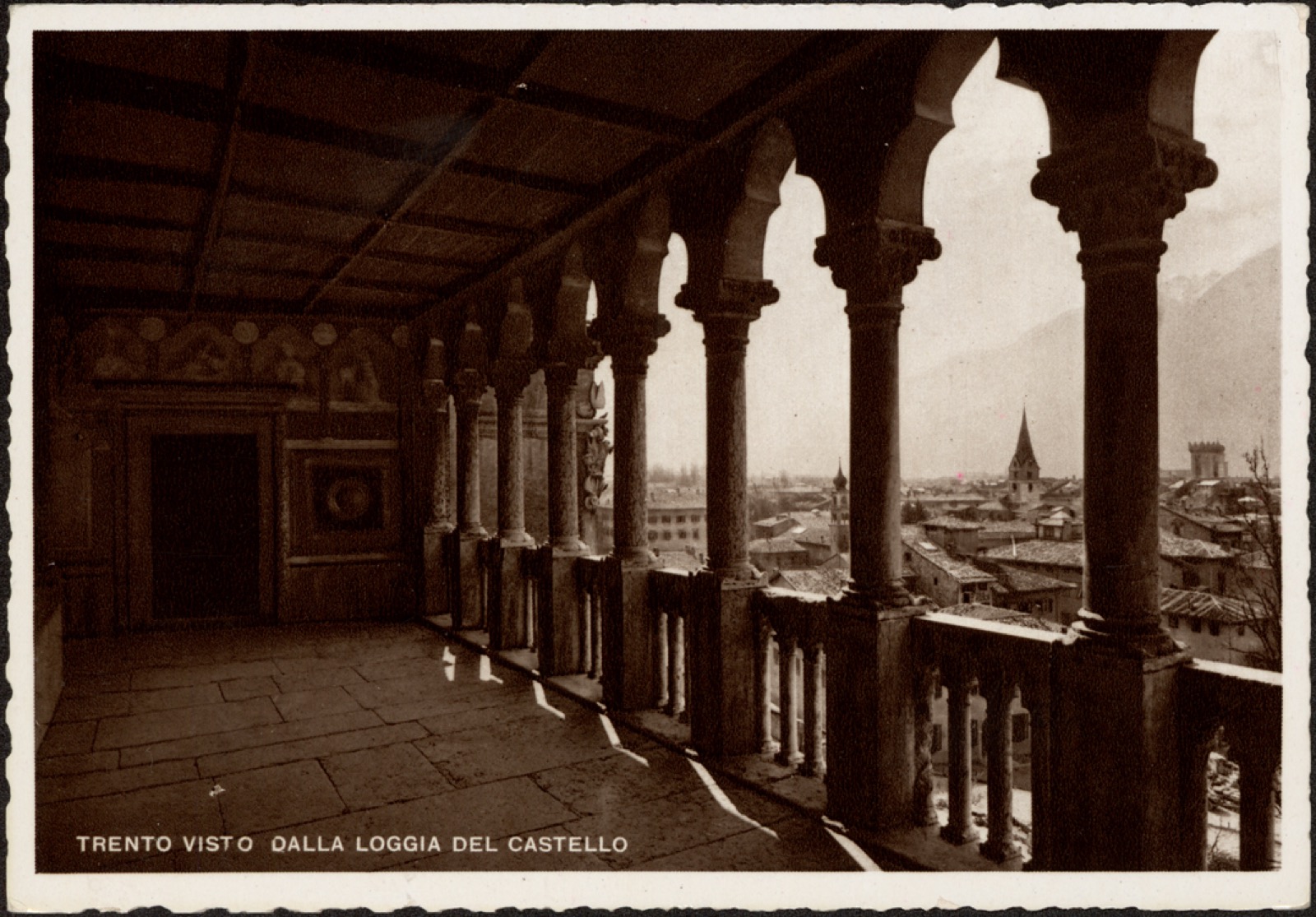
Trento - Loggia di Castelvecchio
· Digital Library Trentino (via Europeana)
Public domain

Questions about Castelvecchio
What is the history of Castelvecchio?
What is inside Castelvecchio?
Who owns Castelvecchio now?
Why was Castelvecchio built, and what was it used for?
Where is Castelvecchio?
When was Castelvecchio built?
Was Castelvecchio ever attacked or besieged?
Which family or clan held Castelvecchio?
What did Castelvecchio look like in its prime?
Is Castelvecchio still standing or is it a ruin?
More castles of Italy


Explore the city


