
Italy · Restored
Miramare Castle
Castello di Miramare
Miramare Castle is a mid-19th-century seaside castle on a rocky promontory overlooking the Gulf of Trieste, built for Archduke Ferdinand Maximilian and his wife. Designed by Carl Junker and completed in 1860, the complex includes the main house, a smaller Castelletto, extensive landscaped park, stables and a little port; the castle interior preserves original mid-19th-century furnishings and decorative schemes.
First raised
1860
Its prime
1860
Today
Restored
Ranked among Europe’s castles
As it stood in 1860
What Miramare Castle looked like in its prime.
Large pale limestone three-storey residence with a crenellated, castellated roofline and short squared corner turrets; façades pierced by tall narrow arched windows, grouped twin and triple openings, and a central arched entrance loggia. A projecting taller bay with a tall narrow window rises above a balconied window group. The castle stands on a rocky seaward promontory with a formal parterre and stone balustrade terrace facing the Adriatic; flat roofs and decorative parapets complete the silhouette in its finished state.
Its story
The story of Miramare Castle.
A Bare Spur of Limestone, 1856
Ferdinand Maximilian of Habsburg-Lorraine, younger brother of the Emperor Franz Joseph, first came to Trieste in 1850 at eighteen and sailed at once on a cruise in the eastern Mediterranean. Commissioned an officer in 1852 and Commander in Chief of the Imperial Austrian Navy by 1854, he resolved to build a house at Trieste facing the sea. Tradition holds that a storm in the Gulf drove him into the little harbour of Grignano, and that he chose there and then a bare limestone spur as the setting for the house. The ground was bought at the beginning of March 1856, and the place called Miramar.
The Viennese architect Carl Junker had the commission, though his first design did not convince Maximilian and it was his second scheme that was built. Work began on 1 March 1856; the archduke, then resident in Milan, came constantly to watch, and in 1858 struck a floor out of the plan. Franz Hofmann and his son Julius took the interiors, and the structure was finished in 1860.
The Novara Cabin
Removed from the governorship of Lombardy-Venetia in 1859, Maximilian moved to Miramare with Charlotte of Belgium, lodging first in the Castelletto in the grounds and, from Christmas 1860, in the castle itself. He set his study facing the Gulf and had it fitted out like the inside of a ship: the ground-floor bedroom and office reproduce the cabin and stern wardroom of the frigate Novara, the warship he had used as Commander of the Navy, which circumnavigated the world between 1857 and 1859.
The 22-hectare park was laid out by Junker to the archduke's wishes on ground that before 1856 carried nothing but shrubs and thorny bushes. The gardener Josef Laube was replaced in 1859 by Anton Jelinek, a Bohemian who had sailed on the Novara's world voyage, and within ten years the promontory held cedars of Lebanon, Spanish firs, Californian and Mexican cypresses and a giant sequoia. It was conceived as a private garden rather than a park, though Maximilian opened it to the public a few days a week.
Querétaro, June 1867
On 14 April 1864, at the invitation of Napoleon III, Maximilian and Charlotte sailed from Miramare for Mexico aboard the Novara. The work on the castle was still unfinished when he left, and after a brief reign as Emperor he was shot at Querétaro in June 1867; the same frigate carried his body back. Charlotte had returned to Trieste in 1866. She began to show signs of mental derangement and was shut in the Castelletto, where she remained until the summer of 1867 before going on to her native Belgium.
The Habsburgs Who Kept Coming Back, 1869-1914
In September 1882 Franz Joseph stayed at Miramare with the Empress Elisabeth, and with the heir Rudolf and his consort Stéphanie of Belgium, on an official visit to Trieste. Elisabeth is recorded at the castle on at least fourteen occasions between 1869 and 1896. On 22 March 1900 Stéphanie (Charlotte's niece and Rudolf's widow) chose its chapel for her second marriage, to the Hungarian noble Elemér de Lónyay.
From 9 March to 11 April 1914 the heir to the throne, Archduke Franz Ferdinand, lived in the castle with his wife and sons and gave hospitality to the German Emperor William. Two months later, on 28 June, he was assassinated at Sarajevo.
Four Armies in the House, 1914-1955
During the First World War the furniture and works of art were moved to Vienna and stored at Schönbrunn, the Belvedere and the court libraries. At the end of the war Miramare passed to the Italian government; between October 1925 and March 1926 Austria returned the furnishings by agreement, and the museum opened to the public on 24 March 1929.
Two years later the government assigned the castle to Duke Amedeo of Aosta, who lived there until 1937, when he was appointed viceroy of Ethiopia; his family used it on and off until the middle of 1943. He reworked the upper floor, taking down the imperial-royal insignia and putting up Savoy crosses. German troops occupying the city then used the castle as a school for officers, and the Gauleiter Friedrich Rainer's opposition to turning it into Nazi headquarters is credited with saving it from bombardment.
At the end of 1945 New Zealand troops under General Freyberg entered Trieste and settled in the castle, altering much of the interior. British troops followed with the headquarters of XIII Corps, then the Americans, for whom Miramare served as headquarters of the Trieste United States Troops garrison from 1947 until 3 October 1954. Restoration began at once, and in March 1955 the park was reopened free of charge; from 2 June it was named the Historical Museum of Miramare Castle.
Step inside
13 places to explore in 1860.
The record describes 13 distinct spots at Miramare Castle, including 9 interiors: archduke's bedroom (ground floor), archduke's office (stern wardroom), library and more. Create your own photoreal reconstruction and explore every one, more scenes means more rooms, more angles, and more of the place to stand in.
Build Your Own Castle
Recreate Miramare Castle with AI to explore it.
The artist rebuilds it as it stood in 1860, a photoreal reconstruction that belongs to you alone. Pay with coins, no subscription needed.
Recreate this castle →Defend this castle →From the archive
Miramare Castle on paper: the measured plan and period views.
The survey plan and photographs below are the ground truth this page's reconstructions are checked against, drawn and photographed while the castle was still a working garrison. Every image is public-domain or openly licensed, with its source named.
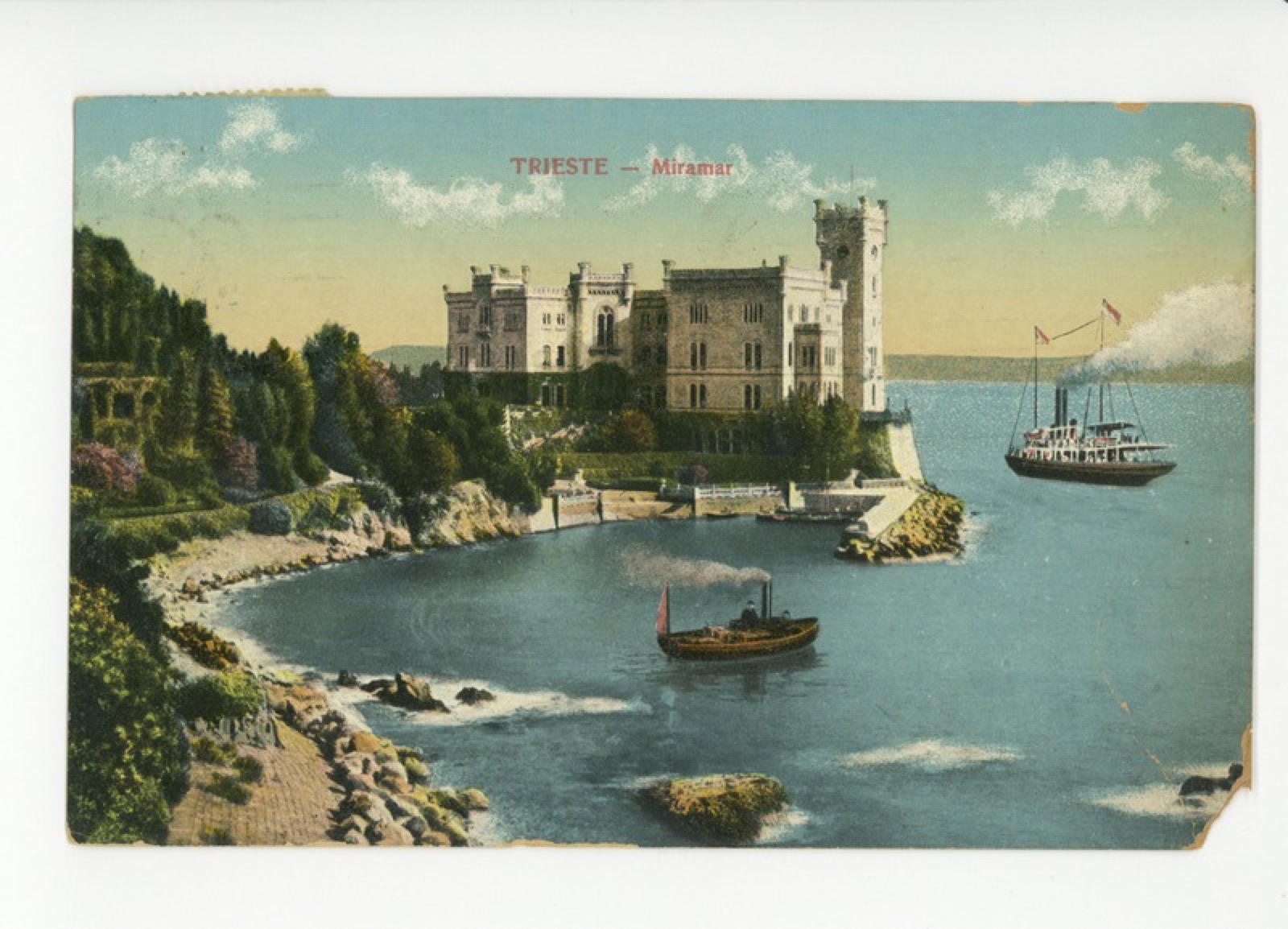
Miramare Castle, Trieste, Italy
· Under and Tuglas Literature Centre (via Europeana)
CC0 (no rights reserved)


