
Italy · Restored
Castel dell'Ovo
Castel dell'Ovo is a seafront medieval castle on the former island of Megaride in Naples, now connected to the mainland by a short causeway. Its present appearance largely dates from Aragonese works in the 15th century and it has served as a royal seat, treasury and prison; today its buildings host exhibitions and cultural events.
Its prime
1500
Today
Restored
Ranked among Europe’s castles
As it stood in 1500
What Castel dell'Ovo looked like in its prime.
Rectangular blocky fortress approximately 200 by 45 metres, rising directly from a rocky promontory into the sea; thick, pale beige ashlar curtain walls with few windows, squat square and rounded towers, and a very high bastion facing the causeway. A short causeway links the castle to the shore; the southern tip projects as a quay protected by a large round tower. Roofline is low and flat with parapets and walkways; interiors occupy the rectilinear range of buildings within the walls.
Its story
The story of Castel dell'Ovo.
Lucullus's Villa and the Exile of Romulus Augustulus
The castle stands on Megaride, a tufa islet off Monte Echia joined to the shore by a thin neck of rock. Greek settlers from Cumae founded the harbour settlement of Palaeopolis here, older neighbour of Neapolis. In the first century BC Lucius Licinius Lucullus built a villa on the island with a very rich library; the site was still called Castrum Lucullanum in the late Roman period.
Valentinian III fortified the villa in the mid-fifth century, and in 476 the deposed Romulus Augustulus, one of the last Western emperors, was exiled to it. Monks came at the end of that century, called from Pannonia with the relics of the abbot Severinus; Eugippius founded a monastery on the site after 492. By the seventh century they had taken the Benedictine rule and built an important scriptorium, probably from what survived of Lucullus's library.
Saracens, Bishop Athanasius and the Arx Sancti Salvatoris
In 872 Saracens imprisoned Bishop Athanasius of Naples on the islet, by then known as San Salvatore; the combined fleets of the Duchy of Naples and the Republic of Amalfi freed him and drove them off. The monastic complex and the old fortifications were afterwards pulled down so that raiders could not use them again. A document of 1128 names a stronghold on the rock again, the Arx Sancti Salvatoris, after the church the monks had built.
Roger the Norman's Castle, 1140
Conquering Naples in 1140, Roger the Norman built the first castle proper on the site, on the older ruins; the architect Buono completed it. Systematic fortification of the rock began with him, its first bulwark the Torre Normandia. It was lived in only occasionally: with Castel Capuano finished, the city's growth and trade had turned landward.
In 1191 the Empress Constance, Roger's daughter, was taken during her struggle with her nephew Tancred for the crown of Sicily. The Sicilian chancellor Matthew d'Ajello pressed Tancred to shut her in the island castle, officially the Castrum Salvatoris ad Mare, where she would be better guarded and cut off from people. She was released the following year and became Queen of Sicily. The kingdom passed to the Swabians through her, and in 1222 Frederick II raised the towers of Colleville, Maestra and Mezzo.
Virgil's Egg in the Foundations
The name belongs to a legend. Virgil kept a medieval reputation as a great sorcerer and foreteller, and the story runs that he hid in the castle's vaults a magic egg that held the fortress up, break it, and not only would the castle fall but disasters would follow for Naples. When an earthquake in 1370 brought down part of the arch the castle rests on, Queen Joanna is said to have sworn that she had replaced the egg, to stop panic spreading. The egg surfaced no earlier than the late Middle Ages, probably invented to explain a nickname already in the documents of Charles I of Anjou, a name owed to the oval shape Roger's rebuilding had given the place.
The Angevin Treasury and the Siege of 1503
Charles I of Anjou, who reigned from 1266 to 1285, moved his court to the new Castel Nuovo, and Castel dell'Ovo's importance began to decline, though the royal treasure stayed there, with the seat of the Royal Chamber and the State Treasury. It was a prison too. Conradin was held here in 1268 before his trial and beheading in the Piazza del Mercato, as were the children of Manfred, King of Sicily, after their father's defeat at Benevento. In 1381 Queen Joanna I, forced to surrender to her nephew Charles of Durazzo, was imprisoned in the castle where she had lived as sovereign.
Alfonso V of Aragon enriched the royal apartments, restored the mole and lowered the towers; his son Ferrante I had to bombard it to recover it after French troops sacked it. The French of Louis XII and the Spanish of Gonzalo Fernández de Córdoba battered it again, and in 1503 the siege by Ferdinand the Catholic finished what remained of the towers. The rebuilding that followed gave the castle its present form: with bombards replacing the older throwing engines, the octagonal towers went up again, the walls thickened, the defences turned inland rather than out to sea.
Under the Spanish viceroys and Bourbons it lost its standing as a royal residence and became a garrison post (the Spanish shelled the city from it during Masaniello's revolt), and a prison that held Tommaso Campanella before his death sentence and later the liberals Carlo Poerio, Luigi Settembrini and Francesco De Sanctis. Its guns were used again in the clashes of the Neapolitan Republic of 1799. A scheme of 1871 proposed pulling it down for a new quarter; instead the fortifications were extensively repaired from 1975.
Step inside
9 places to explore in 1500.
The record describes 9 distinct spots at Castel dell'Ovo, including 2 interiors: upper arched loggia and royal chambers, royal chamber / state treasury room. Create your own photoreal reconstruction and explore every one, more scenes means more rooms, more angles, and more of the place to stand in.
Build Your Own Castle
Recreate Castel dell'Ovo with AI to explore it.
The artist rebuilds it as it stood in 1500, a photoreal reconstruction that belongs to you alone. Pay with coins, no subscription needed.
Recreate this castle →Defend this castle →From the archive
Castel dell'Ovo on paper: the measured plan and period views.
The survey plan and photographs below are the ground truth this page's reconstructions are checked against, drawn and photographed while the castle was still a working garrison. Every image is public-domain or openly licensed, with its source named.
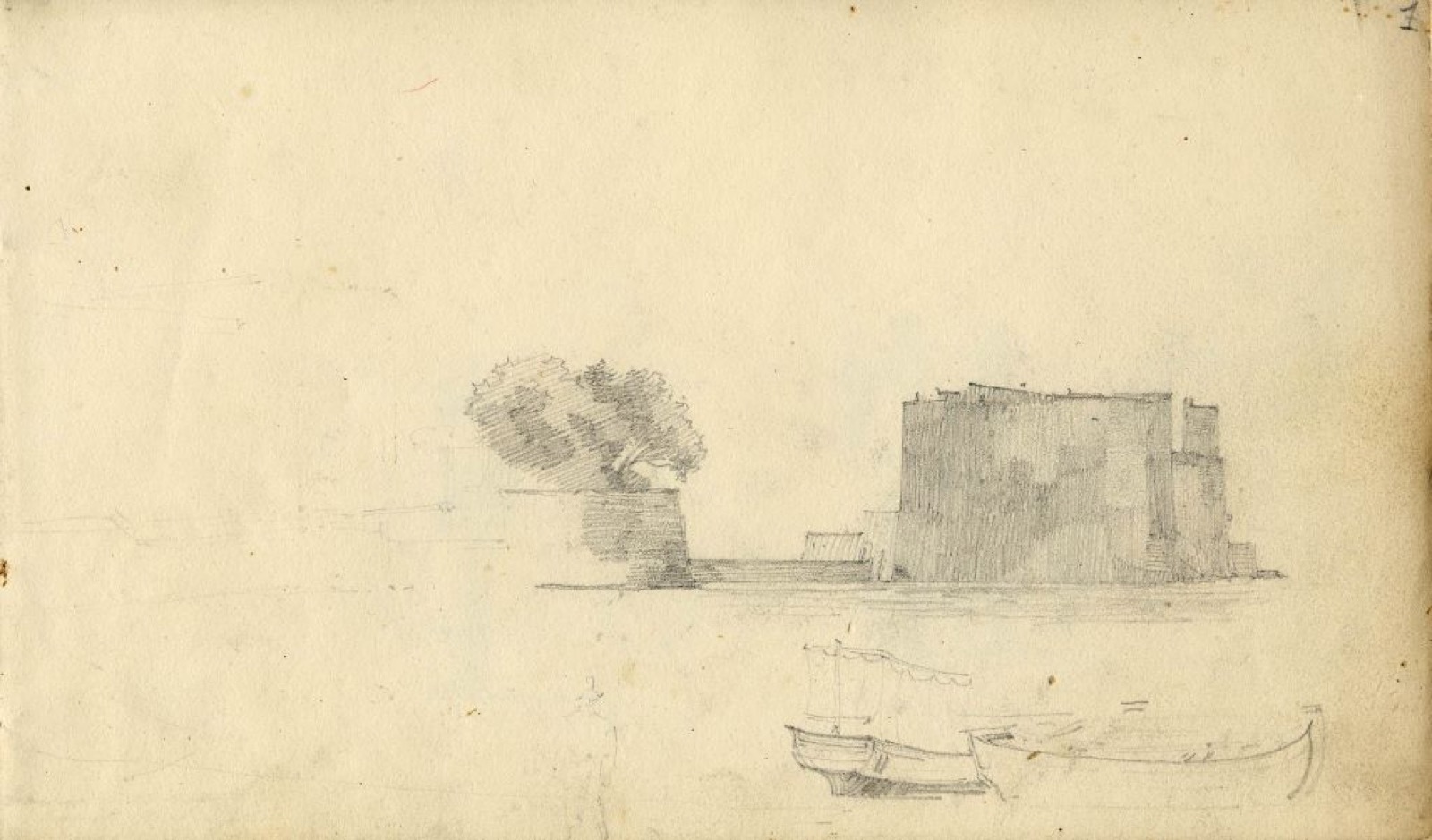
Veduta di Castel dell'Ovo a Napoli
1827 · Turin Gallery for Modern and Contemporary Art (via Europeana)
CC BY
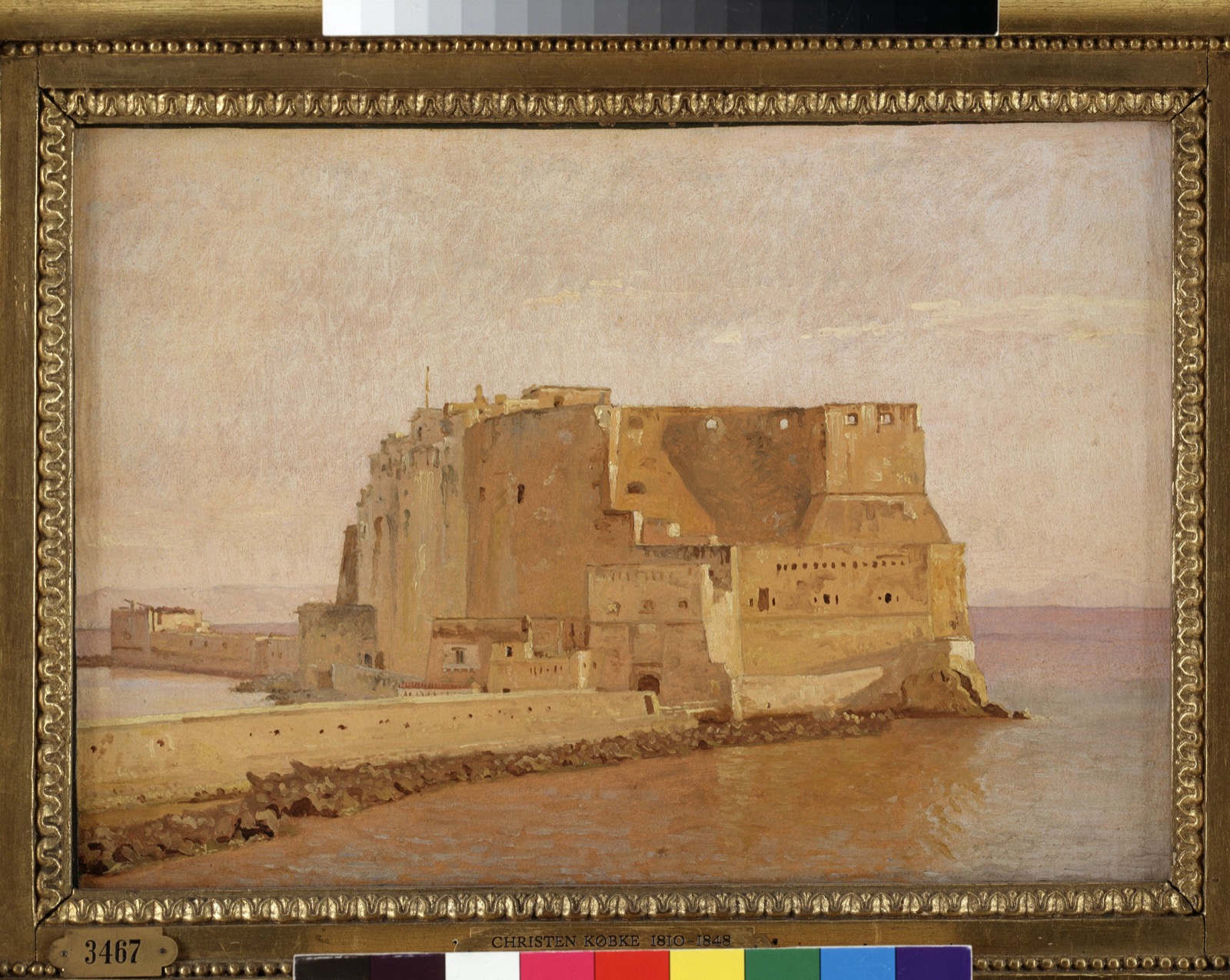
Castel dell'Ovo in Naples
· National Gallery of Denmark (via Europeana)
Public domain
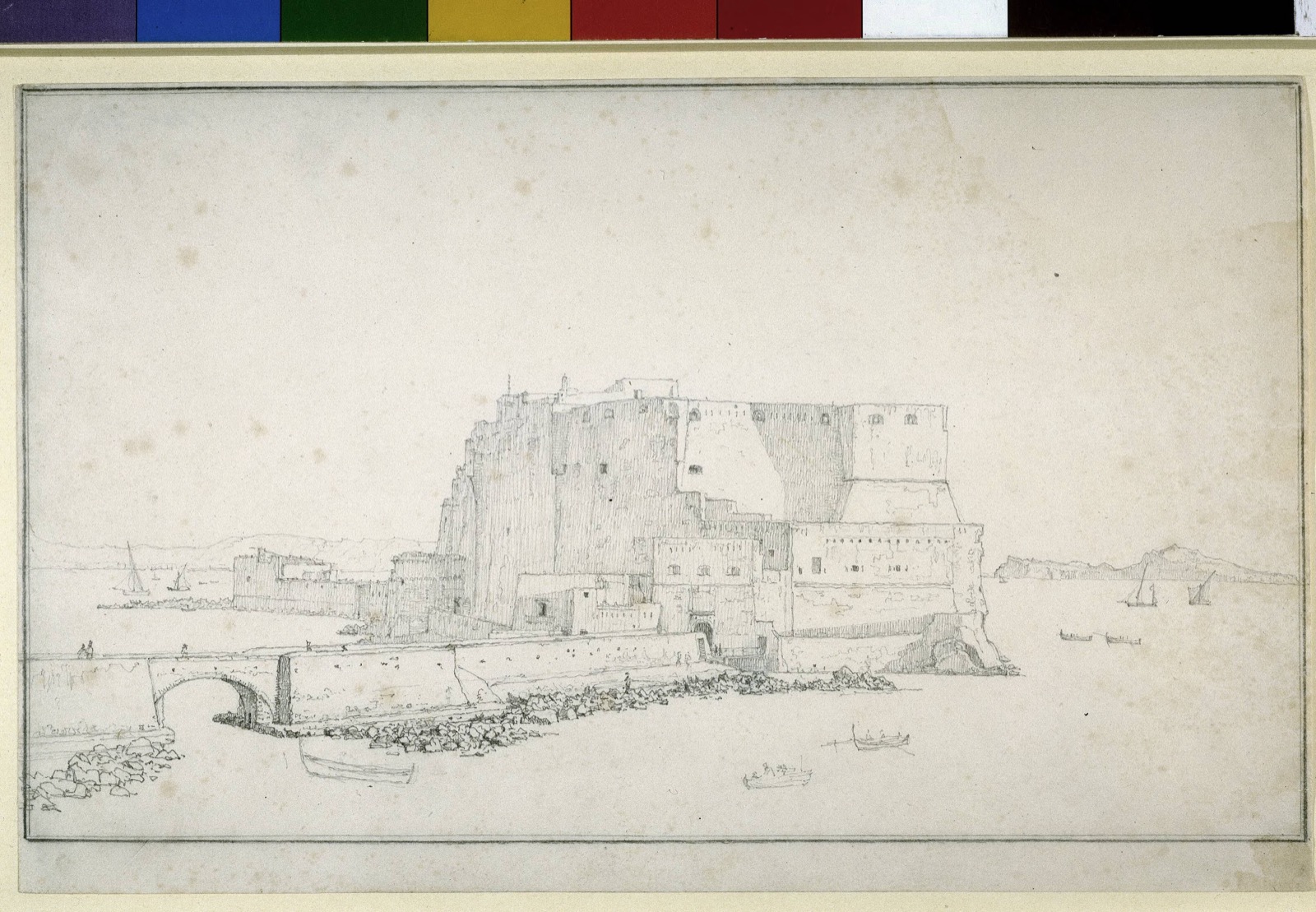
Castel dell'Ovo in Naples
1839 · National Gallery of Denmark (via Europeana)
Public domain
Nearby
Landmarks within reach of Castel dell'Ovo.


Questions about Castel dell'Ovo
What is the history of Castel dell'Ovo?
What is inside Castel dell'Ovo and what can you see?
Why was Castel dell'Ovo built, and what was it used for?
Where is Castel dell'Ovo?
When was Castel dell'Ovo built?
Was Castel dell'Ovo ever attacked or besieged?
What did Castel dell'Ovo look like in its prime?
Is Castel dell'Ovo still standing or is it a ruin?
Can you visit Castel dell'Ovo?
More castles of Italy


Explore the city


