Historic Cities · Italy
Milan through the ages
Milan is the regional capital of Lombardy, in northern Italy, and the seat of the Metropolitan City of Milan. It is the second-most populous city in Italy after Rome, with a population of 1,362,863 in 2026. The city's wider metropolitan area is the largest in Italy, and the fourth-largest in the European Union, with an estimated population of 6.55 million.

Milan in 1490
Sforza Milan
Milan in 1490 is the Duchy of Sforza at the height of a commercial and building boom: the Castello's brick bulk dominates the west and the new white mass of the Duomo rises across the centre, scaffolded and unfinished. Canals and cobbled streets carry stone, silk and people; artists and engineers move among courts and workshops while commissions and civic power reshape the fabric of the city.
Red-brown brick of military walls and the squat mass of the Castello Sforzesco sit against a growing forest of pale marble pinnacles where the Duomo rises, its scaffolds and cranes pricking the skyline. Narrow streets step down from broad market squares; the Navigli cut deep dark ribbons along timber quays where marble barges and laden bateaux are hauled. Roofs are terracotta tiles and lead flashings, shop shutters and awnings in dyed linens, and the light favours cool shadowed arcades and bright sun on white stone.
The route: 21 streets, squares and views
Navigli Approach → Porta Ticinese → Ripa di Porta Ticinese → Santa Maria delle Grazie → Castello Sforzesco → Torre del Filarete → Spianata del Castello → Brera Quarter → Sant'Ambrogio → San Lorenzo Maggiore → …
Step inside, 12 interiors
Lock-Keeper's House · Marble Warehouse · Convent Refectory · Sala delle Asse · Armourers' Forge · Silk-Weavers' Workshop · Ambrosian Chapter House · Romanesque Basilica Nave · Podestà's Council Chamber · Notaries' Chamber · Master Masons' Gallery · Carpenters' Roof Loft
Planned from the Wikipedia record: Duchy of Milan.
Milan in 1810
Napoleonic Milan
Milan in 1810 is the capital of the Napoleonic Kingdom of Italy, a city reshaping its medieval plan with broad neoclassical ambitions and state patronage. The walk passes new building sites, gala theatre nights, completed work on the Duomo façade and the reworked cultural quarter around Brera, showing everyday commerce and civic display under imperial rule.
Low, dense roofs of baked terracotta and dark lead, church spires and the pale marble of the Duomo define the skyline, punctuated by the mass of the Castello Sforzesco. Streets are narrow and cobbled within the medieval rings, opening into small paved piazzas. New stone and stucco neoclassical façades and scaffolds appear beside older brick and timber fronts. Canals and quays cut reflective ribbons through the working quarters, while carriages and foot traffic crowd the principal squares.
The route: 22 streets, squares and views
Western Plain Approach → Porta Sempione Gate → Arco della Pace (worksite) → Piazza Castello Forecourt → Foro Bonaparte Plans → Piazza San Sepolcro → Piazza Cordusio → Piazza dei Mercanti → Broletto Civic Loggia → Piazza del Duomo → …
Step inside, 14 interiors
Sala delle Asse · Royal Audience Chamber · Ambrosian Reading Hall · Covered Market Hall · Medieval Council Chamber · Cathedral Nave · Roof Terraces · Gilded Entrance Foyer · Great Horseshoe Auditorium · Pinacoteca Gallery · Botanical Greenhouse · Convent Refectory · Nave of Sant'Ambrogio · Canal Warehouse
Planned from the Wikipedia record: History of Milan.
Milan in 1906
Liberty Milan
Milan in 1906 is an industrialising, cosmopolitan city hosting the International Exposition for the Simplon (Sempione) Tunnel, where new electric trams run beneath a skyline of cathedral spires and plant chimneys. This walk moves from the rail approach and city gates through the fair in Parco Sempione, the glass-domed Galleria and the Duomo, Liberty villas on Corso Venezia, the canals of the Navigli and the emerging northern factories.
The skyline is dominated by the Duomo’s lace of pinnacles and the low classical cornices of 19th-century palaces, punctured here and there by the iron-and-glass dome of the Galleria and the thin stacks of new factories to the north. Streets are bricked or cobbled, tram wires crisscross the air, and park pavilions and temporary fair towers rise among plane trees; people move in dark wool suits, straw boaters and long structured skirts edged with Art Nouveau jewellery and printed scarves.
The route: 23 streets, squares and views
Fields beyond Porta Garibaldi → Porta Garibaldi Gate → Corso Garibaldi → Piazza Cordusio → Via Dante → Castello Sforzesco → Parco Sempione → Arco della Pace → Arena Civica → Santa Maria delle Grazie → …
Step inside, 12 interiors
Sala delle Asse · Machinery Pavilion Engine Hall · Cenacolo Refectory · Pinacoteca Gallery · Liberty Merchant's Salon · Liberty Villa Main Staircase · Galleria Octagon · Duomo Nave · La Scala Auditorium · Canal Boatwright's Shed · Textile Mill Engine Hall · Gallery among the Spires
Planned from the Wikipedia record: History of Milan.
Its story
The story of Milan.
Medhelanon: A Celtic Sanctuary Between the Rivers, c.590–222 BC
The city began as Medhelanon, settled around 590 BC by a Celtic tribe of the Insubres group belonging to the Golasecca culture; Livy's account puts the foundation at about 600 BC and credits it to Belloveso, chief of the Insubres. The name is read as a settlement in the midst of the plain, or as a place between watercourses: the Seveso and Lambro to the east, the Pudiga, Nirone and Olona to the west.
The settlement grew around a sanctuary near the modern Piazza della Scala, an elliptical wooded enclosure aligned on precise astronomical points and used for religious gatherings. Houses appeared around it about two centuries later, and Medhelanon turned from a religious site into a village and then a military one: a temple to the goddess Belisama stood near the site of the cathedral, and a fortified building ringed by a moat, dated to the fourth century BC, has been found at Via Moneta.
Mediolanum, Capital of the Western Empire, 222 BC–AD 569
Roman legions under the consul Gnaeus Cornelius Scipio Calvus captured the settlement in 222 BC and the Insubrian chief submitted; the region became the province of Cisalpine Gaul, and the town, Latinised as Mediolanum, was raised to the status of municipium in 49 BC. Its weight came from the roads, as the hub of the northern Italian network, and from a country that Polybius describes as abounding in wine, grain and fine wool. In 286 Diocletian moved the capital of the Western Roman Empire from Rome to Mediolanum, residing himself at Nicomedia and leaving his colleague Maximian here; Maximian enclosed 375 acres within a new stone wall about 4.5 kilometres round and built a circus, baths and a complex of imperial palaces.
It was from Mediolanum in 313, where he had come for the wedding of his sister to the eastern emperor Licinius, that Constantine issued the Edict of Milan, granting tolerance to all religions in the empire. The Arian controversy divided the city's Christians in the mid-fourth century, at times leaving rival bishops, and under Ambrose, bishop from 374 to 397, the city reached the height of its ancient power. The Visigoths besieged it in 402 and Honorius moved the imperial residence to Ravenna; Attila besieged it in 452; and in 539, during the Gothic War, Uraias attacked Milan with losses put by Procopius at about 300,000 men. The Lombards took the city in 569 and made Pavia their capital in 572, leaving early medieval Milan to the government of its archbishops.
Commune, Visconti and Sforza, 774–1499
Milan surrendered to Charlemagne and the Franks in 774, its aristocracy and most of its clergy having taken refuge in Genoa; the city grew poorer and became a county seat. The eleventh century brought a reaction against the Holy Roman Emperors and the birth of the city-state, and Milan destroyed Lodi and fought Pavia, Cremona and Como, who called in Frederick Barbarossa. The Milanese captured the Empress Beatrice and forced her to ride a donkey backwards out of the city; much of Milan was destroyed in 1162, and with fire in the storehouses holding its whole food supply the city surrendered within days. The independence the Lombard cities won in the Peace of Constance in 1183 restored the commune, and Milan, well placed for trade, was considered one of the largest cities in Europe. Its chief industries were armaments and wool.
Martino della Torre, elected Capitano del Popolo by the guilds in 1259, took the city by force, paved streets, dug canals, taxed the countryside and emptied the treasury. His family and the Visconti then fought a civil war of more than a decade, which Ottone Visconti ended by winning the city at the Battle of Desio in 1277; the Visconti ruled into the fifteenth century, and in 1395 the Emperor Wenceslaus raised Milan to a duchy under Gian Galeazzo Visconti. Archbishop Antonio de' Saluzzi began the new cathedral in 1386, for which the two basilicas of the old episcopal complex were demolished. When Filippo Maria Visconti died without a male heir in 1447 the Ambrosian Republic was proclaimed; it collapsed in 1450 when Francesco Sforza took the city. Under the Sforza the duchy prospered on mulberry cultivation and silk processing, and drew Leonardo da Vinci, who redesigned the navigli and painted The Last Supper.
Spanish Rule, the Plague of 1629–31 and the Austrian Handover
Milan's last independent ruler, Lodovico Sforza, called the French king Charles VIII into Italy expecting an ally; Louis of Orléans came with that expedition, judged Italy defenceless, and returned in 1500 to claim the duchy. It changed hands through the Italian Wars until Charles V defeated Francis I at Pavia in 1525; when Francesco II Sforza died ten years later it passed to the Emperor, and on Charles's abdication in 1556 to Philip II and the Spanish Habsburgs. A hundred and fifty years of Spanish rule followed. Lombardy was valuable to Spain as an armoury and a source of men: during the Franco-Spanish War of 1635–59 Milan sent and paid for an average of 4,000 soldiers a year, many of them serving in the Low Countries against the Dutch.
The Great Plague of 1629–31 killed an estimated 60,000 people out of a population of 130,000, one of the last outbreaks of the pandemic that had begun with the Black Death, and the epidemic Alessandro Manzoni described in The Betrothed. The plague and the arrival of the German army brought demographic and economic collapse, and stagnation lasted into the middle of the eighteenth century. When the Spanish Habsburg line ended in 1700 the War of the Spanish Succession followed; the French were beaten at Turin in 1706, and the treaties of Utrecht and Rastatt in 1713–14 confirmed Austrian sovereignty over Lombardy and its capital.
Austrian Reform, Napoleon and the Five Days of 1848
Reform under Maria Theresa and Joseph II returned the city to cultural and economic weight from the middle of the eighteenth century, and the institutions the Austrians founded or sponsored include the Teatro alla Scala, the Brera Academy (housed in a convent confiscated from the Jesuits), and the Braidense library, which Maria Theresa made public. Napoleon invaded in 1796, and Milan was capital of the Transpadane Republic, then the Cisalpine Republic, the Italian Republic and, from 1805 to 1814, the Napoleonic Kingdom of Italy; on 26 May 1805 he crowned himself King of Italy in the cathedral with the Iron Crown. The Congress of Vienna returned Lombardy to Austria, and Milan became capital of the Kingdom of Lombardy-Venetia, formally independent and in practice subject to the Austrian Empire, its highest governorships reserved for Austrian aristocrats.
On 18 March 1848 the city rose against Austrian rule in the Five Days, forcing Field Marshal Radetzky to withdraw; Piedmont-Sardinia sent troops, beginning the First Italian War of Independence, and a plebiscite ratified union with Piedmont by a large majority. Austrian forces routed the Piedmontese at Custoza on 24 July and reasserted control over northern Italy. In 1859 French and Italian troops beat the Austrians at Solferino, Milan and the rest of Lombardy were incorporated into Piedmont-Sardinia, and the Kingdom of Italy was proclaimed on 17 March 1861.
Rail, Banks and Fascism, 1861–1945
Unification confirmed Milan's economic hold on northern Italy. A rail network begun under the Austrians made the city the rail hub of the north and, with the Gotthard tunnel of 1882 and the Simplon of 1906, the main southern European hub for goods and passengers; abundant hydroelectric power built up steel and textiles, and Milanese banks dominated Italian finance. In May 1898 troops under General Fiorenzo Bava Beccaris fired on demonstrators protesting the soaring cost of living. Government figures gave at least 80 demonstrators killed, along with two soldiers, and 450 wounded. The suppression brought down Antonio Di Rudinì's government in July and created a constitutional crisis.
The city elected its first socialist mayor, Emilio Caldara, in 1914, and on 14 November of that year Benito Mussolini, still a member of the Socialist Party, began printing Il Popolo d'Italia in Milan. His Blackshirts held their first rally in Piazza San Sepolcro, and he launched the March on Rome from the city on 28 October 1922. In the Second World War Allied bombing did extensive damage to Milan's industry and transport and often struck residential districts. German forces occupied and plundered northern Italy after the Italian surrender in 1943, and a large resistance movement grew, in which the city's factories and those of neighbouring Sesto San Giovanni counted for much. On 25 April 1945 the National Liberation Committee proclaimed an insurrection and the city was liberated the same day; on 29 April the resistance executed Mussolini, his mistress and several officers of the regime, whose bodies were hanged in Piazzale Loreto, where resistance members had been executed a year earlier.
Miracle, Years of Lead and the Migrant City, 1946–2025
La Scala, rebuilt from bomb damage in a year, reopened on 11 May 1946 under Arturo Toscanini, returned from his long American exile; rubble from the bombing was piled into the artificial hill of Monte Stella, whose Giardino dei Giusti commemorates opponents of genocide and crimes against humanity with a tree to each. The industrial triangle of Milan, Turin and Genoa drove the Italian economic miracle. Large firms recruited in the south by posting notices in its towns and offering a bed in company housing; the population rose from 1.3 million in 1951 to 1.7 million in 1967 and peaked at 1,743,427 in 1973, after which about a third of the inhabitants moved out to the suburbs and satellite settlements.
Prosperity was overshadowed in the late 1960s and early 1970s by the Years of Lead, with street violence, strikes and political terrorism; on 12 December 1969 a bomb at the National Agrarian Bank in Piazza Fontana killed 17 people and injured 88. Milanese houses such as Armani, Prada and Versace made the city a fashion capital in the 1980s, and in the 1990s the Tangentopoli corruption trials, a severe financial crisis and steady decline in textiles, cars and steel hit it hard. Former industrial land carried the rebuilding that followed: the Porta Nuova and CityLife districts went up within a decade, and new university campuses were built at Bovisa and Bicocca.
Two waves of migration remade the population: internal migrants from the rural south from the 1950s to the early 1970s, then foreign-born arrivals from the late 1980s onwards (from Africa, eastern Europe, Asia and Latin America) rising from about 58,000 foreign-born residents at the start of the 1990s to 269,397 in 2024, 19.6 per cent of the municipality. The Chinese community, the oldest in Italy, was established in the 1920s around Via Paolo Sarpi by immigrants from Wencheng County who ran small textile and leather workshops; the Jewish community, about 10,000 strong and mainly Sephardi, is the second largest in Italy, its main synagogue built in 1892. The comune had 1,366,155 residents in 2025, and its metropolitan area accounts for about a fifth of Italy's GDP.
From the archive
Milan on paper: the old town as it was mapped.
A period plan or bird's-eye view of the old town, drawn between 1500 and 1850, the streets this page's reconstructions walk. Public domain, with its source named.
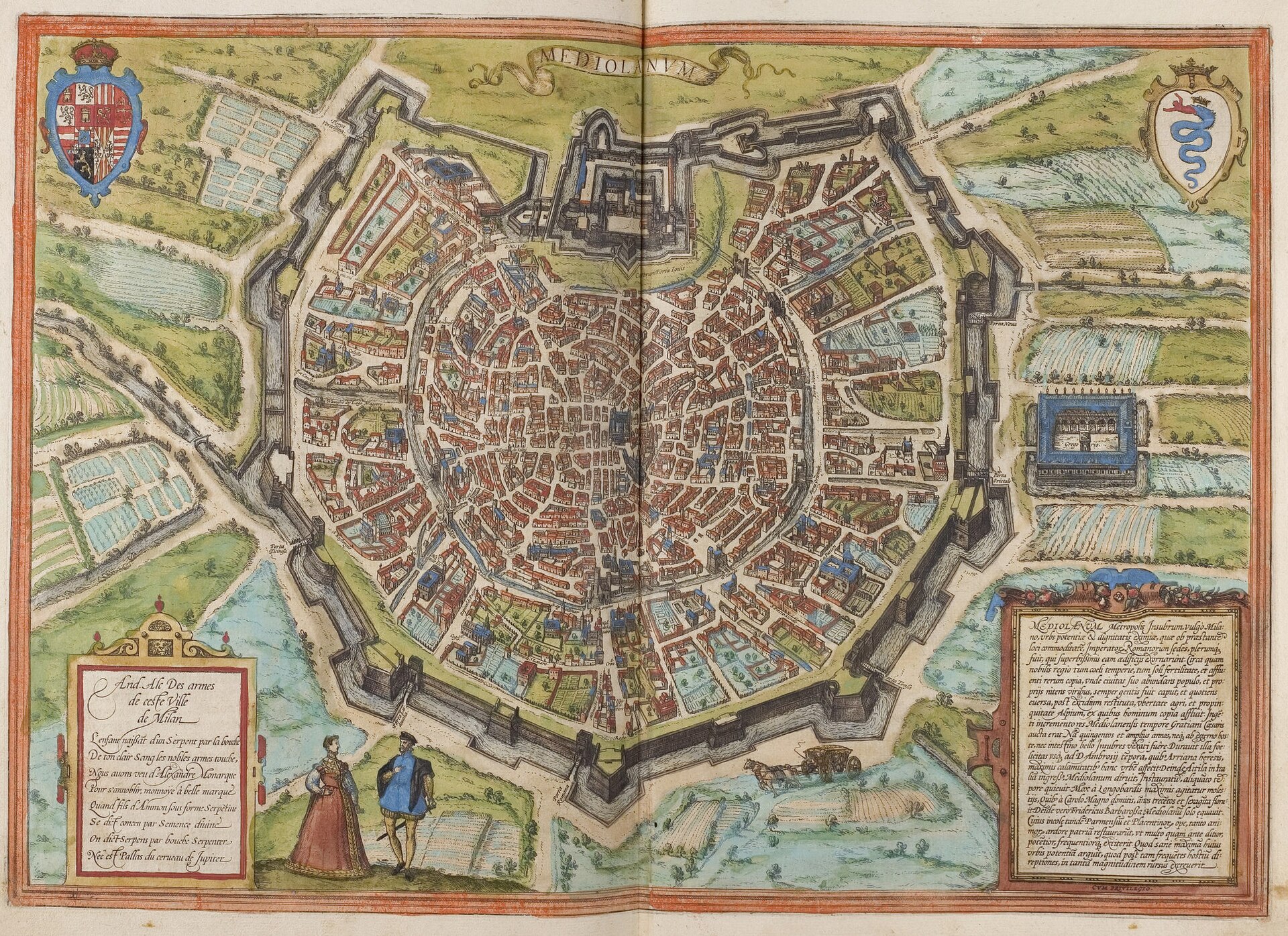
Bird's-eye view of Milan (La Gra. Citta di Milano), from Braun & Hogenberg's Civitates Orbis Terrarum
Shows bastioned city walls and gates, the radial street network, numerous churches and the Castello Sforzesco north of the old town.
1572 · Georg Braun; Frans Hogenberg · Wikimedia Commons
Public domain (plate dated 1572)
In this city
Landmarks of Milan, see each in its prime


Castles of Milan

More cities to explore
 ItalyGenoaExplore it in 1450 · 1650
 ItalyVeronaExplore it in AD 50 · 1340 · 1600
 ItalyRomeExplore it in AD 320 · 1300 · 1600 · 1770
 ItalyVeniceExplore it in 1200 · 1500 · 1740
Castles of Europe · Landmarks of Europe · create your own reconstruction.