Historic Cities · Italy
Genoa through the ages
Genoa is the sixth-largest city in Italy and the capital of the Italian region of Liguria. As of 2025, 565,301 people live within the city's administrative limits. While its metropolitan city has 818,629 inhabitants, more than 1.5 million people live in the wider metropolitan area stretching along the Italian Riviera.

Genoa in 1450
Genoa of the Republic
Genoa in 1450 is a powerful maritime republic shaped by commerce, banking and shipbuilding, still contesting influence across the Mediterranean. This walk moves from the busy harbour and Lanterna headland into the dense medieval caruggi, past palaces, markets and shipyards that furnish the city's wealth and daily labour.
The skyline is a crowded coastal silhouette: the squat stone Lanterna on its promontory, masts and lateen-rigged galleys and broader round ships heaped at the Molo, low slate and terracotta roofs rising in an amphitheatre up the hills. Streets are narrow, shadowed stone alleys and sunlit squares where black‑and‑white marble on church fronts and pale merchant palaces catch the glow of low Mediterranean light.
The route: 22 streets, squares and views
Gulf of Genoa → La Lanterna → Il Molo → Arsenale del Molo → Palazzo San Giorgio → Caricamento → Porto Antico → Piazza Banchi → Loggia dei Mercanti → Borgo di Prè → …
Step inside, 13 interiors
Beacon Lantern Chamber · Shipwright's Shed · Hall of Accounts · Customs Warehouse · Cordage Loft · Counting-house of Moneychangers · Merchants' Loggia Hall · Striped Cathedral Nave · Doria Palace Hall · Wool-weavers' Workshop · Gatehouse Guardroom · Ducal Council Chamber · Covered Market Hall
Planned from the Wikipedia record: Republic of Genoa.
Genoa in 1650
Genoa the Superb
This is Genoa at the height of its mercantile splendour: bankers and noble palaces shoulder one another while new defensive walls stride the surrounding ridges. The walk moves from the crowded quays where silver and spices are landed, past Strada Nuova's frescoed fronts and hanging gardens, into the tight caruggi and up to the new bastions above the harbour.
In 1650 Genoa's skyline is a compact tangle of terracotta roofs, chimney smoke and masts, dominated by the tall stone lantern tower (La Lanterna) beside the busy harbour. The Strada Nuova palaces present long, frescoed façades and balconies with clipped lemon trees, while the medieval core tightens into narrow, painted alleys (caruggi). Stone and stucco in ochres and pale pinks, black-and-white marble highlights at churches, and earth‑coloured tiles give the city a warm, sunlit palette under frequent coastal haze.
The route: 23 streets, squares and views
Gulf of Genoa → La Lanterna → Molo Vecchio → Mandraccio Quay → Palazzo San Giorgio → Piazza Banchi → Loggia dei Mercanti → Porta dei Vacca → Via dei Banchi → Cattedrale di San Lorenzo → …
Step inside, 12 interiors
Lantern Keeper's Chamber · Customs Warehouse · Shipchandler's Store · Bank of Saint George Hall · Counting House · Merchants' Hall · Baptist Chapel · Doge's Banquet Kitchen · Frescoed Gallery · Marble Atrium Stair · Piano Nobile Salone · Portrait Gallery
Planned from the Wikipedia record: History of Genoa.
Its story
The story of Genoa.
The Ligurian Oppidum and the Fatimid Sack of 934–35
The site has been inhabited since the fifth or fourth millennium BC. The first town, or oppidum, was founded in the fifth century BC, probably by the Ligures, on the hill now called Castello, and its inhabitants traded briskly enough to be reckoned the emporium of the Ligurians. The town held an equal pact, a foedus aequum, with Rome during the Second Punic War, and the Carthaginians destroyed it for that in 209 BC. Rebuilt, it received municipal rights after the Carthaginian wars ended in 146 BC and spread from the original castrum towards Santa Maria di Castello and the San Lorenzo promontory. Skins, timber and honey moved between the port and inland cities such as Tortona and Piacenza.
The Ostrogoths took the town after the fall of the Western Roman Empire, and after the Gothic War the Byzantines made it the seat of their vicar. When the Lombards invaded Italy in 568 Bishop Honoratus of Milan fled and held his seat here. For the next century and more Genoa was little more than a small centre, slowly building the merchant fleet that would become the leading commercial carrier of the western Mediterranean. In 934–35 a Fatimid fleet under Ya'qub ibn Ishaq al-Tamimi sacked and burned the town.
Crusader Galleys and the Treaty of Nymphaeum, 1097–1261
Genoa began to expand with the First Crusade, when it was a town of about 10,000 people. Twelve galleys, one ship and 1,200 soldiers sailed in July 1097 under the noblemen de Insula and Avvocato. The fleet carried and supplied the crusaders and blockaded Antioch during the siege of 1098, and at the siege of Jerusalem in 1099 Genoese crossbowmen under Guglielmo Embriaco fought as support units. Sea power turned into commercial treaties: Genoese merchants came to control a large share of the trade of the Byzantine Empire, Tripoli, the Principality of Antioch, Cilician Armenia and Egypt, though some territorial holdings were lost to Saladin's campaigns in Syria and Egypt late in the 12th century.
The rivalry with Venice ran through the 13th century. Venice's part in the Fourth Crusade had won it trading rights across the eastern Mediterranean and control of much of the region's maritime commerce, so Genoa allied with Michael VIII Palaiologos, emperor of Nicaea, who meant to restore the Byzantine Empire by retaking Constantinople. The treaty was signed at Nymphaeum in March 1261; on 25 July that year Nicaean troops under Alexios Strategopoulos recaptured the city, and the balance tipped to Genoa, which was granted free trading rights and then the greater part of Byzantine trading privileges, at Venetian and Pisan expense.
Caffa, Chios and Corsica: The Colonial Republic, 13th–14th Centuries
Chios, Lesbos and Smyrna became Genoese commercial stations, and in the same century the Republic took many settlements in Crimea, the territory known as Gazaria, where it founded the colony of Caffa. Victory over Pisa at the Battle of Meloria in 1284 lies behind the Doge's Palace, begun that year and made the doge's official residence in 1339. Corsica was formally annexed in 1347. During the Catalan–Genoese War the city itself was besieged and sacked by Guillem de Cervelló; in return for Genoese support of Aragonese rule in Sicily the Republic won free trading and export rights in the kingdom, and Genoese bankers lent to the island's new nobility.
The city's textile trade left a durable name. Around the 14th century Genoa was credited with the invention of blue jeans: its jean fabric was a fustian of medium quality and reasonable cost, close to the cotton corduroy for which the city was known, used for work clothes and issued to Genoese sailors, who needed cloth that could be worn wet or dry.
The Bank of Saint George and the Age of the Genoese, 1407–1627
Two of the earliest banks in the world were founded here in the 15th century: the Bank of Saint George in 1407, which was the oldest state deposit bank in the world when it closed in 1805, and the Monte di Pietà in 1483. Christopher Columbus was born in Genoa around 1451 and gave a tenth of his income from the discovery of the Americas for Spain to the Bank of Saint George, to relieve taxation on goods. Aristocratic families (the Balbi, Doria, Grimaldi, Pallavicini and Serra among them) amassed great fortunes in the recovery that followed. Felipe Fernandez-Armesto and others have argued that practices Genoa developed in the Mediterranean, chattel slavery among them, were crucial to the exploration and exploitation of the New World.
Genoa then became something of an associate of the Spanish Empire, its bankers financing the Spanish crown's foreign ventures from counting houses in Seville and supplying the Habsburg system with fluid credit and dependable income; shipments of American silver were moved on from Seville to Genoa as capital for further ventures. Fernand Braudel called the years from 1557 to 1627 the age of the Genoese, a rule so discreet that historians long failed to notice it, while other historians stress that Genoese merchants and entrepreneurs settled across the empire and built networks that lasted into the 19th century. The city's trade still depended on control of the Mediterranean sea lanes, and the loss of Chios to the Ottoman Empire in 1566 struck a severe blow.
At the height of its power in the late 16th and early 17th centuries the ruling aristocracy financed a district of prestigious residences along new thoroughfares: the Strade Nuove, chief among them Via Garibaldi, Via Cairoli and Via Balbi. The houses were part of a public lodging system run through official registers, the Rolli: when a state visit fell due, a palace was drawn from the lists to host the visitor, its grandeur matched to his rank. Peter Paul Rubens compiled a book of drawings of these palaces and presented them as a model of living for the European nobility.
Plague, Corsica and the End of the Republic, 1625–1805
Decline set in from the 17th century. A French-Savoyard army briefly besieged the city in May 1625 and was seen off with Spanish help; plague killed as many as half the inhabitants in 1656–57; and in May 1684 the French bombarded Genoa for its support of Spain in the War of the Reunions. In 1729 the Corsicans rose against Genoese rule under Luiggi Giafferi and Giacinto Paoli, a struggle that cost the Republic dearly in money and men for 26 years and ended in a self-proclaimed Corsican Republic in 1755 under Giacinto's son Pasquale Paoli. The last Mediterranean colony, the island fortress of Tabarka, was lost to the Bey of Tunis in 1742.
Alarmed by the Convention of Turin of 1742, which allied Austria with the Kingdom of Sardinia, the Republic signed a secret treaty with France, Spain and Naples and declared war on Sardinia on 26 June 1745. The decision proved disastrous: Genoa surrendered to the Austrians in September 1746 and was occupied until a revolt freed the city two months later. Too weak to hold Corsica, the Republic ceded the island to France by the Treaty of Versailles in 1768, a year before Napoleon Bonaparte was born there.
Napoleon's invasion during the campaigns of 1796 brought down the Republic in early June the following year, overthrowing the elites who had ruled the state throughout its history; the Ligurian Republic was proclaimed on 14 June 1797 under French military occupation. During the siege of 1800, 30,000 of the city's 160,000 inhabitants died of starvation and disease. The Ligurian Republic was annexed by France in 1805 and divided into the départements of Apennins, Gênes and Montenotte.
Annexed to Savoy: Shipyards and Emigrant Berths of the 19th Century
After Napoleon's fall the city regained independence as the Repubblica genovese for less than a year before the Congress of Vienna handed the whole territory of the former Republic to the Kingdom of Sardinia under the House of Savoy, against the principle of restoring the legitimate governments of the old states. Genoa gave the Risorgimento the patriot Giuseppe Mazzini, who was born there.
Through the 19th century the city consolidated its position as a seaport and became an important steel and shipbuilding centre. Giovanni Ansaldo founded Gio. Ansaldo & C. in 1853, whose yards built many passenger ships; the ferry company Costa Crociere followed in 1854, the Registro Italiano Navale in 1861, and in 1881 the shipowner Raffaele Rubattino was among the founders of Navigazione Generale Italiana, later the Italian Line. Banca di Genova opened in 1870 and became Credito Italiano in 1895; Rinaldo Piaggio founded his locomotive and carriage works in 1884. By 1874 railways linked Genoa to Turin, Ventimiglia and Pisa, and so to France and the rest of Italy. From these berths ran the sea route from Genoa to New York, travelled in past centuries by millions of emigrants.
Steelworks, the G8 of 2001 and the City After Morandi
The city was bombarded in the Second World War: a replica of an unexploded British naval shell that struck the Cathedral of San Lorenzo stands inside it as a memorial. Steel was a major industry through the boom of the 1950s and 1960s and was phased out after the crisis of the late 1980s, as Italian production moved towards less polluting and more technologically advanced goods; shipbuilding (yacht construction and maintenance, cruise-liner building and military shipyards) stayed flourishing across the region. A serious flood in 1970 sent the Bisagno stream over its banks, and further floods in 2010, 2011 and 2014 led to work from 2015 to cover and channel the Bisagno and the Ferreggiano. In 1992 the Colombiadi marked the five hundredth anniversary of Columbus's crossing, and the old port was rebuilt and enlarged to designs by Renzo Piano.
Genoa hosted the 27th G8 summit in 2001; it was overshadowed by violent anti-globalisation protests in which one protester was killed. The European Union named the city European Capital of Culture for 2004 alongside Lille, and in 2006 the Strade Nuove and the system of the Palazzi dei Rolli were inscribed on the World Heritage List. On 14 August 2018 the Ponte Morandi road viaduct collapsed during a torrential downpour, killing 43 people; its remains were demolished in August 2019 and the replacement Genoa-Saint George Bridge, designed by Renzo Piano, was inaugurated in August 2020 during the COVID-19 pandemic.
Genoa is the capital of Liguria and seat of its metropolitan city, with some 565,000 inhabitants in 2025 and more than 1.5 million people in the wider metropolitan area along the Riviera. Its port is the busiest in Italy and in the Mediterranean. The city has the lowest birth rate and the oldest population of any large Italian city, the product of a long demographic decline that has slowed somewhat over the past decade.
From the archive
Genoa on paper: the old town as it was mapped.
A period plan or bird's-eye view of the old town, drawn between 1500 and 1850, the streets this page's reconstructions walk. Public domain, with its source named.
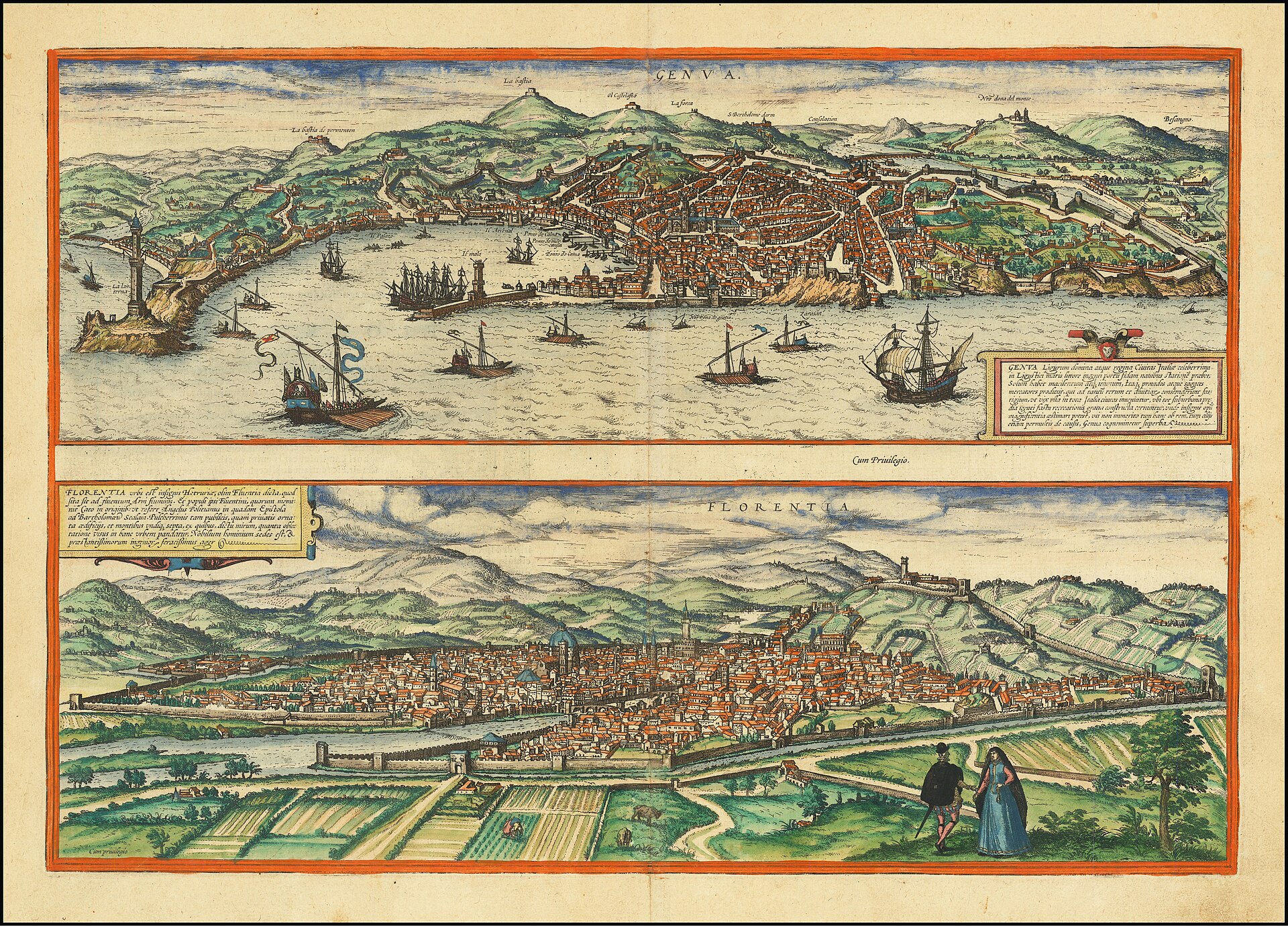
Bird's-eye view of Genoa (Genua), from Braun & Hogenberg's Civitates Orbis Terrarum
Shows Genoa’s harbour with mole and lighthouse, city walls and gates, dense street layout with churches, and surrounding hilltop forts.
1572 · Georg Braun / Frans Hogenberg · Wikimedia Commons
Public domain (plate dated 1572)
In this city
Landmarks of Genoa, see each in its prime


Ships tied to Genoa
- HMS Renown: Bombarded Genoa with Force H on 9 February 1941
- Littorio: Keel laid at the Ansaldo shipyards in Genoa on 28 October 1934
- RMS Carpathia: Called at Genoa on her New York-Mediterranean run
- Roma: Repaired at Genoa in July 1943, weeks before the armistice
- Vittorio Veneto: Sent to Genoa for repair after bomb damage at La Spezia in June 1943
- Zara: In port at Genoa for Navy Day in June 1939
Castles of Genoa

More cities to explore
 ItalyMilanExplore it in 1490 · 1810 · 1906
 ItalyPisaExplore it in 1200 · 1600
 ItalyRomeExplore it in AD 320 · 1300 · 1600 · 1770
 ItalyVeniceExplore it in 1200 · 1500 · 1740
Castles of Europe · Landmarks of Europe · create your own reconstruction.