Historic Cities · Italy
Venice through the ages
Venice is a city in northeastern Italy and the capital of the region of Veneto. It is built on a group of 126 islands that are separated by expanses of open water and by canals; portions of the city are linked by 472 bridges.

Venice in 1200
Medieval Venice
Venetia in 1200 is a compact maritime republic whose wealth and politics are already written on its waterfront, basilicas and palaces beside wooden quays and crowded shipyards. The walk moves from the lagoon approach past St Mark's glittering new mosaics, along the Rialto market and wooden bridge, through merchant quarters and the Arsenal, and ends with a wide view over the lagoon and mast-filled harbour.
Low, terracotta roofs and narrow, colonnaded façades press along greenish canals; Istrian stone and red brick alternate with wooden jetties and arcaded porches. St Mark's domes and the basilica's gold mosaics flash above the piazza like a Byzantine crown. The skyline is punctured by church towers and rigged masts, the city compact and dense, its streets little more than paved alleys, market campos and quays lined with merchant houses in Byzantine-arched style.
The route: 21 streets, squares and views
Lido Approach → Bacino di San Marco → Riva degli Schiavoni → Piazzetta San Marco → Basilica of San Marco → Piazza San Marco → Doge's Palace Exterior → Quay by the Palace → Arsenale Entrance → Arsenal Docks → …
Step inside, 12 interiors
Marble Nave and Mosaic Vaults · Treasury of St Mark · Ducal Audience Hall · Ceremonial Palace Stair · Shipwrights' Long Sheds · Galley Construction Yard · Notary's Office · Butchers' Guildhall · Covered Fish Market Hall · Ground Trading Hall · Silk Merchant's Vaulted Shop · Dominican Choir and Cloister
Planned from the Wikipedia record: Republic of Venice.
Venice in 1500
Renaissance Venice
This is Venice at the high Renaissance cusp, the maritime republic still wealthy from eastern trade and famed for painting, printing and spectacle. The walk moves from the lagoon into the heart of the city: customs and docks, the Doge's Palace and Piazza San Marco, the crowded Rialto markets and the narrow sestieri where painters, printers, mask-makers and shipwrights work and trade.
A low, horizontal skyline of brick campanili, squat palazzi and tiled roofs rises from the lagoon's pale water; canals carve a tight crescent through stone quays and wooden piles. Facades are mottled red-brown brick, pale Istrian stone dressings and painted plaster in warm earth tones; timber bridges and the wooden Rialto arch punctuate the Grand Canal. Streets are narrow, sunlit stretches and shaded alleys; flags, awnings and drying cloth give colour while masts, sails and small boats fill the waterways.
The route: 23 streets, squares and views
Lido Shore Approach → Punta della Dogana → Riva degli Schiavoni → Piazzetta San Marco → Piazza San Marco → Torre dell'Orologio → Merceria Street → Campo San Bartolomeo → Ponte di Rialto → Fondaco dei Tedeschi → …
Step inside, 15 interiors
Procurators' Office · Great Council Hall · Clock Chamber · Mask-makers' Workshop · Bookbinders' Workshop · Spice Counting House · Merchant Goods Hall · Fish Market Hall · Aldine Press Workshop · Piano Nobile of a Palazzo · Frari Choir and Chapel · Confraternity Hall · Formosa Church Nave · Basilica Nave and Sepulchres · Arsenal Ship-shed (Tese)
Planned from the Wikipedia record: History of the Republic of Venice.
Venice in 1740
Canaletto's Venice
This walk visits Venice at the height of its eighteenth‑century spectacle, when state pageantry, masked carnival and daily commerce animate palaces and canals. Expect bright, clear light, the public Bucintoro at the Molo, regattas on the Grand Canal, crowded markets at Rialto and music coming from the Ospedale della Pietà.
Venice in 1740 is a city of pale Istrian stone, warm brick and red‑tile roofs mirrored in still water. Low palazzi with arcaded ground floors and taller piano nobile levels line a network of canals threaded with gondolas, barges and oared boats. Wooden moorings, painted poles and small bridges articulate the shorelines while crisp, cool sunlight brightens facades and long shadows fall across busy quays.
The route: 23 streets, squares and views
San Giorgio Maggiore → Bacino di San Marco → Il Molo → Piazza San Marco → La Piazzetta → Riva degli Schiavoni → Palazzo Ducale → Bridge of Sighs → Rialto Bridge → Rialto Market → …
Step inside, 12 interiors
Basilica Nave and Mosaics · Caffè Florian Saloon · Great Council Hall · Mask-maker's Workshop · Fondaco Counting Hall · Waterfront Palazzo Salon · Scuola Albergo Hall · Salute Dome Nave · Pietà Concert Hall · Ridotto Gaming Salon · Great German Scola · Arsenale Shipwright Shed
Planned from the Wikipedia record: Canaletto.
Its story
The story of Venice.
Refuge in the Lagoon, AD 421–814
No surviving record deals directly with the founding of Venice. Tradition places it at noon on 25 March 421, with the dedication of the church of San Giacomo on the islet of Rialto, the "high shore", though that church dates no further back than the eleventh century at the earliest. Tradition and the surviving evidence point instead to a population of refugees from the Roman towns of the mainland, Padua, Aquileia, Treviso and Altino among them. Attila sacked Altinum in 452, and the Lombard migration of 568 left the Eastern Roman Empire only a strip of coast and the lagoons. Cassiodorus mentions the incolae lacunae, the "lagoon dwellers", their fishing and their saltworks, and how they strengthened the islands with embankments.
Reachable from Ravenna only by sea, the lagoon communities drifted into autonomy as the Duchy of Venetia. Early in the eighth century they elected Orso Ipato, whom Byzantium confirmed as hypatus and dux; he was historically the first doge, though an eleventh-century tradition instead names Paolo Lucio Anafesto, proclaimed in 697. In 804 a pro-Frankish faction seized power and called in Charlemagne's son Pepin; the six-month siege failed, his army ravaged by the diseases of the swamps, and Pepin died a few months later, apparently of a disease contracted there. An agreement between Charlemagne and the emperor Nicephorus then recognised Venice as Byzantine territory with trading rights along the Adriatic, and Agnello Participazio moved the ducal seat to the Rivo Alto islands, the heart of the later city and barely urbanised before the ninth century.
A Port of Trade: the Slave Market and the Adriatic, 8th–11th Centuries
Under Domenico Monegario, Venice changed from a fisherman's town into a port of trade and a centre of merchants, with shipbuilding greatly advanced. Part of that early prosperity came from slaving: Venetians bought in Italy, among other places, and sold to the Moors of North Africa. By the pactum Lotharii of 840 Venice promised the Carolingian Empire that it would neither buy Christian slaves within it nor sell Christian slaves to Muslims; thereafter the Venetians sold Slavs and other Eastern European non-Christians in greater numbers, moved in caravans through the Alpine passes of Austria. Surviving records value a female slave at about 1.5 grams of gold and male slaves, who were more numerous, at considerably less. Eunuchs were especially valuable, and castration houses arose in the city to meet the demand.
Giustiniano Participazio brought the body of St Mark the Evangelist from Alexandria, and by 828 the relics were in the new basilica. Winged lions, visible throughout Venice, are the emblem of St Mark. On Ascension Day in the year 1000 Pietro II Orseolo sailed against the Narentine pirates: the Istrian and Dalmatian cities swore fidelity and Orseolo took the title Dux Dalmatie. Trade with Byzantium was underwritten by the Golden Bull of the emperor Basil II, which freed Venetian merchants from the taxes paid by other foreigners and by Byzantines themselves.
The Fourth Crusade and the Stato da Màr, 1123–1380
Venice grew rich as the intermediary between Europe and the Levant, and the crusades were good business. In 1123 the Pactum Warmundi granted Venice virtual autonomy within the Kingdom of Jerusalem. In the twelfth century the republic built the state shipyard later known as the Arsenal. Doge Domenico Selvo's intervention against the Normans won a bull exempting Venetian merchants from taxation throughout the Byzantine Empire, a considerable factor in the city's later wealth from the spice and silk trade. The relationship was not safe: in 1182 the Orthodox population of Constantinople massacred the Latins of the city, the Venetians their main target.
The Fourth Crusade could not pay for the shipping it had chartered, and doge Enrico Dandolo offered to defer the debt in exchange for help retaking Zara. With Zara taken in 1202 the crusade was diverted again, to Constantinople; the Venetians and French besieged and sacked the city in 1204 after the emperor they restored refused to pay what he had promised. Venice took three-eighths of the empire in the partition that followed, Crete and Euboea included. Holding that empire meant fighting for it: defeat at Nervesa in January 1358 forced the surrender of Dalmatia to Hungary, a colonial revolt in Crete in 1363 took five years to put down, and the intermittent war with Genoa, fought from 1350 to 1381, turned only when the Genoese fleet was destroyed at Chioggia in 1380.
Terraferma, the Presses and Agnadello, 1423–1509
In the early fifteenth century Venice turned inland, taking most of Venetia, Verona and Padua included, against the expansion of Milan. The mainland was held partly as a buffer, partly to guarantee the Alpine trade routes, and partly to secure the wheat supply on which the lagoon city depended. Under doge Francesco Foscari, from 1423 to 1457, the republic reached the height of its power and territorial extent. At the end of the century, with 180,000 inhabitants, Venice was the second largest city in Europe after Paris and probably the richest in the world; its territory of some 70,000 square kilometres held 2.1 million people.
The city also made things: silks, brocades, goldsmiths' work, armour and glass. The glass industry moved to Murano towards the end of the thirteenth century, and Byzantine craftsmen shaped it, some fleeing to Venice after the sack of 1204, more after the Ottomans took Constantinople in 1453. By 1482 Venice was the printing capital of the world, and by 1500 it had 417 printers; the Aldine Press of Aldus Manutius issued the first printed Aristotle in 1497 and established modern punctuation and italic type. Mainland ambition then brought the mainland's enemies down at once: in 1508 every neighbouring power joined the League of Cambrai under Pope Julius II, and on 14 May 1509 the Venetian army was crushed at Agnadello. Venice extricated itself by diplomacy and by the mainland towns rising to the cry of "Marco, Marco", and after seven ruinous years held its mainland again as far as the Adda, but 1509 marked the end of Venetian expansion.
The Ghetto, from Compulsion to Deportation
The Venetian Ghetto was the area in which Jews were compelled to live under the Republic, and the Venetian word ghèto has since passed into many languages. The first complete and uncensored printed edition of the Talmud was produced in Venice by Daniel Bomberg in 1523. When Napoleon took the city in 1797 he was seen as something of a liberator by its Jewish population, removing the gates of the Ghetto and ending the restrictions on when and where Jews could live and travel within Venice. During the Second World War Jews were rounded up in Venice and deported to extermination camps. Since the end of the war the Jewish population has fallen from 1,500 to about 500, of whom around thirty live in the former ghetto, which still houses the city's principal Jewish institutions.
Lepanto, the Plagues and the Long Retreat, 1538–1718
Caught between the Spanish and Ottoman empires, Venice lost ground steadily. Its allied commander was beaten at Preveza in 1538, after which the supremacy of the sea passed to the Ottomans. Until 1545 the galley oarsmen were free men on a wage, but crews grew hard to find and Venice resorted to conscription, chaining the oarsmen to the benches. In 1570 the Ottomans attacked Famagusta, the last Venetian stronghold on Cyprus; it surrendered, and the Turkish commander Lala Kara Mustafa Pasha had the Venetian provveditore Marcantonio Bragadin flayed alive. The Holy League's fleet, 110 of whose 208 galleys were Venetian, beat the Ottoman fleet off Lepanto on 7 October 1571, but Venice gained no strategic advantage and the loss of Cyprus was ratified in the peace of 1573. The Cretan War then ran some twenty-five years until Francesco Morosini surrendered Candia on 6 September 1669; when the Ottomans declared war again in December 1714 the Morea was overrun, and the Treaty of Passarowitz of 21 July 1718 confirmed its loss in the Republic's last war with the Turks.
Disease cut the city harder than any fleet. Plague returned between 1575 and 1577, killing some 50,000 people in three years: the population stood at about 175,000 in 1575 and 124,000 by 1581. The plague of 1630 killed 50,000 in sixteen months, a third of the city, and the first stone of Santa Maria della Salute was laid as a thanks offering for its ending. Venice also kept its distance from Rome, ignoring the interdict Pope Paul V laid on the city in the quarrel that began in 1605, until it was lifted a year later.
Trieste, Napoleon and the Emptying City, 1719–2025
The eighteenth-century decline was commercial before it was military. Livorno became the staging post for British trade in the Mediterranean, while papal Ancona and Habsburg Trieste, a free port from 1719, took the Adriatic traffic. In May 1784 Andrea Tron said that trade "is falling into final collapse"; by 1792 the merchant fleet was down to 309 vessels. By 1796 the Republic could not defend itself. On 25 April 1797 Napoleon told the Venetian delegates at Graz, "I want no more Inquisition, no more Senate; I shall be an Attila to the state of Venice," and declared war on 1 May. On 12 May the Maggior Consiglio voted to hand power to a provisional government, ending a millennium of independence under its last doge, Ludovico Manin; by the treaty of Campoformio that October, Venice and all its possessions passed to Austria.
After a spell in Napoleon's Kingdom of Italy the city returned to Austria in 1814 within Lombardy–Venetia, and in 1848 rose under Daniele Manin to re-establish a Venetian republic, which surrendered after a year's siege on 22 August 1849. After the Third Italian War of Independence in 1866 the city joined the Kingdom of Italy. Trieste meanwhile captured the traffic between Asia and central Europe after the Suez Canal opened in 1869. A railway bridge to the mainland had been built in 1846, and industry followed it across: in 1917 Bottenigo, renamed Marghera, was absorbed into the comune and Porto Marghera begun, the lagoon city having no room for an industrial zone of its own. Mestre and its neighbours were annexed in 1926 and a road bridge added in 1933. In the Second World War Mestre, Marghera and the railway lines were bombed repeatedly, while the historic city was struck once, on 21 March 1945, by a precision raid on German naval operations in the city. British and New Zealand troops of the Eighth Army liberated Venice on 29 April 1945; the city had been a centre of anti-Mussolini partisan activity.
Since the war Venetians have left the islands for work and cheaper housing in Mestre and Porto Marghera. The historic centre fell from about 120,000 residents in 1980 to about 60,000 in 2009 and 50,000 in 2021, while the comune as a whole, capital of the Veneto region, had 249,466 inhabitants in 2025. The city and its lagoon were inscribed as a UNESCO World Heritage Site in 1987, and by 2017 UNESCO was considering adding it to the In-Danger list because of the pressure of tourism. Artesian wells sunk around the lagoon for industry made the city subside, and although they were banned in the 1960s it continues to sink by one to two millimetres a year. The flood of 13 November 2019 peaked at 1.87 metres, the highest since 1966, and covered more than 80 per cent of the city. The MOSE flood-barrier project, inaugurated in 2003, was activated for the first time on 3 October 2020, and from 25 April 2024 the city began charging day-trippers a five-euro access fee on peak days.
From the archive
Venice on paper: the old town as it was mapped.
A period plan or bird's-eye view of the old town, drawn between 1500 and 1850, the streets this page's reconstructions walk. Public domain, with its source named.
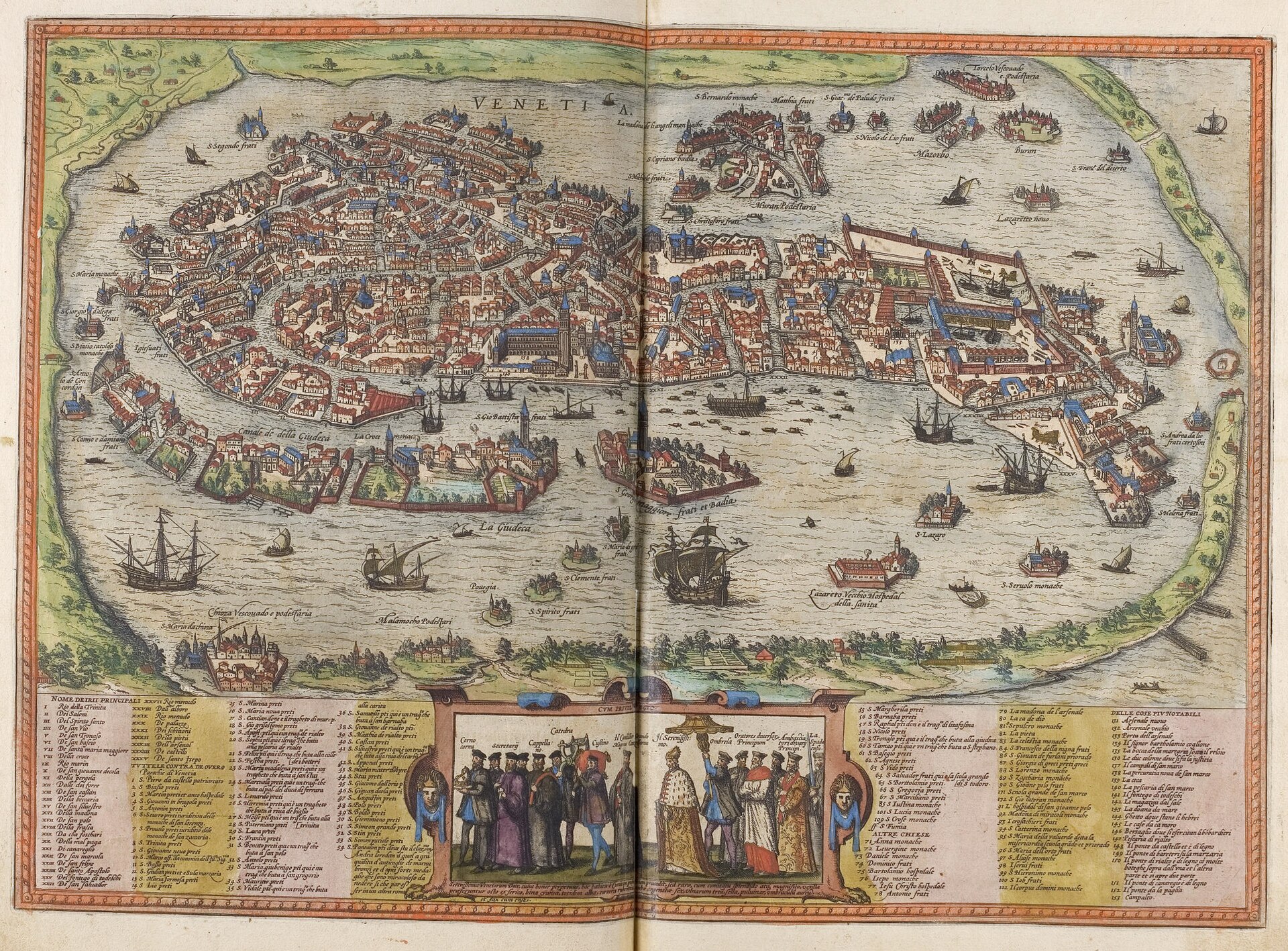
Bird's-eye view of Venice, from Braun & Hogenberg's Civitates Orbis Terrarum
Bird's-eye plan showing St Mark's Square with its campanile and basilica, the Doge's Palace, the Grand Canal, the island of Giudecca and surrounding lagoon with ships.
1572 · Georg Braun; Frans Hogenberg · Wikimedia Commons
Public domain (plate dated 1572)
In this city
Landmarks of Venice, see each in its prime


Ships tied to Venice
- SMS Tegetthoff: Escorted into Venice in March 1919 and displayed there as a war trophy
More cities to explore
 ItalyVeronaExplore it in AD 50 · 1340 · 1600
 ItalyRavennaExplore it in AD 550
 ItalyRomeExplore it in AD 320 · 1300 · 1600 · 1770
 ItalyFlorenceExplore it in 1300 · 1490 · 1600
Castles of Europe · Landmarks of Europe · create your own reconstruction.