Historic Cities · Italy
Ravenna through the ages
Ravenna is the capital city of the Province of Ravenna, in the Emilia-Romagna region of Northern Italy. It was the capital city of the Western Roman Empire during the fifth century A.D. until its collapse in 476, after which it served as the capital of the Ostrogothic Kingdom and then the Byzantine Exarchate of Ravenna.

Ravenna in AD 550
Byzantine Ravenna
Ravenna in 550 is the western capital of the Byzantine emperor, a low brick city set in marsh and reed-lined canals with a naval base at Classis. The walk shows newly consecrated churches and fresh mosaic glory, the working harbour beyond the marshes, palace precincts and the everyday streets that bind them.
A compact skyline of low brick roofs, squat apses and a small number of domes and octagonal towers rises from grey reed beds and a network of shallow canals. Exteriors are mostly baked brick with pale mortar, timber eaves and occasional white marble fragments; gold and cobalt glitter within the churches, while the approach to Classis shows rows of ships and sunlit amphorae on the quays beyond the marshland.
The route: 16 streets, squares and views
Causeway to Classis → Sant'Apollinare in Classe → Quays of Classis → Amphora Yard at Classis → Reed Canals Approach → Western City Walls → Palatium (Royal Palace) → Basilica of San Vitale → Mausoleum of Galla Placidia → Neonian Baptistery → …
Step inside, 9 interiors
Classe Apse Choir · Harbour Stowage Vault · Domed Funerary Chamber · Ceremonial Marble Stair · Imperial Mosaic Court · Starry Blue Vault · Baptistry Dome · Processional Nave · Tesserae Workshop
Planned from the Wikipedia record: Ravenna.
Its story
The story of Ravenna.
Lagoon Islands and the Fleet at Classis
The oldest archaeological evidence dates an Umbrian presence here at least to the 5th century BC, on a site of houses raised on piles across small islands in a marshy lagoon. Until the end of the Middle Ages the place could be reached only by water, which allowed its inhabitants to trade with Etruscans and Gauls while staying independent of both. Ancient writers could not agree on who founded it: Pliny the Elder named the Sabines, Strabo the Thessalians, Dionysius of Halicarnassus the Etruscans, Jordanes the Veneti and Zosimus the Pelasgians.
First contacts with Rome are documented around 220 BC, and in 89 BC Ravenna was accepted into the Roman Republic as a federated town. Julius Caesar gathered his forces here in 49 BC before crossing the Rubicon. After his battle against Mark Antony in 31 BC, Octavian founded the military harbour of Classis, walled at first, which became a station of the Roman imperial fleet and was linked to the Po delta by the Fossa Augusta. Cassius Dio records that at its height, between the 2nd and 3rd centuries, the harbour could hold 250 warships, and the town about 10,000 people, many from the east and therefore Christian. Trajan built a 70-kilometre aqueduct at the beginning of the 2nd century. During the Marcomannic Wars, Germanic settlers in the city revolted and seized it, after which Marcus Aurelius decided against bringing more barbarians into Italy and banished those already there.
Capital of the West, 402-476
In 402 Honorius moved his residence from Milan to Ravenna, out of reach of the Visigothic king Alaric, and the city served as the de facto capital of the Western Roman Empire for most of the 5th century. The move was partly defensive - the swamps and marshes were thought to make the city easy to hold, though in practice it fell repeatedly - and the port and its sea connections to the Eastern Roman Empire likely counted too. In 409 Alaric simply bypassed Ravenna, went on to sack Rome in 410 and took Galla Placidia, daughter of the emperor Theodosius I, hostage.
Galla Placidia returned with her son, the emperor Valentinian III, backed by her nephew Theodosius II, and the imperial court favoured the Christian religion. She raised San Giovanni Evangelista after surviving a storm at sea. Continual power struggles impoverished the city as the century wore on, while subsidence silted the lagoon and put the harbour of Classe out of use. In 476 the general Odoacer deposed the last de facto western emperor, Romulus Augustulus, at Ravenna. The city then held some 50,000 people.
Odoacer, Theodoric and the Exarchs, 476-680
Odoacer ruled as king of Italy for thirteen years. In 489 the eastern emperor Zeno sent the Ostrogoth king Theodoric the Great to retake the peninsula; after losing the Battle of Verona, Odoacer fell back on Ravenna and withstood a three-year siege until the fall of Rimini cut off his supplies. Theodoric entered the city in 493, supposedly slaying Odoacer with his own hands, and made it the capital of the Ostrogothic Kingdom of Italy. He extended the walls, drained marshes and built his palace church of Sant'Apollinare Nuovo, an Arian cathedral and his own mausoleum outside the walls; Boethius, Cassiodorus and Jordanes were among the scholars at his court. Odoacer, Theodoric and their followers were Arian Christians and co-existed peacefully with the largely Nicene Latins: Roman citizens kept Roman law and courts, the Goths their own laws and customs. When a mob burned down the synagogues of Ravenna in 519, Theodoric ordered the town to rebuild them at its own expense.
Theodoric died in 526; his grandson Athalaric and his daughter Amalasuintha were both dead by 535, and no later Ostrogothic commander held Italy as he had. Justinian I, who opposed both Gothic rule and the Gothic variety of Christianity, sent Belisarius into Italy in 535; Ravenna was besieged in 539 and taken in 540. With the conquest completed in 554 the city became the seat of Byzantine government in Italy under a governor, the Exarch. Justinian raised the city to an archbishopric and installed Maximian, whose building programme, San Vitale among it, aimed to make Ravenna an ecclesiastical centre to rank with Rome and Constantinople. In 666 the emperor Constans II granted the archbishop autocephaly from Rome, with jurisdiction over Emilia-Romagna; it was soon revoked, and in 680 Archbishop Theodore gave up autocephaly altogether, setting off rebellions and weakening the see. The archbishop nonetheless held second place in Italy after the pope.
The Port Silts and the Papacy Takes Over, 712-1248
The Lombards under King Liutprand occupied Ravenna in 712 but were forced to return it. Aistulf, crowned king of the Lombards in 749, pushed into the exarchate and into territory claimed by the pope; in 751 the Byzantines surrendered the exarchate to him, and he moved south demanding tribute from Rome. Pope Stephen II travelled to France in 753 to seek help from Pepin, king of the Franks, who campaigned twice in Italy until in 756 Aistulf conceded, paid reparations and gave back what he had taken. Pepin then granted the pope the former exarchate and the Roman duchy - the Donation of Pepin, the legal basis of the Papal States.
Ravenna had lost the thing that made it a capital. Byzantine administrative structures collapsed through the 9th and 10th centuries, with local dukes and Lombard lords holding power in practice; the harbour silted up and Classe emptied of people. An earthquake between 726 and 744 wrecked the street plan and left the city an open quarry. In 784 Charlemagne came to Ravenna and, with a letter from Pope Hadrian, stripped and demolished the palace of Theodoric, carrying its statues and precious marbles to Aachen. Otto I later built a royal palace here to court the archbishops, long antagonists of the pope; through the investiture contest the church of Ravenna kept faith with the emperors, and in 1080 Henry IV named Archbishop Wibert of Ravenna as antipope, which damaged relations with Rome for a long time.
A commune took shape in 1109 and by 1181, under the Traversari, had partly freed itself from the archbishop. In 1198 Ravenna led a league of Romagna and Marche cities against Otto IV, and Innocent III used the anti-imperial mood to strengthen papal influence over the city. Pietro Traversari came to power in 1218 after defeating the Ubertini and Mainardi factions, and his family ruled for twenty-two years, until Frederick II besieged Ravenna in 1240 and expelled them for having taken the Guelph side. Frederick's vicar governed for eight years, until Innocent IV took the city in 1248 and the Traversari returned.
Da Polenta, Venice and the French Sack, 1275-1530
In 1275 Guido Novello da Polenta drove the Traversari out, and the Da Polenta established a hereditary lordship, papal vassals governing with increasing independence. Through the 14th century they pressed the rebuilding of houses in masonry and the repopulation of the city, and spent heavily on restoring the river channels that reconnected it to the Adriatic and the Po delta. Dante Alighieri, banished from Florence, spent most of the rest of his life here and died of malaria in 1321. His funeral was held in the Basilica of San Francesco and he was buried in a tomb annexed to it, the local authorities resisting for centuries all demands from Florence for the return of his remains.
Early in the 15th century Venice offered its protection to the lord of Ravenna, Obizzo da Polenta, who accepted. In 1438 the condottiere Niccolò Piccinino took the city for Filippo Maria Visconti of Milan; Venice answered in 1441 by taking Ravenna, exiling the last Da Polenta lord, Ostasio III, to Crete and annexing the territory by the Treaty of Cremona. The Venetians militarised the place with earthworks and the Rocca Brancaleone of 1457, rebuilt and enlarged it, and drew in growing numbers of incomers from the Po plain.
Venetian rule ended when the French destroyed the Venetian army at Agnadello on 14 May 1509 in the War of the League of Cambrai, and papal legates returned. After Julius II allied with Spain and the Empire against France in 1511, the French besieged Ravenna, beat the League's relief forces at the Battle of Ravenna in 1512 and sacked the city; contemporary accounts describe widespread killing of civilians and extensive looting of churches and houses. The occupation lasted four months. In 1527 the Venetians occupied Ravenna and the Romagna again despite their alliance with Clement VII, and were compelled to restore them in 1529. From 1530, with that pope's favour, an oligarchy of noble families led by the Rasponi took the city and began a long economic and cultural decline, slowed only in part by the archbishopric's church building through the Counter-Reformation.
Fifteen Floods, Rice and the Braccianti, 1544-1922
Rising beds on the Ronco and the Montone brought fifteen floods between 1544 and 1715, among them the flood of May 1636 that damaged the city. In 1739 the two rivers were diverted into the Fiumi Uniti channel south of the city, and the Canale Corsini was cut along the Montone's old bed and named in honour of Clement XII. Over roughly three hundred years a network of canals drained the surrounding swamps into a broad belt of farmland.
General Pierre Augereau entered Ravenna on 26 June 1796. The city was annexed to the French client republics and to the Napoleonic Kingdom of Italy in 1802, and the lands and power of the archbishopric were sharply reduced. Papal rule returned in 1814-15 and faced repeated revolts, often organised by the Carbonari and given heart by Byron, who lived in Ravenna between 1819 and 1821, drawn there by Teresa Guiccioli, a young married noblewoman. Papal drainage works meanwhile encouraged rice growing, which made money for entrepreneurs and tenant farmers. The population rose sharply without a matching expansion in building, so shanty settlements of day-labourers, the braccianti, grew up around the fields.
Piedmontese troops occupied Ravenna in 1859, and the 1860 plebiscite of the Emilian provinces brought the city, strongly republican in temper, into the Kingdom of Italy. Its farming economy of rice and sugar beet produced mutual aid societies, which grew stronger once mechanisation put most of the braccianti out of work. Nullo Baldini led the local union struggle; social-democratic in outlook, he could not hold back the violent protests of 1914, which returned in the summer of 1919 once the First World War had ended. The workers' movement was brought to an abrupt halt in 1922 with the beginning of fascism.
Porto Corsini, the Bombs and the Refinery
In the 1930s the fascist administration reorganised Porto Corsini and created the resort of Marina di Ravenna. Counts of the Allied bombing raids differ, from 52 to around 150; they destroyed early Christian art that could not be replaced. Bombs intended for the railway station and its sidings pulverised the Basilica of San Giovanni Evangelista in August 1944. On 5 November 1944 troops of the 4th Princess Louise Dragoon Guards, the 5th Canadian Armoured Division and the British 27th Lancers entered and liberated the city. Ravenna War Cemetery holds 937 Commonwealth soldiers who died in the winter of 1944-45, 438 of them Canadians. Restoration began as soon as the war ended.
After the war an oil refinery, a petrochemical plant and natural gas extraction drove industrial growth and a rising population, with new building concentrated along the Candiano Canal, which carries the port's traffic eight kilometres to the Adriatic. Subsidence returned as a purely human-made problem, worst along the shore: an Arpae report published in 2023 measured a loss of 35 centimetres at Lido di Dante and 25 at Lido Adriano over the first twenty years of the century. Immigrants made up 15.3 per cent of the population in 2025, the five largest countries of birth being Albania, Romania, Senegal, Moldova and Ukraine. Eight early Christian buildings have been inscribed on the UNESCO World Heritage List since 1996 as the Early Christian Monuments of Ravenna. The city is the capital of the Province of Ravenna, had 156,475 inhabitants in 2026, and at 653.82 square kilometres is the second largest city in Italy by area.
From the archive
Ravenna on paper: the old town as it was mapped.
A period plan or bird's-eye view of the old town, drawn between 1500 and 1850, the streets this page's reconstructions walk. Public domain, with its source named.
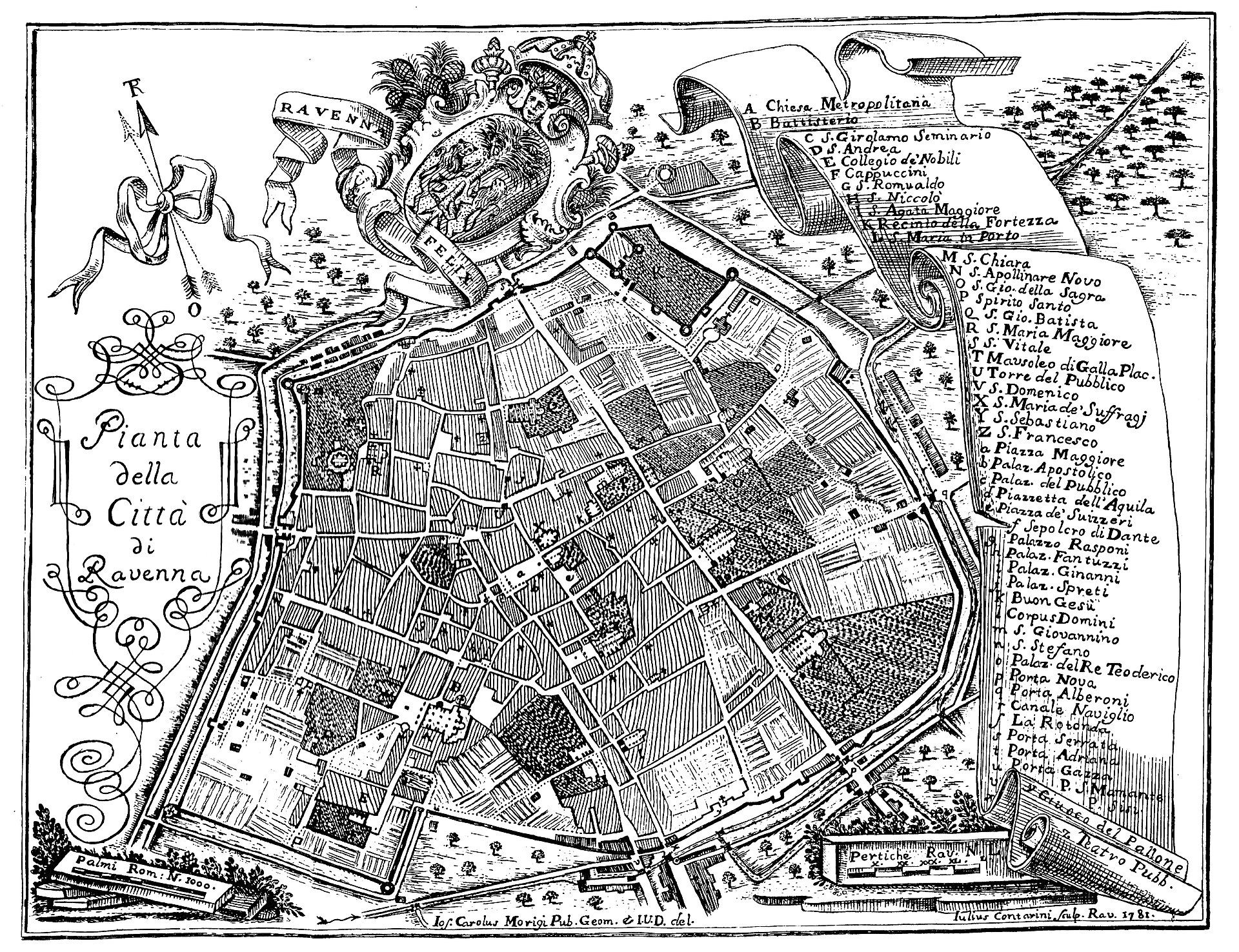
Pianta della Città di Ravenna, engraved by Giulio Contarini (1781)
Shows Ravenna's walled enceinte with bastions and gates, the street network, public squares and numbered churches listed in the marginal legend.
1781 · Giulio Contarini · Wikimedia Commons
Public domain (plate dated 1781)

More cities to explore
 ItalyBolognaExplore it in 1280 · 1575
 ItalyFlorenceExplore it in 1300 · 1490 · 1600
 ItalyRomeExplore it in AD 320 · 1300 · 1600 · 1770
 ItalyVeniceExplore it in 1200 · 1500 · 1740
Castles of Europe · Landmarks of Europe · create your own reconstruction.