Historic Cities · Italy
Florence through the ages
Florence is the capital and most populous city of the Italian region of Tuscany, and, as of 2026, with a population of 361,625, the 8th most populous city in the country. It is also the capital of the eponymous metropolitan province, which counts 988,494 inhabitants, while Eurostat estimates that 696,767 people live in the urban area of Florence.

Florence in 1300
Dante's Florence
Florence in 1300 is a thriving medieval republic on the edge of architectural transformation: the new cathedral has just begun beside the ancient Baptistery, Palazzo della Signoria rises as a civic palace, and a forest of private tower-houses crowns the dense roofscape. The walk moves from the hills into the gates, along the Arno with its wool workshops, through crowded markets, and past building sites where guildsmen, clerics and civic officials conduct the city’s daily business.
Low hills and fortified gates frame a compact city of warm terracotta roofs and rough stone towers; the Baptistery’s octagonal marble body gleams in green and white, while the new cathedral is an active construction site of scaffolds, piled ashlar and masons’ platforms. Palazzo della Signoria climbs in crenellated stone, narrow lanes funnel carts and foot traffic toward market squares, and the Arno’s riverbanks are lined with low timber workshops and drying cloths.
The route: 22 streets, squares and views
Fiesole Hill View → Porta San Miniato → Borgo San Frediano → Lungarno Riverside → Ponte Vecchio → Piazza Santa Trinità → Ponte alla Carraia → Via dei Calzaiuoli → Mercato Vecchio → Via Calimala → …
Step inside, 13 interiors
Fullers' Riverside Shed · Bridge Butchers' Stall · Covered Market Stall · Counting House · Mosaic Dome · Scaffolded Choir · Priors' Council Chamber · Tower Meeting Hall · Wool Guild Hall · Tower Solar Chamber · Santa Croce Nave · Dominican Choir · San Miniato Choir
Planned from the Wikipedia record: History of Florence.
Florence in 1490
Medici Florence
Florence in 1490 is at the height of Medici patronage and civic ambition: Brunelleschi's dome crowns a compact city of merchants, guilds and palazzi. The walk moves from the hills into fortified gates, through markets, riverfront workshops and Medici gardens, ending on the hill above the Arno where the city's stone and terracotta roofs gather beneath the dome.
A low, compact skyline of rusticated palazzi, church towers and the broad hemispherical dome of Santa Maria del Fiore dominates the city; walls and gates ring the dense medieval streets. Buildings are warm ashlar and pale plaster, roofs of red terracotta, narrow alleys opening to busy squares. The Arno cuts a reflective band across the town, its bridges crowded with timbered shops and goldsmiths' signs.
The route: 23 streets, squares and views
Fiesole Overlook → Porta San Gallo → Convent of San Marco → Palazzo Medici → Medici Garden → Bottega of Botticelli → Piazza di San Lorenzo → Mercato Vecchio → Piazza della Signoria → Loggia della Signoria → …
Step inside, 14 interiors
Convent Scriptorium · Medici Courtyard · Medici Private Studiolo · Lorenzo's Sculpture Casino · Botticelli's Workshop · Old Sacristy (Sagrestia Vecchia) · Covered Market Hall · Council Hall of Palazzo Vecchio · Drum Gallery of the Dome · Mosaic Vault of the Baptistery · Upper Bell Chamber · Goldsmith's Shop on the Bridge · Riverside Forge · Sassetti Chapel
Planned from the Wikipedia record: Republic of Florence.
Florence in 1600
Grand-ducal Florence
Firenze in 1600 is the grand-ducal capital of Tuscany: a compact city of guilds, princely palaces and showy collections owned by the Medici. The walk moves from the surrounding hills into the market stalls, civic piazze and riverfront, across the Vasari corridor to the Pitti gardens and the sculptured terraces where courtly display and learned curiosity meet.
The skyline is ruled by Brunelleschi’s red-tiled dome and the crenellated tower of Palazzo Vecchio rising above low, ochre and terracotta roofs. Streets are narrow and paved with worn stone; façades alternate warm plaster and grey pietra serena detailing. The Arno cuts a soft ribbon through the city, spanned by compact stone bridges crowded with shops. Public space concentrates in open marble-dressed piazze dotted with loggias, statuary and merchants’ stalls.
The route: 22 streets, squares and views
Fiesole Panorama → Porta San Gallo → Via San Gallo → Piazza Santa Maria Novella → Mercato Vecchio → Piazza del Duomo → Campanile di Giotto → Via dei Calzaiuoli → Piazza della Signoria → Loggia dei Lanzi → …
Step inside, 13 interiors
Cloth Market Hall · Nave of Santa Maria del Fiore · Bell Chamber of Giotto's Campanile · Hall of the Five Hundred · Arcade of Civic Statues · Octagonal Tribuna · Vasari Elevated Gallery · Covered Goldsmiths' Shops · Grand Ducal Audience Chamber · Buontalenti Grotto Interior · Nave of Santo Spirito · Cortile of Palazzo Strozzi · Choir of San Miniato al Monte
Planned from the Wikipedia record: History of Florence.
Its story
The story of Florence.
The Ford Below Fiesole and Roman Florentia
The plain on which Florence sits stayed marshy until it was reclaimed in the eighteenth century. A settlement is thought to have stood at the confluence of the Mugnone with the Arno between the tenth and eighth centuries BC, and between the seventh and sixth centuries Etruscans found and used the ford there, probably bridging or ferrying it near where the Ponte Vecchio now stands. They built for defence six kilometres away, on the hill that became the fortified centre of Vipsul, today's Fiesole.
Written history conventionally begins in 59 BC, when the Romans founded a settlement for army veterans and, by report, dedicated it to Mars; some historians argue an earlier urban centre existed and was destroyed by Sulla. The name was first Fluentia, for the position between two rivers, and later Florentia. The town sat on the Via Cassia, the main route between Rome and the north, holding the mouth of the Apennine valley of the Arno and the head of the plain running seaward towards Pisa; ports on the Arno and the Mugnone carried trade downriver, a bridge was thrown over the Arno in AD 123, and a forum, baths, aqueduct, theatre and amphitheatre grew around the military camp. In AD 285 Diocletian established at Florence a commander answerable for the whole of Tuscia. Eastern merchants, some in the Oltrarno quarter, brought the cult of Isis and later Christianity.
Ostrogoths, Byzantines and the Move from Lucca, c.300–1128
The city was a bishop's seat from around the beginning of the fourth century, then spent generations being taken and retaken as Byzantine and Ostrogothic powers fought over it. By the end of that unstable period, in the sixth century, the population is speculated to have fallen as low as a thousand. Peace came with Lombard rule in the sixth century; Charlemagne conquered the city in 774 and it became part of the March of Tuscany, whose capital was Lucca. Commerce recovered and the population began to grow again. In 854 Florence and Fiesole were joined in one county.
Around 1000 Margrave Hugh the Great of Tuscany chose to reside at Florence rather than Lucca, and building followed: work began on the Basilica di San Miniato al Monte in 1013, and the baptistery's exterior was reworked in Romanesque style between 1059 and 1128.
The Commune, the Florin and the Exile of Dante
From 1115 the city was governed by an autonomous commune. Its working asset was the Arno, which powered and watered industry, chiefly textiles, and gave access to the Mediterranean for long-distance trade. Florentine merchant bankers won a European reputation by carrying innovations such as bills of exchange and double-entry bookkeeping into the medieval fairs. The gold fiorino d'oro, the florin, was struck from 1252; it is described as the first European gold coin minted in quantities large enough to matter commercially since the seventh century, and it displaced silver bars reckoned in multiples of the mark as the dominant trade coin of western Europe. Florentine banks kept branches across the continent, men such as the chronicler Giovanni Villani of the Peruzzi company trading as far as Bruges. The period saw the eclipse of Pisa, beaten by Genoa in 1284 and subjugated by Florence in 1406. In 1293 an anti-aristocratic movement led by Giano della Bella carried the Ordinances of Justice, shifting power from the nobility to the mercantile elite and the organised guilds, whose hold lasted to the end of the Republic.
Prosperity did not buy quiet. The murder of Buondelmonte del Buondelmonti, who had reneged on an agreement to marry a daughter of the Amidei, opened a thirteenth-century war between Ghibellines, who backed the German emperor, and pro-papal Guelphs. By 1257 the city was under a podestà, the Guelph Luca Grimaldi. The victorious Guelphs then split into White and Black factions behind Vieri de' Cerchi and Corso Donati, and the quarrel ended in the exile of the Whites, among them the poet Dante Alighieri. Dino Compagni, a White Guelph, set it down in his Chronicles of Florence; Giovanni Villani, moved by the Roman jubilee of 1300, began the year-by-year Nuova Cronica of his own city, continued by his brother and nephew after the Black Death killed him in 1348.
Wool, the Ciompi and the Medici Ascendancy, 1325–1494
The city lived on manufacturing, above all luxury textiles, and on trade and banking, with family firms at Bruges, Geneva, replaced by Lyon after 1460, and Constantinople. Florentine money financed industry from Britain to Hungary; its bankers lent to the English kings during the Hundred Years' War and to the papacy, funding its provisional capital at Avignon and, after the return to Rome, the rebuilding there. The wealth was not spread: the richest tenth of the population held 68 per cent of it and the poorest three-fifths just 5 per cent, and in 1338 some 17,000 people were beggars. About 25,000 depended on the wool industry. Plague struck at mid-century, accounts give 1348 and 1349, and cut the population by more than half; estimates of the figure it fell from range from 80,000 to as much as 120,000 at the peak around 1325, with perhaps 300,000 more in the countryside.
The wool workers moved twice. An attempted strike by the ciompi, the carders and combers, failed in 1345; in 1378 they rose against oligarchic rule in the brief Revolt of the Ciompi. After their suppression the city fell under the Albizzi family between 1382 and 1434. Power had for generations been shared by lottery: names elected in a secret ballot went into a bag for each sesto of the city, and one was drawn from each bag every two months to form the Signoria, the scheme controlled so that no two men of the same family came up together. That ran the city until 1434, when the Medici undermined the selection with committees they could work by fear and favour; the draws continued while real power sat elsewhere, and in 1465 a movement to restore them was stopped by a commission packed with Medici supporters.
Cosimo de' Medici (1389–1464) was the first of the family to govern from behind the scenes of what in law remained a republic, his strength resting on patronage, an alliance with recent immigrants known as the gente nuova, and the family's position as bankers to the pope. His son Piero followed, then in 1469 his grandson Lorenzo, who commissioned work from Michelangelo, Leonardo da Vinci and Botticelli. Lorenzo died in 1492 and his son Piero ruled briefly: when Charles VIII of France crossed into Tuscany in 1494 on his way to claim the throne of Naples, Piero accepted humiliating terms, the Florentines drove him into exile, and the first period of Medici rule ended with a republic restored.
Savonarola, the Ten-Month Siege and the Grand Duchy, 1490–1737
Girolamo Savonarola, a Dominican, became prior of San Marco in 1490 and preached against what he saw as widespread immorality and attachment to riches, calling the Medici exile God's punishment for their decadence and pressing reforms towards more democratic rule. When he accused Pope Alexander VI of corruption he was banned from preaching in public; when he broke the ban he was excommunicated. The Florentines turned on him and arrested him, and, convicted as a heretic, he was hanged and burned in the Piazza della Signoria on 23 May 1498, his ashes scattered in the Arno. Niccolò Machiavelli was tortured and exiled by the Medici in 1513 on accusations of conspiracy sharpened by his service to the previous republican government; on a Medici commission he wrote the Florentine Histories in 1520.
The Medici returned in 1512 with Spanish and papal troops, led by the cousins Giovanni and Giulio, who became Popes Leo X and Clement VII. Florence expelled them a second time on 16 May 1527 and re-established the Republic. It was ended by the Siege of Florence of 1529–30, ten months of Spanish investment that wrecked the suburbs, ruined the export trade and stripped the citizens of their wealth. Alessandro de' Medici took the city, ruled from 1531 to 1537, and in 1532 was granted by Charles V the style Duke of Florence, the first Medici to hold it. After the Battle of Marciano in 1554 the old rival Siena was conquered, leaving only the Republic of Lucca outside Florentine rule in Tuscany. Cosimo I was raised to Grand Duke of Tuscany by Pope Pius V in 1569, and the Medici held that title until the death of Gian Gastone in 1737.
Lorraine, Napoleon and Six Years as Italy's Capital
With the Medici line extinct, Francis Stephen, Duke of Lorraine and husband of Maria Theresa of Austria, acceded in 1737 and Tuscany passed to the Austrian crown. The Habsburg-Lorraine were deposed for the House of Bourbon-Parma in 1801, and to 1807 Florence was capital of the Napoleonic client Kingdom of Etruria. The Bourbon-Parma were removed in December 1807 when Tuscany was annexed to France, and until Napoleon's fall in 1814 the city was prefecture of the French département of Arno. The Congress of Vienna restored the Habsburg-Lorraine, deposed for good in 1859 after defeat by France and Sardinia-Piedmont; Tuscany joined the Kingdom of Italy in 1861.
Florence replaced Turin as capital of the kingdom in 1865. Modernisation followed: the old market in the Piazza del Mercato Vecchio and many medieval houses were pulled down for a formal street plan, the square widened, given a triumphal arch at its west end and renamed first for Vittorio Emanuele II and then Piazza della Repubblica. The clearances were unpopular and were halted through the efforts of British and American residents; a museum nearby records what was lost. The capital moved on to Rome six years later, once the withdrawal of French troops made that city's capture possible. Across the nineteenth century Florence's population doubled to over 230,000, and in the second half of it a foreign community came to make up a quarter of the inhabitants; villas assembled by mainly English barons were bequeathed to the city.
Occupation, Flood and the Tourist City, 1943 to the Present
Florence spent a year under German occupation, from 1943 to 1944, as part of the Italian Social Republic, and the Germans ran a subcamp of the Stalag 337 prisoner-of-war camp there. Allied bombers struck the centre on 25 September 1943, destroying many buildings and killing 215 civilians. As the British 8th Army closed in, Hitler declared it an open city on 3 July 1944, which under the Hague Convention barred further shelling and bombing. On 4 August the retreating Germans blew the bridges over the Arno linking the Oltrarno to the rest of the city, to slow the crossing. Gerhard Wolf, the officer in charge of the demolitions and before the war a student in Florence, ordered the Ponte Vecchio spared; the streets immediately south of it, including part of the Corridoio Vasariano, were mined instead. At four that morning an armoured patrol of the South African Imperial Light Horse and Kimberley Regiments found the bridge standing and crossed under heavy German shelling, the first Allied soldiers into the city; New Zealand, South African and British troops liberated it that day alongside partisans of the Tuscan Committee of National Liberation.
On 4 November 1966 the Arno flooded the city centre, killing at least forty people and damaging millions of art works and rare books. The authorities knew the flood was coming and gave no warning beyond a telephone call to the jewellers on the Ponte Vecchio. Volunteers came from around the world to salvage books and paintings, and the recovery drove new methods of conservation; forty years on, work was still awaiting restoration. On 28 May 1993 a car bomb in the via dei Georgofili behind the Uffizi killed five people and seriously damaged the Torre dei Pulci, the gallery and part of its collection; the attack has been attributed to the Mafia.
Florence is the capital of Tuscany and of its metropolitan city, with a population of 361,625 as of 2026 in a metropolitan province of 988,494; UNESCO declared the historic centre a World Heritage Site in 1982. Tourism is now by far the largest industry, worth some €2.5 billion in 2015, most of the economy turning on international arrivals and foreign students. As of 2025 immigrants made up 18.9 per cent of the population, the five largest countries of birth being Peru, Albania, Romania, China and the Philippines.
From the archive
Florence on paper: the old town as it was mapped.
A period plan or bird's-eye view of the old town, drawn between 1500 and 1850, the streets this page's reconstructions walk. Public domain, with its source named.
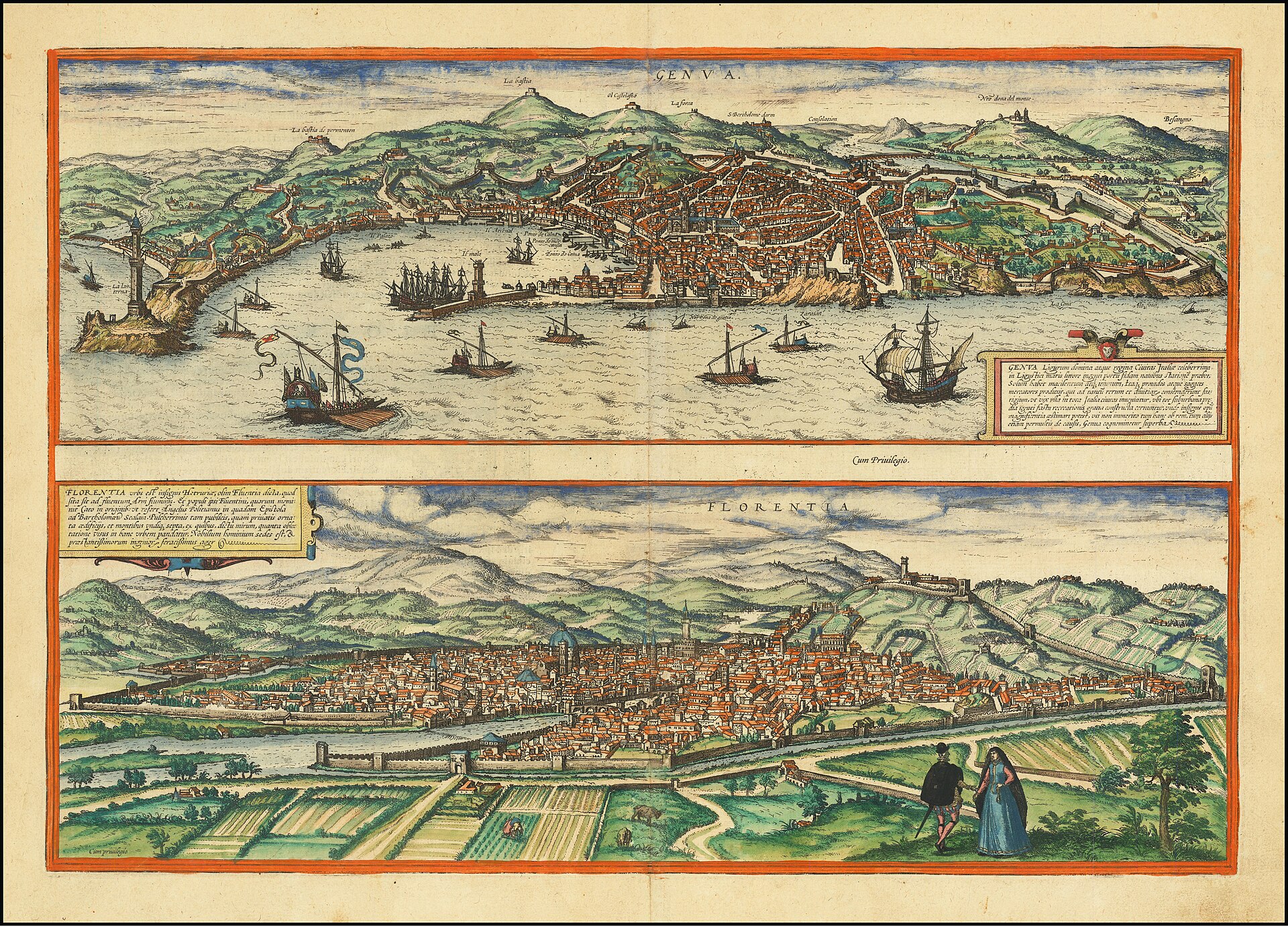
Bird's-eye view of Florence, from Braun & Hogenberg's Civitates Orbis Terrarum
Shows Florence's walled medieval centre with the Arno River, bridges, the cathedral dome (Duomo), city walls and gates, and dense street blocks.
1572 · Georg Braun / Frans Hogenberg · Wikimedia Commons
Public domain (plate dated 1572)
In this city
Landmarks of Florence, see each in its prime


More cities to explore
 ItalySan GimignanoExplore it in 1300 · 1900
 ItalySienaExplore it in 1340 · 1750
 ItalyRomeExplore it in AD 320 · 1300 · 1600 · 1770
 ItalyVeniceExplore it in 1200 · 1500 · 1740
Castles of Europe · Landmarks of Europe · create your own reconstruction.