Historic Cities · Italy
Siena through the ages
Siena is a city in the region of Tuscany in central Italy, and the capital of the province of Siena. With a population of 53,180, it is the 12th-largest city in the region.

Siena in 1340
Siena of the Nine
Siena in 1340 is the commune of the Nine at the height of its power, rich from wool, salt and moneylending and erecting great civic works. The walk moves from the city's approaches through its gates and banking streets to the shell of the Campo, the rising Torre del Mangia, the striped cathedral and the scaffolds and trenches of the vast Duomo Nuovo.
Low hilltops and a dense ring of stone walls enclose a city of terracotta roofs, red brick piazzas and sharp bands of black-and-white marble at the cathedral. The Palazzo Pubblico's ochre brick faces the shell-shaped Campo paved in nine segments; beside it a tall masonry tower climbs in newwork. Narrow lanes of worn stone open to small plazas and fountains; wooden scaffold, canvas awnings and wool bales punctuate the streets, while pilgrims and clerks move beneath the same clear Tuscan light.
The route: 22 streets, squares and views
Approach from Val d'Arbia → Porta Camollia → Via Banchi di Sopra → Palazzo Tolomei → Piazza del Campo → Market at the Campo → Palazzo Pubblico Front → Torre del Mangia → Via di Città → Via Banchi di Sotto → …
Step inside, 13 interiors
Banker's Counting Room · Notary's Office · Tolomei Great Hall · Loggia of Wool Sellers · Sala dei Nove · Bell Chamber · Wool Merchant's Workshop · Franciscan Chapter House · Inlaid Marble Pavement · Pisano Pulpit · Pilgrim Ward · Hospital Apothecary · Fontebranda Vault
Planned from the Wikipedia record: Republic of Siena.
Siena in 1750
Palio Siena
Siena in 1750 is a tightly held medieval city that stages its civic life as festival: the Palio is the city's public drama, its streets, flags and rival wards made visible by the race. This walk moves from the clay hills that surround Siena, through its gates and winding lanes, into the shell of Piazza del Campo and up to the fortress ramparts that look over the crete.
The skyline is a tight cluster of red-brown tile roofs and crenellated brick palaces interrupted by the white-and-green bands of the Duomo and the tall brick shaft of the Torre del Mangia. Streets are narrow, paved with worn stone and pierced by small piazzette; façades are brick and local creta stone, painted shutters and contrada banners. On Palio days the Campo is covered with a thick ring of earth, drums and flag-wavers fill the lanes, and the surrounding hills show olive groves, vineyards and the pale clay of the Val d'Arbia.
The route: 22 streets, squares and views
Crete Senesi Approach → Porta Romana → Fontebranda → Piazza San Domenico → Via Banchi di Sotto → Piazza Tolomei → Via di Città → Piazza del Campo (South) → Fonte Gaia → Palazzo Pubblico → …
Step inside, 14 interiors
Porta Romana Inn · Tanners' Vault at Fontebranda · Chapel of Saint Catherine · Contrada Oratory · Sala del Consiglio · Bellringers' Chamber · Contrada Feast Hall · Covered Market Hall · Monte Counting House · Piccolomini Library · Cathedral Nave · Baptistery Octagonal Hall · Hall of Pellegrini · Fortress Barracks
Planned from the Wikipedia record: Palio di Siena.
Its story
The story of Siena.
The Etruscan Saina and the Colony of Saena Iulia
Siena was first settled in the time of the Etruscans, roughly 900 to 400 BC, by a tribe called the Saina, and Etruscan-period sites have been found inside the historic centre. A Roman town named Saena Iulia was founded on the site in the time of the emperor Augustus. The name has been traced variously to the Etruscan family name Saina or Seina, attested epigraphically at Montalcino, Chiusi and Perugia, to the Roman family name Saenii, or to the Latin senex, meaning old.
Local legend gives a different founding. Senius and Aschius, sons of Remus, are said to have fled Rome after their father's murder by Romulus, carrying off the statue of the she-wolf suckling the infants and so taking that emblem for their town. They are supposed to have ridden one white horse and one black, from which the balzana, Siena's shield of white above black, is held to derive.
The first known document of the Sienese community dates to AD 70, when the Roman senator Manlio Patruito reported to Rome that he had been ridiculed with a mock funeral during an official visit to Saena Iulia, then a small military colony in Tuscia; the Senate punished the chief culprits and called the Sienese severely to greater respect for Roman authority. At the end of the third century the city was Christianised by Sant'Ansano, whom the Roman authorities governing Siena put to the ordeal of fire and boiling oil, then imprisoned and beheaded. He was named patron saint during the Middle Ages, and the day of his liturgical anniversary came to mark the opening of the Contrada Year.
Bishops, Counts and the Road to Rome, 773-1200
Almost nothing survives to illuminate civil life in Siena in the early Middle Ages apart from the affairs of its bishopric, which quarrelled for generations with the bishop of Arezzo over where the boundary between their jurisdictions ran. The Lombard king Liutprand intervened and gave judgment for Arezzo; the Sienese were not satisfied, and in 773, when Italy passed from Lombard to Frankish rule, they obtained the annulment of his sentence. Under the Lombards the city seems to have been governed by a gastaldo, a representative of the king, replaced by an imperial count after the coronation of Charlemagne; the first count of whom anything concrete is known was Winigi, son of Ranieri, in 867. After 900 the emperor Louis III held Siena, but by 903 the chronicles record the counts back in power under Berengar.
What made the town matter was the road. By the tenth century Siena stood at the centre of important trade routes running to Rome and grew on that traffic into a town of consequence, the Via Francigena passing through it supporting a long line of inns and lodging houses. In the twelfth century the city gave itself consular ordinances, began to extend its territory and made its first alliances. The ground for that had been cleared by the collapse of feudal power: on the death of Countess Matilda in 1115 the border territory of the March of Tuscany, held by her family the Canossa, broke into several autonomous regions, and from that came the Republic of Siena. Ambition in northern Tuscany set the new republic against Florence, and the two were seldom at peace thereafter.
Wool, Bankers and the Government of the Nine, 1100-1348
From the first half of the twelfth century onward Siena prospered as a commercial centre on good terms with the Papal States: Sienese bankers were the reference point for the authorities in Rome, who turned to them for loans and financing. The city's wool industry was renowned throughout Europe, its position on the major trade routes let it build networks reaching across the continent, and a well-developed banking system and a strong guild structure regulated the trades and professions. Government ran through councils and magistrates dominated by powerful noble families competing for influence, and, like that of other Italian city-states of the period, was prone to factionalism and civil unrest. The Studium Senese, later the University of Siena, was founded in 1240 and is reckoned among the oldest universities in continuous operation.
Siena supported the Ghibelline cause, though the city had Guelph families of its own who looked to Florence, and in 1260 it beat the Guelph Tuscans at Montaperti, a victory Dante Alighieri recorded. Nine years later the Sienese had the worse of it at Colle di Val d'Elsa, and in 1287 the Guelph Government of the Nine came to power. Under the Nine the city reached its greatest splendour, economic and cultural alike. The commune commissioned Duccio's Maestà in 1308, a work instrumental in turning Italian painting away from the hieratic forms of Byzantine art; in the 1330s Ambrogio Lorenzetti painted the Allegory and Effects of Good and Bad Government in the Sala dei Nove, the council chamber itself.
Before the Black Death of 1348 the city held some 50,000 people. The plague killed approximately half of them, and construction and the economy broke together. A proposed expansion of the cathedral's eastern transept, which would have made the church a basilica on a new east-west nave, was cut short for want of funds after war and plague. Two walls of that unbuilt transept still stand.
The Siege and the Fall of the Republic, 1547-1559
The decline that followed 1348 was slow, and it did not close off Sienese territorial expansion: to the day the Republic fell its lands took in about a third of Tuscany. The rivalry with Florence intensified through the fourteenth and fifteenth centuries and was eventually absorbed into the Italian Wars. From 1547 to 1552 the Spanish-installed governor of Siena was Diego Hurtado de Mendoza, until a Sienese revolt ousted him and re-established the Republic.
In the Italian War of 1551-1559 the republic was defeated by Florence in alliance with the Spanish crown. The city held out a long time - the accounts speak of eighteen months of resistance, and of a siege of more than a year that ended with the population exhausted by hunger - and surrendered in April 1555. Charles V afterwards granted the Republic's territory in fief to the Medici, lords of Florence, to repay what they had spent on the war.
A few Sienese, led by the Florentine exile Piero Strozzi, refused to accept the fall and took refuge in Montalcino, where they maintained the Republic of Siena in exile and kept the French alliance alive, holding the southern part of the old territory and causing the imperial troops considerable trouble. It survived until 31 May 1559, when the French allies whom Siena had always supported concluded the Peace of Cateau-Cambrésis with Charles V and in effect ceded the Republic to the Medici.
The New State under Medici and Lorraine, 1559-1859
Under the Medici, Siena was administered as a separate country. Apart from the brief interlude of Ferdinando I, who tried to build an organised state, the grand dukes gave the Grand Duchy of Tuscany no stable structure, leaving almost unchanged the division between the so-called Old State, meaning Florence, and the New State, meaning Siena and the southern territory as far as Pitigliano, each with different laws and taxes. The Accademia dei Fisiocritici was formed in the city in 1691 by Pirro Maria Gabrielli. When Gian Gastone de' Medici died childless in 1737 the dynasty ended and the Grand Duchy passed to the Habsburg-Lorraine, who held it until 1799.
After the Napoleonic period and the risings of the Risorgimento, Siena in 1859 became the first city in Tuscany to vote in favour of annexation to the Kingdom of Italy.
The Ghetto behind the Campo, 1571-1935
Siena's Jewish community is among the oldest in Tuscany, its presence attested without interruption since the thirteenth century. From 1571 to 1859 it was compelled to live in the ghetto behind the Piazza del Campo. The quarter remains recognisable despite the demolitions of 1935. The synagogue that stands in it, a neoclassical building, is preserved and open to visitors, and the Jewish cemetery in via Certosa is the only one the community has used since its foundation.
Monte dei Paschi, the Palio and a City of 53,000
The Banca Monte dei Paschi di Siena was founded in 1472 and has operated continuously ever since, which makes it the oldest bank in the world still trading; the Palazzo Salimbeni, its original headquarters, remains in its hands. For years it paid generously and decisively for the city's sport, and its own crisis in the 2010s withdrew those subsidies: the football club founded in 1904 and later known as Robur ceased activity three times, in 2014, 2019 and 2023. In 2025 a bidding war opened for the bank itself.
The city lives on tourism, services, agriculture, handicraft and light industry, with little manufacturing inside it beyond the seasonal confectionery trade that produces panforte, ricciarelli and cavallucci at Christmas and pane co' santi for the first two days of November. The century-old Istituto Sieroterapico Achille Sclavo made vaccines under Swiss ownership as Novartis Vaccines and passed in 2015 to GlaxoSmithKline. On the land, the Sienese nobility traditionally held large farms across the province long worked by mezzadri, sharecroppers; as that institution failed and viticulture grew, the property passed in part to farming entrepreneurs of middle-class origin.
The historic centre was inscribed on the UNESCO World Heritage list in 1995, and Siena was named Italian Capital of Culture in 2015; in October 2025 it won the European Green Leaf Award for 2027. In 1966 it became the first European city to ban cars from its main square. Its population is 53,180, the twelfth-largest in Tuscany, and for thirty years people have been leaving the walled centre for the surrounding communes of Asciano, Castelnuovo Berardenga, Monteriggioni, Monteroni d'Arbia and Sovicille, which show rising populations and much younger age profiles. Immigrants made up 14.1 per cent of the population in 2025, the five largest countries of birth being Albania, Romania, Ukraine, Pakistan and Peru. The city within the walls is divided into three terzi and below them into seventeen contrade, wards originally formed as battalions for Siena's defence; ten of them run the Palio in the Piazza del Campo on 2 July and 16 August, the seven that missed the corresponding race a year earlier entering by right and three more drawn by lot from those that ran.
From the archive
Siena on paper: the old town as it was mapped.
A period plan or bird's-eye view of the old town, drawn between 1500 and 1850, the streets this page's reconstructions walk. Public domain, with its source named.
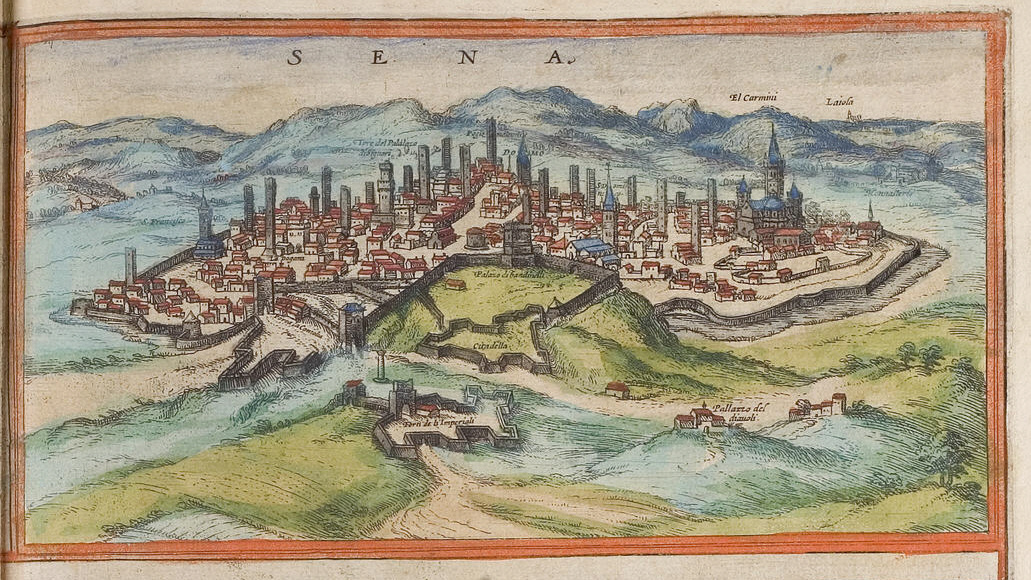
Bird's-eye view of Siena, from Braun & Hogenberg's Civitates Orbis Terrarum
Depicts Siena's encircling medieval walls and gates, numerous tower-houses and an outer citadel on the surrounding hills.
1572 · Georg Braun; Frans Hogenberg · Wikimedia Commons
Public domain (plate dated 1572)


More cities to explore
 ItalySan GimignanoExplore it in 1300 · 1900
 ItalyFlorenceExplore it in 1300 · 1490 · 1600
 ItalyRomeExplore it in AD 320 · 1300 · 1600 · 1770
 ItalyVeniceExplore it in 1200 · 1500 · 1740
Castles of Europe · Landmarks of Europe · create your own reconstruction.