Historic Cities · Italy
Rome through the ages
Rome is the capital city and most populated comune (municipality) of Italy. It is also the administrative centre of the Lazio region and of the Metropolitan City of Rome. A special comune named Roma Capitale with a population of 2.7 million in an area of 1,287.36 km2 (497.1 mi2), Rome is the third most populous city in the European Union by population within city limits.

Rome in AD 320
Imperial Rome
Rome in 320 is the imperial capital at a moment of continued public building and visible change: monumental arches and basilicas stand alongside thriving baths and crowded markets. Visitors will move from the city approaches and gates through the imperial fora, baths and theatres to end on the Capitoline height with a view across domes, vaults and the river.
The skyline is a scatter of domes, broad barrel and groin vaults, triumphal arches and rows of columned porticoes, all faced where possible with gleaming marble over brick and concrete cores. Terracotta roof tiles warm the hills; the Tiber threads dark and reflective. Streets vary from wide processional ways lined by colonnades to narrow lanes between crowded insulae, while the great baths and basilicas throw deep shadows and reveal monumental coffered vaults and carved statuary.
The route: 22 streets, squares and views
Via Appia Approach → Porta Appia → Thermae Antoninianae → Circus Maximus → Mons Palatinus → Forum Romanum → Via Sacra → Amphitheatrum Flavium → Arcus Constantini → Basilica Nova → …
Step inside, 12 interiors
Frigidarium Pool Chamber · Imperial Audience Chamber · Vestal Hearth Chamber · Cella of Antoninus and Faustina · Lower Cavea and Velarium · Coffered Central Nave · Basilica Ulpia Nave · Pantheon Rotunda · Hadrianic Mausoleum Chamber · Stage and Orchestra · Marble Caldarium · Trajanic Market Hall
Planned from the Wikipedia record: Ancient Rome.
Rome in 1300
Jubilee Rome
Rome in 1300 is the papal city suddenly swollen by Boniface VIII's first Holy Year, its basilicas overwhelmed with pilgrims and processions. Ruined temples and sunken forums sit beside fortified baronial towers, riverside quays and narrow lanes leading from the gates to the great basilicas of San Pietro and San Giovanni in Laterano.
The skyline is a serrated silhouette of medieval tower-houses, battered Roman monuments and squat church camps, all of brick, tufa and reused marble. Domes and temple drum walls rise among ochre plastered houses; the Tiber is lined with muddied quays and low boats. Streets narrow into shaded alleys, while wide ruined fora lie half-buried under grass, grazing cattle and occasional shepherds, a city both ancient and militarised, bright in sharp Mediterranean light.
The route: 23 streets, squares and views
Ponte Milvio → Porta Flaminia → Borgo → Atrium of San Pietro → Pons Aelius → Ripa Grande Quays → Forum Boarium → Theatrum Marcelli → Forum Romanum → Via Sacra → …
Step inside, 14 interiors
Santo Spirito Ward · Nave of Old St Peter · Castel Sant'Angelo Antechamber · Ripa Grande Customs Hall · Butchers' Hall · Marcellus Vomitorium Smithy · Forum Scriptorium · Aracoeli Nave · Pantheon's Rotunda · Stadium Arcade Tavern · Colonna Tower Great Chamber · Trajan Market Arcade · Colosseum Artisan Yard · Sancta Sanctorum Chapel
Planned from the Wikipedia record: History of Rome.
Rome in 1600
Baroque Rome
Rome in 1600 is a city remade by recent papal projects: obelisks lifted into piazzas, straight new thoroughfares cutting through medieval fabric, and the great dome of St Peter's asserting a renewed papal skyline. The walk moves from the city approach through market streets, taverns of the Campo Marzio where painters gather, riverside quays and the Borgo, finishing on the Janiculum with a wide view of dome and monuments.
Granite and travertine obelisks punctuate wide axial streets whose sharp lines are new additions to an otherwise ragged medieval city of brick palaces, tiled roofs and church towers. St Peter's lead-covered dome rises above low ochre houses; fountains gurgle from recently repaired aqueducts and wash market dust. Narrow alleys open occasionally onto bright piazzas filled with merchants, muleteers, clerics in black and cardinals in red.
The route: 20 streets, squares and views
Via Flaminia Approach → Porta del Popolo → Piazza del Popolo → Pincian Terrace → Via dei Condotti → Via del Corso → Piazza Colonna → Piazza della Rotonda → San Luigi dei Francesi → Campo Marzio → …
Step inside, 13 interiors
Cerasi Chapel · Medici Gallery · Doria Gallery · Chigi Reception Hall · Pantheon Rotunda · Contarelli Chapel · Sant'Agnese Oratory · Tavern Common Room · Goldsmith's Workshop · Papal Audience Hall · Santo Spirito Ward · St Peter's Nave · Basilica Nave
Planned from the Wikipedia record: Roman Baroque.
Rome in 1770
Grand Tour Rome
This is Rome at the height of the Grand Tour era, where freshly completed Baroque works sit beside half-buried antiquities and an international stream of sketching tourists moves through the city. The walk passes gates and piazzas, excavated forums and river quays, artists and milords sketching among columns, the new Trevi Fountain, the Spanish Steps' models and the goats grazing on the Palatine.
Stone and brick predominate: warm ochres, pale stuccoes and red-brown roof tiles against the grey lead of St Peter’s dome. Narrow, shadowed lanes spill into broad piazzas with travertine steps and fountains; the Tiber runs a muddied ribbon with timber quays. Scale shifts rapidly, intimate shopfronts and artists’ studios give way to monumental ruins and church domes; carts, mules and foot traffic fill streets under a clear, strong Mediterranean light.
The route: 24 streets, squares and views
Monte Mario View → Porta del Popolo → Piazza del Popolo → Via dei Condotti → Spanish Steps → Fontana di Trevi → Via delle Muratte → Via del Corso → Piazza Colonna → Piazza Venezia → …
Step inside, 15 interiors
Pio-Clementino Gallery · Cerasi Chapel · Caffè degli Inglesi Room · Trinità dei Monti Nave · Sculptor's Studio of Casts · Doria Pamphilj Ballroom · Palazzo Venezia Hall · Santi Cosma e Damiano Interior · Domitian's Audience Hall · Colosseum Vaults and Arches · Pantheon Rotunda · Sant'Agnese Nave · Farnese Gallery Salon · Santa Maria Mosaics Nave · Galleria Borghese Sculpture Room
Planned from the Wikipedia record: Grand Tour.
Its story
The story of Rome.
The Ford at the Tiber Bend
Rome grew from pastoral settlements on the Palatine and the hills around it, about 30 kilometres from the Tyrrhenian Sea on the south bank of the Tiber, where the river makes a Z-shaped curve containing an island and could be forded. That put the site on the crossing of two routes: the traffic following the river valley, and the traders moving north and south along the west of the peninsula. Archaeology has confirmed two fortified settlements here in the 8th century BC, Rumi on the Palatine and Titientes on the Quirinal. Rome was unusually large for Latium: most of the larger Early Iron Age Latial towns covered 50 to 80 hectares, and Rome had reached about 200.
The traditional founding date, 21 April 753 BC, follows the reckoning of Varro; excavations in 2014 uncovered a wall built well before that year, with 9th-century BC walling and 8th-century BC pottery. The name itself was long credited to the legendary Romulus, said to have killed his twin Remus in a dispute over the founding, to have declared the new town an asylum open to criminals, runaway slaves and free men alike, and to have secured wives for its citizens by abducting Sabine women.
Kings, Republic and the Long Conquest, 753–31 BC
Roman tradition counted seven kings between 753 and 509 BC, the last three Etruscan or partly so, and credited Etruscan engineers with the Pons Sublicius, which replaced the ford. The traditional chronology allots those reigns 243 years, an average of nearly 35 apiece, which modern scholarship has generally discounted; no contemporary records survive, because the Gauls destroyed much of Rome's archive when they sacked the city after the Battle of the Allia, dated 390 BC in the received tradition and 387/386 by Polybius.
The monarchy was abandoned around 500 BC for a republic of an aristocratic Senate, popular assemblies and annually elected magistrates, its internal history turning on the Conflict of the Orders, the plebeians' struggle for equality with the patricians, which won them the office of tribune from 494 BC. By 290 BC Rome held more than half the Italian peninsula, and the Punic Wars of 264–146 BC made it the capital of an overseas empire. Conquest reshaped the city itself, as farmers driven off their land by the great slave-worked latifundia flocked in from the 2nd century BC. The old constitution could not manage what empire produced: Sulla's dictatorship, Caesar's crossing of the Rubicon in 49 BC and his assassination in 44 BC, and the defeat of Mark Antony by Octavian at Actium in 31 BC followed in turn.
A Capital Fed by Other People's Provinces, 27 BC–AD 380
Imperial Rome was the largest city in the world; estimates of its peak population range from 450,000 to over 3.5 million, with one to two million the figures most historians favour. It could not feed itself. Roughly 15 to 25 per cent of its grain supply was paid for by the central government, commerce and industry counted for less here than in cities such as Alexandria, and the population lived on goods drawn from the rest of the empire and paid for out of taxation. Augustus is said to have remarked that he found Rome a city of brick and left it a city of marble. In AD 64, under Nero, the Great Fire destroyed much of the city and was in many ways treated as an opportunity for rebuilding.
The population fell away after its 2nd-century peak; the Antonine Plague was killing 2,000 people a day at the end of Marcus Aurelius's reign, and when Aurelian closed a wall of nearly 20 kilometres' perimeter around the capital in 273 the city held around 500,000. Rome remained formally the capital, but emperors spent less and less time in it: Diocletian's reforms stripped it of its administrative role, later western emperors ruled from Milan, Ravenna or cities in Gaul, and in 330 Constantine established a second capital at Constantinople. Christianity, persecuted locally rather than by general law until Diocletian's persecution of 303 to 311, was tolerated by the Edict of Milan in 313 and established as the religion of the empire by Theodosius I in 380, by the Edict of Thessalonica, which also stated the Bishop of Rome to be the senior religious figure in the Western Empire.
When the Grain Stopped: Sacks, Gothic Wars and a City of 30,000, 410–653
The walls did not prevent the city being sacked by Alaric on 24 August 410, by Geiseric on 2 June 455, and by the unpaid Roman troops of the general Ricimer in 472. The sack of 410 was the first time in almost 800 years that Rome had fallen to an enemy, and Jerome, then in Bethlehem, wrote that "The City which had taken the whole world was itself taken." What broke the city was food: the Vandal capture of Africa Proconsularis ended the grain shipments from the mid-5th century, and its people left. Estimates vary, but the fall is not in doubt: from 750,000–800,000 in AD 400 to perhaps 80,000–100,000 by 500.
The Gothic Wars finished the collapse. Belisarius took the city for Justinian on 9 December 536 and held it through a year-long siege; Totila's Ostrogoths recaptured and sacked it on 17 December 546 and took it again in 549, and Narses secured it for good in 552. The fighting left Rome near-abandoned, its drainage neglected, the low ground turned to marsh where malaria took hold and every aqueduct but one unrepaired; the population shrank to under 50,000, and by the end of the 6th century to around 30,000. Romans stripped stone and marble from closed temples and burned statues for lime, and churches were built from the spoil or made out of the temples themselves, as the Pantheon became the church of All Martyrs.
What was left was governed in practice by the pope, and pilgrims made the city a magnet again; the population may have recovered to 90,000 in the 7th century, when eleven of the thirteen popes between 678 and 752 were of Greek or Syrian descent. Relations with Constantinople were not therefore easy: Pope Martin I was deported there in 653, tried and exiled to the Crimea, where he died.
The Popes' City: Papal States, Commune and Avignon, 727–1418
The break with Constantinople came over iconoclasm: Gregory II refused the decrees of Leo III in 727, and when Gregory III called a council in St Peter's in 731 to excommunicate the iconoclasts, the emperor confiscated the great papal estates in Sicily and Calabria. Needing another protector, Gregory III appealed to Charles Martel in 739, and after the Lombard king Aistulf ended the Exarchate of Ravenna, Stephen II went to France in 754 to name Pippin the Younger protector of Rome. Aistulf besieged Rome for 56 days in 756; when Pippin handed over the promised territories, the Papal States came into being. On 25 December 800 Leo III crowned Charlemagne emperor in St Peter's, severing Rome's loyalty to Constantinople. What followed were centuries of feudal anarchy with the papacy as the prize of the noble families; in 897 a crowd exhumed the corpse of Pope Formosus and put it on trial.
Rome now lived on the church and the pilgrims it drew; even at 30,000 people it was a city of consumers dependent on a governmental bureaucracy. In 1143, led by Giordano Pierleoni and preached at by Arnaldo da Brescia, the Romans rebelled against the aristocracy and church rule and revived the Senate as the Commune of Rome; the revolt was put down in 1155, and the communal government was recognised by Clement III in 1188, the 56 senators becoming papal vassals. Rome never became a stable independent commune like Florence or Siena; the endless feuds of the Savelli, Orsini, Colonna and Annibaldi always deprived it of the chance.
Boniface VIII launched the first Jubilee in 1300, which filled the city with paying pilgrims, and founded the first University of Rome in 1303. After his humiliation at Anagni his successor Clement V never entered the city, and for more than seventy years the popes stayed at Avignon. Without their revenues Rome decayed, its population dropping below 20,000, with no major building for over a century and churches falling into ruin, the very lack of construction that left so much ancient fabric standing. Cola di Rienzo's seizure of the Capitoline in 1347, under the title of tribune, ended with his flight that December and his killing in a riot in 1354. Gregory XI restored the Holy See to Rome on 17 January 1377, and his successor's conduct set off the Western Schism, unsettled until the election of Martin V.
Renaissance Building, the Sack of 1527 and the Counter-Reformation City
From the election of Nicholas V in 1447 the seat of the Italian Renaissance moved from Florence to Rome, as the papacy set out to surpass the grandeur of the other Italian cities: a new St Peter's, the Sistine Chapel, Ponte Sisto (the first bridge built across the Tiber since antiquity), and Piazza Navona, with Michelangelo, Raphael and Botticelli working for the popes, and Tuscan bankers such as Agostino Chigi among the city's patrons of the arts. In 1527 the imperial troops of Charles V sacked the city: about 1,000 defenders were executed before the pillage began, citizens were killed or fled beyond the walls, only 42 of the 189 Swiss Guards on duty survived, and Clement VII was held for months in Castel Sant'Angelo.
Paul IV, elected in 1555, ordered a central area around the Porticus Octaviae to be delimited as the Roman Ghetto, into which the city's Jews (a community present in Rome since the 1st century BC and formerly based in Trastevere) were forced to live in seclusion. They had to remain in the rione Sant'Angelo and were locked in at night, and the pope decreed that they wear a distinguishing sign: yellow hats for men, veils or shawls for women. Jewish ghettos existed in Europe for the next 315 years. Under Pius V the Inquisition's power in the city was reasserted and its palace rebuilt with more space for prisons. Sixtus V, pope from 1585 to 1590, restored ancient aqueducts, built the Acquedotto Felice and drove wide new streets through the city to give pilgrims better access to the major basilicas.
Napoleon, the Breach at Porta Pia and the Capital of the Republic
Papal rule was interrupted by the Roman Republic of 1798–99, by Napoleon's annexation of the city to the French Empire from 1809 to 1814, and by a second Roman Republic in 1849 that counted Mazzini and Garibaldi among its defenders and fell when French troops brought Pius IX back. French protection was withdrawn on the outbreak of the Franco-Prussian War, and on 20 September 1870 the Italian army under General Raffaele Cadorna entered Rome through a breach at Porta Pia after a three-hour cannonade. A plebiscite on 2 October returned 133,681 votes for annexation against 1,507, and Rome became the capital of united Italy on 1 July 1871. Pius IX, refusing the offer of the Leonine City as a remnant state, called himself the prisoner of the Vatican, and the dispute was not settled until the Lateran Treaty of 11 February 1929 created the Vatican City State.
The city the kingdom inherited held about 212,000 people, all living inside the ancient walls; it reached 660,000 by 1920 and passed a million in the early 1930s. Mussolini, who marched on the city in 1922, demolished large parts of the centre for wide avenues meant to glorify the regime: the Via dei Fori Imperiali, and the Via della Conciliazione in front of the Vatican, which destroyed much of the old Borgo. On 19 July 1943 Allied bombing of the San Lorenzo district killed about 3,000 people and injured 11,000, of whom a further 1,500 died. Mussolini was arrested on 25 July. The Germans declared Rome an open city on 14 August 1943, a day after the last Allied raid, and occupied it after the armistice of 8 September; bombing continued into 1944, and Rome was liberated on 4 June that year, the first Axis capital to fall to the Allies.
Rome grew fast again after the war as one of the drivers of the Italian economic miracle, and the Cinecittà studios gave the years of la dolce vita their films. The commune passed 2.8 million residents by the mid-1980s before people began moving to the suburbs. Rome is the capital of the Italian Republic and the seat of its president, government, parliament and high courts, a special comune of some 2.7 million people, with about 4.2 million in the metropolitan city. Its historic centre is a UNESCO World Heritage Site.
From the archive
Rome on paper: the old town as it was mapped.
A period plan or bird's-eye view of the old town, drawn between 1500 and 1850, the streets this page's reconstructions walk. Public domain, with its source named.
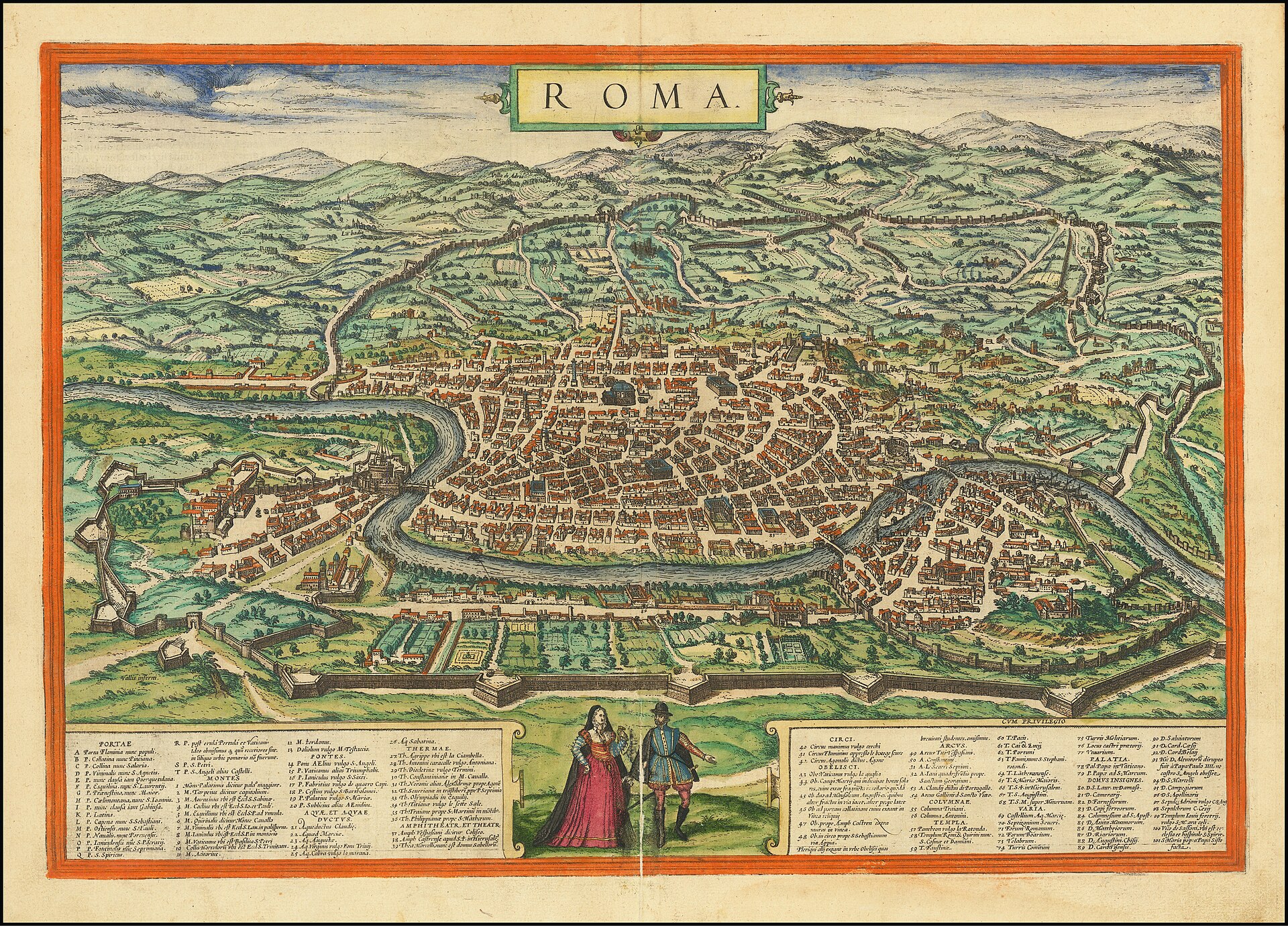
Bird's-eye view of Rome, from Braun & Hogenberg's Civitates Orbis Terrarum
Shows the Tiber winding through the city, enclosing the historic core, surrounding walls and bastions, gates, and numerous churches and public blocks with an accompanying key.
1572 · Georg Braun / Frans Hogenberg · Wikimedia Commons
Public domain (plate dated 1572)
In this city
Landmarks of Rome, see each in its prime


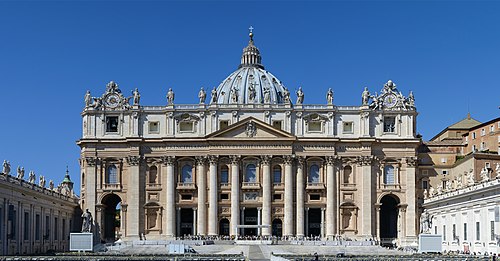


Castles of Rome

More cities to explore
 ItalyPerugiaExplore it in 1500
 ItalySienaExplore it in 1340 · 1750
 ItalyVeniceExplore it in 1200 · 1500 · 1740
 ItalyFlorenceExplore it in 1300 · 1490 · 1600
Castles of Europe · Landmarks of Europe · create your own reconstruction.