Basilica · Vatican City · Still standing
St. Peter's Basilica
Basilica di San Pietro
St. Peter's Basilica is the Papal Basilica in Vatican City, a large Renaissance church that forms the principal liturgical site of the papacy and the most prominent building in the Vatican. Constructed in stages from 1506 and completed in 1626, it is dominated by a vast central dome and a monumental façade facing St. Peter's Square. The interior contains numerous chapels, papal tombs and major artworks including Michelangelo's Pietà and Bernini's baldachin.
First raised
1506
Its prime
1667
Today
Still standing
As it stood in 1667
What St. Peter's Basilica looked like in its prime.
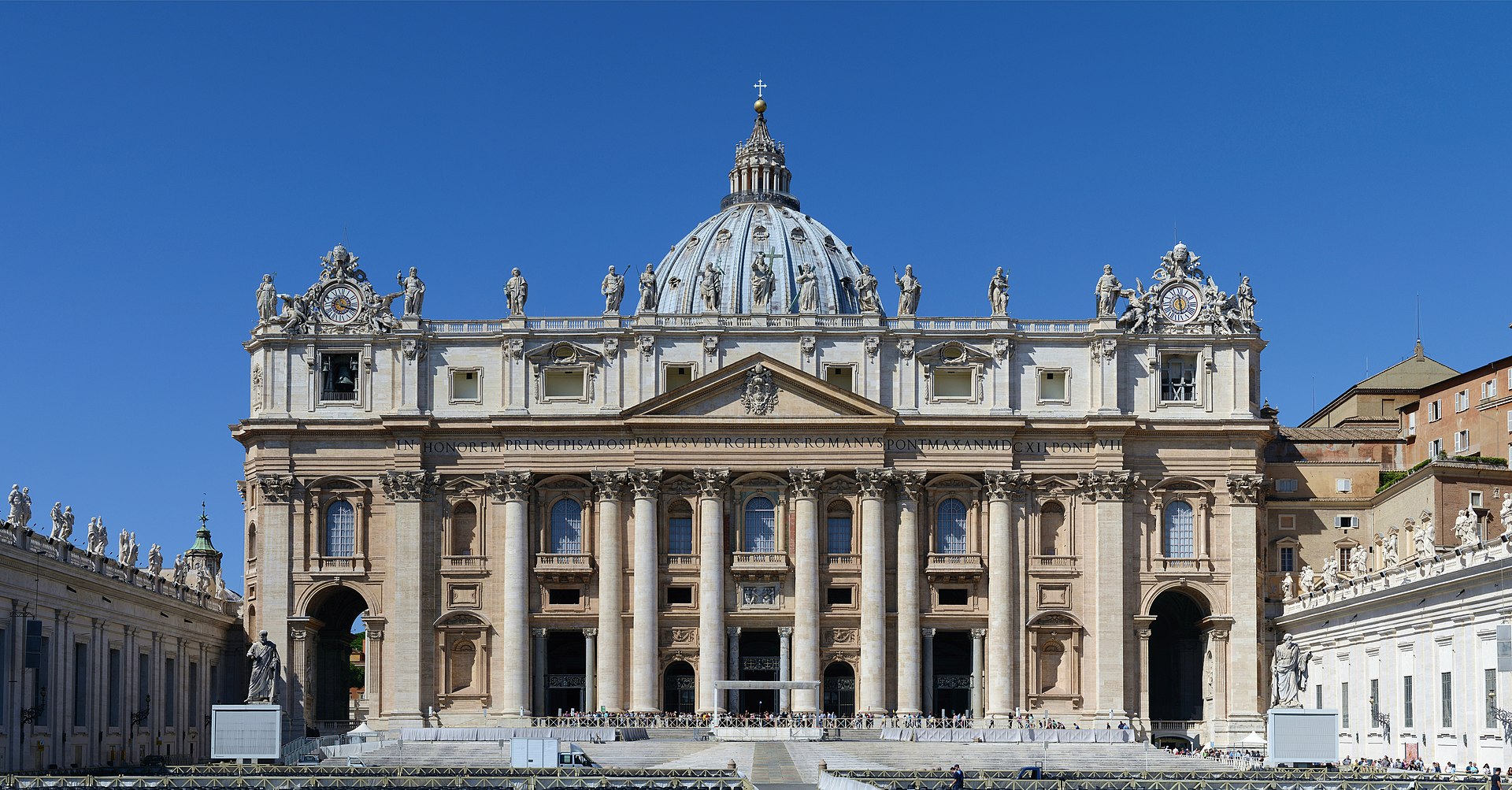
A massive travertine and marble façade with a giant order of paired Corinthian columns, a wide flight of steps and a triangular pediment beneath a monumental coffered dome; the roofline and balustrade are lined with life-size statues, twin clock faces sit near the corners, and expansive colonnades and an ancient obelisk frame the forecourt. Inside, vast marble floors, gilded capitals, sculpted altars, a central bronze baldachin and a soaring cofferdome dominate the scale and colour palette.
Its story
The story of St. Peter's Basilica.
Constantine's Basilica over Peter's Grave, 319–846
Catholic tradition holds that Peter, chief among Jesus's apostles, was martyred in Rome under Nero and buried on the Mons Vaticanus, where a shrine was raised some years later. Over it the emperor Constantine the Great began a basilica between 319 and 333, which held the burials and memorials of most popes from Peter to the fifteenth century. The tomb itself was smashed in 846.
Nicholas V, Julius II and the Indulgence Scandal, 1447–1510
Neglected during the Avignon Papacy, the old church had fallen into disrepair by the end of the fifteenth century. Nicholas V (1447–1455) had Bernardo Rossellino design an entirely new basilica; building began around 1450 and stalled at the pope's death, by which time 2,522 cartloads of stone had been carted from the Colosseum on his orders. In 1505 Julius II resolved instead to demolish it and raise a monumental church around the enormous tomb Michelangelo was to build him. Donato Bramante's design won the competition that followed: a vast Greek cross under a dome inspired by the Pantheon's. The foundation stone was laid on 18 April 1506.
Bramante had almost the whole presbytery of the old basilica pulled down, drawing protest from Michelangelo, who attacked the destruction of its columns, and from Erasmus, and earning the nickname maestro ruinante. Indulgences granted from 1507 to almsgivers helped pay for the work: Albrecht of Mainz and Magdeburg, clearing debts owed to the Roman Curia, appointed the Dominican preacher Johann Tetzel, whose salesmanship provoked a scandal reckoned among the causes of the Protestant Reformation. Luther saw the works in progress on his visit to Rome late in 1510.
Raphael, Michelangelo and the Dome, 1514–1590
Raphael was confirmed as architect on 1 August 1514 and died in 1520. Peruzzi's plan was blocked by difficulties of Church and state; Rome was sacked by Charles V in 1527. Antonio da Sangallo the Younger strengthened Bramante's piers, which had begun to crack, and from 1539 to 1546 worked on a huge wooden model.
On 1 January 1547 Paul III made Michelangelo, then in his seventies, Capomaestro of the works. He took the post unwillingly, writing: "I undertake this only for the love of God and in honour of the Apostle". He returned to the Greek cross and redesigned the dome as a double shell of brick with sixteen stone ribs; at his death in 1564 the drum stood complete. Little happened in the years under Vignola; in 1585 Sixtus V appointed Giacomo della Porta, with Domenico Fontana to assist him, and they brought the dome to completion in 1590.
Maderno's Nave, Bernini's Fifty Years and the Piazza, 1602–1667
Carlo Maderno was appointed in 1602, and on 18 February 1606, under Paul V, the dismantling of what was left of the Constantinian basilica began. A committee of ten architects met in 1607 and decided to extend Michelangelo's centralised building into a nave, influenced by a Counter-Reformation view of the Greek cross as pagan and the Latin cross as truly Christian. Work began on 7 May 1607 with 700 labourers, and the nave was ready for use by Palm Sunday 1615. Urban VIII solemnly dedicated the basilica on 18 November 1626.
Gian Lorenzo Bernini took Urban VIII's patronage in 1626, succeeded Maderno in 1629 and worked here for fifty years: the bronze baldacchino over the papal altar, the dome piers hollowed into relic niches despite fears that the dome would fall, and the Cathedra Petri, enshrined on 16 January 1666. His bell towers for the facade were abandoned, work stopped in 1642 and he paid the cost of demolition. The piazza was laid out to his design between 1656 and 1667.
Jacobite Tombs, the 1939 Excavation and Modern Custody
Over a hundred tombs, extant to varying extents, lie in and beneath the basilica: 91 popes, Queen Christina of Sweden, who abdicated in 1654 to convert to Catholicism, and the exiled Stuarts granted asylum by Clement XI, James Francis Edward, his wife Maria Clementina Sobieska and their sons Charles Edward and Henry Benedict. Canova's monument to James Francis Edward and his sons was unveiled in 1819. The most recent interment was Benedict XVI, on 5 January 2023.
Ten years of excavation began beneath the crypt in 1939, under Pius XII, and found shrines above an aedicula holding bone fragments wrapped in gold-decorated purple cloth. The bones could not be identified with certainty, but on 23 December 1950 Pius XII announced the discovery of Peter's tomb. The basilica lies wholly within the sovereign jurisdiction of Vatican City and was inscribed with it as a UNESCO World Heritage Site in 1984. It is not a cathedral, that rank belonging to St John Lateran; it housed the sessions of both Vatican Councils and draws some eleven million visitors a year.
Step inside
11 places to explore in 1667.
The record describes 11 distinct spots at St. Peter's Basilica, including 9 interiors: narthex and holy door, nave looking to the dome, crossing under the dome with bernini's baldachin and more. Create your own photoreal reconstruction and explore every one, more scenes means more photos, more angles and more of the immersive experience.
Build Your Own Castle
Recreate St. Peter's Basilica with AI to explore it.
The artist rebuilds it as it stood in 1667, a photoreal reconstruction that belongs to you alone. Pay with coins, no subscription needed.
Recreate Basilica to Explore →Nearby
Castles within reach of St. Peter's Basilica.


Landmarks within reach of St. Peter's Basilica.


More landmarks of Vatican City


Explore the city


