
Italy · Still standing
Castello Orsini-Odescalchi
Castello Orsini-Odescalchi is a large late-medieval / Renaissance castle in Bracciano, Italy, on the southern shore of Lake Bracciano. Built from 1470 and completed in the late 15th century by the Orsini family, it combines defensive military architecture with richly decorated residential interiors and today houses a museum and event spaces.
First raised
1470
Its prime
1558
Today
Still standing
As it stood in 1558
What Castello Orsini-Odescalchi looked like in its prime.
A massive rectangular stone keep with four large cylindrical corner towers linked by high curtain walls and a continuous crenellated parapet; towers rise with corbelled machicolations beneath their battlements. The exterior is pale grey volcanic stone with small rectangular windows punctuating the façades and a narrow projecting timber-or-iron balcony on the main wall. The roofline is defined by regular merlons; the castle stands above the southern shore of Lake Bracciano, appearing complete and continuously roofed in its prime.
Its story
The story of Castello Orsini-Odescalchi.
From Tenth-Century Watchtower to Orsini Fief, 900s–1419
The castle's earliest history is thought to begin with one of the many towers raised in the tenth century against Saracen raids: the site's old name, Castrum Brachiani, implies as much. In the eleventh century the surrounding territory was acquired by the Prefetti di Vico family, whose medieval rocca on the spot still survives in part as a truncated sixth tower among the castle's five. The historian Ferdinand Gregorovius dated Orsini possession of Bracciano to 1234; from 1375 it was a papal possession, and in 1419 the Colonna Pope Martin V confirmed the fiefdom of Bracciano in the Tagliacozzo branch of the Orsini.
Napoleone Orsini's New Castle, 1470–1485
From 1470 Napoleone Orsini began building a new castle around the old rocca, and his son Gentil Virginio completed it in 1485: a pentagon of cylindrical towers within three rings of outer walls, combining a military defence work with the residence of feudal lords, and reckoned among the most noteworthy examples of Renaissance military architecture in Italy. Francesco di Giorgio Martini, a guest of Gentil Virginio's court in 1490, is credited with a hand in its design. Antoniazzo Romano decorated the interiors; his fresco of 1490 shows Gentil Virginio's cavalcade and his meeting with Piero de' Medici.
In 1481 the castle sheltered Pope Sixtus IV, who had fled the plague in Rome, the Sala Papalina in one of the corner towers commemorates the stay. Four years later town and castle were ravaged by papal troops under Prospero Colonna, after which a new line of walls was built.
Defying the Borgias, 1494–1496
When Charles VIII of France halted at Bracciano in 1494 on his march against Rome, the hospitality cost the Orsini their communion; the family was excommunicated. In 1496 Pope Alexander VI, deeply hostile to the Orsini, moved to seize the castle: his son Giovanni di Candia led a papal army against it and was successfully resisted, and Cesare Borgia fared no better a few years later. When the quarrel with the papacy had run its course, the castle was in Orsini hands, and they went on embellishing and enlarging their stronghold.
A Medici Duchess and the Long Decline, 1558–1696
The sixteenth century was Bracciano's age of splendour. In 1558 Paolo Giordano I Orsini married Isabella de' Medici, daughter of Cosimo I, Grand Duke of Tuscany, and received the title of Duke of Bracciano. For the marriage, Giacomo Del Duca, a pupil of Michelangelo, carried out a series of works, and the brothers Taddeo and Federico Zuccari frescoed several rooms, in the Sala Papalina they painted the couple's wedding horoscope amid grotesques on a gold ground. The frieze of the labours of Hercules, from the late fifteenth century, still runs beneath one ceiling.
The lavish living of the Orsini eventually damaged the town's economy. The last great ruler was probably Paolo Giordano II, a patron of arts and letters who made Bracciano a centre of culture in Italy, and the decline culminated in 1696, when the castle was sold to Livio Odescalchi, nephew of Pope Innocent XI. Emperor Leopold I made Livio a Prince of the Holy Roman Empire in recognition of services in the war against the Turks.
Looting, Restoration and the Odescalchi Museum, 1696 to Today
Under the French occupation the castle was looted of its valuable furniture. The estate passed to Duke Marino Torlonia until 1848, when it was sold back to Prince Livio Odescalchi III. In the second half of the nineteenth century Prince Baldassarre Odescalchi set about refurnishing the rooms and assembling the collections of ceramics and paintings still displayed there, and in the early 1900s he and the architect Raffaello Ojetti led a long campaign of restoration.
Prince Livio IV Odescalchi opened the castle to the public in 1952, and the Odescalchi family retain it still. Its halls now serve as a museum and a setting for events, including the weddings of Martin Scorsese and Isabella Rossellini in 1979 and Tom Cruise and Katie Holmes in 2006.
Step inside
8 places to explore in 1558.
The record describes 8 distinct spots at Castello Orsini-Odescalchi, including 4 interiors: sala papalina (corner tower chamber), papal apartments with zuccari frescoes, hall with the labours of hercules frieze and more. Create your own photoreal reconstruction and explore every one, more scenes means more rooms, more angles, and more of the place to stand in.
Build Your Own Castle
Recreate Castello Orsini-Odescalchi with AI to explore it.
The artist rebuilds it as it stood in 1558, a photoreal reconstruction that belongs to you alone. Pay with coins, no subscription needed.
Recreate this castle →Defend this castle →Whose castle
Clans who held Castello Orsini-Odescalchi.
The families that held Castello Orsini-Odescalchi for a decade or more across its history, follow a name to its clan.
Prefetti di Vico
Acquired the territory in the 11th century and turned the existing tower into a castle.
Orsini
Confirmed in the fiefdom of Bracciano in 1419; enlarged the castle from 1470 and held it until 1696.
Odescalchi
Bought by Livio Odescalchi, nephew of Pope Innocent XI, in 1696; the family retains the castle.
From the archive
Castello Orsini-Odescalchi on paper: the measured plan and period views.
The survey plan and photographs below are the ground truth this page's reconstructions are checked against, drawn and photographed while the castle was still a working garrison. Every image is public-domain or openly licensed, with its source named.
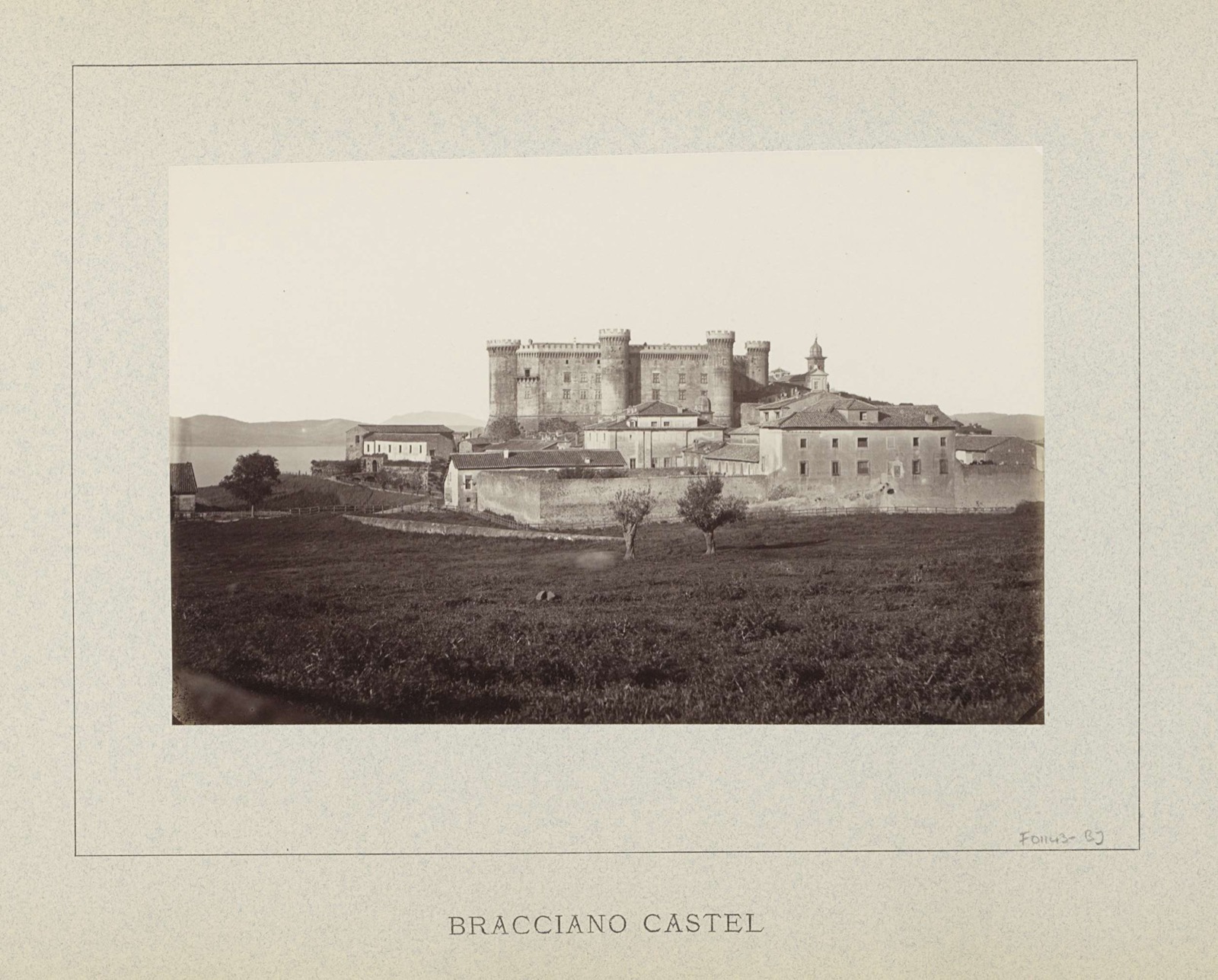
Gezicht op het Castello Orsini-Odescalchi bij Bracciano
· Rijksmuseum (via Europeana)
Public domain
Nearby


