Historic Cities · Italy
Perugia through the ages
Perugia is the capital city of Umbria and the province of Perugia in central Italy, crossed by the River Tiber. The city is located about 164 km (102 mi) north of Rome and 148 km (92 mi) southeast of Florence. It covers a high hilltop and part of the valleys around the area. With a population of 162,384, it is the 23rd-largest city in Italy.

Perugia in 1500
Perugino's Perugia
Perugia in 1500 sits at the height of its Umbrian Renaissance: guilds, bankers and the Baglioni household shape a crowded hilltop of stone palaces and narrow alleys. The walk moves from the plains below, up aqueduct-lined streets and stairways, across the Corso and the Piazza with the Fontana Maggiore, and finishes on a high terrace above the city roofs.
A compact medieval acropolis of ochre and travertine, Perugia rises in terraces of red-tiled roofs, crenellated palaces and narrow alleys breaking to small piazze. Campanili and small family towers pierce the skyline; loggias, carved stone benches and the pale curve of an ancient aqueduct mark the slopes. The dominant civic face is the Palazzo dei Priori, its griffin plaques and Pisano fountain anchoring the busy Piazza and the cathedral steps.
The route: 16 streets, squares and views
Pian di Massiano View → Porta San Pietro → San Pietro Precinct → Via dell'Acquedotto → Porta Sole Stairs → Porta Sole → Il Corso → Arco Etrusco → Piazza IV Novembre → Fontana Maggiore → …
Step inside, 7 interiors
San Pietro Choir Stalls · Bankers' Counting Chamber · Council Hall of the Priors · Chapel of the Virgin's Ring · Sala del Cambio · Notaries' Painted Vault · Baglioni Staircase
Planned from the Wikipedia record: Perugia.
Its story
The story of Perugia.
Perusia, City of the Etruscan Twelve
Villanovan settlement at the foot of the hill above the right bank of the Tiber dates from the last decades of the tenth century BC, and an Etruscan urban fabric formed on the summit in the second half of the sixth. An older literary tradition going back to Herodotus and Pliny the Elder made the place Umbrian in origin, but archaeological research places it in the Etruscan sphere from its earliest phases. The Tiber traffic below made it one of the principal cities of the Etruscan dodecapolis, and between the late fourth and the third century BC it built a travertine circuit some three kilometres long around the two hills of the acropolis, long stretches of which still stand.
Perusia enters written history in Quintus Fabius Pictor's account, used by Livy, of the campaign Fabius Maximus Rullianus led against the Etruscan League in 310 or 309 BC. It joined the Third Samnite War in 295 BC and sued for peace the following year, then backed Rome against Hannibal. Its ruin came in the civil war between Octavian and Mark Antony: the city sheltered Antony's brother Lucius, Octavian besieged it into 40 BC, and the surrender that February was followed by executions among the leading men, three hundred of them by one account, and by a fire that spared the temples of Vulcan and Juno. Rebuilding began almost at once under Augustus's favour, attested by statue bases inscribed Augusto sacr(um) Perusia restituta, and the town took the title Augusta Perusia.
Totila's Siege and the Passage to the Popes, 493–800s
Theodoric's Ostrogoths took the city in 493. Perugia was the only city in Umbria to hold out against Totila, who captured it after a long siege in the 540s, apparently once the Byzantine garrison had evacuated. Negotiation with the besiegers fell to the bishop, Herculanus, acting for the townspeople; Totila is said to have had him flayed and beheaded, and he became the city's patron as Sant'Ercolano. Byzantine rule lasted until the eighth century, broken by two short Lombard occupations. From the later eighth century the city fell within the orbit of the papacy and was governed for two centuries by its bishops; in the ninth century, with the consent of Charlemagne and Louis the Pious, it passed formally under the popes.
The Commune of the Forty-One Guilds, 1139–1376
Consular government is first attested in 1139, power divided between the consuls, a general assembly called the Arengo and a lesser council. The commune pushed north towards Gubbio and Città di Castello and west towards Lake Trasimeno, and drew Assisi and Foligno under its influence. Henry VI, king of the Romans, recognised the consular government in 1186, and Innocent III accepted that recognition and treated the city's established practices as having force of law. Perugia took his protection in 1198 and stayed Guelph, but it never accepted papal sovereignty, claimed jurisdiction over clergy, and in 1282 was excommunicated for taking the field against the Ghibellines in defiance of a papal prohibition.
Trade and craft carried the city. Forty-one guilds were counted in 1286, the governing priors were elected from among their members, and chroniclers describe up to seventy family towers, which earned Perugia the byname Turrena. An aqueduct from Monte Pacciano, begun in 1254 and completed in 1280 under Fra Bevignate, fed the Fontana Maggiore of 1275–78, carved by Nicola and Giovanni Pisano. Against that prosperity ran the flagellant movement founded in 1260 by the hermit Raniero Fasani, who attributed plague to divine punishment for sin; it spread rapidly beyond the city.
The magistracy of the priors was instituted in 1303 and lasted, apart from a break between 1540 and 1552, until 1816. The university followed in 1308 and the city statute was written in the vernacular in 1342. With the papacy at Avignon from 1305 the chief obstacle to Perugian autonomy was weak, and the commune kept expanding through the years of the Black Death, destroying Bettona in 1352 and beating Siena and Cortona at Torrita in 1358. Popes had repeatedly sheltered inside the walls, and five conclaves met in the city, among them those that elected Honorius III in 1216 and Clement V in 1305, but legates who came to coerce or tax met resistance. War with Urban V in 1369 ended with the treaty of Bologna, which forced the city to accept a papal legate: Gregory XI's kinsman Cardinal Gérard du Puy, who proscribed seventy of the Raspanti (the guild faction of money-changers, shoemakers, artisans and merchants) forbade gatherings of more than three people and took over the Palazzo dei Priori. The city rose against him in December 1375 and he left the following month.
Condottieri and the Baglioni, 1393–1520
On 5 August 1393 the condottiero Biordo Michelotti, of the Raspanti, entered Perugia and was made knight of the people and general captain of the militias, while a commission of twenty-five citizens banished a hundred and fifty noblemen, among them Braccio da Montone. Michelotti was recognised as the first lord of the city; on 10 March 1398 he was stabbed at Porta Sole in a plot organised by the abbot of San Pietro. With the city deep in debt, the twenty-five looked for a protector, and on 21 January 1400 Gian Galeazzo Visconti was proclaimed lord of Perugia by voluntary submission and cancelled its debts; he died in 1402. In 1411 the city surrendered to Ladislaus of Naples, preferring a foreign ruler to a nobleman of its own: a betrayal in the eyes of Braccio da Montone, who came back in April 1416 with a large army and forced its surrender, ending the Raspanti government. He ruled moderately until he died of wounds in 1424.
From 1438 the Baglioni held what amounted to a covert lordship, never taking formal control of civic powers. Braccio I Baglioni, nephew of Braccio da Montone and captain of the militias of the Holy See, governed until 1479 without stripping the people of their institutions, and family patronage drew Piero della Francesca, Pinturicchio and Raphael to the city, alongside Perugino, who frescoed the Hall of Audiences of the Collegio del Cambio. Under Guido and Rodolfo Baglioni the noble feuds turned lethal, with the Baglioni, the Oddi and the Ranieri killing one another almost as routine, until on 30 October 1488 the Baglioni drove the Oddi out of the city. The family's own quarrels culminated in the Red Wedding massacre of 14 July 1500, and Gian Paolo Baglioni was lured to Rome in 1520 and beheaded by Leo X.
The Salt War and the Rocca Paolina, 1540–1543
In 1540 Paul III, raising money against the Turkish threat and the Protestant and heretical movements, imposed new taxes, of which the most hated obliged Perugia to buy salt only from the papal salt pans, at twice the price charged by its usual Sienese suppliers. The city answered by taking salt out of its bread and handing the resistance to twenty-five leading citizens, and sent ambassadors to Rome to argue that the measure broke agreements made with earlier popes. On 17 March 1540 the pope had a bull excommunicating the population delivered to the head of the priors, Alfano Alfani, and told the consistory he meant to use force.
Papal troops under Pier Luigi Farnese, eight thousand Italians and four hundred Landsknechts, entered Perugian territory on 1 April and devastated the country round Foligno, Assisi and Bastia. Ridolfo Baglioni, the exiled former lord, came home on 16 May to an enthusiastic welcome, but had returned intending to negotiate the surrender he concluded on 3 June at the monastery of Monteluce. The Twenty-Five were dissolved, the city lost its civic liberties and its centuries of autonomy, and it has eaten unsalted bread ever since. Between 1540 and 1543 the Perugians were made to build the Rocca Paolina over the Baglioni houses and the old borgo of Santa Giuliana, to designs by Antonio da Sangallo the Younger, absorbing the Etruscan Porta Marzia and garrisoned by papal troops. It was raised, in the phrase inscribed on it, ad coercendam Perusinorum audaciam, and was hated for centuries as the thing that had taken the sunlight from the quarter it buried.
Papal Stagnation, the Massacres of 1859 and Annexation
Through the seventeenth and eighteenth centuries the ecclesiastical state consolidated across Umbria through the provincial Governor resident at Perugia, feudal jurisdictions disappeared, and the city dropped out of the Italian and international trade routes; its wealthy families tied themselves instead to landed property managed at a distance, to the law and to a visibly noble style of living. From the mid-sixteenth century until 1860 Perugia was demographically and economically stagnant. Papal rule broke only with the French: the city was taken in 1797, and on 4 February 1798 the Tiberina Republic was proclaimed with Perugia as its capital and the French tricolour as its flag, before being absorbed into the Roman Republic, which fell in 1799. Earthquakes struck in 1832, 1838 and 1854, and the Austrians seized the city in May 1849.
In June 1859 the inhabitants rebelled against the temporal authority of the pope and set up a provisional government. Pius IX sent Swiss regiments against them and the rising was put down with bloodshed on 20 June, remembered as the stragi di Perugia; the city is the ninth of the twenty-seven awarded the gold medal as merit-holders of the national Risorgimento, for that resistance. On 14 September 1860 fifteen thousand Piedmontese troops under General Fanti entered the city and forced the surrender of the last Swiss garrison holed up in the Rocca Paolina; after Castelfidardo on 18 September, Umbria and the Marche were annexed to the Kingdom of Sardinia, confirmed by plebiscite on 4 November 1860. Much of the Rocca was pulled down after unification. The new state made Perugia the capital of a very large province reaching as far as the Sabina, cut back only in 1927 with the creation of the provinces of Terni and Rieti.
From the March on Rome to the Umbrian Capital
The March on Rome was directed from Perugia in 1922, from the Hotel Brufani on piazza Italia. Under the German occupation and the Italian Social Republic, clandestine relief for persecuted Jews was coordinated in the city by don Federico Vincenti (1885–1955), parish priest of Sant'Andrea at Porta Santa Susanna, working with padre Aldo Brunacci and the DELASEM organisation at Assisi; Yad Vashem named Vincenti Righteous Among the Nations on 16 July 1997. British troops of the Eighth Army entered by Porta San Pietro on 20 June 1944, days after the German withdrawal, the city having come through the war with limited damage. The first Perugia–Assisi peace march, promoted by the antifascist philosopher Aldo Capitini, set out on 24 September 1961.
In 1970 Perugia was chosen as capital of the region of Umbria, which it remains alongside its role as seat of the province. Teaching is a large part of what the city does: the university founded in 1308, the University for Foreigners that teaches Italian language and culture to students from abroad, and the Pietro Vannucci fine arts academy. Chocolate is the other: Perugina, whose Baci are widely exported, runs the largest of Nestlé's nine Italian plants at San Sisto, and the EuroChocolate festival is held each October, as Umbria Jazz is each July. The comune has a population of 162,384, of whom 16.0 per cent were immigrants in 2025, the five largest countries of birth being Albania, Romania, Morocco, Ecuador and Ukraine.
From the archive
Perugia on paper: the old town as it was mapped.
A period plan or bird's-eye view of the old town, drawn between 1500 and 1850, the streets this page's reconstructions walk. Public domain, with its source named.
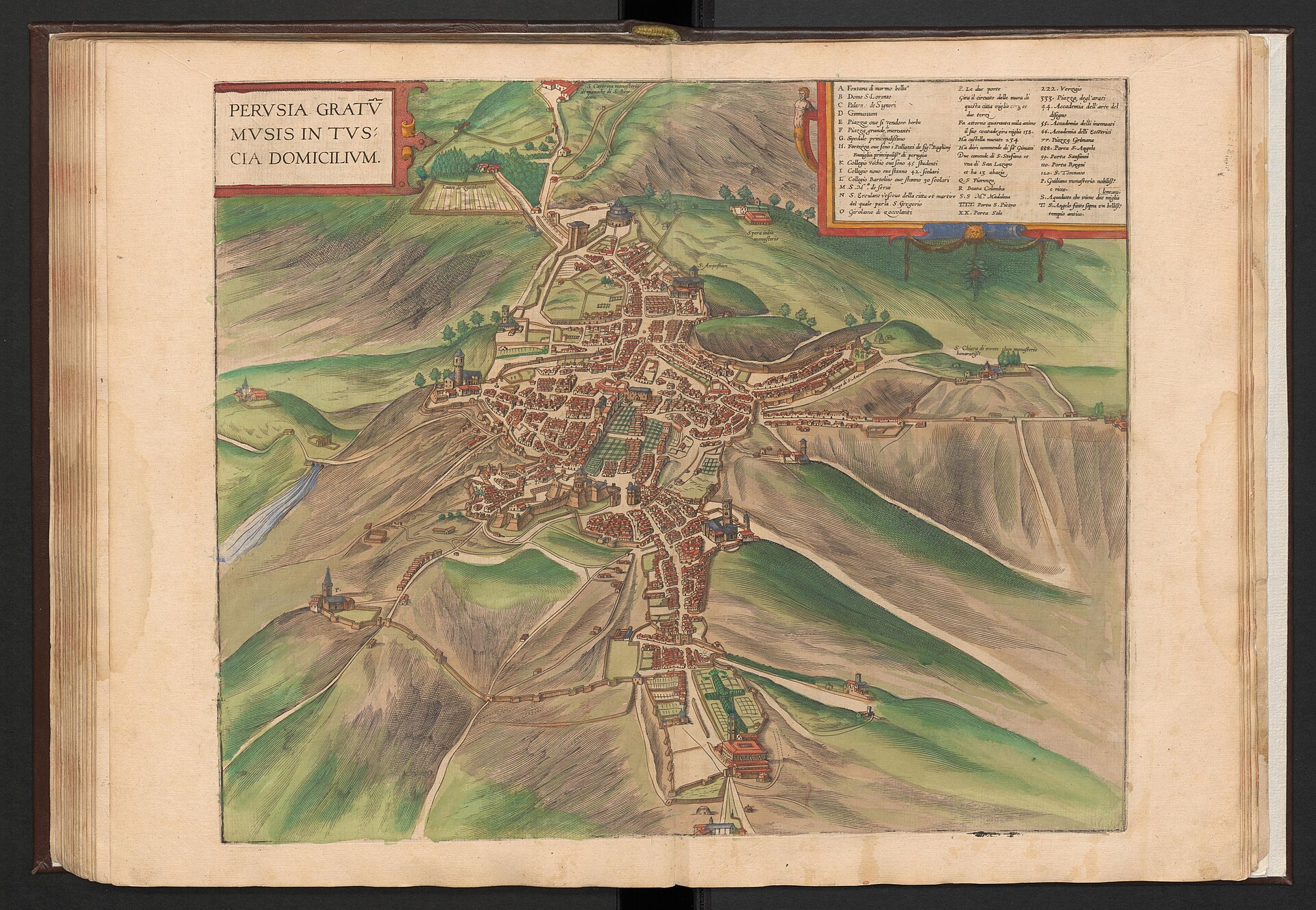
Bird's-eye view of Perugia (Pervsia Gratv· Mvsis in Tvscia Domicilium), from Braun & Hogenberg's Civitates Orbis Terrarum
Shows Perugia’s fortified walls and gates, winding streets and blocks, prominent church towers and the Rocca fortress amid surrounding hills.
1594 · Georg Braun · Wikimedia Commons
Public domain (plate dated 1594)
Castles of Perugia


More cities to explore
 ItalySienaExplore it in 1340 · 1750
 ItalySan GimignanoExplore it in 1300 · 1900
 ItalyRomeExplore it in AD 320 · 1300 · 1600 · 1770
 ItalyVeniceExplore it in 1200 · 1500 · 1740
Castles of Europe · Landmarks of Europe · create your own reconstruction.