Historic Cities · Italy
San Gimignano through the ages
San Gimignano is a small walled medieval hill town in the province of Siena, Tuscany, north-central Italy. Known as the Town of Five Towers, San Gimignano is famous for its medieval architecture, unique in the preservation of about a dozen of its tower houses, which, with its hilltop setting and encircling walls, form "an unforgettable skyline".

San Gimignano in 1300
City of Fine Towers
San Gimignano in 1300 stands at the height of its civic rivalry, its ridge crowded with tall stone tower-houses raised by competing families and ringed by stout medieval walls. The walk approaches across saffron fields and vineyards, enters through Porta San Giovanni, threads the main streets and market piazzas, and finishes on the western ramparts beneath the clustered skyline of towers.
Perched on a sandstone ridge and encircled by two great rings of wall, the town presents a jagged skyline of many narrow tower-houses in rough grey and warm ochre stone. Roofs of terracotta tile and timber eaves slope between towers, while streets fall steep and narrow to sunlit piazzas where brick and stone paving from the thirteenth century collects dust and market refuse. Below the walls, terraces of vineyards and saffron plots ripple the slopes.
The route: 9 streets, squares and views
Saffron Fields and Vineyards → Porta San Giovanni → Via San Giovanni → Piazza della Cisterna → Piazza del Duomo Steps → Palazzo Comunale Forecourt → Tower-House Street → Via San Matteo → Western Walls and Rocca
Step inside, 5 interiors
Saffron Merchant's Storeroom · Cistern Chamber · Nave and Chapel of the Collegiata · Dante's Hall, Council Chamber · Upper Family Hall
Planned from the Wikipedia record: San Gimignano.
San Gimignano in 1900
San Gimignano Rediscovered
At the turn of the century San Gimignano is a poor hill town of farmers and vintners whose cluster of medieval towers has lately drawn painters and Baedeker travellers. This walk crosses the working market and main streets, passes beneath the southern gate where ox-carts arrive, climbs to the ruined Rocca and finishes on the western walls with a wide view of the towers and surrounding vineyards.
Perched on a sandstone ridge and ringed by three medieval walls, San Gimignano's skyline in 1900 is defined by fourteen surviving stone tower-houses, blunt battlements and the taller Torre Grossa rising above low ochre and grey palazzi. Roofs of red terracotta, rough-hewn ashlar and brick façades, narrow shaded lanes and small triangular piazze give the town a compact, vertical silhouette. Outside the walls the slopes are patchworked with vineyards and olive groves, and simple stone farmhouses and wine-presses speckle the hills.
The route: 9 streets, squares and views
Road from Poggibonsi → Porta San Giovanni → Via San Giovanni → Piazza della Cisterna → Piazza Duomo → Piazza Agostino → Rocca di Montestaffoli → Vernaccia Presses on the Slopes → Panorama from the Walls
Step inside, 5 interiors
Slope Farmhouse Kitchen · Painter's Lodging Room · Collegiata Frescoed Nave · Sant'Agostino Nave · Vernaccia Wine Cellar
Planned from the Wikipedia record: San Gimignano.
Its story
The story of San Gimignano.
Sancte Gemiane on the Via Francigena: the Etruscan Hill to the Walls of 1214
The hill was inhabited by Etruscans from at least the 3rd century BC, chosen because at 324 metres it commanded the upper Val d'Elsa; on the slopes of the Poggio del Comune stand the ruins of Castelvecchio, a village of the Lombard period. The first documented mention of the town dates to 929, and from that year it was ruled by the bishop of Volterra. Tradition derives the name from Geminianus, the sainted bishop of Modena, who is said to have defended the settlement from Attila's followers; the chroniclers Lupi, Coppi and Pecori tell a further origin story in which two patrician brothers fleeing Rome during the Catiline conspiracy built the castles of Mucchio and Silvia, the second of which became San Gimignano.
What made the place was the road. San Gimignano sat on the Via Francigena, the pilgrim route to Rome, and Sigeric, archbishop of Canterbury, travelled it between 990 and 994 on his way home to England: his itinerary lists the town as his nineteenth stage under the name Sancte Gemiane and notes it as the point where the road crossed the route between Pisa and Siena. The first ring of walls, raised in 998, enclosed the Montestaffoli hill (where a market stronghold belonging to the bishop of Volterra already stood), and the Poggio della Torre with its episcopal castle.
Around 1150 a new line of the Francigena opened, but the town kept growing, pushing its territory outwards and expanding its trade. Two boroughs formed beyond the walls along a new main road: San Matteo towards Pisa and San Giovanni towards Siena. Both were taken inside the town when the new circuit of walls was completed in 1214.
Saffron, Usury and the Commune of 1199
In 1199, at the height of its economic strength, San Gimignano made itself independent of the bishops of Volterra, established a podestà and set about filling the commune with churches and public buildings. The thirteenth century, under the Ghibellines, was its richest period. The trade rested on the agricultural produce of the surrounding hills, above all saffron, used in cooking and in dyeing cloth, which was sold at Pisa, Lucca and Genoa and exported to France and the Low Countries and as far as Syria and Egypt. Vernaccia, the white wine grown on the sandstone slopes, was traded alongside it.
As in other Tuscan towns, financial speculation and money-lending at interest spread alongside the trade. The capital accumulated produced two things: an urban aristocracy, and the public works commissioned through the thirteenth century that gave the town the arrangement of streets and squares it still has.
Seventy-Two Towers and the Rule of 1255
The rivalry between Guelphs and Ghibellines, led locally by the Ardinghelli and the Salvucci, ran through the town for two centuries, and the competing families expressed their standing by building tower houses ever higher, by the fourteenth century there were 72 of them, some reaching 70 metres. A regulation of 1255 forbade private citizens to raise a tower higher than the Torre Rognosa, then the tallest in the town; the Ardinghelli and the Salvucci each answered with a tower only slightly lower, of almost equal size, to demonstrate their power. The tallest survivor is the Torre Grossa, also called the Torre del Podestà, 54 metres high and dating from 1311.
The walls took in Montestaffoli in 1251, but in 1255 the Guelphs of Florence seized the town and ordered the walls pulled down. Independence was recovered in 1261 and Ghibelline supremacy returned after the battle of Montaperti, after which the townspeople rebuilt the circuit to include the Poggio della Torre; from then the town was divided into four contrade, each answering to one of the main gates. With the commune's backing the religious orders settled from the middle of the century onwards: the Franciscans outside Porta San Giovanni in 1247, the Augustinians at Porta San Matteo in 1280, the Dominicans at Montestaffoli in 1335 and the Benedictine nuns of San Girolamo near Porta San Jacopo in 1337. On 8 May 1300 the commune received Dante Alighieri as ambassador of the Guelph League in Tuscany.
Plague, the Surrender to Florence and the Collegiate Church, 1348–1782
The fourteenth century broke the town. Already worn by its internal feuds, San Gimignano was struck in 1348 by the Black Death and by famine, and about half the townsfolk died. In 1351 the exhausted city gave itself up to Florence of its own accord, surrendering its autonomy and any political role in Tuscany. The Rocca di Montestaffoli dates from that year, and the walls were reinforced in 1358. Some Gothic palazzi were built in the Florentine manner and many of the towers were cut down to the height of the houses.
Politically finished, the town remained artistically busy: through the fourteenth and fifteenth centuries painters from Siena and more often from Florence were brought in, mostly by the religious orders decorating their own properties, Memmo di Filippuccio, Lippo and Federico Memmi, Taddeo di Bartolo, Benozzo Gozzoli, Domenico Ghirlandaio, Piero del Pollaiolo and Sebastiano Mainardi, who was born in the town. A sign that it still counted came in 1462, when Pope Pius II granted the collegiate church wide autonomy from the bishop of Volterra while leaving it formally within his diocese, an arrangement that set provosts against bishops, especially after the reforms of the Council of Trent.
In the second half of the eighteenth century it was proposed to the Grand Duke of Tuscany that the collegiate church be moved from the diocese of Volterra to that of Colle and raised to a co-cathedral, with the bishops taking a double title and residing alternately in each place; that would have made San Gimignano a city in full, but the scheme was not carried through in full. On 18 September 1782 the bull Dum nos singulis of Pope Pius VI transferred the collegiate church and its territory, 29 parishes in all, from Volterra to Colle.
The Town Its Decline Preserved, 1580–1936
Of the 72 towers and tower houses of the commune's best years, 25 were still standing in 1580 and 14 stand today, with others cut short and absorbed into the surrounding buildings. It was precisely the town's decline and marginality in the following centuries that allowed its medieval appearance to survive largely unaltered. In the plebiscite of 1860 on the annexation of Tuscany to Sardinia, the 'yes' votes fell just short of a majority of those entitled to vote, 1,122 out of 2,275, a sign of local opposition to annexation.
From the end of the nineteenth century the town began to be valued for exactly what its decline had preserved, and its status as a resort for travellers and artists took hold. The whole of it was placed under monument protection in 1929, and by a royal decree of 29 April 1936 San Gimignano was granted the title of city.
Ten Days of Bombing in the Second World War
During the Second World War the town was bombed by the Americans for ten days. The raids began on a Thursday, market day, and killed several people; one young mother was struck in the foot by a fragment and had her leg amputated. A house on the piazza collapsed, part of the cathedral came down, and the bell of the Torre Grossa was destroyed; a replacement was presented after the war by the people of the Soviet Union. The townspeople spent some ten days in shelters before the priest convinced the Americans that there were no more than ten Germans in the town and that it could be entered without risk. There are reports of intended retribution against the town, but no evidence of any plan to destroy its churches.
Vernaccia, World Heritage and a Comune of 7,480
Vernaccia di San Gimignano was the first Italian wine to be granted the Denominazione di Origine Controllata, in 1966; it is produced in a restricted zone matching the municipal territory, alongside the town's saffron and olive oil. The comune covers 138 square kilometres in the province of Siena and had 7,480 inhabitants; at the end of 2019 its foreign residents numbered 692, or 8.9 per cent of the population, the largest groups Romanian and Albanian. Its own emigrants are marked each March by a giornata del ritorno, a day of return.
Tourism is now the town's principal resource, helped by its position halfway between Florence and Siena, and it supports a range of craft and service trades around it. The historic centre was declared a UNESCO World Heritage Site in 1990. Despite some nineteenth- and twentieth-century restoration the site is largely intact in its thirteenth- and fourteenth-century form.
From the archive
San Gimignano on paper: the old town as it was mapped.
A period plan or bird's-eye view of the old town, drawn between 1500 and 1850, the streets this page's reconstructions walk. Public domain, with its source named.
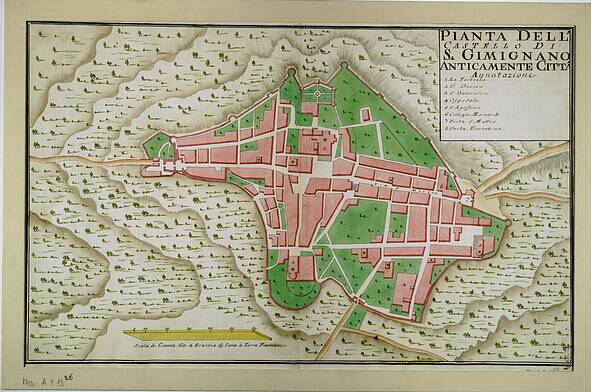
Pianta dello Castello di S. Giminiano anticamente città (Plan of San Gimignano)
Shows the walled medieval town with surrounding ramparts, gates, principal streets and built-up urban blocks.
1780 · The Central National Library of Florence · Europeana
Public domain (plate dated 1780)

Castles of San Gimignano

More cities to explore
 ItalySienaExplore it in 1340 · 1750
 ItalyFlorenceExplore it in 1300 · 1490 · 1600
 ItalyRomeExplore it in AD 320 · 1300 · 1600 · 1770
 ItalyVeniceExplore it in 1200 · 1500 · 1740
Castles of Europe · Landmarks of Europe · create your own reconstruction.