Historic Cities · Italy
Bologna through the ages
Bologna is the capital and largest city of the Emilia-Romagna region in northern Italy. It is the seventh most populous city in Italy, with 390,734 inhabitants from 150 different nationalities. Its metropolitan province is home to more than 1 million people as of 2025.

Bologna in 1280
Forest of Towers
This is Bologna at the height of its medieval ascent: a dense commune of law students, merchants and rival families whose stone tower-houses puncture every quarter. The walk crosses gate, market, canal and cloister; you will see the great twin towers at Porta Ravegnana, the busy Quadrilatero markets, the mill races of the Moline and the seven churches of Santo Stefano.
A jagged medieval skyline of nearly a hundred towers rises above closely packed terracotta roofs, timber sporti and nascent stone porticoes. Streets are narrow, often shadowed, with sun on ochre walls and mud at cart-ruts; canals thread the lower quarters and power wheel-driven mills. Colour is stone-grey and red-brown with bright cloths on market stalls; students in plain tunics and merchants in hose and hoods animate every thoroughfare.
The route: 22 streets, squares and views
Via Aemilia Approach → Porta Ravegnana → Strada Maggiore → Piazza Maggiore → Palazzo del Podestà → Palazzo Re Enzo → Quadrilatero Market → Via Pescherie Vecchie → Via Clavature → Canale delle Moline → …
Step inside, 14 interiors
Crenellated Family Hall · Glossator's Lecture Hall · Great Hall of the Podestà · King's Captive Chamber · Merchant's Counting‑House · Notary's Studio · Lock‑keeper's Chamber · Millwright's Workshop · Fuller's Mill Hall · Friary Refectory · Nicola Pisano's Shrine · Basilica Nave of Santo Stefano · Goldsmith's Workshop · Tower‑house Family Hall
Planned from the Wikipedia record: Bologna.
Bologna in 1575
Papal Bologna
Bologna in 1575 is a prosperous provincial capital of the Papal States in the midst of a Renaissance remaking: a new Archiginnasio houses the Studium, Giambologna's bronze Neptune presides over a renewed square, and a network of hidden canals still turns mills and feeds a busy canal port. This walk moves from the rim of the city through its gates, market streets and porticoes to the waterways and hilltop views that shape its skyline.
Low, dense roofs of terracotta and ochre brick, punctured by a few tall towers and church domes, frame a city of long shadowed porticoes and narrow streets. Marble and unfinished white stone meet warm brick on San Petronio's front; bronzed Neptune gleams in a new open piazza. Narrow, tree‑lined canals run close to workshops and waterwheels; timber cranes lean over quays. The overall palette is red and warm brown, with bright white stone highlights and occasional gleams of bronze and copper.
The route: 22 streets, squares and views
Colle della Guardia → Porta Galliera → Strada Maggiore Porticoes → Porta Ravegnana → Mercato di Mezzo → Torre della Garisenda → Torre degli Asinelli → Piazza del Nettuno → San Petronio Façade → Palazzo Re Enzo → …
Step inside, 14 interiors
Portico Osteria · Great Meat Hall · Asinelli Watch Chamber · Vast Nave · Cell of King Enzo · Money-changers' Hall · Papal Legate's Audience Hall · Students' Painted Corridor · Great Hall of Law · Notaries' Scriptorium · Colonnaded Nave · Reel and Throwing Room · Water-Throwing Mill · Crane House and Warehouse
Planned from the Wikipedia record: Bologna.
Its story
The story of Bologna.
Felsina to Bonōnia: The Colony on the Via Emilia, 196 BCE–774 CE
Habitation in the area goes back to the 3rd millennium BCE, with substantial settlement from about the 9th century BCE under the Villanovan culture. The Etruscan city of Felsina was established on the site by the end of the 6th century BCE. By the 4th century the place was held by the Gaulish Boii, and in 196 BCE it became a Roman colony and municipium under the name Bonōnia. The town grew along the Via Emilia, which still runs straight through it, and the central streets keep the grid of the Roman settlement.
In the waning years of the Western Roman Empire the town was repeatedly sacked by the Goths. Ancient chronicles credit the bishop Petronius with rebuilding the ruined town and founding the basilica of Saint Stephen; he is still revered as the city's patron saint. In 727–728 Bologna was sacked and taken by the Lombards under King Liutprand, whose people laid out a new quarter near the St Stephen complex known as the addizione longobarda. Frankish troops occupied the city in 774 on behalf of the papacy, and it prospered thereafter as a frontier mark of the Carolingian Empire.
Irnerius, the Studium and the Peace of Constance, 1088–1183
Bologna became the centre of a revived study of law around the scholar Irnerius (c. 1050 – after 1125) and the students known as the Four Doctors of Bologna. The university, conventionally said to have been founded in 1088 by the glossators Irnerius and Pepo, has run without interruption since: it is the oldest university in continuous operation and the first in the sense of a higher-learning, degree-awarding institution, the word universitas having been coined at its foundation. It began as a loosely organised system in which each master collected fees from students individually, with colleges founded to support students of one nationality or another. Dante, Petrarch and Boccaccio studied there, and the medical school was especially renowned. By 1200 Bologna was a commercial and artisanal centre of some 10,000 people.
After the death of Matilda of Tuscany in 1115 the town won substantial concessions from Emperor Henry V. When Frederick Barbarossa later tried to strike the deal down, Bologna joined the Lombard League, which defeated the imperial armies at the Battle of Legnano and secured effective autonomy at the Peace of Constance in 1183.
Canals, King Enzo's Captivity and the Bentivoglio, 1183–1506
Freed of imperial control, the town expanded quickly and became one of the main commercial trade centres of northern Italy, on the strength of a system of canals that allowed barges and ships to come and go. During a campaign in support of the imperial cities of Modena and Cremona against Bologna, Frederick II's son King Enzo of Sardinia was defeated and captured at the Battle of Fossalta on 26 May 1249. The emperor demanded his release; instead Enzo was held as a knightly prisoner in the palace that took his name, Palazzo Re Enzo, and died there after more than 22 years, the last of the Hohenstaufen heirs.
Late in the 13th century the leading families fought continuously for control of the town, and the free commune was weakened enough for the pope to impose his envoy, Cardinal Bertrand du Pouget, in 1327. A popular rebellion ousted him and in 1334 Bologna became a signoria under Taddeo Pepoli. The Black Death reached a city of 40,000 to 50,000 inhabitants in 1348 and left 20,000 to 25,000. Milan seized it in 1350 under Archbishop Giovanni Visconti, and the papacy recovered it in 1363 through Cardinal Gil Álvarez Carrillo de Albornoz, at the cost of a long negotiation and a huge indemnity.
Bologna revolted against papal rule again in 1376 and joined Florence in the unsuccessful War of the Eight Saints. Infighting in the Holy See after the Western Schism kept the papacy from restoring its grip, and the city governed itself for some decades as an oligarchic republic. Giovanni I Bentivoglio took power in a coup in 1401 with Milanese backing, then turned to Florence and was killed the following year when Milan marched on the city. His nephew Hannibal I recovered Bologna in 1442 and was assassinated three years later in a conspiracy plotted by Pope Eugene IV, but the family's signoria held, passing in time to Giovanni II. On 7 October 1506 Pope Julius II deposed and excommunicated him and placed the city under interdict; when papal troops and a contingent sent by Louis XII of France marched, the Bentivoglio fled, and Julius entered in triumph on 10 November.
Papal Rule, Plague and the Failing Silk Trade, 1506–1796
Historians have generally judged the period of papal rule one of severe decline, but that was not yet visible in the 1500s. Charles V was crowned in Bologna in 1530, the last emperor to be crowned by a pope, and 1564 brought the Piazza del Nettuno, the Palazzo dei Banchi and the Archiginnasio, the university's main building. Churches and religious houses were built and older ones restored: the city held ninety-six convents, more than any other in Italy.
Severe signs of decline showed only towards the end of the 16th century. Plagues from then into the early 17th century cut the population from some 72,000 in the mid-16th century to about 47,000 by 1630, the Italian plague of 1629–1631 alone carrying off up to a third of the inhabitants; numbers steadied at roughly 60,000 and crept back to some 70,000 by the mid-18th century. As the centres of global trade shifted towards the Atlantic the economy weakened, the traditional silk industry reached a critical state, and the university lost the students who had once come from all over Europe, a loss attributed to the Church's illiberal attitude towards culture, particularly after the trial of Galileo. Deindustrialisation continued through the 18th century under heavy customs duties and monopolies granted to single manufacturers.
In the mid-1700s Pope Benedict XIV, himself a Bolognese, tried to reverse the decline with reforms: his efforts on the decaying textile industry achieved little, while his tax reform, liberalisation of trade and relaxation of an oppressive censorship went further. In 1790 the city counted 72,000 inhabitants, second largest in the Papal States, a figure that had not moved for decades.
Napoleon, the Beggars' Census and the Vote of March 1860
Napoleon entered Bologna on 19 June 1796 and briefly restored the old form of government, returning power to the Senate of Bologna, which had to swear fealty to a succession of French client states: the Cispadane Republic created at the congress of Reggio in the winter of 1796–97, the Cisalpine Republic from 9 July 1797, then the Italian Republic and the Kingdom of Italy. After Napoleon's fall the Congress of Vienna returned Bologna to the Papal States in 1815. Papal rule was challenged in the uprisings of 1831, when the insurgent provinces planned to unite as the Province Italiane Unite with Bologna as their capital. Pope Gregory XVI asked Austria for help, and in the spring of 1831 Austrian forces marched across the peninsula and had put the rebellion down by 26 April.
By the mid-1840s unemployment was very high and the old industries continued to languish or vanish. The papal census of 1841 recorded 10,000 permanent beggars and a further 30,000 people living in poverty out of a total population of 70,000; the top tenth lived off rent, another fifth on professions or commerce, and seventy per cent on low-paid, often insecure manual work. In the revolutions of 1848 the Austrian garrisons holding the city for the pope were expelled, then returned and crushed the revolutionaries. Papal rule ended after the Second War of Italian Independence, when French and Piedmontese troops drove the Austrians out of Italian lands: on 11 and 12 March 1860 Bologna voted to join the new Kingdom of Italy.
The last decades of the century brought economic and social revival, and a railway to Florence in 1864. The city's moderate agrarian elites, who had backed the liberal risings against the papacy and admired free trade, wanted a unified national state that would open a larger market for the heavy agricultural output of the Emilian plains. Bologna gave Italy one of its first prime ministers in Marco Minghetti.
Biennio Rosso, Fascist Factories and the Liberation of April 1945
After the First World War Bologna was heavily involved in the Biennio Rosso socialist uprisings, and in reaction the traditionally moderate elites turned their backs on the progressive faction and threw their support behind Mussolini's rising Fascist movement. Dino Grandi, a high-ranking party official and foreign minister, came from Bologna. Between the wars the city grew into an important manufacturing centre for food processing, agricultural machinery and metalworking, with massive investment from the regime, including a giant tobacco plant set up in 1937.
That industry, and the railway junction linking northern and central Italy, made the city a target for Allied bombing. A massive air raid on 24 July 1943 destroyed a significant part of the historic centre and killed about 200 people; the main railway station and the streets around it were severely hit, and 44 per cent of the buildings in the centre were listed as destroyed or severely damaged. The city was bombed again on 25 September, this time beyond the centre, leaving 2,481 dead and 2,000 injured. By the end of the war 43 per cent of all buildings in Bologna had been destroyed or damaged.
After the armistice of 1943 Bologna became a key centre of the Italian resistance. On 7 November 1944 partisans of the 7th Brigade of the Gruppi d'Azione Patriottica fought a pitched battle around Porta Lame against Fascist and Nazi occupation forces; one of the largest resistance-led urban actions in the European theatre, it did not trigger the general uprising intended. Resistance forces entered the city on the morning of 21 April 1945, the Germans having largely withdrawn before the Allied advance, spearheaded by Polish forces coming from the east in the Battle of Bologna fought since 9 April. First into the centre, through Porta Maggiore, was the 87th Infantry Regiment of the Friuli Combat Group under General Arturo Scattini.
Communist Mayors, the Station Bomb of 1980, and the City Since
The post-war city was both a thriving industrial centre and a stronghold of the Italian Communist Party: from 1945 to 1999 it was governed by an unbroken succession of mayors from the PCI and its successor parties, beginning with Giuseppe Dozza. At the end of the 1960s a council worried by gentrification and suburbanisation asked the architect Kenzo Tange for a master plan for a new town to the north; the 1970 plan was vetoed as too ambitious and expensive, but his exhibition centre and business district was built from the end of 1978, and the regional government of Emilia-Romagna moved into the new quarter in 1985.
In 1977 the city saw rioting linked to the Movement of 1977, after police shot dead a far-left activist, Francesco Lorusso, setting off two days of street clashes. On 2 August 1980, at the height of the years of lead, a bomb was detonated in the central railway station, killing 85 people and wounding 200. Members of the neo-fascist group Nuclei Armati Rivoluzionari were convicted of the attack in 1995; Licio Gelli, Grand Master of the Propaganda Due masonic lodge, was convicted of obstructing the investigation, along with three agents of the military intelligence service SISMI, among them Francesco Pazienza and Pietro Musumeci. The city commemorates the dead every 2 August, ending the day with a concert in the main square.
The line of left-wing mayors broke in 1999 with the win of the independent centre-right candidate Giorgio Guazzaloca, and resumed in 2004 with the former trade union leader Sergio Cofferati. The city is the capital of Emilia-Romagna and seat of its metropolitan city, with 390,734 inhabitants drawn from 150 nationalities. A dense network of cooperatives, rooted in the farm and worker struggles of the 1800s, produces up to a third of the city's GDP and employs 265,000 people across Emilia-Romagna. Bologna was European Capital of Culture in 2000, and in 2021 its porticoes (some 38 kilometres of them in the historic centre) were named a World Heritage Site.
From the archive
Bologna on paper: the old town as it was mapped.
A period plan or bird's-eye view of the old town, drawn between 1500 and 1850, the streets this page's reconstructions walk. Public domain, with its source named.
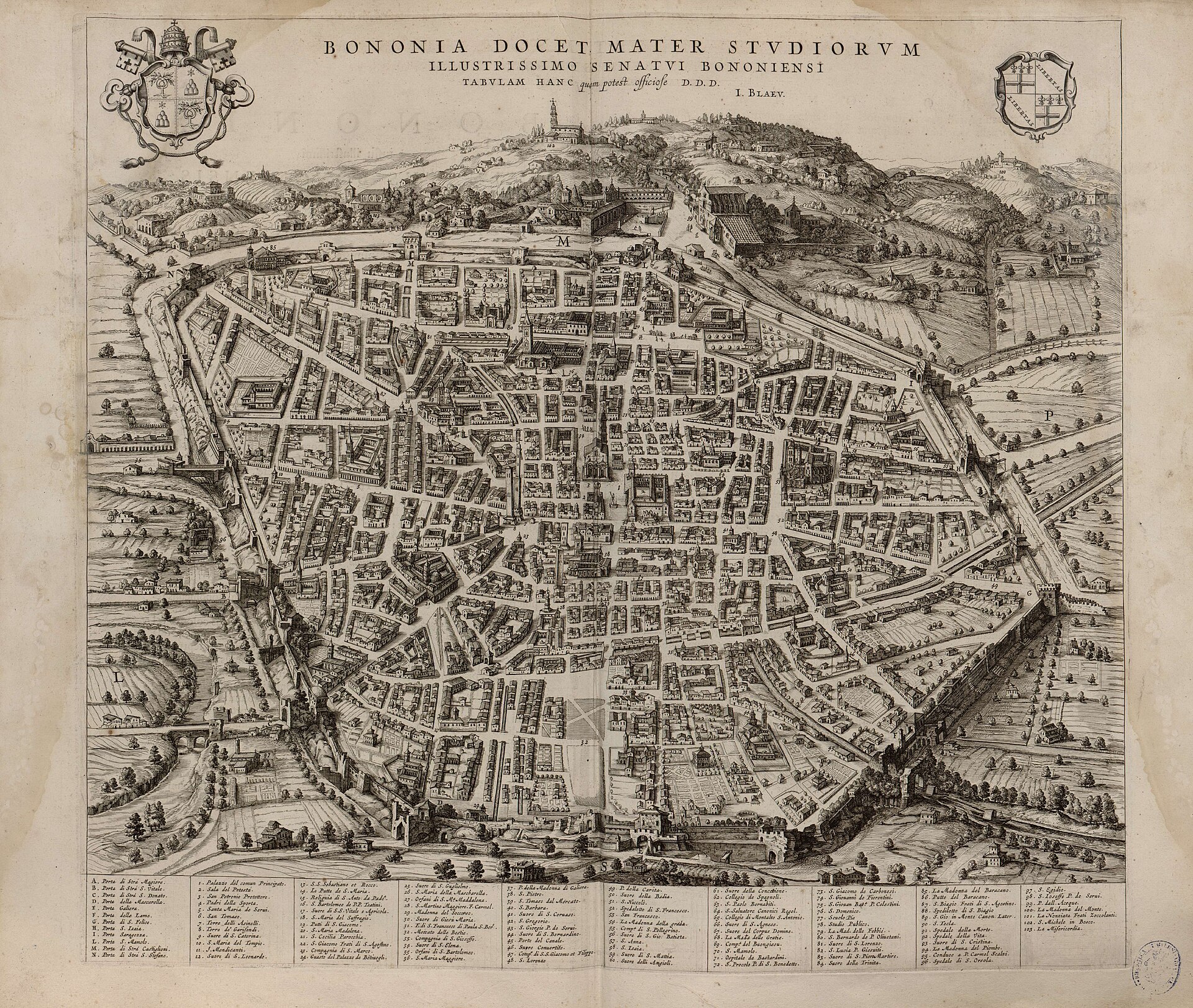
Bird's-eye view of Bologna (Bononia docet mater studiorum), from Joan Blaeu's Theatrum Civitatum et Admirandorum Italiae
Engraved bird's-eye map showing Bologna's complete medieval walls with gates and bastions, the dense street grid and blocks, prominent towers and churches, and surrounding hills and waterways.
1663 · Joan Blaeu · Wikimedia Commons
Public domain (plate dated 1663)
In this city
Landmarks of Bologna, see each in its prime


More cities to explore
 ItalyRavennaExplore it in AD 550
 ItalyFlorenceExplore it in 1300 · 1490 · 1600
 ItalyRomeExplore it in AD 320 · 1300 · 1600 · 1770
 ItalyVeniceExplore it in 1200 · 1500 · 1740
Castles of Europe · Landmarks of Europe · create your own reconstruction.