Historic Cities · Italy
Verona through the ages
Verona is the largest city in the region of Veneto in Italy, with 255,131 inhabitants. It is one of the seven provincial capitals of the region, and is the largest city municipality in the region and in northeastern Italy. The metropolitan area of Verona covers an area of 1,426 km2 (550.58 sq mi) and has a population of 714,310 inhabitants.

Verona in AD 50
Roman Verona
Verona in 50 sits as a compact Roman colonia on a grid of cardines and decumani, its forum at the future Piazza Erbe and an amphitheatre newly finished outside the city. The walk moves from the city’s river crossings and gates through markets, workshops and public colonnades to the theatre on the hill and final views over the Adige bend.
Rooflines of low two‑storey houses, red clay tiles and pale tufa or brick facades, rise behind arcaded public buildings and stone city walls. The Adige threads green and brown through the town, spanned by a single great stone bridge; the amphitheatre sits as a white ring outside the grid. Streets are narrow, paved with stone or packed earth, shaded by colonnades and heavy awnings where merchants display pottery, cloth and produce.
The route: 22 streets, squares and views
San Pietro Hill Approach → Ponte Pietra → Adige River Quay → Riverside Warehouses → Porta Leoni → Cardo Maximus → Decumanus Maximus → Forum (Piazza Erbe site) → Basilica of the Forum → Macellum Market → …
Step inside, 14 interiors
Quay Portorium Office · Riverside Lower Store · Porta Leoni Guardroom · Draper's Taberna · Bakers' Oven Hall · Colonnaded Forum Portico · Basilica Central Nave · Macellum Covered Market Hall · Bronze Smith's Workshop · Domus Atrium with Frescoes · Stagehouse and Painted Scaenae · Backstage Dressing Rooms · Arena and Vaulted Galleries · Forecourt Vomitorium Entrance
Planned from the Wikipedia record: Verona.
Verona in 1340
Scaliger Verona
Verona in 1340 is a compact, fortified river city at the height of Scaliger rule, its walls and bridges recently strengthened and its courts alive with patronage and rivalry. The walk passes markets, crenellated palaces and tomb-shrines, the busy Adige quays, and the lanes and houses long linked to the Montecchi and Cappelletti memory later taken up by poets.
Red clay roof tiles crowd low stone and brick palaces topped with crenellations and wooden hoardings; narrow lanes open to sunlit market squares. The Adige flows green and swift under successive arches of Roman and medieval bridges, flanked by timbered wharves and stone quays. White marble Gothic canopies and scalloped niches mark the Scaliger tombs and church fronts, while bell towers and the far castle silhouette puncture the skyline.
The route: 22 streets, squares and views
Castel San Pietro View → Porta Borsari → Piazza Bra → Arena Exterior → Via Postumia → Piazza delle Erbe → Torre dei Lamberti → Piazza dei Signori → Santa Maria Antica → Scaliger Tombs → …
Step inside, 15 interiors
Porta Borsari Guardroom · Arena Stone Passage · Belfry Chamber of Lamberti · Audience Chamber of the Signori · Nave of Santa Maria · Cansignorio's Tomb Canopy · Cappelletti Family Hall · Merchants' Covered Loggia · Riverside Warehouse · Fish Market Arcade · Stagehouse of the Roman Theatre · Bridge Tower Guardroom · Great Hall of the Lords · Castle Chapel · Nave of San Zeno
Planned from the Wikipedia record: Scaliger.
Verona in 1600
Venetian Verona
Verona in 1600 is a prosperous provincial city governed from Venice, where new bastioned works and old Roman stones meet. The walk follows the river and the market heart past painted palazzi, river quays busy with wool and silk bales, medieval towers and Scaliger monuments to a high hillside view over the Adige.
The city’s silhouette is a tight jumble of Roman masonry, brick bell towers and crenelled Scaliger stone punctuated by the rounded bulk of the Arena. Many palazzi display painted façades and trompe-l’oeil cornices; narrow streets open into lively markets. The Adige bisects the town with stone bridges and lined quays where small barges moor. Venetian bastions and gates of Sanmicheli punctuate the outer ramparts, giving a compact, fortified profile against the plain.
The route: 22 streets, squares and views
South Approach Road → Porta Nuova → Bastioned Walls → Piazza Bra and Arena → Porta Borsari → Piazza delle Erbe → Piazza dei Signori → Torre dei Lamberti → Palazzo della Ragione → Arche Scaligere → …
Step inside, 12 interiors
Arena's Sand-Floored Circle · Gran Guardia Assembly Hall · Erbe Market Loggia · Podesta's Audience Hall · Lamberti Bell Chamber · Sala del Consiglio · Casa Cappello Painted Salon · Sottoriva Merchants' Counting Room · Giusti Upper Cypress Terrace · Castelvecchio Armory · Adige Silk-Throwing Mill · San Zeno Basilica Nave
Planned from the Wikipedia record: Verona.
Its story
The story of Verona.
The Ford at San Pietro Hill and the Res Publica Veronensium
Verona grew at the southern foot of the San Pietro hill, at one of the few fordable points on the Adige and at the mouth of the valley that was the main route to the peoples of northern Europe; the hill was defensible and stood above the river's annual flooding. With Cisalpine Gaul subdued, the Senate required the fortified castrum to be enlarged in 174 BC while settlers laid out a new city inside the bend of the Adige, and the Via Postumia, running from Genoa to Aquileia, passed through it.
Latin rights came in 89 BC, and in 49 BC the Lex Roscia made Verona a municipium with a countryside of up to 3,700 square kilometres, entitled to call itself the Res publica Veronensium. It grew on vines and olives, horse and sheep breeding and wool, and two bridges replaced the ford. Under Augustus the Via Claudia Augusta was built from Ostiglia through the Adige valley to the Brenner Pass, and under Vespasian the Arena was raised for a population by then above 25,000. In 265 Gallienus had the walls enlarged to enclose the Arena and fortified in seven months. The city was slow to convert to Christianity, and orthodoxy took hold only under Bishop Zeno. Stilicho defeated Alaric and his Visigoths here in 402, and Attila's invasion of Italy in 452 ended at Verona, where a delegation including Pope Leo I persuaded him to retreat to Pannonia.
Dietrich von Bern: Capital of Goths, Lombards and Kings of Italy
Odoacer, who deposed Romulus Augustulus in 476, was an Arian who left the Nicene Latins alone; he confiscated a third of the landowners' estates for his soldiers, gave the peasants tax relief and freed the slaves into serfdom, formally free but still bound to masters. He was beaten by Theodoric the Great at the Battle of Verona on 30 September 489 and fled to Ravenna. Theodoric made Ravenna his capital in 493 but kept Verona as his favourite seat and chief military centre, so much so that in Germany he was known as Dietrich von Bern, Theodoric of Verona. Verona and Brescia held out as the last Gothic pockets after the war's official end in 555, Verona falling on 20 July 561, though some scholars read that as a revolt instead.
Alboin, king of the Lombards, took the undefended city without bloodshed in 568, and it was his kingdom's capital until the court moved to Pavia in 571. He was killed in Theodoric's palace there, by his wife Rosamund in one account and by his own people with her connivance in another. In 774 Adalgis, son of Desiderius, made the last Lombard resistance to Charlemagne at Verona. Under the Franks it became the capital of a county, and from 781 part of the Italian kingdom given to Charlemagne's son Pepin, who had the basilica of San Zeno raised at the saint's tomb. Berengar I later made Verona his capital and was killed there by Milo of Sambonifacio, one of his own relatives; Berengar II established the March of Verona, which passed to the Duke of Bavaria in 951.
Commune, Barbarossa and Ezzelino's Massacre, 1117-1259
The earthquake of 3 January 1117 brought down the outer ring of the Arena and destroyed many other buildings, setting off intense rebuilding. The first three consuls of the free commune were elected in 1136. The countryside was largely Guelph, headed by the Sambonifacio, the city largely Ghibelline, with the Montecchi prominent among them. Verona, Venice, Padua, Vicenza and Ferrara formed the Veronese League against Frederick Barbarossa, which merged with the Lombard League in 1167; three hundred Veronese knights fought at Legnano in 1176, and the emperor recognised communal autonomy at the Peace of Constance in 1183.
From 1200 the Ezzelini took power, Ezzelino III being made imperial vicar in Italy by Frederick II. Friar Giovanni da Schio, given unlimited powers in Verona and Vicenza, hunted heretics and alleged heretics and burned more than sixty men and women at the stake within days, before both cities turned on him. When Ezzelino learned that Padua, his own city, had given itself to the papacy, he took his rage out on the Veronese: the massacre that began on 25 June 1256 ran for eight days, citizens killed regardless of age, sex or status, some beheaded, some hanged, others burned at the stake or quartered, the killing carried out by Paduan troops still loyal to him. In 1257 he caused the slaughter of 11,000 Paduans on the plain of Verona. He lost a battle on the Adda on 29 September 1259, was captured, and died shortly after.
The Scaliger Lordship and Its Fall, 1258-1393
Mastino I della Scala, podestà from 1258, was made perpetual captain general of the people in 1262, carrying the city from commune to lordship. To have an excommunication of the city lifted he was required to seize some 170 Cathar bishops and priests at Sirmione and imprison them; unwilling to kill them, he left them alive, and they were burned in the Arena only after his death. Guelph conspirators killed him in 1277. His brother Alberto completed the transition to lordship, and in his time the bishop of Verona allowed the Cimbri to settle the half-empty uplands of Lessinia.
Cangrande I della Scala, imperial vicar from 1310, brought Vicenza, Padua and Treviso under his control and housed Dante, exiled from Florence, in a palace kept for political refugees and artists. Before the Black Death the city held more than 40,000 people. Cangrande died at 38 leaving no legitimate son, and his nephew Mastino II took the lordship. A league of Venice, Florence, the Visconti, the Este and the Gonzaga formed against him in 1337; after a three-year war the Scaliger dominions were cut back to Verona and Vicenza, and the family, weaker than before, still commissioned Castelvecchio and the Scaliger tombs. Cangrande II was killed in 1359 by his brother Cansignorio, who had a third brother killed in turn; Antonio, who followed, killed his brother Bartolomeo and turned the people against him. The Visconti, Carraresi, Este and Gonzaga made war on him, the Veronese army was beaten at the Battle of Castagnaro in 1387, and Antonio fled the city at midnight on 19 October 1387. Visconti rule followed, harsh, with rebellions put down in blood and the communal militia suppressed in 1393.
Devotion to Venice and the Plague of 1630, 1405-1797
On 24 June 1405 forty citizens carried the city's insignia to Venice and swore allegiance to the Republic, and from then Verona was governed by two Venetians, a podestà for civil affairs and a captain for military ones. In the War of the League of Cambrai the Republic dissolved Verona's oath of allegiance on 31 March 1509 to spare it a siege, and Maximilian I held the city with French and Spanish troops who robbed and assaulted the population; plague in 1511-1512 killed 13,000, taking the population from 38,000 to about 25,000 in a year. On recovering the city Venice set Michele Sanmicheli to rebuild the defences against gunpowder artillery, making Verona a military city again.
Plague returned in 1630, carried by German soldiers who had come into Italy for the capture of Mantua. The 53,333 inhabitants recorded in 1626 were down to 20,738 by the end of the contagion, more than half the population dead; the count did not return to a comparable level until 1793, when 49,000 were recorded.
Napoleon took Verona on 1 June 1796 and at once demanded heavy contributions. On Easter Monday 1797 the city rose against the French: the Veronese Easter ran from 17 to 25 April, until 15,000 soldiers surrounded the city and it surrendered. The reprisal was an indemnity of two million Turin lire and death sentences carried out in the months that followed, in some cases without trial. French rule also brought a declaration of equality among all citizens, including the Israelite minority of about a thousand people. Venetian rule, after more than four centuries, was over.
Austrian Stronghold and the Plebiscite of 1866
Verona passed to Austria in 1798, and under the Treaty of Lunéville of 1801 the city was cut in half along the Adige between Austria and France, the French calling the Austrian side Veronette - the name Veronetta survives. Veneto went to the Napoleonic Kingdom of Italy in 1805, and the Austrians returned in 1814. Under the Kingdom of Lombardy-Venetia created in 1815, the silk industry that had taken the place of wool went into crisis while Austria concentrated on fortifications: from 1833 its military engineers turned Verona into the pivot of the Quadrilatero, work that employed 10,000 men at once.
In 1848 moderate citizens calmed the crowd in Piazza Erbe with promises of a constitutional government and a civic guard, which turned out to number about forty men while the garrison was reinforced; Verona was one of the few cities not to join the Risorgimento risings. When 400 volunteers resisted at Castelnuovo, the Austrians burned the village, looted it, raped and killed women along with their husbands, and tortured captured volunteers to death. Carlo Montanari, head of the Veronese patriotic committee, was executed at Mantua on 8 March 1853. Austria's defeat by Prussia, after the Italian loss at Custoza in 1866, finally brought Verona and the Veneto to the Kingdom of Italy. That October, before the handover, Austrian soldiers in Piazza Bra beat a child dressed as a Garibaldian, then looted shops and killed a pregnant woman, Carlotta Aschieri, bayoneting her husband as he tried to defend her. Italian troops entered on 16 October 1866, and the plebiscite of 21 and 22 October returned 88,864 votes for union and two against - a result reflecting, by some accounts, the complete absence of secrecy in the voting and of transparency in the count.
Emigration to Brazil, the Social Republic and Modern Verona
Economic crisis at the end of the 19th century began a mass emigration that ran until after the First World War. The favoured destination of the Veronese was Brazil, where workers were wanted after the end of slavery: 50,000 people left the Verona area between 1886 and 1890 alone, of whom only about a tenth stayed in Europe. Across Veneto 333,000 left in the same decade, eleven per cent of its people, and in the Veronese lowlands the share reached a third. Industry arrived with the Camuzzoni canal, and the number of industrial workers in the province rose from 8,658 in 1890 to nearly 20,000 by 1911.
The first air raid of the First World War, on 14 November 1915, killed and wounded about a hundred people in Piazza delle Erbe. In 1938 the Jewish population was struck by the Manifesto of Race; after the German invasion of 1943 came deportations to Nazi concentration camps. Verona became one of the de facto capitals of the Italian Social Republic alongside Salò and Milan, seat of the principal German commands and five of its ministries, and hosted both the only Fascist congress and, in January 1944, the Verona Trial at Castelvecchio, where five of the six accused were sentenced to death, among them Mussolini's son-in-law Galeazzo Ciano, shot on the banks of the Adige with other officers. An Austrian fort, now the Santuario della Madonna di Lourdes, was used to hold and torture Allied troops, Jews and anti-fascists. Between July and October 1944 the members of the local National Liberation Committee were captured one by one, tortured and sent to death camps, from which they did not return. Bombing destroyed 45 per cent of the city, the heaviest raid hitting the Porta Nuova station area on 28 January 1944. The retreating Germans destroyed every bridge in April 1945, and the city was liberated on 26 April; Verona holds the Gold Medal of Military Valour for its part in the partisan struggle.
Reconstruction covered 11,627 buildings destroyed outright and 8,347 badly damaged. The economy shifted from farming to industry through the Italian economic miracle, and the population rose from 190,856 in 1956 to 248,945 ten years later. The university was founded on 10 January 1959. Its closeness to the Iron Curtain made Verona the seat of the South European Allied Terrestrial Forces and gave it a strong American military presence through the Cold War. The city was declared a UNESCO World Heritage Site in November 2000. It is the largest city in the Veneto, with 255,131 inhabitants, and its Jewish community, one of the oldest in Italy, is still traceable in the buildings of the old ghetto, the synagogue and the old cemetery at Borgo Venezia.
From the archive
Verona on paper: the old town as it was mapped.
A period plan or bird's-eye view of the old town, drawn between 1500 and 1850, the streets this page's reconstructions walk. Public domain, with its source named.
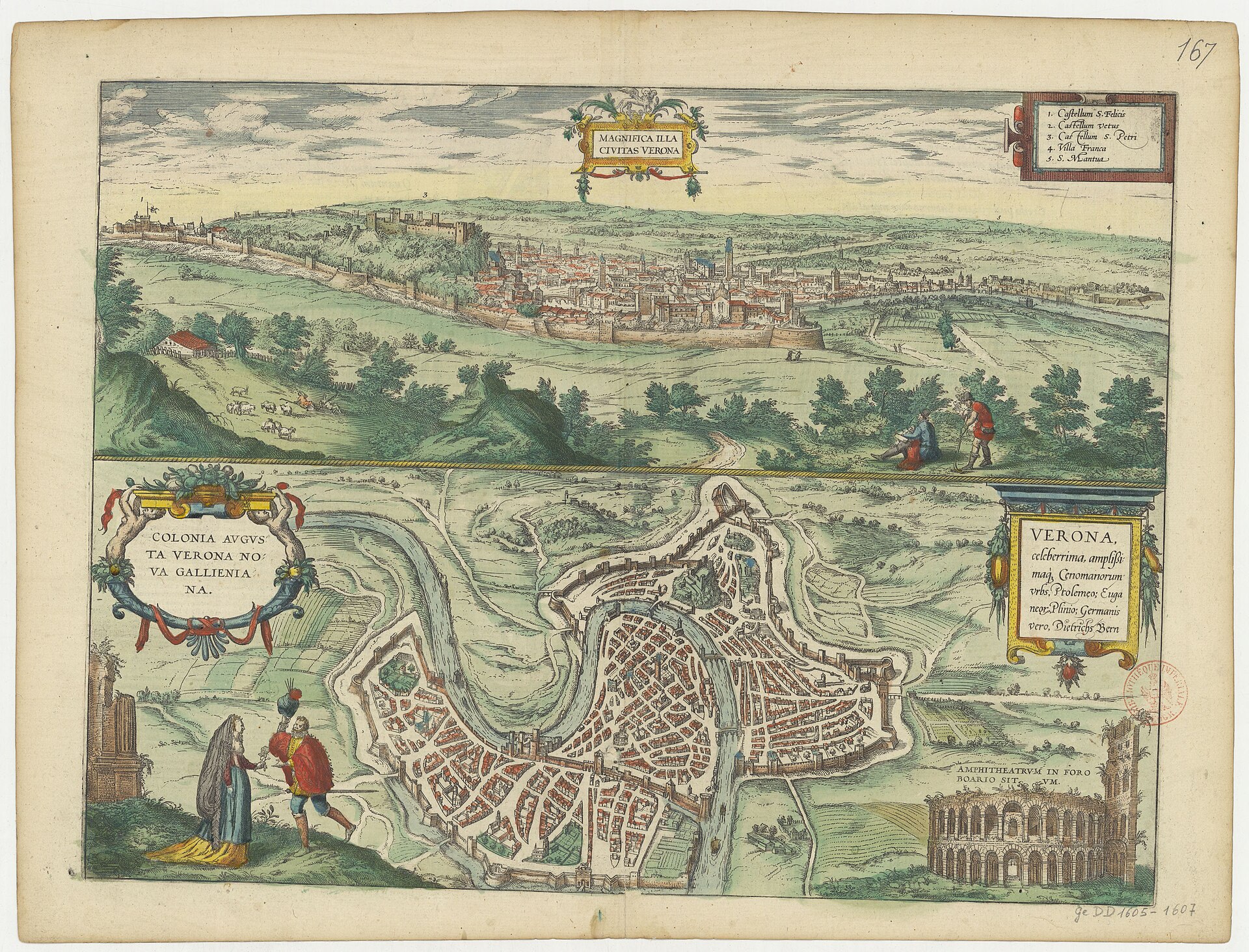
Bird's-eye view and plan of Verona, from Braun & Hogenberg's Civitates Orbis Terrarum
Depicts Verona's walled circuit with gates, the looping Adige River, dense street plan and the Roman amphitheatre (Arena) with towers and churches.
Public domain (plate dated 1645)

Castles of Verona

More cities to explore
 ItalyVeniceExplore it in 1200 · 1500 · 1740
 ItalyBolognaExplore it in 1280 · 1575
 ItalyRomeExplore it in AD 320 · 1300 · 1600 · 1770
 ItalyFlorenceExplore it in 1300 · 1490 · 1600
Castles of Europe · Landmarks of Europe · create your own reconstruction.