Historic Cities · Italy
Pisa through the ages
Pisa is a city and comune (municipality) in Tuscany, Central Italy, straddling the Arno just before it empties into the Ligurian Sea. It is the capital city of the Province of Pisa. Although Pisa is known worldwide for the Leaning Tower of Pisa, the city contains more than twenty other historic churches, and several medieval and Renaissance palaces, mostly facing each other on the avenues along th

Pisa in 1200
Pisa the Maritime Republic
Pisa in 1200 stands at the height of its maritime power, a river city whose ships and merchants link the Tyrrhenian to the Levant and the Byzantine world. This walk moves from the river mouth and port through the Arno's quays, markets and tower-houses to the white marble cathedral field, the round baptistery and the rising, already-leaning campanile, ending on the city walls' high viewpoints.
The skyline is a compact cluster of white marble and dark stone, low red-tiled roofs and a ring of crenellated walls; the cathedral complex punctuates a wide green beside the Arno, its round baptistery and a tall campanile visibly tilting as it climbs. Narrow, shaded streets run from the river to the Duomo, while the Arno's quays gather wooden ship-sheds, flat-hulled barges and returning galleys unloading spices, timber and bolts of eastern cloth.
The route: 22 streets, squares and views
Portus Pisanus → Sea Towers, Porto Pisano → Foce dell'Arno → Porta a Mare → Arno Warehouses → Arsenale (Ship-sheds) → Quay of the Galleys → Ponte di Mezzo → Borgo Stretto → Piazza delle Vettovaglie → …
Step inside, 12 interiors
River Warehouse Great Hall · Ship-sheds of the Arsenal · Galley Foreman's Shed · Bankers' Counting Chamber · Covered Market Hall · Striped Nave of the Basilica · Southern Aisle Arcades · Echoing Dome of the Baptistery · Tower Stair and Platform · Merchant Tower Great Hall · Fondaco of the Merchants · Gualandi Tower Hall
Planned from the Wikipedia record: Republic of Pisa.
Pisa in 1600
Medici Pisa
Pisa in 1600 is a Medici-ruled university town where students thread narrow lanes between marble churches and civic palaces. This walk follows the Arno, the university precinct, Vasari's reworked Piazza dei Cavalieri and the great cathedral precinct, passing botanical beds, riverside quays and the towers that mark Pisa's long maritime past.
A compact riverside city of pale, weathering marble and warm brick, Pisa in 1600 reads as a layered patchwork: broad river quays and low bridges, narrow shaded lanes and open ceremonial squares. White-washed pietra and darker stone have been worn to dove-grey; roofs are shallow terracotta. Church domes, the cathedral massing and the campanile pierce a low skyline; students, clerics, knights and river crews fill the streets and quays with steady human movement.
The route: 20 streets, squares and views
Road from San Piero a Grado → Porta a Lucca → Lungarno Gambacorti → Ponte di Mezzo → Santa Maria della Spina → Borgo Stretto → Piazza delle Vettovaglie → University of Pisa → Via Santa Maria → Piazza dei Cavalieri → …
Step inside, 12 interiors
Merchant Counting House · Covered Market Loggia · Dissection Hall · Natural Philosophy Hall · Grand Stair Hall · Audience Chamber · Knights' Church Nave · Botanical Study Pavilion · Cathedral Nave · Tower Spiral Staircase · Camposanto Cloister Gallery · Riverside Warehouse
Planned from the Wikipedia record: Pisa.
Its story
The story of Pisa.
The Only Port Between Genoa and Ostia
Excavations in the 1980s and 1990s, among them the fifth-century BC tomb of an Etruscan prince, established the Etruscan origin of the city at the mouth of the Arno and its early role as a maritime town trading with other Mediterranean peoples; the origin of the name is less settled, one reading taking it as Etruscan for mouth, another as a pre-Latin water-word akin to the Greek pisos, an irrigated place, which suits the water landscape of the Arno delta. Roman writers treated Pisa as an old city, and Virgil gave it the epithet Alphaea because it was said to have been founded by colonists from Pisa in Elis, a tradition modern criticism reads as a learned construction built on the shared name rather than the memory of a migration.
What is not in doubt is the harbour. Pisa was the only port on the western coast between Genoa, then a small village, and Ostia, and it served as a base for Roman naval expeditions against Ligurians and Gauls; ancient authorities credited the city with inventing the naval ram. It became a Roman colony under Roman law in 180 BC as Portus Pisanus, a municipium in 89 BC, and was fortified by Augustus into an important port renamed Colonia Iulia obsequens. The sea then began to withdraw: alluvium from the Arno and the Serchio pushed the shore west, so that Strabo placed the city four kilometres from the coast where it now stands nearly ten, and ships reached it by sailing up the river.
Lombards, Vikings and the First Communal War, 774–1003
Pisa declined less than other Italian cities in the last years of the Western Empire, probably because its river system made it easy to defend, and it was the only Byzantine centre of Tuscia to pass into Lombard hands peacefully, by assimilation with a neighbouring region in which its trading interests already lay. From that position it grew into the main port of the upper Tyrrhenian and the chief trading link between Tuscany and Corsica, Sardinia and the southern coasts of France and Spain. Charlemagne's defeat of the Lombard king Desiderius in 774 brought a crisis it soon recovered from, and the city became part of the duchy of Lucca. In 860 it was captured by vikings led by Björn Ironside.
From 930 Pisa was a county centre within the mark of Tuscia. Lucca was the capital, but in the middle of the tenth century Liutprand, bishop of Cremona, called Pisa the capital of the province, and a century later the marquis of Tuscia was commonly called the marquis of Pisa. In 1003 the city fought Lucca in what is described as the first communal war in Italy. Saracen piracy from the ninth century pushed it to build a fleet, which it then used offensively: Pisan ships attacked the North African coast in 828, helped defend Salerno in 871, and in 970 supported Otto I's expedition by beating a Byzantine fleet off the Calabrian coast.
The Maritime Republic and the First Crusade, 1005–1099
Pisan sea power peaked in the eleventh century, when the city gained its standing as one of the four historical maritime republics of Italy. It sacked Reggio Calabria in 1005, and in 1017 joined Genoa in backing the Sardinian Giudicati against the Saracen king Mugahid, who had established a base in northern Sardinia the year before; the victory gave Pisa supremacy in the Tyrrhenian, and the subsequent ousting of the Genoese from Sardinia founded a rivalry that shaped the next three centuries. Between 1030 and 1035 Pisa defeated rival towns in Sicily and took Carthage in North Africa, the admiral Jacopo Ciurini conquered Corsica in 1051–52, and in 1063 Admiral Giovanni Orlandi, aiding the Norman Roger I, took Palermo, whose captured gold paid for the beginning of the cathedral and the other buildings of the Piazza del Duomo.
Gregory VII recognised the Pisan laws and customs of the sea in 1077, Henry IV recognised the communal government in 1081, and in 1092 Urban II granted the city supremacy over Corsica and Sardinia and raised it to an archbishopric. A hundred and twenty Pisan ships joined the First Crusade under their archbishop Daibert, later patriarch of Jerusalem, and the Pisans were instrumental in the taking of Jerusalem in 1099. Out of the crusade came a chain of trading colonies (Antioch, Acre, Jaffa, Tripoli, Tyre and Latakia, with lesser establishments at Cairo, Alexandria and Constantinople), where the Pisans held privileges and exemption from taxation in exchange for helping defend the city that housed them. The Pisan quarter of Constantinople had grown to a thousand people by the twelfth century, and for some years Pisa was the Byzantine Empire's foremost commercial and military ally, ahead of Venice.
Wars with Genoa and Venice, 1119–1206
Pisan trade with Languedoc and Provence obstructed Genoese interests, and in 1119 the Genoese attacked Pisan galleys on their way home, beginning fourteen years of raiding at sea and on land. At the Council of Pisa in June 1135 Bernard of Clairvaux pressed the claims of Innocent II against Anacletus II, and Innocent II settled the Genoese conflict by fixing spheres of influence, freeing Pisa to act against Roger II of Sicily. Amalfi was taken on 6 August 1136, its ships destroyed and a relieving army driven back, and Salerno was sacked two years later. This brought Pisa to a standing equal to Venice.
As a firm supporter of the Ghibelline party, Pisa was rewarded by Frederick I with charters in 1162 and 1165 granting freedom of trade throughout the empire, the coast from Civitavecchia to Portovenere, and a street of merchant houses in every city of the Kingdom of Sicily. The grants marked the height of Pisan power and hardened the resentment of Lucca, Massa, Volterra and Florence, all of which wanted their own access to the sea; the quarrel with Lucca also turned on control of the Via Francigena, the main trade road between Rome and France. War with Genoa resumed in 1165 and ran to 1175 without decisive result; Pisa took Messina in 1192, Genoa took Syracuse in 1204, and Innocent III then allied himself with the Florentine-led Guelph League of Tuscany and made a pact with Genoa as well. Against Venice, a non-aggression treaty of 1180 gave way to attacks on Venetian convoys; after the Pisans blockaded Brindisi in 1199 and were beaten at sea, the treaty of 1206 ended their ambitions in the Adriatic.
Meloria and the Silting of the Port, 1230–1324
The merchant class had outgrown the old constitution. The consuls were abandoned and in 1230 the city named a capitano del popolo as its civil and military head; in 1254 the people rebelled and imposed twelve Anziani del Popolo as their representatives, adding People's Councils drawn from the main guilds and the chiefs of the People's Companies. None of it settled the feud between the Della Gherardesca and the Visconti, which harassed the city and its conquered lands even after the archbishop and Frederick II intervened in 1237. Abroad, a Pisan and Sicilian fleet under the emperor's son Enzo attacked a Genoese convoy carrying prelates to an anti-imperial council off the isle of Giglio in 1241, taking about a thousand sailors, two cardinals and a bishop prisoner; the council failed and Pisa was excommunicated for it until 1257.
The decline is dated to 6 August 1284, when the numerically superior Pisan fleet under Albertino Morosini was beaten at Meloria by the Genoese under Benedetto Zaccaria and Oberto Doria. Pisan sea power ended there, and the city never fully recovered: in 1290 the Genoese destroyed Porto Pisano and covered the ground with salt, and the thinly peopled country around Pisa could not replace the thousands of sailors lost, where Liguria could keep supplying Genoa. Trade continued in reduced volume until the Arno changed course and galleys could no longer reach the river port; the surrounding area is also thought to have become malarial. Sardinia was lost entirely to the Aragonese in 1324.
Florentine Conquest and the Second Pisan Republic, 1315–1509
Still Ghibelline, Pisa tried to rebuild its position in the fourteenth century and beat Florence at Montecatini in 1315 under Uguccione della Faggiuola. It was not enough. After a long siege the Florentines took the city in 1405, having bribed the capitano del popolo Giovanni Gambacorta to open the San Marco gate at night; Pisa was never taken by an army. In 1409 it hosted a council convened to settle the Great Schism, and through the fifteenth century the port silted up and lost its outlet to the sea.
When Charles VIII of France invaded the Italian states in 1494 to claim the Kingdom of Naples, Pisa declared itself independent again as the Second Pisan Republic. Fifteen years of Florentine sieges under Antonio da Filicaja, Averardo Salviati and Niccolò Capponi failed to take it; Vitellozzo Vitelli and his brother Paolo alone breached the defences, at the Stampace bastion on the south-western walls, but did not go in, and on suspicion of treachery Paolo was put to death. Pisan resources ran out in the end, the city was sold to the Visconti of Milan and passed once more to Florence, and Livorno took over as the main port of Tuscany.
Livorno Takes the Port, Pisa Takes the University
What remained was a cultural and academic role. The University of Pisa had been created in 1343. The Piazza dei Cavalieri was rebuilt to Giorgio Vasari's designs, with the Palazzo della Carovana and the church of Santo Stefano dei Cavalieri, which holds spoils from the naval battles fought by the Knights of St Stephen against the Turks between the sixteenth and eighteenth centuries, including the battle pennant taken from Ali Pasha's flagship at Lepanto in 1571. Galileo Galilei was born in the city and showed the Grand Duke of Tuscany the planets he had found with his telescope from the Palazzo Reale on the Lungarno.
Tuscany passed under French and Spanish control for fourteen years: the Kingdom of Etruria was created out of the Grand Duchy by the Treaty of Aranjuez in 1801, Napoleon dissolved it in 1807 and put Pisa in the French department of Méditerranée, and the Congress of Vienna restored the Grand Duchy to Ferdinand III of Habsburg-Lorraine in 1815. The Scuola Normale Superiore was founded in the middle of that period, in 1810, by Napoleonic decree as a branch of the École Normale Supérieure of Paris, and was recognised as a national university in 1862, a year after Italian unification; the Sant'Anna School of Advanced Studies grew out of it in 1987.
Pisa suffered repeated destruction in the Second World War. Every bridge in the city dates from the middle of the twentieth century, the earlier ones having been wrecked by Allied bombing or by the retreating Germans, and the city holds the bronze medal for military valour for the war of liberation, awarded for the sacrifices of its people and for partisan activity. It is the capital of its province, with a population of about 90,500 and an international airport named after Galileo Galilei. At the end of 2023 foreign residents numbered 12,327, 13.83 per cent of the population, the largest groups coming from the Philippines, Romania, Albania, Bangladesh, Ukraine and Senegal, while the Pisan-born population has kept thinning through low birth rates and movement out to neighbouring communes where housing is cheaper.
From the archive
Pisa on paper: the old town as it was mapped.
A period plan or bird's-eye view of the old town, drawn between 1500 and 1850, the streets this page's reconstructions walk. Public domain, with its source named.
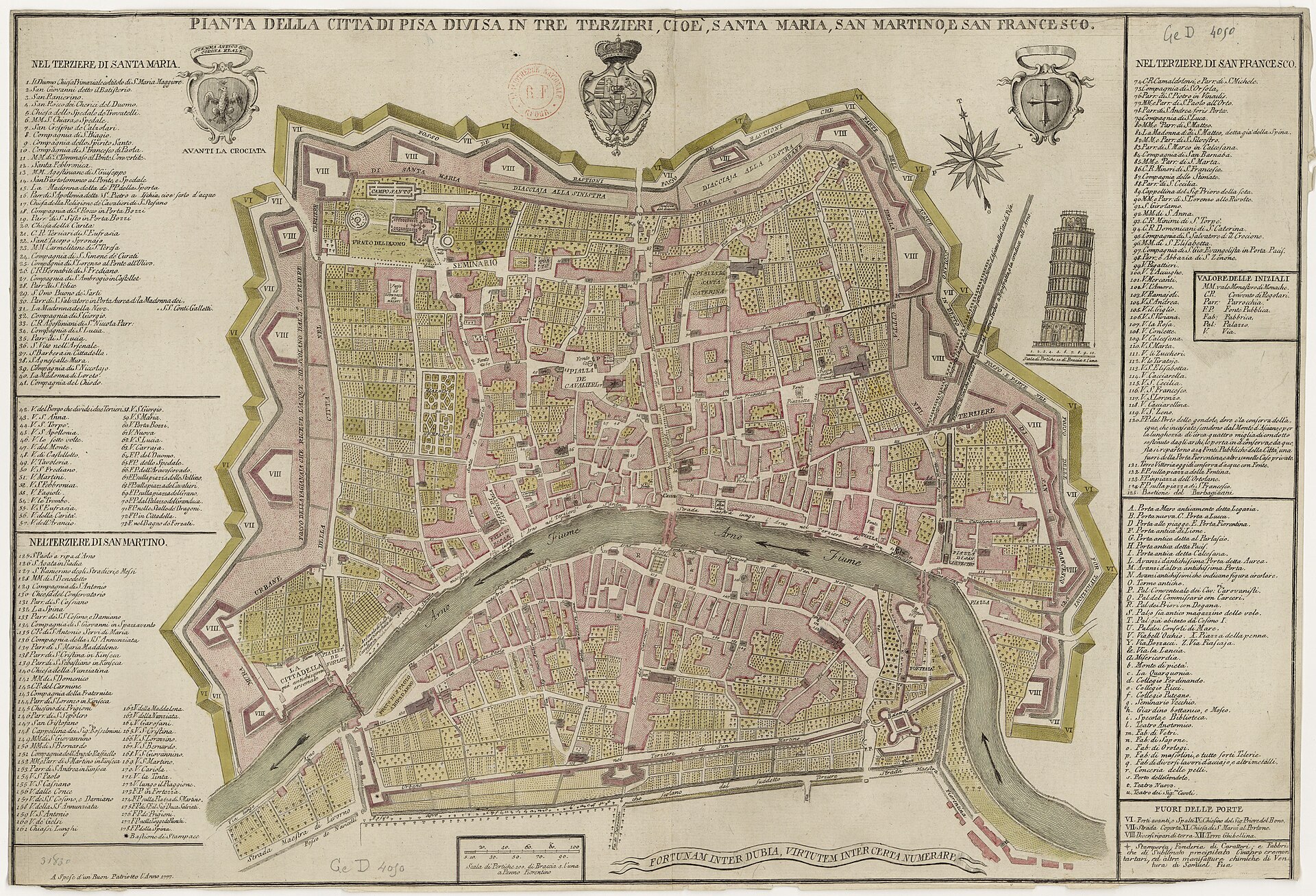
Plan of the city of Pisa divided into three terzieri (Santa Maria, San Martino, San Francesco)
Shows bastioned city walls and gates, the River Arno with multiple bridges, street blocks, the cathedral complex and an inset of the Leaning Tower.
1777 · Wikimedia Commons
Public domain (plate dated 1777)


More cities to explore
 ItalyLuccaExplore it in 1420
 ItalySan GimignanoExplore it in 1300 · 1900
 ItalyRomeExplore it in AD 320 · 1300 · 1600 · 1770
 ItalyVeniceExplore it in 1200 · 1500 · 1740
Castles of Europe · Landmarks of Europe · create your own reconstruction.