Historic Cities · Italy
Lucca through the ages
Lucca is a city and comune in Tuscany, Central Italy, on the Serchio River, in a fertile plain.

Lucca in 1420
Republic of Silk
Lucca in 1420 is Paolo Guinigi's silk republic, a compact medieval city of commerce and towers held within its ancient walls. The walk moves from the river plain into market squares, along mill channels where silk is thrown and dyed, past lofty private towers and marble church fronts, ending on the ramparts that look out over mulberry orchards and the Serchio.
The skyline is a close constellation of brick and stone towers, squat church campaniles and the occasional marble façade, all in a palette of warm terracotta, pale local marble and dark timber. Streets are narrow and flagged, opening into small market piazzas where arcades and loggias catch light; watercourses and mill channels cut cool shadows beside wooden sheds. Mulberry trees and the green crowns of rooftop oaks on Torre Guinigi break the compact roofscape, while merchants, clerks and artisans animate every lane.
The route: 14 streets, squares and views
Serchio River Approach → Porta San Pietro → Via Fillungo → Piazza San Michele → Torre delle Ore → Torre Guinigi → Palazzo Guinigi → Piazza dell'Anfiteatro → Piazza San Francesco → Duomo of San Martino → …
Step inside, 8 interiors
Merchant's Sample Hall · Painted Chamber · Amphitheatre Courtyard House · Volto Santo Shrine Chapel · Ilaria del Carretto's Tomb · Mint Hall · Weaver's Loft of Drawlooms · Silk-Throwing Mill Shed
Planned from the Wikipedia record: Republic of Lucca.
Its story
The story of Lucca.
Colony and Frontier Fortress, 220–56 BC
The plain by the left bank of the Serchio was settled before Rome reached it, though the accounts differ on by whom: the Etruscans are attested here, with traces of a probable earlier Ligurian presence, while other readings put an Etruscan foundation at around 220 BC. What made the place a town was Roman. Luca was granted the status of a Roman colony in 180 BC and became a municipium in 89 BC, and the rectangular grid of the old centre still follows the Roman street plan, cardo and decumano surviving as the lines of Via Fillungo and Via San Paolino. The forum lay where Piazza San Michele is now; the outline of the amphitheatre survives in the Piazza dell'Anfiteatro and that of a theatre in Piazza Sant'Agostino, and fragments of the Roman walls are built into the church of Santa Maria della Rosa.
Luca was a frontier fortress. It sat on the early boundary of the Roman Republic and guarded the approach from the north against attack, and the stone blocks recovered from its defences are of exceptional size; on the Peutinger Table the city is drawn not as a settlement but as a fortification. In 56 BC Julius Caesar, Pompey and Crassus met here and reaffirmed the alliance known as the First Triumvirate, an occasion at which Caesar had his proconsular command in Gaul extended by a further five years.
Lombard Capital and the Via Francigena, 553–1181
Frediano, an Irish monk, was bishop of Lucca in the early sixth century. The city was taken by the Goths and, in the following century, by the Byzantines; it was plundered at one point by Odoacer, and in 553 Narses besieged it for several months, which is measure enough of how strong its walls still were. From 576 it was the capital of the Lombard Duchy of Tuscia, which covered much of present-day Tuscany and the Viterbo country, and it minted its own coins. Desiderius, third count of Lucca, was elected Rex Langobardorum in 756. Lombard rule ended in 773 when Charlemagne defeated the dukes of Lucca, and the fifth count, Wicheramo, became his vassal.
Under Carolingian rule the city held the position it had won and began to live by trade and cloth. Its other business was pilgrims. The Volto Santo, an eight-foot wooden crucifix held to be the oldest surviving wooden carving in Europe and traditionally attributed to Nicodemus, arrived in 742, and with the relics of Saint Fridianus, San Regolo and San Cesario of Terracina (the last brought from the Domus Augustana on the Palatine during the pontificate of Alexander II) it made Lucca one of the principal stops on the Via Francigena, the pilgrim road between Rome and the north. When Sigeric, Archbishop of Canterbury, recorded his return journey from Rome at the end of the tenth century, Luca was the twenty-sixth stage.
A Jewish community lived in the city through the medieval centuries; the earliest mention of it is a document of 859. It was led by the Kalonymos family, which later became a major component of proto-Ashkenazic Jewry. The bishopric mattered beyond Tuscany: Anselm of Baggio, appointed in 1057, went on to the papacy as Alexander II, recovered alienated property for the church of Lucca, drew donations on the strength of his standing and had the cathedral rebuilt; his nephew Anselm II, bishop from 1073 to 1086, was a prominent figure in the Investiture Controversy. The Allucingoli, among the leading families of the High Middle Ages here, produced Pope Lucius III in 1181.
Silk, the Commune and Castruccio Castracani, 1160–1328
Lucca grew rich on silk. The trade began in the eleventh century and came to rival the silks of Byzantium; Lucca cloth, woven with gold or silver thread, was sought across Europe, its quality put down to the fineness of the material and the beauty of the decoration. After the death of Matilda of Tuscany (the city had been capital of the feudal margraviate of Tuscany during the tenth and eleventh centuries, largely independent but owing nominal allegiance to the Holy Roman emperor) Lucca constituted itself an independent commune under a charter in 1160. Dante, who spent part of his exile in the city, filled the Divine Comedy with references to the great feudal families of the region and their administrative and judicial jurisdictions.
In 1273 and again in 1277 the city was ruled by a Guelph capitano del popolo, Luchetto Gattilusio. Internal discord let Uguccione della Faggiuola of Pisa make himself lord of Lucca in 1314; the Lucchesi expelled him two years later and handed the city to another condottiero, Castruccio Castracani degli Antelminelli, under whom it became a leading state in central Italy and the only serious check on Florentine expansion. On 22 and 23 September 1325 Castracani beat the Florentine Guelphs at Altopascio and pursued them to the walls of Florence, and for it Louis IV the Bavarian named him duke of Lucca. He died in 1328 and is buried in the church of San Francesco; Machiavelli wrote his life.
Sold, Pawned and Besieged, 1328–1430
Castracani's death left the city a possession to be traded. Occupied by the troops of Louis of Bavaria, Lucca was sold to a rich Genoese, Gherardino Spinola, seized by John, king of Bohemia, pawned to the Rossi of Parma, ceded by them to Mastino II della Scala of Verona, sold to the Florentines, surrendered to the Pisans, and passed under the Visconti and under Giovanni dell'Agnello, doge of Pisa. Liberty was recovered in 1370 through the intervention of the emperor Charles IV, who left the city nominally under his vicar; Lucca gave itself a republican government and, on careful diplomacy, its bankers and its silk, regained a name in Europe. Charles IV also granted it the right to a studium generale, but no working university operated in Lucca before 1787. In 1408 Pope Gregory XII convened his cardinals here in an attempt to end the papal schism.
Apart from short periods of lordship such as that of Paolo Guinigi, the republic held. In 1429 Florence besieged Lucca in revenge for Guinigi having taken Milan's side in the previous war; Lucca appealed to Milan, and Francesco Sforza's army drove the Florentines off. Days later the Lucchesi arrested Guinigi, on the report that he had been treating with Florence, and Florence paid Sforza to abandon the city. The siege resumed in 1430. The Florentines tried to dam the Serchio and flood Lucca and, through miscalculation, flooded their own camp instead. Filippo Maria Visconti, barred by treaty from intervening against Florence directly, had Genoa act for him: invoking an old alliance with Lucca, Genoa sent 6,000 men under Niccolò Piccinino, who attacked on the Serchio, and after a bloody battle the Florentines withdrew when the Lucchesi came out of the city behind them.
Libertas Extinguished, 1628–1861
Lucca was the second largest Italian city state after Venice to keep a republican constitution and its independence across the centuries. It governed itself at first as a democracy and, after 1628, as an oligarchy, and painted the word Libertas on its banner until the French Revolution of 1789. The independence ended in 1799, when French troops took the city and the old republic was put down; between 1799 and 1800 French and Austrian armies contested it, the French prevailed, and a democratic constitution was granted in 1801.
In 1805 the republic was converted into a monarchy. At the request of the Lucca senate the Principality of Lucca and Piombino was constituted on 23 June and given to Napoleon's sister Elisa Bonaparte Baciocchi and her husband Felice Baciocchi. The Congress of Vienna replaced it with a Bourbon-Parma duchy: Maria Luisa of Spain took over as regent on 10 May 1815 and her son Charles II succeeded her in 1824. The Duchy of Parma meanwhile had been assigned for life to Marie Louise, Napoleon's second wife, and under the Treaty of Vienna her death in 1847 sent Parma back to Charles II while Lucca lost its independence and was annexed to the Grand Duchy of Tuscany. As part of Tuscany it passed to the Kingdom of Sardinia in 1860 and to the Italian state in 1861.
Camp PG 60 and the Liberation, 1942–1944
In 1942 a prisoner-of-war camp was established at the village of Colle di Compito, in the municipality of Capannori about 11 kilometres from Lucca. Its official number was P.G. 60 and it was generally called PG 60 Lucca. It never had permanent structures; the prisoners were housed in tents on ground prone to flooding, and more than 3,000 British and Commonwealth prisoners of war passed through it. On 10 September 1943, shortly after the Italian armistice was signed, the camp was handed over to the Germans. Under the Italian Social Republic, the German puppet state, political prisoners, foreigners, common-law prisoners and Jews were interned there and it functioned as a concentration camp. In June 1944 the prisoners were moved to Bagni di Lucca. Lucca was liberated on 5 September 1944 by Allied troops advancing slowly towards the Gothic Line.
The Walls That Were Never Stormed
The wall circuit built between the fifteenth and seventeenth centuries runs about 4,223 metres around the old city and was never used for the purpose it was raised for. Having lost its military value the rampart was turned, from the second half of the nineteenth century, into a pedestrian promenade, the Passeggiata delle Mure Urbane, which runs over the gates and links the bastions; the roadway on top was wide enough that it served as the city's ring road, heavy traffic included, until the last stretch was closed to vehicles in the 1980s. Lucca is one of four Italian provincial capitals whose Renaissance circuit survives intact, with Ferrara, Grosseto and Bergamo, and the historic centre inside it is largely unaltered. The comune, capital of the Province of Lucca, covers 185.79 square kilometres and has a population of about 88,000.
From the archive
Lucca on paper: the old town as it was mapped.
A period plan or bird's-eye view of the old town, drawn between 1500 and 1850, the streets this page's reconstructions walk. Public domain, with its source named.
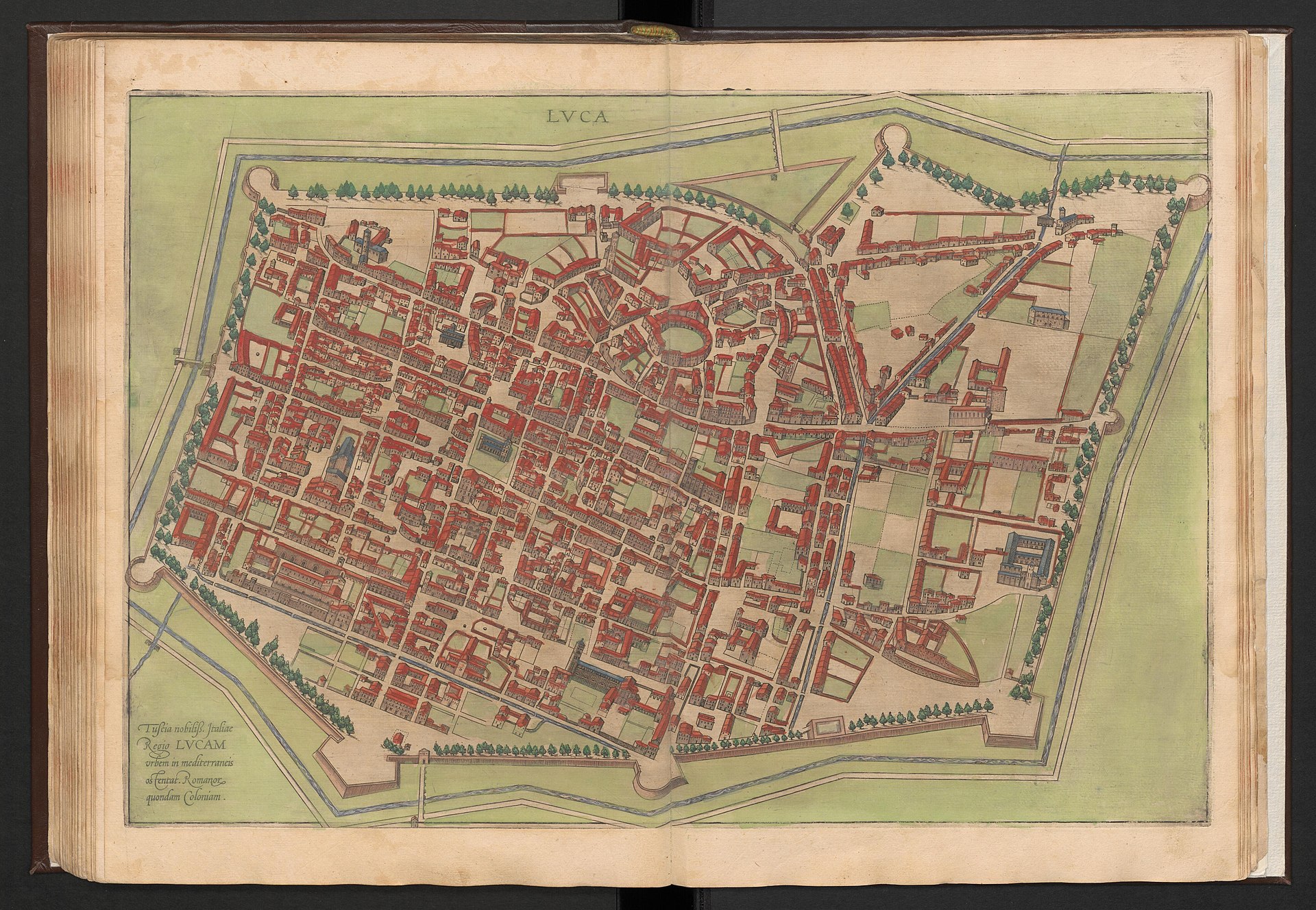
Bird's-eye view of Lucca, from Civitates Orbis Terrarum by Georg Braun and Frans Hogenberg (1594)
Shows Lucca’s encircling bastioned walls and moat, city gates, inner street grid, churches and open cloistered blocks.
1594 · Georg Braun · Wikimedia Commons
Public domain (plate dated 1594)
More cities to explore
 ItalyPisaExplore it in 1200 · 1600
 ItalyFlorenceExplore it in 1300 · 1490 · 1600
 ItalyRomeExplore it in AD 320 · 1300 · 1600 · 1770
 ItalyVeniceExplore it in 1200 · 1500 · 1740
Castles of Europe · Landmarks of Europe · create your own reconstruction.