Historic Cities · Italy
Naples through the ages
Naples is the regional capital of Campania, southern Italy. With a population of 905,050 within the city's administrative limits as of 2026, it is the largest city in southern Italy and the third-largest city in Italy after Rome and Milan, while its province-level municipality is the third most populous metropolitan city in Italy with a population of 2,954,847 residents, or the second largest acco

Naples in 1350
Angevin Naples
This is Naples under the Angevin kings: a crowded maritime capital where the new royal stronghold of Castel Nuovo presides over a busy bay while Vesuvius smokes beyond the galleys. The walk follows quays, market squares and the medieval streetgrid between great churches (Santa Chiara, San Domenico and San Lorenzo), and the compact merchant quarter where clerks, sailors and craftsmen meet.
Stone towers and low ochre houses press the shore; the dark mass of Castel Nuovo rises directly from the mole, its Angevin battlements visible from the approach. Timber galleys and small fishing feluccas crowd the harbour, nets drying along the riva. The dense medieval centre threads three ancient decumani lined with overhanging timber shops, open markets and Gothic church gables in gray volcanic stone. Mount Vesuvius, smoking by day, frames the bay.
The route: 21 streets, squares and views
Bay of Naples → Port of Naples → Castel Nuovo → Mole and Quays → Borgo Marinari → Castel dell'Ovo → Riva di Santa Lucia → Piazza del Mercato → La Pescheria → Borgo dei Mercanti → …
Step inside, 14 interiors
Ship Chandlery · Barons' Great Hall · Sea-Keep Chamber · Meat Hall · Fish Stalls' Shed · Silk Fondaco · Weavers' Workshop · Merchant Church Nave · Chapter House · Monastery Scriptorium · Palace Court Hall · Tanners' Loft · Gothic Nave · Inner Cloister Garth
Planned from the Wikipedia record: Kingdom of Naples.
Naples in 1650
Spanish Naples
This is Naples under the Spanish viceroys, a crowded Mediterranean capital where Baroque churches and fortress walls press close to fishing quays and markets. The walk moves from the bay and harbour into the dense streets of the Spanish Quarter and up to the Certosa di San Martino above the city, showing markets, workshops, and the lazzaroni of everyday urban life.
The skyline is a serried mass of terracotta roofs, church domes and tall campaniles backed by Vesuvius and the open Gulf of Naples. Many façades are rough volcanic tuff or lime-washed plaster in ochres and paler pinks, pierced by narrow, sunken alleys and shuttered windows. Streets alternate broad, crowded thoroughfares like Strada di Toledo with the claustrophobic lanes of the Quartieri Spagnoli; the harbour smells of fish, pitch and smoke, and scaffolds and laundry line the dense blocks.
The route: 21 streets, squares and views
Gulf of Naples and Vesuvius → Castel dell'Ovo and Borgo Marinari → Santa Lucia Shore → Molo Grande and Quays → Maschio Angioino (Castel Nuovo) → Porta Alba (Port'Alba) → Porta Capuana Gate → Piazza del Mercato → Forcella Neighbourhood → Via dei Tribunali (Decumano) → …
Step inside, 13 interiors
Mariners' Tavern Room · Shipwright's Warehouse · Barons' Hall · Great Meat Hall · Street-level Basso Room · Ribera's Studio · Nativity Sculptor's Workshop · Cathedral Nave · Viceroy's Grand Stair · Palazzo Salone · Fishmarket Shed · Fortress Guardroom · Certosa Marble Church
Planned from the Wikipedia record: History of Naples.
Naples in 1780
Grand Tour Naples
Naples in 1780 is the Bourbon capital where music, antiquities and volcanic spectacle draw foreign travellers and the city's own lazzaroni into the streets. The walk moves from the harbour and seafront through opera, royal palaces and the old Greek decumani, finishing at Capodimonte with a wide view of Vesuvius and the Bay of Naples.
The skyline is a close-packed collage of low ochre palaces, church domes, tiled roofs and terraces, punctuated by the dark volcanic towers of Castel Nuovo and Castel dell'Ovo. The Bay of Naples and the cone of Vesuvius dominate the horizon; the sea brightens façades and throws strong shadows into narrow streets. Streets run in long straight decumani with tight side alleys; materials are stucco, plastered brick and local tuff, with wooden shutters, iron balconies and laundry lines between buildings.
The route: 22 streets, squares and views
Golfo di Napoli → Molo Grande → Castel Nuovo → Borgo Marinari → Castel dell'Ovo → Santa Lucia Seafront → Chiatamone → Via Chiaia → Palazzo Reale Forecourt → Teatro di San Carlo → …
Step inside, 14 interiors
Maschio Great Hall · Harbour Chamber · Hamilton's Cabinet of Vases · Chiaia Lazzaroni Osteria · Scalone d'Onore · Six-Tiered Auditorium · Royal Box of Bourbon · Silk Merchant's Showroom · Refectory of San Domenico · Pompeian Antiquities Gallery · Porcelain Display Salon · Porcelain Painting Room · Wood-Fired Kiln Hall · Monastery Belvedere Loggia
Planned from the Wikipedia record: History of Naples.
Its story
The story of Naples.
Parthenope, Neapolis and a City That Lived Off the Sea
Accounts of the first Greek town on the bay differ: one has sailors from Rhodes establishing a small commercial port called Parthenope, named for a siren, on the island of Megaride in the ninth century BC, later extended by Cumaeans; another has Cumae, the earliest Greek city on the Italian mainland, founding it outright at the end of the eighth. It stood on the Pizzofalcone promontory, commanding the sea traffic of the bay, and when it began to draw people away the Cumaeans, fearing their own city would empty, resolved to destroy it.
Neapolis, the New City, was founded by Cumaean aristocrats whom the tyrant Aristodemus had expelled after the victory of Aricia in 507 BC, and was laid out on a rectangular grid; the older centre on Pizzofalcone survived beside it as Palaepolis, the old city. Marshes made the routes inland difficult and denied Neapolis the farmland most of Campania enjoyed, so the city turned to the sea and to trade for its living. It took over Cumae's maritime business and the water from the Cumaean gulf to the bay of Naples after the fall of the Deinomenid tyranny at Syracuse in 466 BC. Athenian traders, needing grain for a growing population, built up the port and tied it to the wheat-growing plains at Capua, Nola and Cumae, until the destruction of the Athenian expedition against Syracuse in 413 BC loosened the connection.
From the Samnite Wars to Roman Naples, 423 BC–AD 476
At the end of the fifth century BC the Oscan-speaking Samnites pushed towards the richer plains. Capua fell to them in 423 BC and Cumae capitulated in 421 after a bloody siege; many who fled Cumae were taken in behind the walls of Neapolis, which then kept its own sovereignty by admitting Oscan elites to the city's chief offices, a course that badly damaged its standing with Cumae. During the First Samnite War it allied with the Samnites against a Rome that had already taken Capua. Livy, whose account may be partial, says Neapolis attacked Romans living in Campania and rebuffed Rome's demand for redress; in 326 BC the consul Publilius Philo laid siege, with about four thousand Samnite and Nolan troops inside, and after a year betrayal by Greek citizens gave the city to Rome. Rome left it wide autonomy, allowing its customs, language and Greek traditions to stand, and made with it the pact known as the foedus Neapolitanum, with particular regard to its maritime role.
From 199 BC its standing as a sea power began to slip towards its neighbour Puteoli, and promotion to Roman municipium cost part of its autonomy, though administration in the Greek manner remained. Neapolis then backed the losing side twice, siding with Marius in the civil war of 82 BC (for which Sulla's armies devastated it, taking its fleet and the island of Ischia), and with Pompey against Caesar in 50 BC.
Under Augustus the city recovered as a centre of Hellenistic culture, drawing Romans who wanted to perfect their Greek: Augustus founded the Isolympic Games, the Sebasta, in AD 2 as an equivalent of those at Olympia and attended in person in AD 14. Long after Hellenism declined elsewhere in Magna Graecia, Neapolis still used the Greek language, institutions and cults. The eruption of Vesuvius in 79 set the city back. Januarius, who became its patron saint, was beheaded at nearby Pozzuoli in 305, and in 476 Romulus Augustulus, the last nominal emperor in the west, was exiled to a villa on the site of the Castel dell'Ovo.
The Duchy: Byzantine Siege to Norman Surrender, 536–1137
Naples suffered badly in the Gothic War. Garrisoned by Goths, it resisted the Byzantine commander Belisarius in 536 until his troops got in through its aqueduct; the Ostrogoth Totila starved it into surrender in the 540s, and Narses took it back for the empire in the 550s. When the Lombards overran much of Italy it stayed loyal to Constantinople, its population then about 30,000 to 35,000. A duchy was created in 638 under an official sent from abroad, and in 661, with the emperor's permission, Naples was governed by a local duke, Basilius, whose loyalty to Constantinople soon became nominal. Duke Stephen II transferred his allegiance to the Pope in 763, and in 840 Duke Sergius I made the succession hereditary, leaving the city independent in fact.
Naples was not a trading city like Amalfi or Gaeta but a military one, run by warriors and landowners and stripped by the Lombards of much of its inland territory. It kept a fleet, and dealt with anyone useful: in 836 it asked Saracen help to break a siege by Lombard troops from the Duchy of Benevento. The city declined through the tenth century and was taken by its old rival Pandulf IV of Capua. In 1027 Duke Sergius IV, needing help in the war with Capua, granted the county of Aversa to Norman mercenaries under Rainulf Drengot, the settlement that began the process ending Neapolitan independence. In 1137 the last duke, Sergius VII, surrendered to Roger II of Sicily, and Naples passed into the Kingdom of Sicily under a palatine count, its population around 30,000 and its commerce largely in Pisan and Genoese hands.
Capital of the Kingdom: Hohenstaufen, Anjou and Aragon, 1191–1503
When the Sicilian succession was disputed between Tancred and the Hohenstaufen, Henry VI invaded in 1191 and many cities gave in, but Naples held out from May to August until disease forced the Germans back. Tancred captured the empress Constance and held her at the Castel dell'Ovo until her release in May 1192. Henry returned in 1194 after Tancred's death, met no resistance, and the kingdom passed to the Hohenstaufen. Frederick II founded the university in 1224 (the first in Europe intended to train secular administrators), and treated Naples as the intellectual capital of a kingdom whose political centre stayed at Palermo.
After Frederick's son Manfred was defeated in 1266 the kingdom was given to Charles of Anjou, who moved the capital from Palermo to Naples and settled in the Castel Nuovo, with a quarter of noble palaces and Gothic churches rising around it. After the Sicilian Vespers the kingdom was split, an Aragonese king holding the island and an Angevin king the mainland, the war between them closing with the Peace of Caltabellotta in 1302. The division did not check Naples: Tuscan bankers joined the Pisan and Genoese merchants, and Boccaccio, Petrarch and Giotto came too. Alfonso of Aragon defeated the last Angevin king, René, in 1442 and entered in triumph the following February; his dynasty tied Naples commercially to the Iberian peninsula, but its land grants to provincial nobles fragmented the kingdom. In 1501 the Neapolitan king Frederick was taken prisoner to France and the kingdom came under French rule; Spain won it at the Battle of Garigliano in 1503.
Spanish Viceroys, Masaniello and the Plague of 1656
The Spanish conquest began nearly two centuries of government by viceroys, under whom the population rose from 100,000 to 300,000, ranked in one account second in Europe only to Istanbul, in another second only to Paris. The most consequential of them, Pedro Álvarez de Toledo, imposed heavy taxation and favoured the Inquisition while opening the main street that still bears his name and strengthening the walls, work that by 1560 had made Naples the largest and best fortified city of the Spanish empire. Not all its people stayed: in 1544 around 7,000 were taken as slaves by Barbary corsairs and carried to the Barbary Coast of North Africa. Caravaggio, Salvator Rosa and Bernini worked in the city, as did the philosophers Giordano Bruno and Tommaso Campanella.
The pressures of an overcrowded city broke out in July 1647, when the fisherman Masaniello led the populace in revolt against Spanish rule. The Neapolitans declared a republic and asked France for support; the Spanish put the rising down in April of the following year. In 1656 an outbreak of bubonic plague killed about half the city's 300,000 inhabitants, and a period of decline followed.
Bourbons, the Parthenopaean Republic and the End of the Kingdom, 1714–1861
Spanish rule ended in 1714 and the Austrian Habsburgs governed through viceroys of their own until 1734, when the two kingdoms were joined under the independent crown of Charles of Bourbon. Charles built the Villa di Capodimonte and the Teatro di San Carlo and drew jurists such as Gaetano Filangieri to the city; his attempts at reform stopped when news of the French Revolution arrived. By then the population was largely the lazzaroni, living in extreme poverty beneath a heavy royal bureaucracy and a landowning elite.
French revolutionary troops entered in January 1799, welcomed by a small pro-revolutionary part of the middle class and resisted hard by the royalist, devout lazzari. The short-lived Parthenopaean Republic tried to win support by abolishing feudal privileges, but the mass of the people rose against it and the republicans surrendered in June 1799. On the restored monarchy's order Admiral Horatio Nelson arrested the leaders of the revolution and handed them over for execution (Francesco Caracciolo, Mario Pagano, Ettore Carafa and Eleonora Fonseca Pimentel), and was rewarded by the king with the dukedom of Bronte. Napoleon took the kingdom in 1806 and gave it to his brother Joseph Bonaparte and then, in 1808, to Joachim Murat, whom the Austrians defeated in the Neapolitan War of 1815, restoring Ferdinand. The Congress of Vienna joined Naples and Sicily as the Kingdom of the Two Sicilies with Naples as capital, and in 1839 the Naples–Portici line made the city the first on the Italian peninsula to have a railway. On 6 September 1860 Garibaldi entered by train, and a plebiscite that October ended the kingdom and carried Naples into the Kingdom of Italy.
Cholera, Four Million Emigrants and the Four Days of Naples
Unification exposed an economy resting on agriculture to international wheat prices, and cheap sea fares did the rest: an estimated four million people emigrated from the Naples area between 1876 and 1913. In the forty years after unification its population grew by 26 per cent against 63 per cent for Turin and 103 for Milan, though at 496,499 in 1884 it was still the largest city in Italy. Twelve epidemics of cholera and typhoid killed some 48,000 people between 1834 and 1884, and a major cholera epidemic in August 1884, largely caused by the sewers, prompted the government in 1885 to order the risanamento, meant to replace the most crowded quarters with wide avenues. Corruption exposed by the Saredo Inquiry, land speculation and bureaucracy delayed it badly.
Naples was the most-bombed Italian city of the Second World War. Neapolitans had not risen against Italian Fascism, but the city was the first in Italy to rise against the German occupation: between 28 September and 1 October 1943 the population drove the Germans out in what is known as the four days of Naples, and the German commander, Colonel Scholl, negotiated a surrender to insurgents, the first time in Europe that had happened. Armoured patrols of the King's Dragoon Guards, the first Allied unit to arrive, found it already free and went on towards Rome. The departing Germans burned the university library, destroyed the city archives, looted food and fuel, blew up the gas, water and sewage mains, wrecked the port, scuttled more than 300 ships in the harbour and destroyed three-quarters of the major bridges; time bombs left behind went on exploding into November. The rebuilding of Santa Chiara, destroyed in a United States Army Air Corps raid, became the symbol of the city's recovery.
Italy's Fund for the South paid into Naples from 1950 to 1984 and the economy improved somewhat, but unemployment stayed high: by August 2011 a quarter of a million people in the area had no work. Organised crime is deeply rooted: more than 120 people died in Camorra killings in 2004, many of them connected to the drug trade. The population peaked at 1,226,594 in 1971 and has fallen by 26 per cent since as residents moved to the suburbs. Naples is the regional capital of Campania, with 905,050 people within its administrative limits as of 2026 and 2,954,847 in its metropolitan city; its historic centre is a UNESCO World Heritage Site and its port among the busiest in the Mediterranean. Immigrants made up 6.8 per cent of the population as of 2025, a far smaller share than in northern Italian cities.
From the archive
Naples on paper: the old town as it was mapped.
A period plan or bird's-eye view of the old town, drawn between 1500 and 1850, the streets this page's reconstructions walk. Public domain, with its source named.
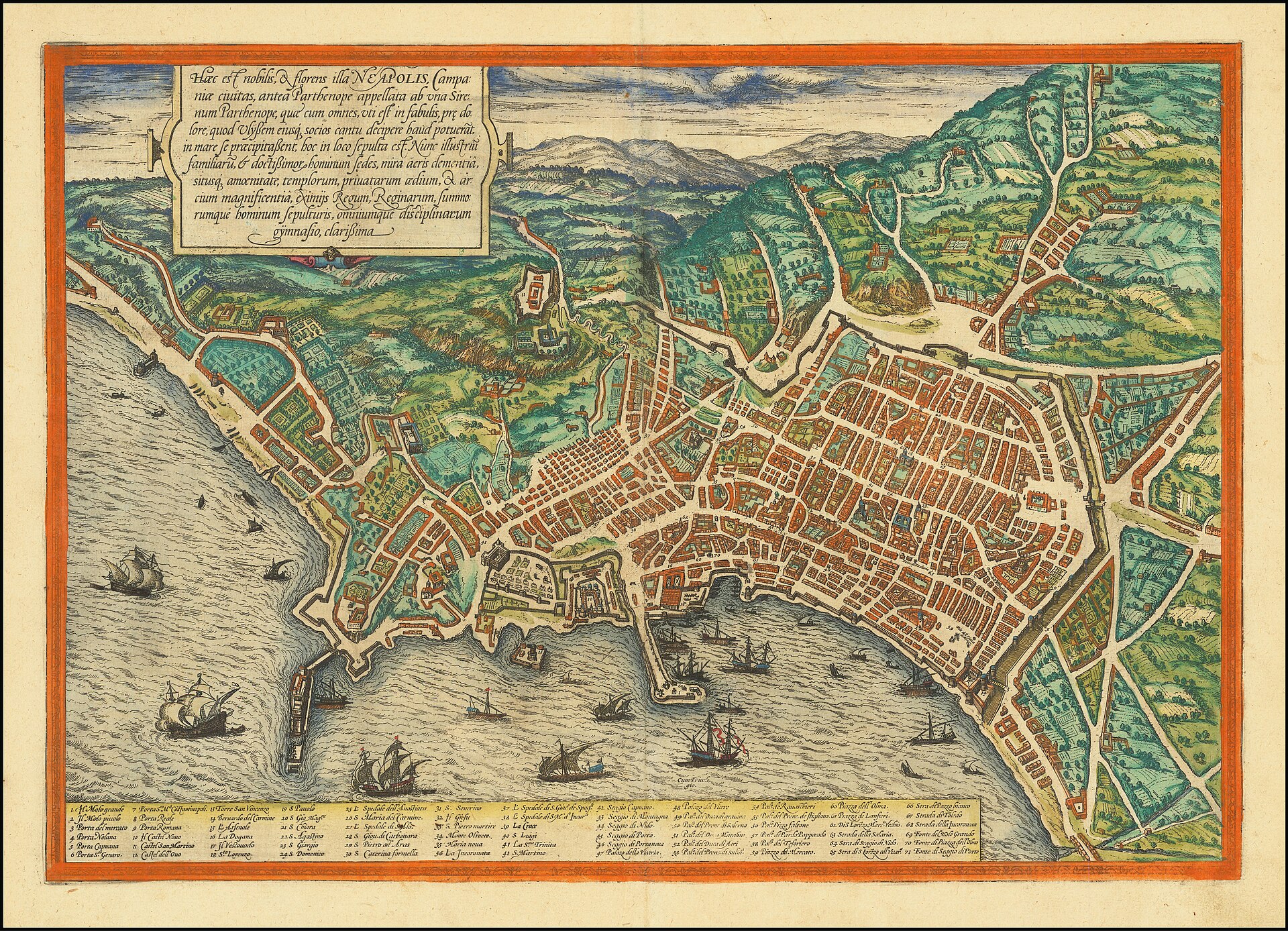
Bird's-eye view of Naples (Neapolis), from Braun & Hogenberg's Civitates Orbis Terrarum
Shows Naples' walled old town with harbour, piers and ships, Castel Nuovo, a dense street grid and multiple city gates.
1572 · Georg Braun / Frans Hogenberg · Wikimedia Commons
Public domain (plate dated 1572)


Ships tied to Naples
- HMHS Britannic: Coaled at Naples outbound, and was held there by a storm on her last voyage
- Pola: Hit amidships by two bombs in a British air raid on Naples
- RMS Carpathia: Called at Naples on her New York-Mediterranean run
- Roma: Moved to Naples in November 1942 after the Allied landings in North Africa
- Vittorio Veneto: Led the fleet to Naples after the Taranto raid and became flagship there
- Zara: Reviewed in the Gulf of Naples for Mussolini, the King and Hitler's 1938 visit
Castles of Naples


More cities to explore
 ItalyPompeiiExplore it in AD 79 · 1800
 ItalyRomeExplore it in AD 320 · 1300 · 1600 · 1770
 ItalyVeniceExplore it in 1200 · 1500 · 1740
 ItalyFlorenceExplore it in 1300 · 1490 · 1600
Castles of Europe · Landmarks of Europe · create your own reconstruction.