
Italy · Restored
Palazzo dei Normanni
Palazzo Reale
The Palazzo dei Normanni (Royal Palace of Palermo) is a large royal residence in Palermo, Sicily, built and expanded from the Arab, Norman and later Spanish periods. It served as the seat of the Norman kings of Sicily and later viceroys; today it houses the Sicilian Regional Assembly. The complex includes the 12th-century Cappella Palatina and a mixture of fortified Norman elements and later Aragonese/Spanish additions.
Its prime
1600
Today
Restored
As it stood in 1600
What Palazzo dei Normanni looked like in its prime.
A massive multi-wing palace rising above the city’s tiled roofs, combining a tall, crenellated Norman block with a long, plastered Aragonese/Spanish wing. The Norman façade features vertical blind arches and circular oculi, pale sandstone and rendered wall surfaces; the longer wing has regularly spaced rectangular windows, small balconies and terracotta roof tiles. Two domed structures puncture the roofline; the whole complex stands on an elevated site above streets and gardens with palm trees below, complete and inhabited.
Its story
The story of Palazzo dei Normanni.
Al-Qasr, the Dwelling of the Emirs
The palace occupies the highest point of Palermo, its foundations enclosing Phoenician-Punic fortifications of the eighth to fifth centuries BC; a Punic structure came to light beneath the Duke of Montalto Halls in 1984. Belisarius seized the fortification with the city in 535, opening nearly three centuries of Byzantine rule. Under Constantine IX Monomachos the prefect George Maniakes raised the kastron to palace rank and adorned it with spoils of war.
The first building here conceived as a royal residence, al-Qasr, the dwelling of the emirs, belongs to Islamic rule, and stood between the rivers Kemonia and Papireto with the defensive character of a fortress. Aghlabid, Fatimid and Kalbid governors held it for some two centuries, until a rising against the governor Salim ibn Rashid, put down in the autumn of 937 by Khalil ibn Ishaq, persuaded the emirs to leave this upper citadel for a new seat near the arsenal.
The Castrum Superius of the Hautevilles
Besieging Palermo, the Normans camped beside the old Arab residence below the hill before attacking the Kalsa and the fortified Cassaro. After the conquest of 1072 they built on the height a castle serving as royal residence and administrative hub, the Castrum superius. Robert Guiscard enlarged it with the Chapel of Jerusalem, and Count Roger added the Torre Greca. Four towers marked its core, which held the mint, the goldsmiths and the tiraz, the textile workshops carried over from the island's eastern rulers.
The coronation of Roger II in 1130 was followed by the Cappella Palatina, set above the palace prisons in place of an earlier mosque; Roger also raised the middle range that still bears his name, converted from a silk workshop. William I, called the Mean, and William II, the Good, added the apartments of the court ladies, quarters kept in the Arab manner for the eunuchs' service, and the Pisan tower. Al-Idrisi in 1150 and Ibn Jubayr in 1184 described its splendours. The chapel is by far the best example of the Norman-Arab-Byzantine style of twelfth-century Sicily.
Sacked in 1160-61, Stripped in 1194
In 1160–61 the palace was the theatre of the barons' revolt bred by Matteo Bonello's conspiracy: the royal halls were plundered and put to the flames, and an irreplaceable library and collection of art perished with them. A second sack came in 1194 at Henry VI's order: a hundred mules carried away the gold and precious objects kept there. Under the Hohenstaufen the building remained a seat of the sciences and letters, praised by Dante; Frederick II and his son Manfred kept government, administration and chancery here, while the Sicilian school of poetry gathered at the Favara.
The Vespers, the Collapse, and the Quarry
Decline set in from 1269. Stripped of its war engines, the palace showed its vulnerability during the Sicilian Vespers, and in 1282 the people of Palermo stormed and plundered it again. With the Angevins expelled, Peter III of Aragon moved in but lived there barely three years, and the Aragonese afterwards preferred the Steri confiscated from the Chiaramonte family.
Reports of a ruinous collapse date from 1340, after which the royal apartments emptied steadily. From the early fifteenth century the palace and the structures around it were worked as a quarry for stone to build churches and cemeteries. The Tribunal of the Holy Inquisition sat there between 1513 and 1553, and in 1549 Tommaso Fazello found it so far gone that the Cappella Palatina could be glimpsed through the wreckage.
The Viceroys' Bastions and the Sicilian Assembly
The palace recovered in the second half of the sixteenth century, when the Spanish viceroys abandoned the Steri and made it their residence; demolition and new building began in 1553. Juan de la Cerda began the Parliament Hall in 1560, and the duke of Maqueda the porticoed courtyard of 1600. In 1637 Luigi Moncada, duke of Montalto, converted the old munitions store into the summer audience hall of Parliament, frescoed by Pietro Novelli among others. Cardinal Teodoro Trivulzio had three churches pulled down in 1648 to make room for two heavy bastions defending the palace, and after the anti-Spanish revolt added two artillery bulwarks in 1649, completed by John of Austria in 1650.
The apartments were made ready for the entry and coronation of Victor Amadeus II of Savoy and Anne Marie of Bourbon-Orléans on Christmas Eve 1713. Since 1946 the building has housed the Sicilian Regional Assembly, and on 3 July 2015 it joined the UNESCO World Heritage list within the serial site of Arab-Norman Palermo and the cathedral churches of Cefalù and Monreale. It is reckoned the oldest royal residence in Europe.
Step inside
10 places to explore in 1600.
The record describes 10 distinct spots at Palazzo dei Normanni, including 5 interiors: cappella palatina (palatine chapel), sala normanna (norman hall), hercules hall (bourbon-decorated interior) and more. Create your own photoreal reconstruction and explore every one, more scenes means more rooms, more angles, and more of the place to stand in.
Build Your Own Castle
Recreate Palazzo dei Normanni with AI to explore it.
The artist rebuilds it as it stood in 1600, a photoreal reconstruction that belongs to you alone. Pay with coins, no subscription needed.
Recreate this castle →Defend this castle →From the archive
Palazzo dei Normanni on paper: the measured plan and period views.
The survey plan and photographs below are the ground truth this page's reconstructions are checked against, drawn and photographed while the castle was still a working garrison. Every image is public-domain or openly licensed, with its source named.
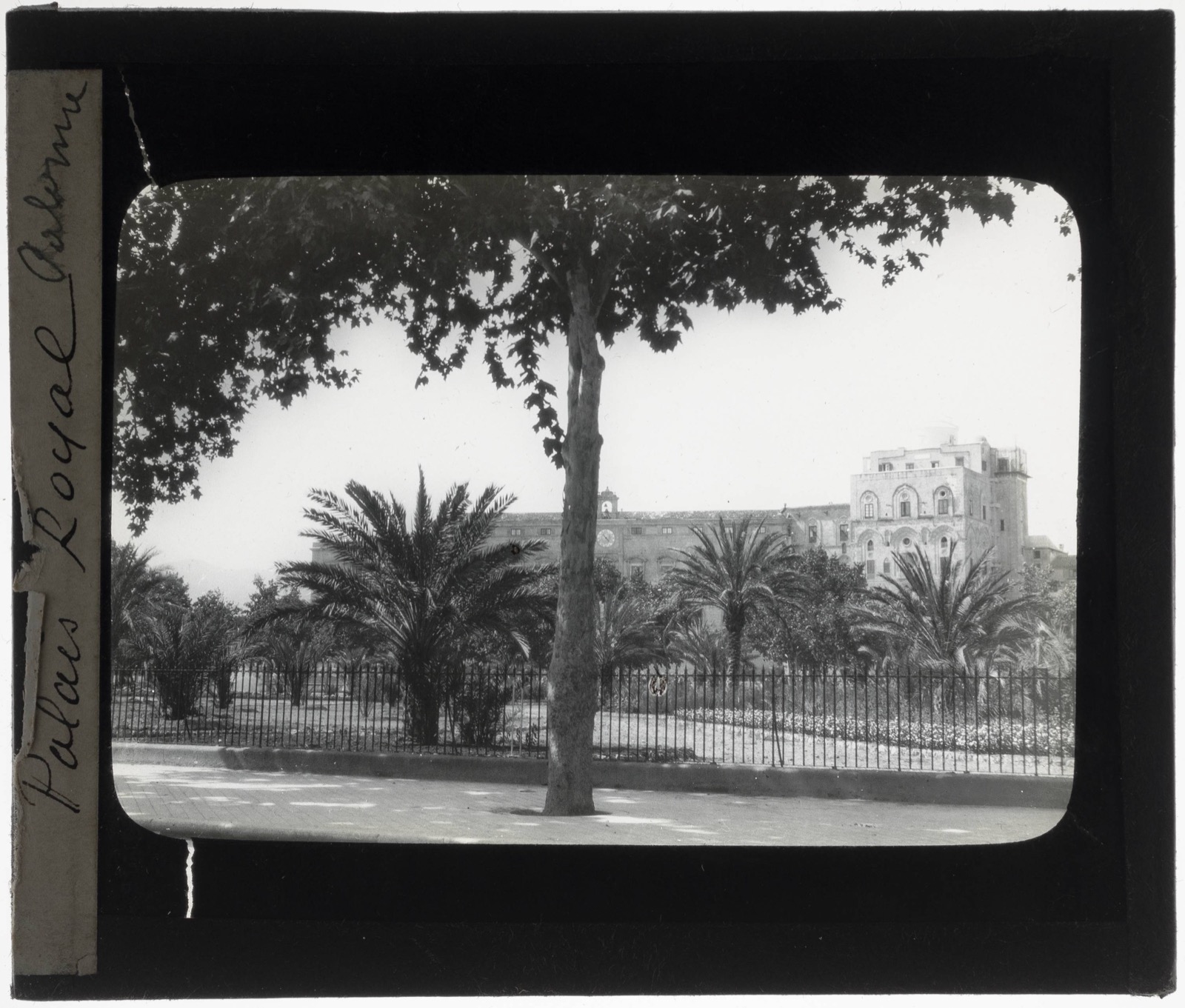
Palermo. Palazzo dei Normanni Exterior
· Catholic University of Leuven (via Europeana)
Public domain
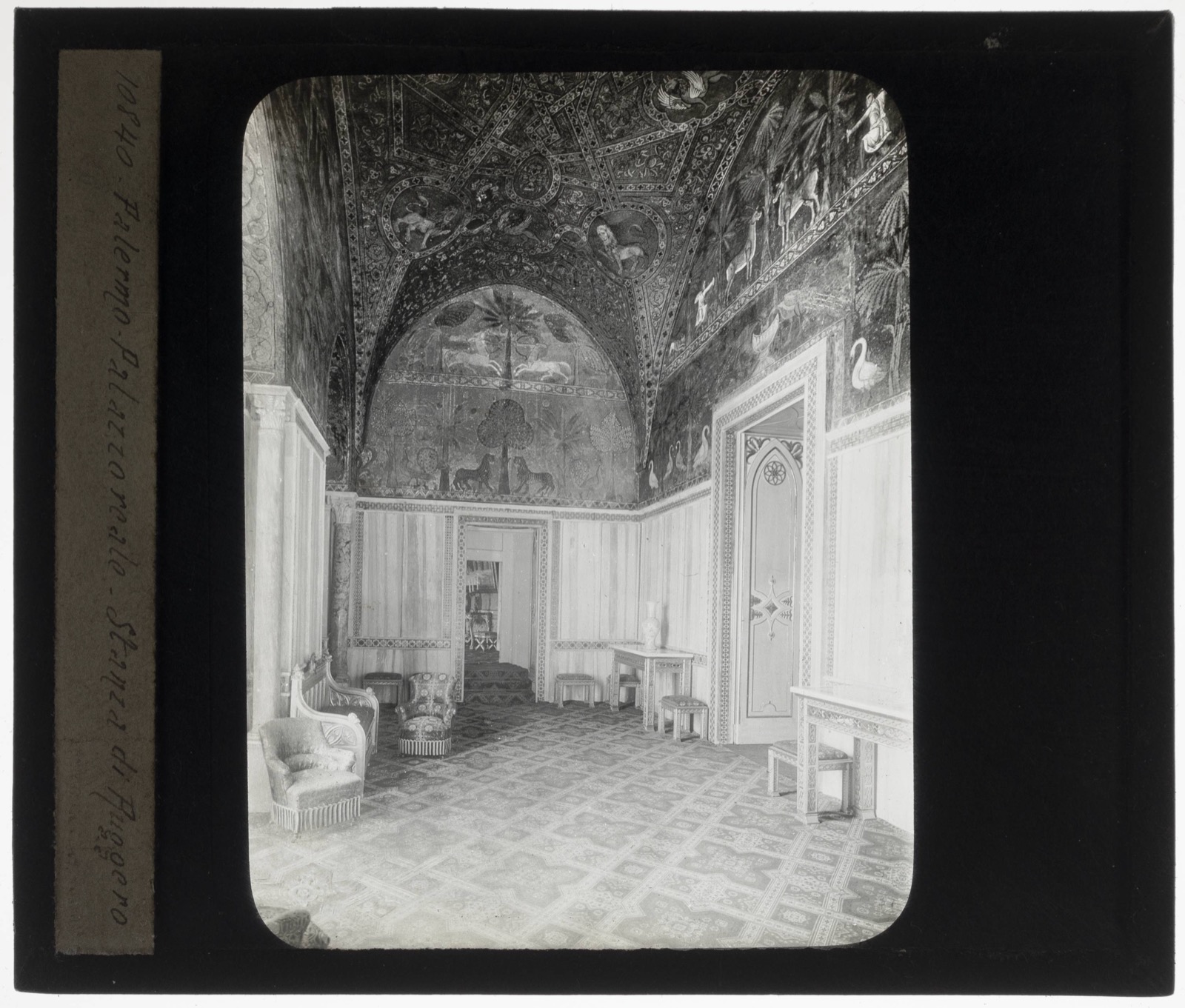
Palermo. Palazzo dei Normanni Interieur: Stanza di Re Ruggero
· Catholic University of Leuven (via Europeana)
Public domain
Nearby
Landmarks within reach of Palazzo dei Normanni.


Questions about Palazzo dei Normanni
What is the history of Palazzo dei Normanni?
What is inside Palazzo dei Normanni?
Why was Palazzo dei Normanni built, and what was it used for?
Does anyone live in Palazzo dei Normanni now?
Where is Palazzo dei Normanni?
When was Palazzo dei Normanni built?
Was Palazzo dei Normanni ever attacked or besieged?
What did Palazzo dei Normanni look like in its prime?
Is Palazzo dei Normanni still standing or is it a ruin?
Can you visit Palazzo dei Normanni?
More castles of Italy


Explore the city


