
Italy · Restored
Issogne Castle
Castello di Issogne
Issogne Castle is a Renaissance seigniorial residence in the village of Issogne in the lower Aosta Valley, on the right bank of the Dora Baltea. It is noted for its arcaded portico with a cycle of frescoes and for the central pomegranate fountain in the courtyard. The castle is open to guided visits and was restored and furnished in the 19th and 20th centuries.
Its prime
1520
Today
Restored
As it stood in 1520
What Issogne Castle looked like in its prime.
Horseshoe-shaped quadrangular plan of three built sides around a central open courtyard, the fourth side opening onto a walled Italian garden. Façades of pale plastered stone punctuated by rectangular windows and angular square turrets rising slightly above the main roofline. Roofs covered in overlapping grey stone slabs. Courtyard side has an arcaded portico with round arches and cross-vaults; at the courtyard centre sits an octagonal stone basin with a wrought-iron pomegranate-tree fountain.
Its story
The story of Issogne Castle.
Issogne was an episcopal seat, tensions with the De Verrecio lords of neighbouring Verrès boiled over around 1333, when the castle was attacked and damaged by fire. It remained the seat of the Bishop of Aosta until 1379, when the bishop submitted to the jurisdiction of Yblet of Challant, lord of Verrès, who transformed the episcopal stronghold into an elegant princely residence in Gothic style, with towers and buildings enclosed by an encircling wall.
On Yblet's death in 1409 Issogne passed to his son Francis, who received the title of Count of Challant from the Duke of Savoy in 1424. From about 1480 Luigi di Challant, and after his death in 1487 the prior George of Challant-Varey, remade the castle; under Philibert of Challant and his son René it reached its greatest splendour, hosting a rich and refined court. From this Renaissance era come its famous pomegranate-tree fountain and the frescoed portico with scenes of daily life, a rare example of medieval Alpine painting.
René's possessions passed to Giovanni Federico Madruzzo, husband of his daughter Isabelle, sparking an inheritance dispute between the Madruzzo family and the Challant cousins that lasted more than a century. The lordship passed from the Madruzzo to the Lenoncourt family, then in 1693 to Cristina Maurizia Del Carretto di Balestrina, before finally returning to the Challants in 1696. Restored and furnished in the 19th and 20th centuries, the castle is open to guided visits.
Step inside
10 places to explore in 1520.
The record describes 10 distinct spots at Issogne Castle, including 4 interiors: hall of justice (lower halls), dining room with service hatch, kitchen with large fireplace and oven and more. Create your own photoreal reconstruction and explore every one, more scenes means more rooms, more angles, and more of the place to stand in.
Build Your Own Castle
Recreate Issogne Castle with AI to explore it.
The artist rebuilds it as it stood in 1520, a photoreal reconstruction that belongs to you alone. Pay with coins, no subscription needed.
Recreate this castle →Defend this castle →Whose castle
Clans who held Issogne Castle.
The families that held Issogne Castle for a decade or more across its history, follow a name to its clan.
Challant
Lords of Issogne from 1379, when the bishop of Aosta submitted to Yblet of Challant; the family recovered the castle in 1696 after a century-long inheritance dispute.
Madruzzo
Passed to the Madruzzo family through Isabelle of Challant's marriage to Giovanni Federico Madruzzo, held through a century-long dispute.
From the archive
Issogne Castle on paper: the measured plan and period views.
The survey plan and photographs below are the ground truth this page's reconstructions are checked against, drawn and photographed while the castle was still a working garrison. Every image is public-domain or openly licensed, with its source named.
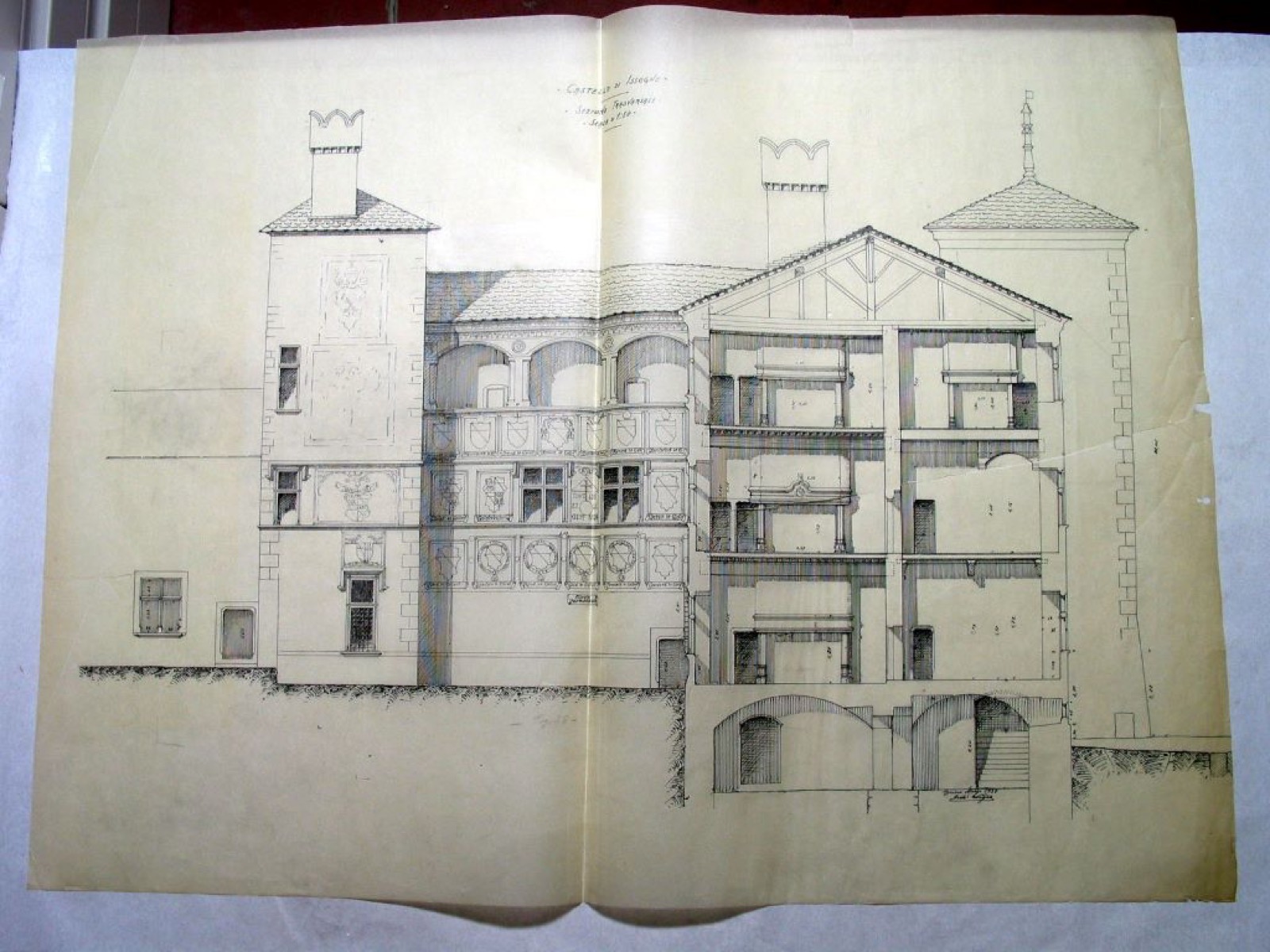
Issogne Castle - Transverse Section
1938 · Turin Gallery for Modern and Contemporary Art (via Europeana)
CC BY
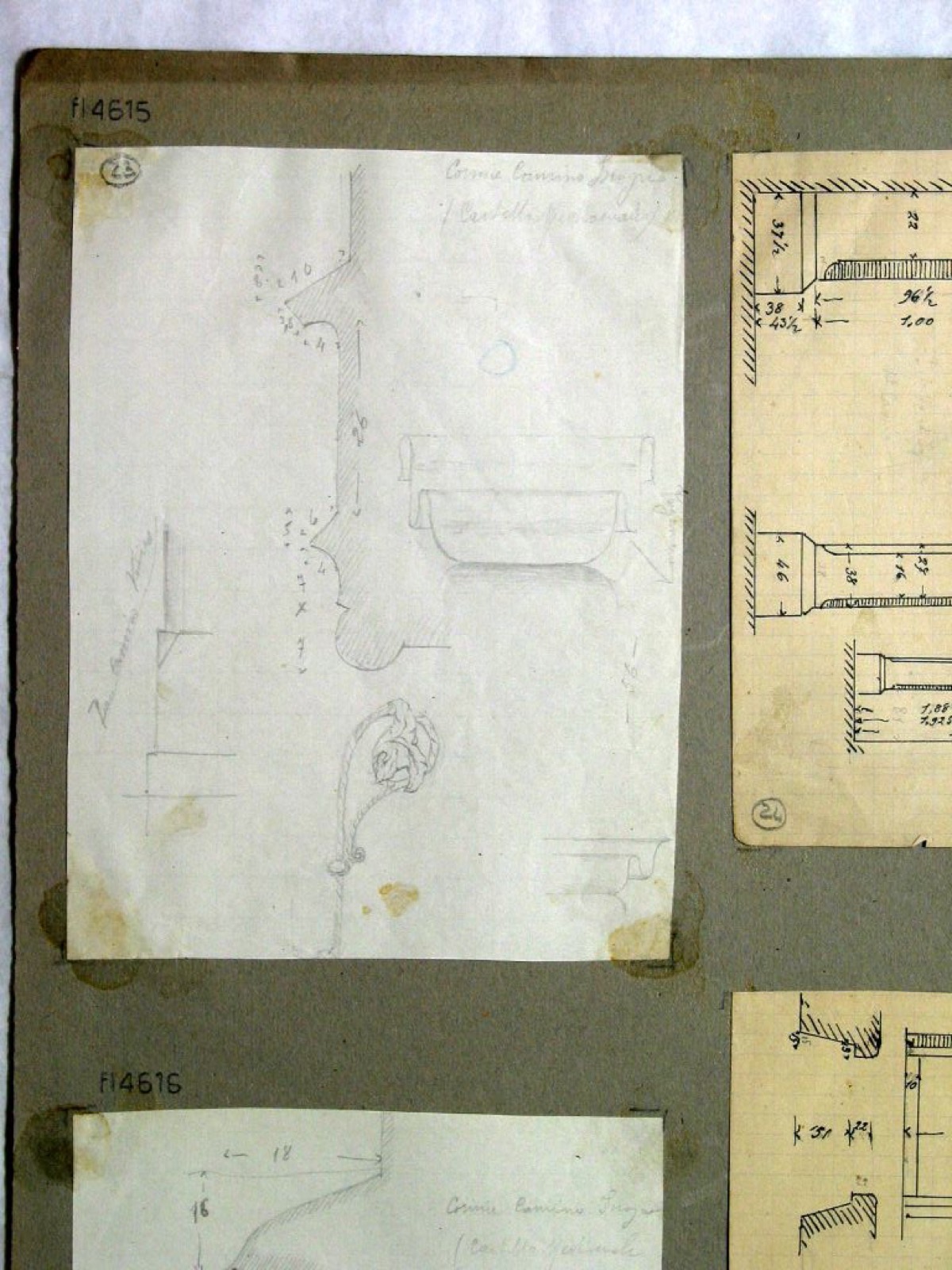
Castello di Issogne - Cornice camino
· Turin Gallery for Modern and Contemporary Art (via Europeana)
CC BY
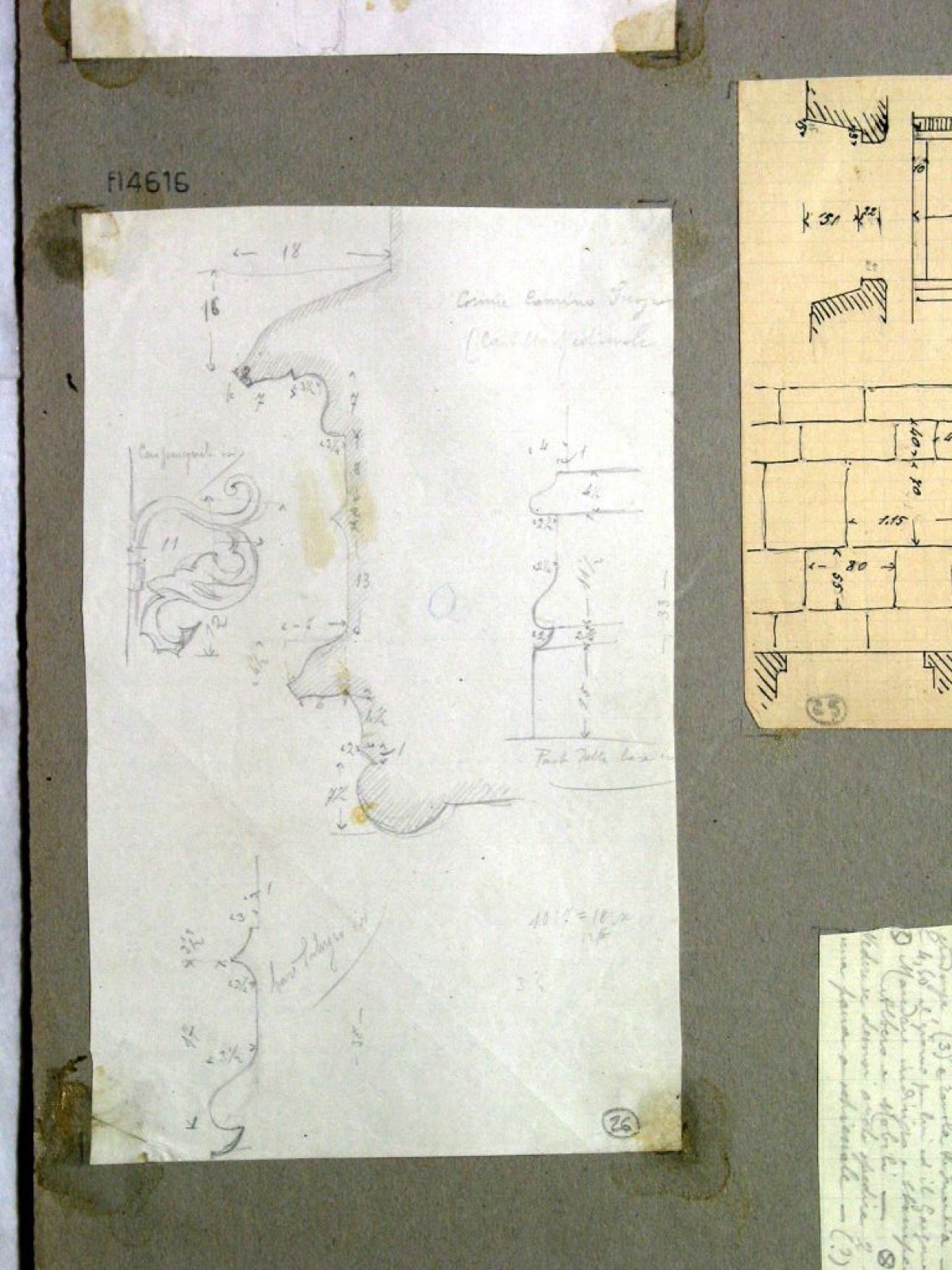
Castello di Issogne - Cornice camino
· Turin Gallery for Modern and Contemporary Art (via Europeana)
CC BY


