
Poland · Restored
Kwidzyn Castle
Zamek w Kwidzynie
Kwidzyn Castle is a large brick Gothic castle in Kwidzyn, northern Poland, built by the Pomesanians in the early 14th century. The fortress is arranged on a square plan with a central courtyard, square corner keeps and a dansker (a latrine bridge) projecting from the walls. Today parts of the north‑western and western wings are used by a branch of the Malbork Castle Museum.
First raised
1400
Its prime
1400
Today
Restored
As it stood in 1400
What Kwidzyn Castle looked like in its prime.
Red brick Gothic massing on a roughly square plan, with steep red‑tiled roofs and tall rectangular windows set in deep reveals. Four squat square keeps occupy the corners; a tall, plain square tower rises above the main block. A distinctive dansker projects from the curtain wall, carried on five tall brick arcades spanning a defensive ditch. The castle sits close to a town street and green embankments, approached across grassy banks and trees.
Its story
The story of Kwidzyn Castle.
The Pomesanian Chapter's Castle, 1334–1380s
An earlier bishop's castle, known as the Old Little Castle, stood nearby on the probable site of the Prussian stronghold of Kwedis; it was pulled down in the 16th century, well after the present castle's own construction, and its stone was reused in later rebuilding work on the chapter castle. Construction of the standing castle began in the first half of the 14th century, and it first appears in the written record on 28 October 1334, as castrum Merginwerder, when it may still have consisted only of its perimeter walls and unfinished wings. Most of the building work was complete by around 1345, when a refectory is mentioned in the sources, and the dansker (a latrine tower linked to the main block by a gallery on five arcades) was finished in the 1380s.
Raised as a four-winged, roughly square fortress with corner towers around a cloistered courtyard, it became the seat of the Pomesanian cathedral chapter and the religious and administrative centre of the bishopric. It stood originally as its own complex; only later was it joined directly to the adjoining cathedral, and its tallest corner tower was converted into that cathedral's bell tower.
The Priests' War and the Loss of the Bishop's Castle, 1410–1520
Polish forces under King Władysław II Jagiełło took the castle in 1410, during the wars against the Teutonic Knights; it was later returned to the Order, together with the Pomesanian bishopric, under the Second Peace of Toruń, which granted the bishopric for life to the Polish bishop of Chełmno, Wincenty Kiełbasa. After Kiełbasa's death the Order tried to install its own candidate, backed by the cathedral chapter, provoking Polish military intervention remembered as the Priests' War. Polish troops captured Kwidzyn in 1478; townspeople took refuge in the chapter castle and set fire to the town, and the castle itself was damaged badly enough that its wrecked corner towers had to be dismantled during repairs in 1487. Renewed fighting in 1520 saw Polish forces destroy the bishop's castle completely and probably damage the chapter castle as well.
Protestant Bishopric to Prussian Court, 1526–1800
The Pomesanian bishops converted to Protestantism in 1526, and in the 1530s the first Protestant bishop, Paulus Speratus, paid for the chapter castle's repair from his own funds. Duke Albrecht Hohenzollern's officials took the castle over in 1551, turning it into a government building and residence. Swedish forces partially destroyed it during the Deluge campaigns of the 17th century, and Tsar Peter I of Russia lodged there in 1709, during a visit to Kwidzyn made at the invitation of the Prussian king Frederick I.
In 1728 the south wing was converted into a food store for the garrison, and after the First Partition of Poland the castle became the seat of a court: its first-floor rooms were subdivided, part of the west cloister was demolished to fit a new staircase, and part of the building was adapted as a prison. In 1798 the Prussian authorities demolished the castle's east and south wings, including the bishop's former refectory, and used the salvaged material to build a separate courts building nearby, completed by 1800.
Restoration, the Hitlerjugend School and a Museum, 1854–2018
King Frederick William IV halted the dismantling in 1854 and ordered the castle restored; the main phase of that work, carried out in 1874 under Gustav Reichert, rebuilt the corner towers, reconstructed the vaulting in the north wing's first-floor rooms and reinstated architectural detail lost in the 18th-century demolitions. The castle continued to serve as a court and prison until 1935. In 1936, after further adaptation, it became the seat of the Hitlerjugend's HJ-Ostlandführerschule, a role it held until 1945.
When the Red Army took the town, the castle, unlike Kwidzyn's Old Town, escaped serious destruction; only its interiors were looted. It passed to Poland's Ministry of Culture and Art in December 1949 and later became a branch of the Castle Museum in Malbork, which today occupies its surviving north-western and western wings; the largest dansker and a well with a porch have also been preserved. Since 2018 the castle-and-cathedral complex has held Poland's "Historic Monument" status.
Step inside
9 places to explore in 1400.
The record describes 9 distinct spots at Kwidzyn Castle, including 2 interiors: western wing internal chambers (chapter rooms), chapter house interior. Create your own photoreal reconstruction and explore every one, more scenes means more rooms, more angles, and more of the place to stand in.
Build Your Own Castle
Recreate Kwidzyn Castle with AI to explore it.
The artist rebuilds it as it stood in 1400, a photoreal reconstruction that belongs to you alone. Pay with coins, no subscription needed.
Recreate this castle →Defend this castle →From the archive
Kwidzyn Castle on paper: the measured plan and period views.
The survey plan and photographs below are the ground truth this page's reconstructions are checked against, drawn and photographed while the castle was still a working garrison. Every image is public-domain or openly licensed, with its source named.
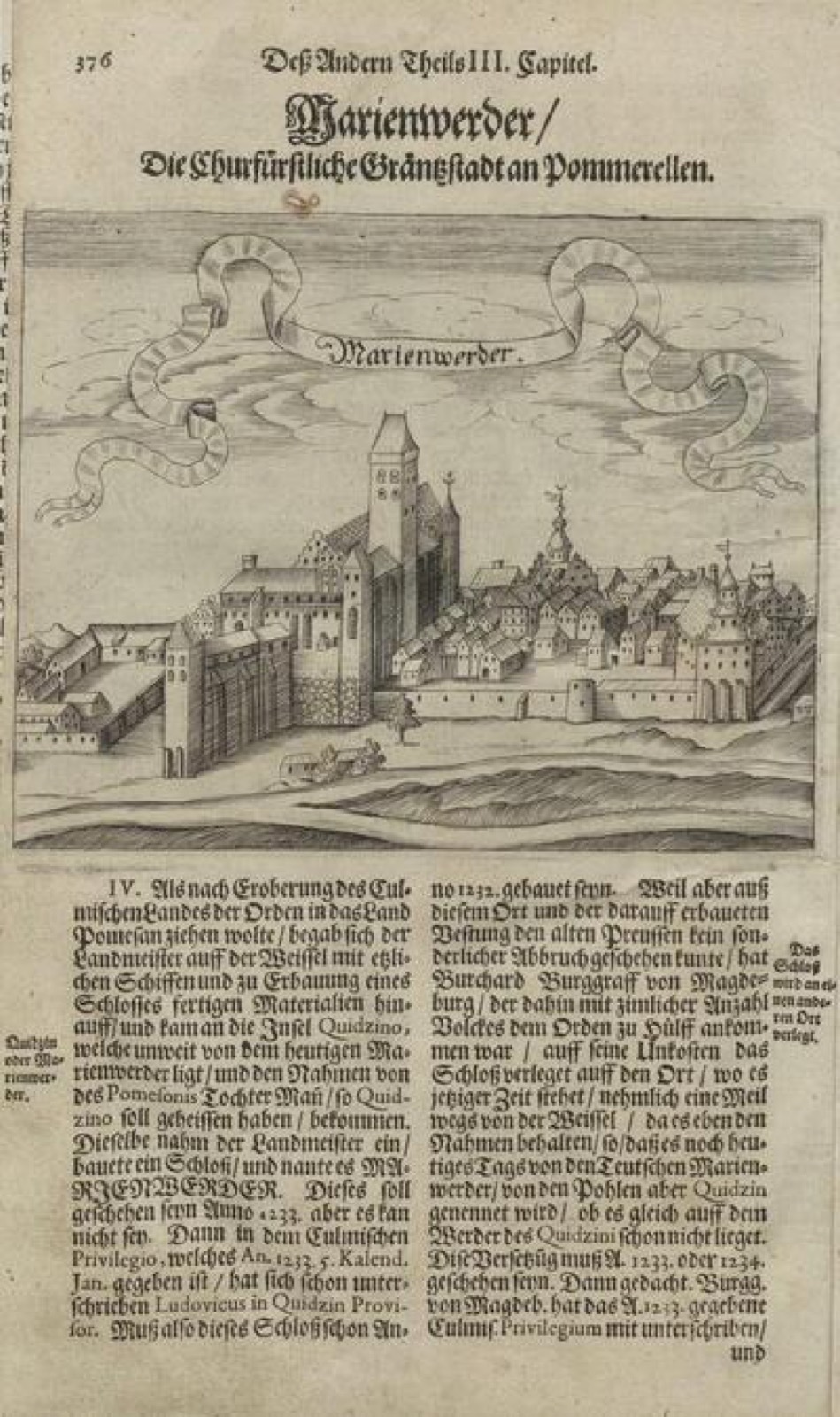
Marienwerder (Kwidzyn)
1648 · Elbląska Digital Library (via Europeana)
Public domain
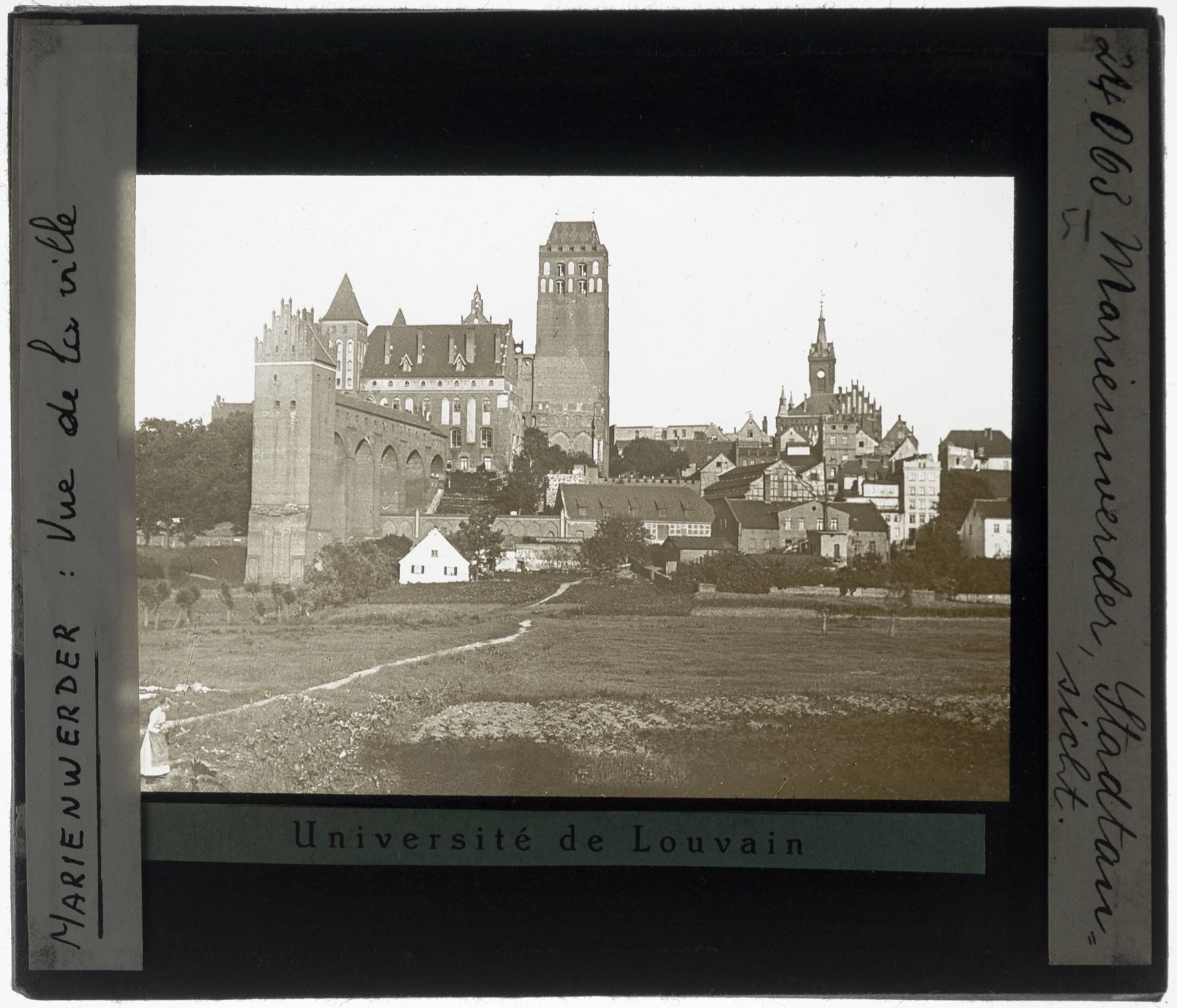
Kwidzyn. Panorama with castle and cathedral
· Catholic University of Leuven (via Europeana)
Public domain


