
Poland · Restored
Wawel Castle
Zamek Królewski na Wawelu
Wawel Royal Castle is the historic fortified royal residence on Wawel Hill overlooking the Vistula River in Kraków, Poland. The complex includes the Wawel Cathedral and numerous medieval, Renaissance and Baroque buildings clustered around a central courtyard, with multiple defensive towers and ramparts.
First raised
1001
Its prime
1564
Today
Restored
Ranked among Europe’s castles
As it stood in 1564
What Wawel Castle looked like in its prime.
Perched on a limestone outcrop above the Vistula, the complex presents a compact silhouette of red terracotta roofs, brick cylindrical towers with conical tiles, long low ranges of masonry buildings with regular rows of windows, and the cathedral’s green-patinated copper spires rising above. Stone retaining walls and curtain walls step down the hill; the castle groups a Renaissance arcaded courtyard to the rear of the visible roofline. Materials are predominantly red brick, pale limestone bases and terracotta roofing, with copper-clad church towers.
Its story
The story of Wawel Castle.
The Vistulan Stronghold and Casimir the Great's Gothic Castle
The limestone hill above the Vistula was fortified long before it was royal: Wawel is thought to have been one of the strongholds of the Vistulan tribe that formed a nation at the turn of the 8th and 9th centuries. Jan Długosz's account has the Wawel stronghold and the adjoining Okół holding out against the Tatar siege of 1241. Around 1265 Bolesław the Chaste rebuilt the timber-and-earth works wholesale, and by 1289 stone curtain walls stood, probably raised by Duke Leszek the Black.
Casimir III the Great, who reigned from 1333 to 1370, had a Gothic castle built beside the cathedral: several structures around an irregular closed courtyard, sized for the apparatus of state he had greatly enlarged, the works directed by Wacław of Tenczyn. Under Jadwiga and Władysław II Jagiełło came the Danish Tower, the Hen's Foot Tower on its three projecting buttresses, a lower gate complex of two gates and three towers, and fortifications for the lower castle. Władysław the Elbow-high had been crowned in the fire-damaged older cathedral in 1320; in 1333 he became the first king buried there, under a sandstone sarcophagus set up by his son Casimir.
Sigismund's Renaissance Rebuilding, 1507–1536
Alexander Jagiellon wanted the ageing castle rebuilt in the Renaissance manner then new to Poland, and Francesco Fiorentino (an Italian who came by way of Hungary) started on the west wing by the gate in 1504. Alexander died in 1506 and Sigismund I the Old took the work far further, having spent part of his youth at the Buda court of his brother Vladislaus among Italian craftsmen working in a style barely known outside Florence. The gate wing was finished in 1507, the north wing between 1507 and 1515 with the Kraków bankers Jan and Seweryn Boner paying, and after Sigismund's marriage to the Italian-born Bona Sforza the east wing rose between 1520 and 1529. The residence was complete in 1536 and burned the same year; rebuilding fell to Mikołaj Castiglione after Bartolomeo Berrecci's death in 1537.
The courtyard that resulted is Italian in inspiration but not in obedience: a steeply hipped, projecting roof answers a northern climate, and the uppermost arcade stands taller than those beneath it, unknown in Italy, placing the piano nobile on the third floor rather than the second. Berrecci's Sigismund Chapel, built at the king's expense as the mausoleum of the last Jagiellons, was begun about 1517 and finished in 1533, and Italian visitors judged it the equal of anything of its kind at home.
Swedes, Fire and the Bar Confederates, 1595–1795
A fire in 1595 took the roofs and upper rooms of the north wing, and repairs ran to 1603 under Giovanni Trevano. The capital had moved to Warsaw in 1596 and Sigismund III moved his court there for good in the years after 1606, but coronations stayed at Wawel, and through the 17th century the hill was modernised and heavily fortified. In 1655 the castle held out a week before Swedish troops occupied it; they stayed until 1657 and stripped it thoroughly. John III Sobieski paid from his own purse for a partial restoration between 1689 and 1692. The heaviest damage came in 1702, when Swedish soldiers lit a fire in one of the chambers: it burned for a week and took the roofs, most of the north wing down to the ground floor and much of the east wing.
In 1772 the Bar Confederates held Wawel for more than two months under Claude Gabriel de Choisy before the Russians took it on 26 April. A loopholed wall was carried round the hill between 1790 and 1792. It bought little. Prussian troops took the castle after a short defence during the Kościuszko Insurrection of 1794 and broke into the treasury; the royal insignia went to Berlin and were melted down, and of the regalia only the coronation sword Szczerbiec survived.
The Austrian Barracks and the Buy-Back of 1903
Austrian troops entered under the Third Partition and turned the royal seat into barracks. Between 1803 and 1807 the military engineer Jan Markl divided the great rooms with partition walls, bricked up windows and arcades and lowered the roofs; the churches of St Michael and St George were pulled down, and a restoration of 1854–1856 stripped Renaissance and Baroque detail. The hill meanwhile became the place where Kraków gathered against partition, and Prince Józef Poniatowski's funeral in the cathedral in 1815 opened its crypts to national heroes as well as monarchs. Attempts to buy Wawel back came to nothing (the Galician Sejm went so far as to make a gift of it to Franz Joseph in 1880), until 1903, when the city and provincial authorities bought the garrison buildings for 3.5 million crowns and the Emperor ordered his troops off the hill two years later.
Hans Frank's Residence and the Museum on the Hill
In 1921 the Polish parliament resolved that Wawel should be the residence of the President of the Republic, and the museum was founded in 1930. Under the German occupation of 1939–45 the castle served as the office and home of Governor General Hans Frank, later executed as a war criminal. Art was taken from Wawel and from Kraków at large: Raphael's Portrait of a Young Man has never been returned, and many tapestries disappeared, though 150 sent to Canada for safe keeping came home. In 1945 the National Council ended the castle's function as a head-of-state residence and gave the buildings over to exhibition; the Crown Treasury still keeps Szczerbiec and the hat and sword given to Sobieski by the pope after the Battle of Vienna.
Step inside
10 places to explore in 1564.
The record describes 10 distinct spots at Wawel Castle, including 3 interiors: wawel cathedral nave and chapels (interior), silver bell tower base and crypt, jadwiga and jogaila chamber (exhibition room). Create your own photoreal reconstruction and explore every one, more scenes means more rooms, more angles, and more of the place to stand in.
Build Your Own Castle
Recreate Wawel Castle with AI to explore it.
The artist rebuilds it as it stood in 1564, a photoreal reconstruction that belongs to you alone. Pay with coins, no subscription needed.
Recreate this castle →Defend this castle →From the archive
Wawel Castle on paper: the measured plan and period views.
The survey plan and photographs below are the ground truth this page's reconstructions are checked against, drawn and photographed while the castle was still a working garrison. Every image is public-domain or openly licensed, with its source named.
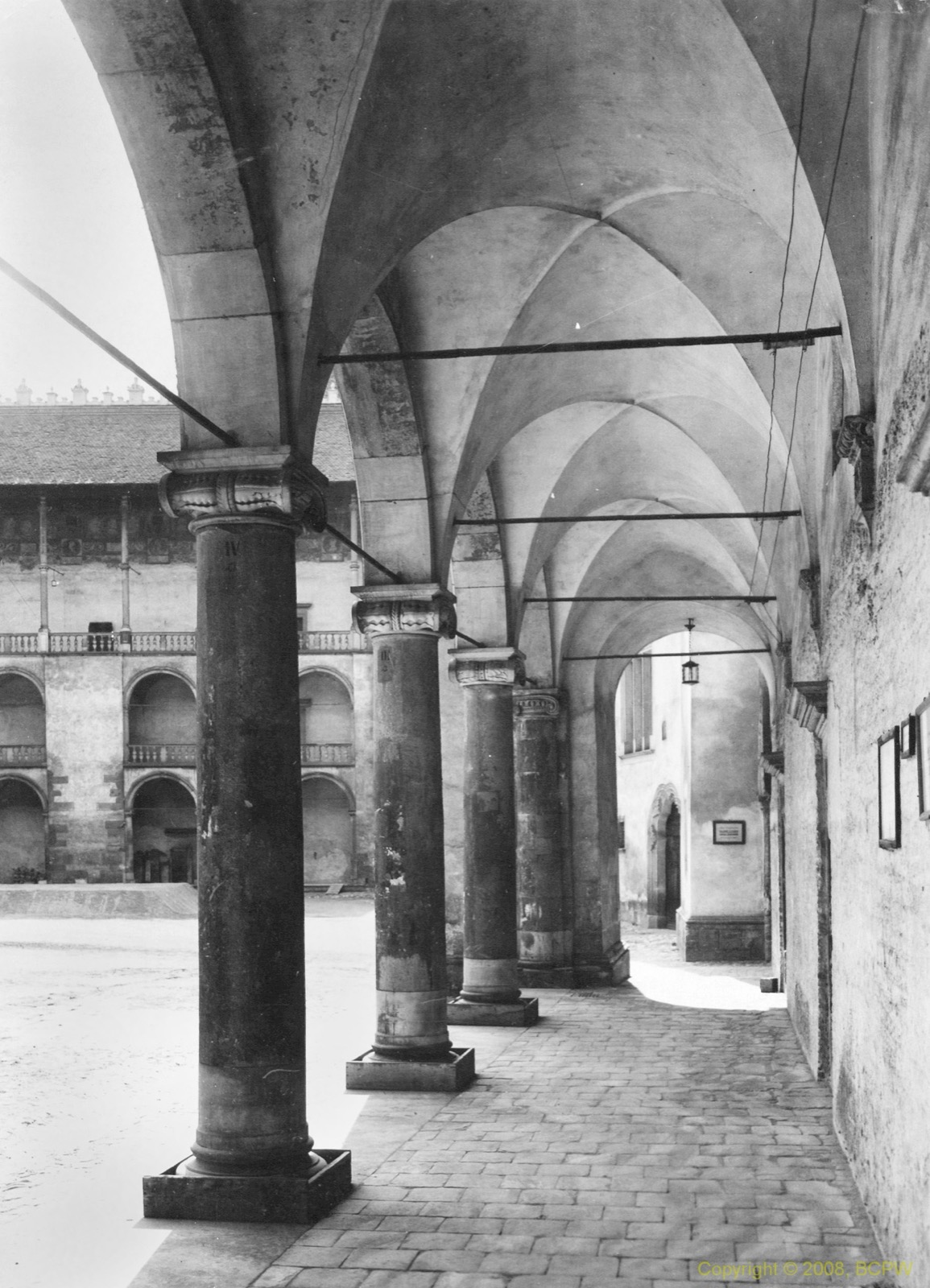
Wawel Castle. Arcade courtyard
· Digital Library of the Warsaw University (via Europeana)
Public domain
Nearby
Landmarks within reach of Wawel Castle.


Questions about Wawel Castle
What is the history of Wawel Castle?
What is inside Wawel Castle?
Why was Wawel Castle built, and what was it used for?
Where is Wawel Castle?
When was Wawel Castle built?
Was Wawel Castle ever attacked or besieged?
What did Wawel Castle look like in its prime?
Is Wawel Castle still standing, or is it a ruin?
Who built Wawel Castle?
Can you visit Wawel Castle?
More castles of Poland


Explore the city


