Historic Cities · Poland
Warsaw through the ages
Warsaw, officially the Capital City of Warsaw, is the capital and most populous city of Poland. The metropolis stands on the river Vistula in east-central Poland. Its population is officially estimated at 1.87 million residents within a greater metropolitan area of around 3.5 million residents, which makes Warsaw the 7th most populous city in the European Union.

Warsaw in 1650
Royal Warsaw
This is Warsaw at the moment it has recently taken its place as the royal seat: the Royal Castle crowns the escarpment and Sigismund's Column stands newly raised on the square. The walk traces the Old Town's tall painted houses, the royal palaces along the Vistula escarpment, busy river quays and the ferry crossings that bind the city to Praga.
A compact skyline of church spires, the reddish block of the Royal Castle and rows of narrow, gabled houses rise above a steep earthen escarpment; their plastered façades are lime‑washed in pale ochres, greens and pinks while red tile roofs glitter. Below, timber granaries and low wharves crowd the Vistula and small sail and flat‑bottomed barges and rafts ply the river; dirt streets are narrow, trampling carts and foot traffic give the town a close, textured scale.
The route: 22 streets, squares and views
Praga Riverbank → Praga Ferry → Powiśle Landing → Podzamcze Riverside → Długie Pobrzeże Granaries → Castle Square (Plac Zamkowy) → Sigismund's Column → Royal Castle Façade → Kanonia Lane → St. John's Archcathedral → …
Step inside, 13 interiors
Boatmen's Riverside Alehouse · Ferry-landing Waiting Shed · Palace Garden Loggia · Shipwright's Covered Loft · Riverside Granary Loft · Royal Armory Hall · Marble Audience Chamber · Castle Chapel Nave · Collegiate Choir Nave · Merchant Parlor in Tall House · Apothecary Shop and Workshop · Patrician Great Hall · Jesuit College Study
Planned from the Wikipedia record: History of Warsaw.
Warsaw in 1775
Bellotto's Warsaw
Warsaw in 1775 is the Polish capital under King Stanisław August Poniatowski, a city of palaces, church towers and the widening Royal Route. The walk follows Bellotto's precise views from the river and the royal gardens into Krakowskie Przedmieście and the Old Town, where church façades, marketplaces and riverside craft reveal the city's everyday life.
The skyline is low and punctured by church towers and palace cupolas, tiled roofs and classical façades rendered in cool, steely light. Streets are a mix of plastered noble palaces and narrower timber-fronted houses; the Vistula hosts small sailing barges and ferries while tree-lined avenues lead to landscaped royal gardens. Clouds gather in broad masses, throwing crisp shadows over stone steps, carriageways and market stalls.
The route: 20 streets, squares and views
Wilanów Meadows → Ujazdów → Łazienki Park Entrance → Palace on the Isle → Belweder → Nowy Świat → Krakowskie Przedmieście → St. Anne's Church → Załuski Library → Royal Castle → …
Step inside, 13 interiors
Wilanów Grand Hall · Audience Chamber Vault · State Dining Hall · Belweder State Salon · Holy Cross Church Nave · St Anne's Nave · Załuski Reading Room · Canaletto Panorama Room · Thursday Dinner Salon · St John's Choir · Capuchin Chapel · Krasiński Palace Great Hall · Riverside Boatmen's Inn
Planned from the Wikipedia record: Bernardo Bellotto.
Warsaw in 1925
Interwar Warsaw
This is Warsaw in the early years of the Second Polish Republic, a capital rebuilding its institutions and public life after the trials of the 1910s and 1920s. The walk moves from the Vistula's banks through the cafés and grand promenades of the centre to the crowded Jewish quarter of Nalewki and finally to the parks and palaces south of the city.
A low, church-spired skyline punctuates broad river views; the Royal Castle and Sigismund's Column stand over narrow Old Town roofs while newer avenues show low stone and stucco façades, occasional Art Nouveau detail and rows of tram rails. Horse-drawn droshkies share streets with motorcars; tram wires cross merchant-paved squares; chestnut alleys shade formal gardens. Markets, tram stops and café terraces give a lively, layered urban texture.
The route: 22 streets, squares and views
Praga Riverbank View → Poniatowski Bridge → Powiśle Embankment → Three Crosses Square → Nowy Świat → Café Ziemiańska Terrace → Krakowskie Przedmieście → University Frontage → Castle and Sigismund's Column → Old Town Market Square → …
Step inside, 13 interiors
Blikle Tea Salon · Upper Literary Salon · University Reading Hall · Castle Audience Chamber · St. John's Nave · Canopy Chamber for the Fallen · Palace Grand Stair · Grand Cinema Auditorium · Grand Marble Lobby · Courtyard Linen and Notions Shop · Tailor's Courtyard Workshop · Bakery Oven Room · Palace White Room
Planned from the Wikipedia record: History of Warsaw.
Its story
The story of Warsaw.
Bródno, Jazdów and a Fishing Village Called Warszowa
Three fortified settlements preceded the city: Bródno, of the 9th or 10th century, burned about 1040 in the uprising of the Mazovian prince Miecław; Kamion, established about 1065; and Jazdów, raised before 1250. After Lithuanians raided Jazdów in 1262 and the Płock prince Bolesław II of Masovia in 1281, Bolesław moved the settlement some three and a half kilometres north to a fishing village called Warszowa, where his successor Konrad II built a wooden castellan's seat and, when Lithuanians burned that too, a brick church that later became St John's Cathedral.
The first document attesting a Warsaw castellany dates to 1313. The town became a seat of the Dukes of Masovia early in the 14th century and capital of Masovia in 1413, living on crafts and trade with about 4,500 inhabitants. In the 15th century settlement spread beyond the northern wall into New Town, a precinct with its own charter and council, established partly to house incomers not permitted to settle in the Old Town, particularly Jews. In 1525 the city's poor revolted against the rich and their abuse of power, winning a third order in the town's government alongside the patrician council and assessors. With Janusz III the local ducal line died out, and Masovia returned to the Polish Crown in 1526.
The Sejm, the Crown Capital and the Swedish Deluge, 1529–1699
The General Sejm met in Warsaw for the first time in 1529 and held the privilege permanently from 1569, and the Italian architect Giovanni di Quadro rebuilt the King's Castle to house it. In 1573 the city gave its name to the Warsaw Confederation, which formally established religious freedom in the Polish–Lithuanian Commonwealth; royal elections were held at Wielka Wola, now the district of Wola, and those of 1575 and 1587 came to blows between divided nobles. Lying between the Commonwealth's two capitals, Kraków and Vilnius, and near Gdańsk, from where Sweden was a standing threat, Warsaw took the court itself in 1596, when Sigismund III Vasa moved it from Kraków after fire damaged the Wawel. He settled there for good in 1611, when the city held some 14,000 people.
The town spread into jurydyki, private districts owned by aristocrats and gentry, ruled under their own laws and settled by craftsmen and tradesmen; Praga, one of them, took a city charter in 1648. Between 1655 and 1658 Warsaw was besieged three times and three times taken and pillaged by Swedish, Brandenburgian and Transylvanian forces. The century also drew Armenian, Scottish and Italian migrants, the Italian and Scottish communities among the largest in Poland: the Scot Alexander Chalmers was elected mayor of the Old Town in 1691. Armenians fled there from Podolia during the Polish–Ottoman War of 1672–1676, and four Polish Armenians were mayors of the Old Town.
Saxon Kings, the Constitution of 3 May 1791 and the Slaughter of Praga
Augustus II, elected in 1697, joined the Great Northern War on Russia's side in 1700 and made Poland a battlefield; Warsaw was besieged and changed hands repeatedly between 1702 and 1705, and from 1713 Russian and Saxon garrisons were permanent, an oppressive occupation under which the city paid heavy contributions. The Saxon decades were nonetheless building years, and in 1747 the Załuski brothers founded the Załuski Library, considered the first Polish public library.
The pro-Russian Stanisław August Poniatowski was elected in 1764, after which Poland was in practice a Russian protectorate, and the First Partition followed in 1772. Factories multiplied and peasants migrated in on a large scale, taking the city from 24,000 inhabitants in 1754 to 115,000 by 1792. The Sejm that gathered in 1788 passed the Constitution of 3 May 1791, which the historian Norman Davies calls the first constitution of its kind in Europe and which held for a year, and the City Act of 21 April 1791, which abolished the jurydyki.
The Second Partition of 1793 led to the Warsaw Uprising of 17 April 1794, an insurrection by the city's populace within the wider Kościuszko Uprising, in which about 2,000 Russian soldiers of the garrison died. Russian forces reached the eastern outskirts on 3 November 1794 and four hours of fighting ended in complete Polish defeat. Against the orders General Alexander Suvorov had given before the battle, Russian troops then looted and burned the whole borough of Praga and murdered many of its inhabitants. The death toll is not known; estimates run up to 20,000 men, women and children. The British envoy William Gardiner wrote to William Pitt the Younger that the attack on Praga's lines of defence was accompanied by the most gruesome and totally unnecessary barbarousness.
Partition, Russification and the Return of the Capital, 1795–1939
In the third partition of 1795 Warsaw passed to Prussia as capital of South Prussia; Napoleon's army took it in 1806 and made it the capital of the Duchy of Warsaw, and the Congress of Vienna assigned it in 1815 to Congress Poland, in personal union with Imperial Russia, under which the Royal University of Warsaw was founded in 1816. Repeated violations of the Polish constitution brought the November Uprising of 1830; the greatest battle of the war that followed was fought at Grochów on 25 February 1831, and the war ended in defeat. A military administration was imposed, the Sejm suspended, the Polish army dissolved and the university closed, and manors north of the New Town were cleared to build the Citadel, a fortress with a prison.
Railways made the city a hub from 1848, and between 1850 and 1882 the population grew by 134 per cent to 383,000, largely through migration from Masovian villages; Wola turned from farms and windmills into a district of metallurgical, textile and glassware works. Under mayor Sokrates Starynkiewicz, a Russian-born general who served from 1875 to 1892, the English engineers William Lindley and his son built the city's first water and sewer systems. Alongside this ran a sustained assault on Polish national identity: Polish schools were closed and Orthodox churches built. Russian troops fired on a crowd protesting against Russian rule on 27 February 1861, killing five, and the underground Polish National Government sat in Warsaw during the January Uprising of 1863–64. The census of 1897 recorded 626,000 inhabitants, 61.7 per cent Polish and 27.1 per cent Jewish; the poorer minorities, Jews among them, settled in the crowded northern quarter of Muranów.
German troops entered in August 1915, and the retreating Russians demolished every bridge in the city and stripped the factories of their equipment. The German administration lifted the Russian ban on building beyond the ring of forts, extending the city from about 33 to 115 square kilometres in April 1916. The Germans left on 8 November 1918, and the Regency Council handed Józef Piłsudski military authority on the 11th and civil authority on the 14th; Warsaw became the capital of Poland. The Battle of Warsaw of 1920 was fought on the eastern outskirts, where the Red Army was defeated. Gabriel Narutowicz, the first President of Poland, was assassinated in the Zachęta gallery on 16 December 1922 by a painter of the right-wing National Democracy, five days after his election, and on 12 May 1926 Piłsudski marched on Warsaw, which his troops took by force the next day at a cost of nearly 400 lives, opening thirteen years of authoritarian sanation rule. Warsaw passed a million inhabitants in 1925; in the late 1930s roughly 30 per cent of the city was Jewish, the second largest Jewish population in the world after New York.
Siege, Ghetto and the Razing of the City, 1939–1945
The first bombs fell on 1 September 1939. German tank divisions attacking from the south-west on 9 September were stopped in Ochota, but the encirclement closed on 20 September and Warsaw surrendered on the 27th; some 31,000 people died in the city that month, 25,000 of them civilians. Mayor Stefan Starzyński, who had taken full civil power during the siege, was arrested on 27 October and deported to Dachau; he was shot in December 1939, in or near Warsaw. Central Poland came under the General Government, a Nazi colonial administration, and all higher education institutions were closed at once. Executions in the forests around the city began immediately, and the occupiers ran łapanki, sudden cordons around a chosen place in which every person present was seized and deported to a concentration or forced-labour camp.
From October 1940 the Germans deported Warsaw's entire Jewish population, several hundred thousand people and some 30 per cent of the city, into the Warsaw Ghetto, confining about 500,000 people within roughly 2.6 square kilometres. Executions and hunger killed many; the daily food ration set for a Jew was 183 kilocalories. From October 1941 any Jewish resident who left the ghetto, and anyone who helped those inside in any way, including throwing food over the wall, was punished by death. In July 1942 mass deportations began to the Aktion Reinhard extermination camps, principally Treblinka. When the order came on 19 April 1943 to annihilate the ghetto as part of the Final Solution, Jewish fighters launched the Warsaw Ghetto Uprising and held out for almost a month, heavily outgunned and outnumbered. When the fighting ended almost all the survivors were massacred, and only a few escaped or hid. Jürgen Stroop, commanding the Verbrennungs- und Vernichtungskommando, destroyed the ghetto so completely that not even house walls remained.
Knowing Stalin hostile to an independent Poland, the government-in-exile in London ordered the underground Home Army to seize Warsaw before the advancing Red Army arrived, and the Warsaw Uprising began on 1 August 1944. Planned to last 48 hours, it went on for 63 days and ended in capitulation on 2 October. Home Army fighters were sent to prisoner-of-war camps in Germany and the entire civilian population, about 650,000 people, was expelled to the transit camp at Pruszków. Around 170,000 died in the rising, of whom 16,000 were insurgents. Ignoring the terms of the capitulation, Hitler ordered the city razed; about 85 per cent of Warsaw was destroyed, including the Old Town and the Royal Castle. Soviet troops and the First Polish Army entered the ruins on 17 January 1945. Some 700,000 people died in Warsaw during the occupation; the city had held roughly 1,300,000 inhabitants in 1939, and by 1945 there were 420,000.
Rebuilt from Rubble: the Bureau, the Royal Castle and the Round Table
The Bureau of Capital's Rebuilding was set up in 1945. Its architects, working to functionalist principles under the communist government, rebuilt in a modern style with large open areas and demolished buildings that could have been restored. The Old Town and the Royal Route were reconstructed in 1953 to their pre-war appearance, worked up in part from paintings by Canaletto, and in 1980 UNESCO inscribed the Old Town on the World Heritage list. The city was enlarged from 118 to 411 square kilometres in 1951 to meet the housing shortage; even so, residence was restricted to the families of permanent residents and to specialists, artists and engineers until 1990.
Edward Gierek, who replaced Władysław Gomułka as party leader in 1970, agreed to rebuild the Royal Castle, which Gomułka had refused as a symbol of feudalism; the work ran from 1971 to 1974. In 1979 John Paul II celebrated Mass in Victory Square and closed his sermon with the call "Let Thy Spirit descend and renew the face of the land! This land!", understood by Poles as an incentive to democratic change. Between February and April 1989 the government and Solidarity negotiated at the Round Table in the Namiestnikowski Palace; Solidarity won every seat it was permitted to contest in the elections of 4 June, and the Sejm reinstated Warsaw's own city government on 18 May 1990.
The metro, under construction since 1983, opened in 1995, and Poland's entry into the European Union in 2004 brought the city its largest economic expansion. As of August 2022 Warsaw had taken in around 180,000 refugees from Ukraine following the Russian invasion of that year, a number equal to a tenth of its population. It is the capital of Poland and the seat of the Masovian Voivodeship, covering 517 square kilometres in 18 districts, with about 1.87 million residents.
From the archive
Warsaw on paper: the old town as it was mapped.
A period plan or bird's-eye view of the old town, drawn between 1500 and 1850, the streets this page's reconstructions walk. Public domain, with its source named.
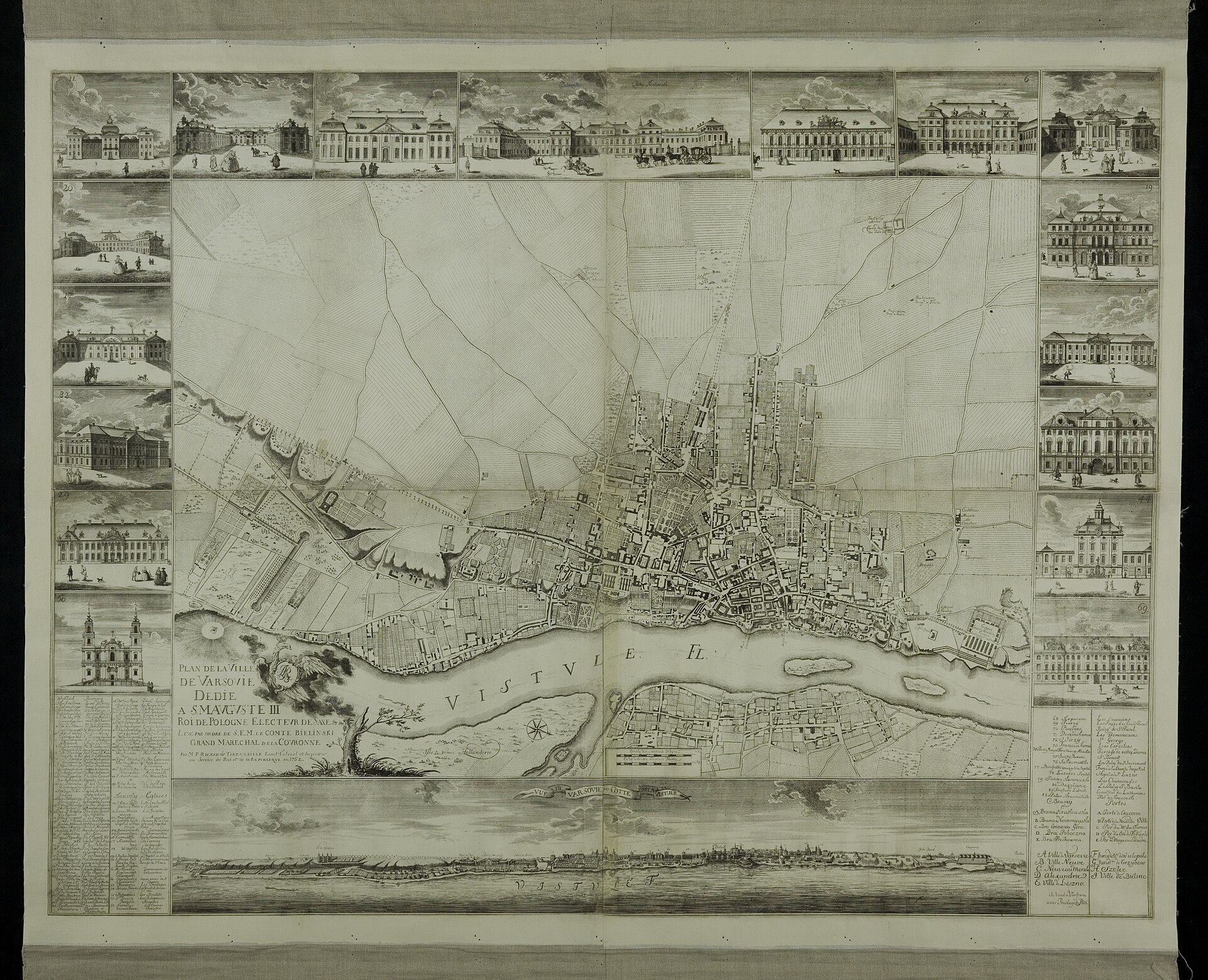
Plan of the city of Warsaw, dedicated to His Majesty Augustus III (Pierre Ricaud de Tirregaille, 1762)
Detailed town plan showing Warsaw’s old‑town street grid, city walls and gates, the Vistula River with Praga island, and major churches and palace blocks.
1762 · Pierre Ricaud de Tirregaille · Wikimedia Commons
Public domain (plate dated 1762)
In this city
Landmarks of Warsaw, see each in its prime


Castles of Warsaw


More cities to explore
 PolandKrakówExplore it in 1400 · 1570 · 1900
 PolandPoznańExplore it in 1560
 PolandGdańskExplore it in 1650 · 1900
 PolandWrocławExplore it in 1500 · 1913
Castles of Europe · Landmarks of Europe · create your own reconstruction.