Historic Cities · Poland
Gdańsk through the ages
Gdańsk is a city on the Baltic coast of northern Poland, and the capital of the Pomeranian Voivodeship. With a population of 486,492, it is Poland's sixth-largest city and its major seaport. Gdańsk lies at the mouth of the Motława River and is situated at the southern edge of Gdańsk Bay, close to the city of Gdynia and the resort town of Sopot; these form a metropolitan area called the Tricity (Tr

Gdańsk in 1650
Danzig of the Grain Trade
Danzig in 1650 is the great Polish Crown port where Vistula grain and timber are mustered for the Baltic trade. The walk moves from the sea and river mouth through quays, granaries and the ornamented Long Market to end on the vast brick mass of St. Mary's.
A low, red‑tiled skyline of stepped and Dutch gables, tall brick churches and coppered spires rises behind timbered wharves and rows of tall brick granaries on narrow islets. Streets are narrow and paved, façades richly painted or plastered, the Motława crowded with sailing merchantmen and flat barges piled high with sacks of rye and oak timber awaiting the Crane’s roar.
The route: 22 streets, squares and views
Gulf of Danzig Approach → Wisłoujście Fortress → Motława Channel Mouth → Granary Island Entrance → Southern Spichrzów Quay → The Crane (Żuraw) → Długie Pobrzeże Quay → Great Mill (Wielki Młyn) → St. Nicholas' Quay → Granary Island Center → …
Step inside, 12 interiors
Lower Loading Floor · Winch and Gear Chamber · Millstone and Gear Hall · Stone Wine Cellar · Rye‑stacked Granary Floor · Burgher Parlour · Counting House · Vaulted Merchants' Hall · Red Council Chamber · Framed Shipwrights' Workshop · Whitewashed Nave · Astronomical Clock Chamber
Planned from the Wikipedia record: History of Gdańsk.
Gdańsk in 1900
Imperial Danzig
This is a Prussian provincial capital wearing a Hanseatic costume: restored brick façades line the Long Market while imperial shipyard slipways and gantry cranes clatter along the Vistula. The walk moves from the busy Motlau quays, past the Green Gate and Langer Markt, through tram-lined streets and barrack squares, and finishes on the high ground overlooking the red-tiled roofs.
The skyline is a tapestry of broad red-brown brick: the enormous mass of Marienkirche and its squat tower, stepped-gabled merchants’ houses along the Langer Markt, and the verdigris spires of late-medieval towers. Along the Motlau, long rows of brick warehouses and gantry cranes meet the water; the new railway station rises in polychrome brick turrets. Streets are paved with cobbles, horse trams thread narrow frontages, and uniformed soldiers, dockers and black-clad merchants create a busy city of commerce and garrison life.
The route: 22 streets, squares and views
Danzig from the Bay → Neufahrwasser Lighthouse → Kaiserliche Werft → Schichau-Werft → Motlau Quay → Der Kran (The Crane) → Speicherinsel (Granary Island) → Grünes Tor (Green Gate) → Langer Markt (Long Market) → Artushof (Artus Court) → …
Step inside, 14 interiors
Imperial Shipyard Drawing Office · Schichau Engine Workshop · Ship-Agent's Office on Motława · Harbour Crane Mechanism Room · Great Granary Storage Hall · Green Gate State Chamber · Artus Court Great Hall · Main Town Council Chamber · Lange Gasse Merchant's Parlor · Mariengasse Amber Workshop · Brick-Vaulted Nave of St. Mary's · Great Mill Milling Floor · Main Station Booking Hall · Horse Tram Depot Stable
Planned from the Wikipedia record: History of Gdańsk.
Its story
The story of Gdańsk.
Urbs Gyddanyzc and the Lübeck Charter, 997–1294
The settlement that became Gdańsk began in the 9th century as a farming and fishing village at the mouth of the Motława, turned in the early 10th century into a centre of trade, and was annexed in about 975 by Mieszko I, who raised a stronghold there in the 980s and tied the Piast state to the Baltic trade routes. The first written record thought to refer to the place is the life of Saint Adalbert, written in 999, which describes how in 997 Adalbert of Prague baptised the inhabitants of urbs Gyddannyzc, "situated on the edge of the vast state and touching the seashore".
The site was held by the Samborides within the Duchy of Pomerelia, a fief of Poland from 1119, and from about 1180 the growing Baltic trade drew German settlers, mostly from Lübeck. Świętopełk II, who ruled Pomerelia as an independent duchy from 1227 fought the Teutonic Order in 1242–48 and 1252–54, which held back the colony's growth into a self-governing town; by 1263 at the latest he had granted city rights under Lübeck law, the law of the settlers' own home town. His successor Mestwin II was the last male of the line, and his death in 1294 opened a contest for the town between the Polish Piasts, the Přemyslids of Bohemia, the Margraves of Brandenburg and the Teutonic Order.
The Teutonic Order and the Killings of 1308
In 1308 a rebellion against Bogusza, the governor appointed by the future king Władysław I the Elbow-high, let Brandenburg take the town. The Polish garrison called on the Teutonic Knights, who relieved them and then seized the town themselves. The Order killed the Brandenburg forces and the Pomeranian knights who had backed them, and also townspeople; the toll is disputed. Śliwiński in 2008, and Śliwiński and Możejko in 2017, put the dead at roughly a thousand, most of them commoners from a town and its adjacent settlements reckoned at two to three thousand people; Smoliński in 2021 estimates between sixty and 150. The Polish Crown used the events against the Order in a papal lawsuit, and a bull of Clement V charged the Knights with a massacre.
The Order absorbed the town into its monastic state and ordered the surviving burghers out. It did not rebuild until the mid-1320s, when some former inhabitants returned, Lübeckers above all, alongside settlers from other German regions, and the town became almost entirely German, thereafter known chiefly by its German name, Danzig. Under the Treaty of Kalisz of 1343 Casimir of Poland recognised the Order's possession of Danzig and Pomerelia, which the Order in turn acknowledged holding as a grant from the Polish Crown.
The town's living was the river: grain, especially wheat, with timber, potash and tar, came down the Vistula from Prussia and Poland for export. Danzig joined the Hanseatic League in 1358 and became an active member in 1361, trading with Bruges, Novgorod, Lisbon and Seville. In 1440 it helped found the Prussian Confederation against the Order's rule, and the Confederation's complaint of 1453 listed repeated cases of the Order imprisoning or killing local patricians and mayors without trial.
The Great Privilege of 1457
In 1454 the Prussian Confederation renounced obedience to the Grand Master and asked Casimir IV of Poland to reincorporate the territory, beginning the Thirteen Years' War. On 15 May 1457 Casimir granted the Great Privilege: full autonomy under the king's protection, freedom from tariffs and taxes on trade within Poland, Lithuania and Ruthenia, independent jurisdiction, and the right to strike its own coin, the Danzig thaler.
The port now had free and privileged access to Polish markets alongside its Hanseatic trade. The Second Peace of Thorn in 1466 ended the fighting for good and the Order recognised the city's incorporation into Poland, within the autonomous province of Royal Prussia. During the Reformation most German-speaking inhabitants became Lutheran. As one of the largest cities of Poland, Danzig held voting rights in royal elections.
Báthory's Siege and the Merchant Communities, 1575–1721
In the royal election of 1575 Danzig backed Maximilian II against Stephen Báthory. Báthory won, and the city, secretly supported by Denmark and the Emperor, shut its gates against him. The siege lasted six months and the city's army of 5,000 mercenaries was beaten in the field on 16 December 1577, but Báthory could not take the walls. The settlement confirmed the city's special status and its privileges; the city recognised him as ruler of Poland and paid 200,000 gold guldens as an apology. The Swedish Deluge of 1655–1660 ended in the Treaty of Oliwa, signed in a district of the city.
The city drew in people as steadily as it drew in grain. Scots began arriving as refugees or migrants from 1380 and took citizenship; a large Mennonite community grew in the 1560s and 1570s; a French Huguenot congregation was founded in 1686. These incomers were mostly Protestant and assimilated into the local German culture: around 1600 over ninety per cent of the population was German and Protestant. There was also a Polish minority, and the Gdańsk Bible printed here in 1632 became the Bible of Evangelical Poles. A last great plague and the wars of the 18th century brought a slow decline, with steady recovery only after peace returned in 1721.
Partition, Prussian Rule and the Emigrant Port, 1734–1919
As a stronghold of Stanisław Leszczyński's supporters in the War of the Polish Succession, the city was taken by the Russians in 1734, then restored through the 1740s and 1750s until its port was again the Baltic region's most significant grain exporter. The First Partition of 1772 gave Prussia almost all of Royal Prussia, but Danzig itself remained Polish, an exclave cut off by a Prussian military barrier that also blocked shipping to foreign ports. Prussia annexed the city outright in the Second Partition of 1793; the population largely opposed it and wanted to stay within the Kingdom of Poland, and both the mayor and the city councillor Johann Uphagen resigned over the annexation. In 1807 a French-led coalition besieged and took the city, which became a free city and client state of the French Empire until Prussian and Russian forces captured it in 1814.
From the 1820s the Wisłoujście Fortress served as a prison, mainly for Polish political prisoners: insurgents of the November and January uprisings, and men fleeing conscription into the Russian army from the Russian partition. Between May and June 1832 and again in November 1833, more than a thousand Polish insurgents left partitioned Poland through the city's port on ships bound for France, the United Kingdom and the United States, part of the movement known as the Great Emigration. The second half of the century brought railways, port expansion and shipbuilding, though industrial growth lagged behind other major Prussian cities. With German unification in 1871 Danzig became part of the German Empire, and remained so until 1919.
The Free City, the Ghetto and Westerplatte, 1920–1945
When Poland regained independence with the access to the sea promised under Woodrow Wilson's Fourteen Points, Poles hoped the harbour would come with it; because Germans formed a majority in the city, it was not placed under Polish sovereignty. Under the Treaty of Versailles it became the Free City of Danzig, a state under the League of Nations with its external affairs largely controlled by Poland, which had free use of the harbour, a post office, a garrison at Westerplatte and a customs union. In 1929 Poles and Kashubians numbered 23,120 out of 215,464 inhabitants.
As Nazism grew among the German population, anti-Polish feeling spread with it. Public Polish-language schools were heavily restricted, so Poles founded private ones of their own. In the 1930s the local Nazi Party under Albert Forster, a member of the SS, won the elections to the city legislature and began a wave of repression: Polish students were expelled from the technical university, dozens of Polish surnames were forcibly Germanised, the Artus Court and Neptune's Fountain were struck from the heritage list as reminders of Polish rule, German firms were forbidden to employ Poles, and Polish was banned in public places. Polish schools and their pupils were attacked by Danzig citizens, and Polish railwaymen beaten. Many ethnic Poles were tracked by the Gestapo and, in Operation Tannenberg, arrested and sent to camps such as Stutthof or executed in the Piaśnica forest. Within a year of a pogrom in 1937, more than half the city's Jewish community had left, and organised emigration began after the Kristallnacht riots of 1938. Regular transports to Mandatory Palestine started in 1939. By 1941 only 600 Jews remained, and many of those were moved into the single-building Danzig Ghetto.
Germany demanded the city's return along with a German-controlled road across the Polish Corridor, pressing the claim harder than it had the Sudetenland against Czechoslovakia in 1938. Poland refused, and the invasion of Poland began on 1 September 1939. At 04:45 that morning the SMS Schleswig-Holstein fired the war's first shots at the Polish military depot on Westerplatte, while a small group of men held the Polish post office for several hours; its defenders were later executed. During the war Germany ran a prison here, an Einsatzgruppen penal camp, a Zigeunerlager for Romani people, two subcamps of the Stalag XX-B prisoner-of-war camp and several subcamps of the Stutthof concentration camp within the present city limits. German civilians fled as the Red Army advanced, in spontaneous flight and in an organised evacuation running from the summer of 1944 into the spring of 1945; thousands left during Operation Hannibal aboard ships including the Wilhelm Gustloff. The city was captured by Polish and Soviet troops in March 1945 after heavy Allied and Soviet air raids, and Soviet soldiers carried out large-scale rape and looting, particularly in the industrial districts.
A Polish City Remade, 1945 Onwards
Under the decisions taken by the Allies at Yalta and Potsdam, the city was annexed by Poland under a Soviet-installed communist government. Around 124,000 Germans were still in the city in June 1945; in July the authorities began deporting them to Allied-occupied Germany, and about 93,029 remained on 1 November 1945. Locals who declared Polish nationality and were verified as Poles could stay: of 194,633 inhabitants counted in 1950, 12 per cent were pre-war autochthons. The rest were newcomers: Poles freed from forced labour in Germany, repatriates expelled from east of the new Polish-Soviet border, Kashubians from nearby villages, settlers from central Poland, Jewish Holocaust survivors mostly repatriated from the Eastern Borderlands, and refugees of the Greek Civil War. Ukrainians and Belarusians were forcibly resettled here under Operation Vistula in 1947, a policy of scattering non-Polish groups across the newly acquired territories to break up their communities.
Parts of the ruined historic city were rebuilt through the 1950s and 1960s, the reconstruction deliberately setting out to dilute the city's German character and return it to how it was thought to have looked before the Prussian annexation of 1793. Investment in the port and shipyards, driven by Soviet ambitions in the Baltic, made Gdańsk the major shipping and industrial centre of the People's Republic. In December 1970 anti-regime demonstrations here brought down the Polish leader Władysław Gomułka; military and police opened fire on demonstrators in Gdańsk and Gdynia, killing several dozen. In August 1980 the Gdańsk Shipyard was the birthplace of Solidarity, whose opposition to communist rule helped end it in Poland in 1989.
Lech Wałęsa became President of Poland in 1990, and the European Solidarity Centre opened in the city in 2014. In January 2019 the mayor, Paweł Adamowicz, was stabbed by a man recently released from prison for violent crimes, who claimed the mayor's party had been responsible for imprisoning him; Adamowicz died the following day. Gdańsk is the capital of the Pomeranian Voivodeship and Poland's major seaport, with a population of 486,492. Its historic city centre is listed as one of Poland's national monuments, and in 2025 it became a UNESCO City of Literature.
From the archive
Gdańsk on paper: the old town as it was mapped.
A period plan or bird's-eye view of the old town, drawn between 1500 and 1850, the streets this page's reconstructions walk. Public domain, with its source named.
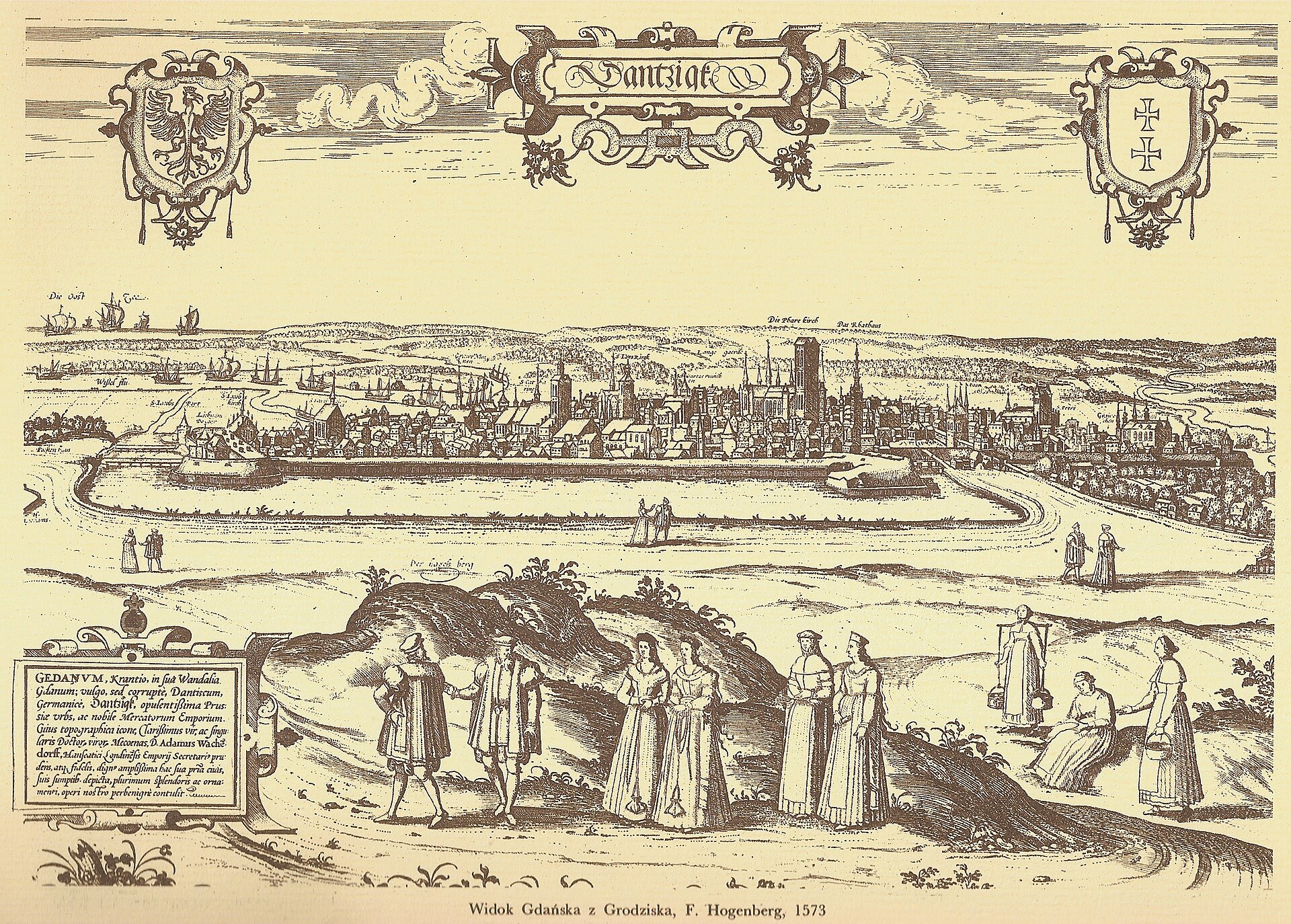
Bird's-eye view of Dantzig (Gdańsk), from Braun & Hogenberg's Civitates/period panorama (cartouche: Dantzigk)
Shows the walled old town with moat and bastions, gates and bridges, rows of houses and church spires including the tall St Mary's tower, and the river harbour.
1573 · Hogenberg · Wikimedia Commons
Public domain (plate dated 1573)

Ships tied to Gdańsk
- German cruiser Prinz Eugen: Bombarded Soviet forces around Danzig and Gotenhafen in 1945
- SMS Lützow: Built by Schichau-Werke at Danzig, her keel laid in May 1912
- SMS Schlesien: Laid down at Schichau-Werke, Danzig, in 1904; shelled Soviet forces there in 1945
- SMS Schleswig-Holstein: Fired the first shots of the Second World War at the Westerplatte in Danzig
Castles of Gdańsk

More cities to explore
 PolandPoznańExplore it in 1560
 PolandWarsawExplore it in 1650 · 1775 · 1925
 PolandKrakówExplore it in 1400 · 1570 · 1900
 PolandWrocławExplore it in 1500 · 1913
Castles of Europe · Landmarks of Europe · create your own reconstruction.