Historic Cities · Poland
Kraków through the ages
Kraków, officially the Royal Capital City of Kraków, is the second-largest and one of the oldest cities in Poland. Situated on the Vistula River in Lesser Poland Voivodeship, the city has a population of 816,614 (2025), with 1,428,363 people living in the Kraków metropolitan area.

Kraków in 1400
Jagiellonian Kraków
Kraków in 1400 is a rising royal capital under early Jagiellon rule, its castle and cathedral on Wawel Hill already the city's ceremonial heart while the vast Rynek pulses with long-distance merchants. The walk follows the medieval approach, passing fortified gates, the Cloth Hall and market stalls, the developing Collegium Maius and the separate royal town of Kazimierz across the Vistula meadows.
The skyline is dominated by Wawel's clustered Gothic towers and the squat mass of the castle above the Vistula, pierced by a few church spires from the Main Market. Street surfaces are cobble and packed earth; houses are timber-framed or narrow brick townhouses with steep red-tile roofs and pale plaster façades. Defensive stone walls, the round Barbican and wooden river bridges shape edges, while open meadows and the broad Vistula floodplain frame the city.
The route: 22 streets, squares and views
Vistula Meadows Approach → St. Florian's Gate → Kraków Barbican → Floriańska Street → Sławkowska Street → Rynek Główny: East Side → St. Mary's Basilica → Cloth Hall (Sukiennice) → Town Hall Tower → Szewska Street → …
Step inside, 14 interiors
Gatehouse Chamber under St. Florian · Barbican Guardroom and Passage · Merchant Inn Taproom · High Choir and Canons' Stalls · Cloth Hall Merchants' Stalls · Council Hall of the Town Hall · Masters' Shoemaker Workshop · Canons' Refectory at Kanoniczna · Great Hall of the Royal Castle · Royal Choir and Piast Tombs · Armory and Stone Cellars · Skałka Chapel and Votive Shrine · Collegium Maius Cloistered Courtyard · Scriptorium and Library Room
Planned from the Wikipedia record: History of Kraków.
Kraków in 1570
Renaissance Kraków
Kraków in 1570 stands at the height of its Renaissance remaking: Wawel renewed under Italian architects, a gilded Sigismund Chapel crowning the cathedral, and a reworked Cloth Hall presiding over Europe's largest medieval market. The walk passes royal terraces, crowded market arcades, university courts, and the Jewish quarter of Kazimierz, where synagogues and merchants animate narrow streets and river quays.
The skyline is dominated by Wawel Hill: the castle's pale stone façades, the cathedral's campanile and the gold dome of the Sigismund Chapel catch the sun above a forest of slender church spires. Red-tiled roofs, timber-framed houses and pale masonry line wide market streets and narrow lanes; the Vistula runs low and brown with barges and warehouses, while the city walls, gateway towers and the Barbican mark the old defensive edge.
The route: 24 streets, squares and views
Błonia and the Vistula Approaches → Vistula Bank at Stradom → Barbican and St. Florian's Gate → Floriańska Street → Town Hall Tower → Rynek Główny (Main Market) → Cloth Hall (Sukiennice) → St. Mary's Basilica Tower → Merchant Tenements of the Rynek → Grodzka Street to Wawel → …
Step inside, 12 interiors
Town Hall Council Chamber · Cloth Hall Storage Attic · Veit Stoss High Altar Chapel · Italian Merchant's Palazzo Hall · Canons' Hall at Kanonicza · Tapestried Audience Hall · Cathedral Nave and Royal Tombs · Gilded Sigismund Chapel · Arcaded Royal Courtyard · Collegium Maius Lecture Hall · Old Synagogue Prayer Hall · Remuh Prayer Room
Planned from the Wikipedia record: History of Kraków.
Kraków in 1900
Young Poland Kraków
Kraków at the turn of the century is the cultural centre of the Young Poland movement under Austrian rule, where artists, writers and musicians gather amid medieval streets and new Secession tastes. The walk moves from the railway arrival into the Planty gardens, through the market and the lanes toward Wawel, then across to Kazimierz and up to a broad mound view, showing everyday life, studios and the stained glass that defines this era.
Wawel’s castle and cathedral spires puncture a compact skyline of red-tiled roofs and mixed Gothic and Renaissance gables, ringed by the green belt of the Planty where gas lamps and gravel paths replace the old walls. Narrow, cobbled streets open into the vast Rynek Główny with the Sukiennice at its centre; horse-drawn cabs, tram horses and promenading townspeople animate façades of plaster, brick and newly detailed Art Nouveau shopfronts and church windows glowing with fresh stained glass.
The route: 22 streets, squares and views
Kraków Główny Approach → Planty at Basztowa → Barbakan (The Barbican) → Brama Floriańska (St. Florian's Gate) → Ulica Floriańska → Rynek Główny (Main Square) → Kościół Mariacki Exterior → Sukiennice (Cloth Hall) → Wieża ratuszowa (Town Hall Tower) → Kościół Franciszkanów → …
Step inside, 13 interiors
Main Station Waiting Hall · Carriagemen's Tavern Cellar · Merchant Showroom on Floriańska · Nave of St. Mary's Basilica · Sukiennice Upper Exhibition Hall · Old Council Chamber · Franciscan Stained-Glass Chapel · Green Balloon Cabaret Room · Main Auditorium of Słowacki Theatre · Palace of Art Exhibition Hall · Painter's Studio with Folk Costumes · Royal Audience Chamber · Chapel of the Holy Cross
Planned from the Wikipedia record: Young Poland.
Its story
The story of Kraków.
Wawel Hill, the Vistulans and the Mongol Sack
Kraków began as a fortified settlement on Wawel Hill above the Vistula, a stronghold of the Vistulans, a Lechitic tribe, around the 8th century; tradition attributes the founding to the mythical ruler Krakus. Before the Polish state existed it was briefly subject to Great Moravia and then part of the Duchy of Bohemia. Its name first appears in the written record in the mid-960s, when the Sephardi Jewish traveller Abraham ben Jacob described it as a notable commercial centre under the Bohemian duke Boleslaus I. Towards the end of his reign Mieszko I took Kraków from the Bohemians into the holdings of the Piast dynasty, and by the end of the 10th century it was a leading centre of trade.
In 1038 Kraków became the seat of the Polish government. The Testament of Bolesław III Wrymouth, effective on his death in 1138, named Kraków the Seniorate Province, to be ruled by the eldest male of the royal family as High Duke. The system collapsed in fighting between brothers, and the fragmentation of Poland lasted until 1320.
Kraków was almost entirely destroyed in the first Mongol invasion of 1241, after the Polish attempt to stop the invaders was crushed at the Battle of Chmielnik. It was rebuilt on practically the same plan and incorporated in 1257 by the high duke Bolesław V the Chaste, who granted city rights modelled on Magdeburg law, with tax benefits and trade privileges that drew German-speaking burghers. The Mongols ravaged the city again in 1259, and a third attack in 1287 was repelled, helped by the new fortifications. By the end of the 13th century German-speaking burghers formed the majority of the magistrates and the merchant class, and in 1311 the rebellion of wójt Albert against High Duke Władysław I drew them in; they were massacred or fled, and the burgher class was re-Polonised gradually afterwards.
Casimir's University and the Golden Age, 1335–1558
In 1335 King Casimir III the Great declared the two western suburbs a separate city named Kazimierz after himself, and walled its central section in 1362. In 1364 he founded the university, the second in central Europe after Prague; a cathedral school had taught there since 1150. The city grew under the Jagiellonian dynasty from 1386 as the capital of the Kingdom of Poland and a member of the Hanseatic League, drawing craftsmen from abroad who set up businesses and formed guilds.
Kasper Straube printed the Calendarium Cracoviense here in 1473, the first work printed in Poland, and Johann Haller had a press by 1500. In 1489 the Nuremberg sculptor Veit Stoss finished the high altar of St Mary's Church. Italian artists came with the Renaissance in the late 15th century, and Nicolaus Copernicus studied at the local academy. Sigismund I the Old, who took the throne in 1507, married Bona Sforza of Milan and used his Italian connections to have the Florentine Bartolommeo Berrecci remake Wawel Castle as a Renaissance palace. A permanent postal connection between Kraków and Venice was established in 1558, founding Poczta Polska.
Expelled to Kazimierz, 1469–1608
During the 15th century extremist clergy advocated violence against Jews, who lost their positions by degrees. In 1469 the Jewish community was expelled from its old settlement to Spiglarska Street, and in 1485 the Jewish elders were forced to renounce trade in the city, which led many to leave for Kazimierz, a royal town outside the restrictions. A fire in Kraków in 1494 was followed by a wave of attacks on Jews, and in 1495 King John I Albert expelled the Jews from within the city walls; they moved to Kazimierz. Its Jewish quarter, in the north-east of the town, produced Renaissance synagogues including the Old Synagogue. In 1553 the Kazimierz district council licensed the Jewish qahal to build its own interior walls across the western section of the existing defences, and these were extended again in 1608 as the community grew with an influx of Jews from Bohemia.
The Court Leaves for Warsaw, 1572–1795
In 1572 Sigismund II Augustus, the last of the Jagiellons, died childless. The throne passed in quick succession to foreign-born rulers, and the city's importance declined. In 1596 Sigismund III of the House of Vasa moved the administrative capital of the Polish–Lithuanian Commonwealth from Kraków to Warsaw. The city was besieged, captured and pillaged in the Swedish invasion of 1655, and occupied in December 1656 by George II Rákóczi of Transylvania. An outbreak of bubonic plague in 1707 killed 20,000 residents.
After the first two partitions of the Commonwealth, in 1772 and 1793, Kraków was still part of the much reduced Polish state. In 1794 Tadeusz Kościuszko proclaimed his revolt against the partitioning powers in the city's main square. The rising was put down despite his victory at Racławice; the Prussian army took Kraków on 15 June 1794 and looted the royal treasure kept at Wawel Castle, regalia valued at 525,259 thalers and secretly melted down in 1809. Poland was partitioned for the third time in 1795 and Kraków passed to the Austrian province of Galicia.
Free City, Grand Duchy and Polish Athens, 1802–1918
German became the town's official language in 1802, and only half the councillors appointed by the Habsburgs were Polish. In 1809 Napoleon took West Galicia from Austria and added Kraków to the Duchy of Warsaw, and army upkeep, occupation and a flood in 1813 left the city in debt. The Congress of Vienna in 1815 restored the partition but made Kraków a partially independent, neutral free city. Its population grew from 23,000 to 43,000, and the Jewish share of it from 20.8 to 30.4 per cent. A free trade zone helped at first, but political insecurity discouraged investment and the city fell into recession, losing over 4,000 inhabitants between 1844 and 1850.
The Kraków Uprising of 1846 failed to spread to other Polish lands and was crushed by the Austrians, who annexed the city state as the Grand Duchy of Kraków, administratively part of Austrian Galicia. Around a tenth of the city was destroyed by fire in 1850. After Austria's defeat in the Austro-Prussian War of 1866 Galicia was granted partial autonomy, with Polish as a language of government. Freer than the Polish cities under Russian and Prussian rule, Kraków became a national symbol and a centre of culture and art, called the Polish Athens, where Jan Matejko and Stanisław Wyspiański both worked.
Running water and electric streetcars arrived in 1901. Under the mayor Juliusz Leo the surrounding suburban communities were incorporated between 1910 and 1915 into a single unit known as Greater Kraków; with migration from the countryside the population roughly doubled in fifteen years, from about 91,000 to 183,000 in 1915. On 3 August 1914 Józef Piłsudski formed the First Cadre Company here, the predecessor of the Polish Legions. Russian troops besieged the city that November and thousands of residents left for Moravia and elsewhere, mostly returning in 1915. Austrian rule ended in 1918 when the Polish Liquidation Committee took power and the city passed to the reborn Polish state.
The General Government and the Ghetto, 1939–1945
German forces entered Kraków on 6 September 1939. Mayor Stanisław Klimecki went out to meet the advancing Wehrmacht, called on them to stop shooting because the city was defenceless, and offered himself as a hostage; the Gestapo killed him three years later in the Niepołomice Forest. Einsatzgruppen I and zbV entered the city to commit atrocities against Poles, and on 12 September the Germans carried out a massacre of ten Jews. On 26 October the occupiers created Distrikt Krakau and made the city the capital of the General Government, ruled by Governor-General Hans Frank from Wawel Castle. They intended to Germanise Kraków completely: to remove all Jews and Poles, rename streets and places in German, and promote propaganda presenting the city as historically German. On 6 November, in Sonderaktion Krakau, more than 180 professors and academics of the university, including Rector Tadeusz Lehr-Spławiński, were arrested at a meeting called by the Gestapo chief Bruno Müller and sent to Sachsenhausen and then in March 1940 to Dachau; the survivors were released only after international protest. On 9 and 10 November, in the Intelligenzaktion, 120 more Poles were arrested, among them teachers, students and judges. The Sicherheitspolizei took over the Montelupich Prison; over 1,700 Polish prisoners were eventually massacred at Fort 49 of the Kraków Fortress and the wood beside it, and others deported to Ravensbrück and Auschwitz. The prison held a cell for kidnapped Polish children under ten, about seventy at a time, who were sent on to concentration camps and executed.
Some 56,000 Jews lived in Kraków at the outbreak of the war, almost a quarter of a population of about 250,000, and by November 1939 the number had grown to around 70,000. Jews were encouraged to flee before the ghettos were formed from December 1939; for those who stayed, the German authorities decided in March 1941 to make the then-suburban district of Podgórze the Kraków Ghetto, where many died of illness or starvation. From autumn 1941 the SS pursued a policy of extermination through labour. Mass deportation from the ghetto took place in the first week of June 1942, and it was liquidated in March 1943; its inhabitants were murdered or sent to the extermination camps at Bełżec and Auschwitz and to the Kraków-Płaszów camp. Oskar Schindler selected workers from the ghetto for his enamelware factory and so saved them from the camps; the film director Roman Polanski survived the ghetto. By September 1943 the last of the Jews of the Kraków Ghetto had been deported. Of at least ninety synagogues active before the invasion, most were stripped of their ceremonial objects and used by the Germans as stores, ammunition dumps and stables.
The Polish resistance was active from the first weeks: the Organizacja Orła Białego was founded in September 1939, the city held one of the six main commands of the Union of Armed Struggle in occupied Poland, and a local branch of Żegota was set up to rescue Jews. The Germans ran forced labour camps in the city and, in 1942–1944, the Stalag 369 prisoner-of-war camp, and deported many Poles captured in Warsaw here during and after the Warsaw Uprising of 1944. Kraków came through the war looted but largely intact. The account popularised under the People's Republic, that Marshal Ivan Konev saved the city by a lightning attack that left the Germans a withdrawal route, has been questioned by the historian Andrzej Chwalba, who finds no evidence of a German demolition plan and none of Konev's stated intention. Soviet forces entered on 18 January 1945 and began arresting Poles loyal to the government-in-exile or who had served in the Home Army; their entry was accompanied by a wave of rapes of women and girls that drew official protests.
Nowa Huta and the Papal City, 1945 Onwards
The city's post-Holocaust Jewish population had fallen to about 5,900 by the end of the 1940s; Poland was the only Eastern Bloc country to permit free emigration to Israel without visas or exit permits after the war. Under the People's Republic the universities lost their printing rights and their autonomy. The government ordered the country's largest steel mill built at Nowa Huta, a new suburb; the Lenin Steelworks sealed its transformation from a university town into an industrial centre, and the project was regarded by some as an attempt to dilute Kraków's intellectual and artistic influence by importing a new working class. Greek refugees of the Greek Civil War settled in Nowa Huta in the 1950s.
Karol Wojtyła, cardinal archbishop of Kraków from 1964 to 1978, spent two decades lobbying for permission to build the first churches in the newly industrialised suburbs. In 1978 he was elevated to the papacy as John Paul II, the first non-Italian pope in over 450 years, and in the same year UNESCO placed the Old Town on the first World Heritage list, alongside the nearby Wieliczka Salt Mine. Since the end of communism and Poland's accession to the European Union, offshored IT work has become important to the city's economy. Kraków is the capital of the Lesser Poland Voivodeship, with a population of 816,614 in 2025.
From the archive
Kraków on paper: the old town as it was mapped.
A period plan or bird's-eye view of the old town, drawn between 1500 and 1850, the streets this page's reconstructions walk. Public domain, with its source named.
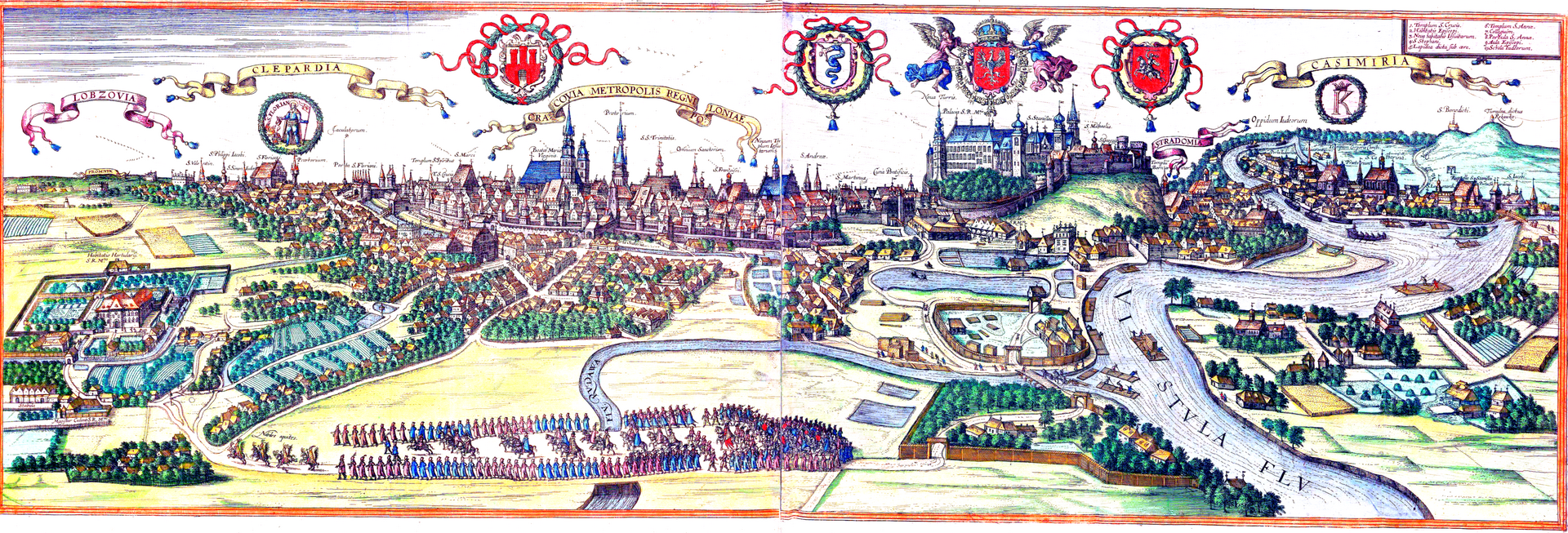
Bird's-eye view of Kraków (Cracovia), from Braun & Hogenberg's Civitates Orbis Terrarum
Shows the medieval core with Wawel Castle on the hill, St Mary's spire, city walls and gates, the Vistula with bridges, and suburbs Kazimierz, Kleparz and Łobzów.
1618 · Braun and Hogenberg · Wikimedia Commons
Public domain (plate dated 1618)


Castles of Kraków

More cities to explore
 PolandWrocławExplore it in 1500 · 1913
 PolandWarsawExplore it in 1650 · 1775 · 1925
 PolandGdańskExplore it in 1650 · 1900
 PolandPoznańExplore it in 1560
Castles of Europe · Landmarks of Europe · create your own reconstruction.