Historic Cities · Poland
Poznań through the ages
Poznań is a city on the River Warta in west Poland, within the Greater Poland region. The city is an important cultural and business center and one of Poland's most populous regions with many regional customs such as Saint John's Fair, traditional Saint Martin's croissants and a local dialect. Among its most important heritage sites are the Renaissance Old Town, Town Hall and Poznań Cathedral.

Poznań in 1560
Renaissance Poznań
Poznań in 1560 stands at the height of its role as a trade hub between east and west, its streets full of goods, barges and foreign merchants. The rebuilt Renaissance town hall dominates the Old Market with its arcades and clockwork goats; beyond it the brick towers of the cathedral mark Ostrów Tumski and the Warta carries grain, furs and fish to the city.
Rooflines of red clay tile and steep gables crowd a compact market town of painted plaster and pale brick, pierced by church spires and the squat brick towers of Ostrów Tumski. Narrow lanes give on to a broad arcaded market; timber-framed workshops sit beside new masonry facades after the great fire. Along the Warta wooden quays and barges form a busy waterfront while town walls and an observation tower rim the compact urban profile.
The route: 17 streets, squares and views
Warta Riverbank, Chwaliszewo → Bridge to Ostrów Tumski → Ostrów Tumski Quay → Poznań Cathedral (outside) → Przemysł Hill → Royal Castle → Chwaliszewo Quay → Fish Market on the Warta → Śródka Market → Ulica Żydowska → …
Step inside, 8 interiors
Nave over Piast Tombs · Granary Loft Above Warta · Lubrański Lecture Hall · Great Hall of the Council · Weigh-house Weighing Hall · Vaulted Cloth Merchant's Shop · Burgher Kitchen Behind Market · Górka Palace Great Chamber
Planned from the Wikipedia record: History of Poznań.
Its story
The story of Poznań.
Stronghold, Baptism and Charter: Piast Poznań to 1320
The city began as a stronghold built in the 8th or 9th century between branches of the Warta and the Cybina, on what is now Ostrów Tumski, Cathedral Island. In the 10th century the early Piast state of the Polans, under Mieszko I, was centred on Poznań, Gniezno and Giecz. The Baptism of Poland, the ceremony by which Mieszko converted in 966, is likely to have taken place here; in 968 the country received its first missionary bishop, Jordan, believed to have had his seat in Poznań, and work began on the cathedral, the first in Poland. Mieszko I, Bolesław I and Mieszko II are buried beneath it.
Anarchy and pagan reaction followed Mieszko II's death in 1034, probably in Poznań, and in 1038 Bretislaus I, Duke of Bohemia, sacked and destroyed both Poznań and Gniezno. When Casimir the Restorer reunited the country in 1039 the capital went to Kraków, and Poznań was rebuilt as an economic centre rather than a political one.
The town proper was a 13th-century act of policy. About 1249 Duke Przemysł I began a castle on the hill on the left bank of the Warta, and in 1253 he and his brother Bolesław the Pious issued a charter founding a town under Magdeburg law. It went to Thomas of Gubin, who brought many German settlers to build and populate it. The town covered the ground of the present Old Town around the Market Square and was walled and tied into the castle under Przemysł II, who was crowned king of Poland in 1295 and murdered at Rogoźno the following year. Poznań passed to Władysław the Elbow-high in 1314, whose coronation in 1320 ended the period of fragmentation.
Fur, Fire and the Jewish Quarter in the Commonwealth City, 1320–1600
In the reunited kingdom, and later the Polish–Lithuanian Commonwealth, Poznań was the seat of a voivodeship. Its rise came in the Jagiellonian period, when it stood on the trading route from Lithuania and Ruthenia to western Europe and Władysław II Jagiełło granted it numerous privileges; by the end of the 16th century it was a major centre for the fur and leather trade, particularly in skins from Lithuania and Russia, and as one of the most influential cities of the state it held voting rights during the free election period. Growth was checked by epidemics, floods and repeated fire: the blaze of 2 May 1536 destroyed 175 buildings including the castle and the town hall, which was rebuilt in 1550–1560 under Giovanni Battista di Quadro.
A Jewish community had probably existed since the mid 13th century, though the first documentary record dates from 1367, by which time the city had a synagogue; the self-governing Jewish quarter lay in the north-east of the walled city, around the street called ulica Żydowska. The Lubrański Academy, founded in 1519, was Poland's second institution of higher education after the Jagiellonian University.
Swedes, Plague and the Bamberg Settlers, 1655–1793
From the second half of the 17th century the city was worked over by one army after another. A Swedish army occupied it in 1655 during the Second Northern War and was replaced by Brandenburgers in 1656, the Swedes burning the suburbs as they left; the Brandenburg garrison surrendered after a two-month siege in 1657 that left the city devastated. During the Deluge the Jewish community was accused of collaborating with the invading Swedes, and suffered pogroms carried out both by the city's non-Jewish residents and by units of the Polish Crown Army. A Swedish army held Poznań again from 1703 to 1709 in the Third Northern War, making it the main centre of the pro-Swedish movement in the country, and outbreaks of plague continued until 1711. A fire on 16 March 1717 spread from the Jewish quarter through the whole city, and an alleged failure by the Jews to allow fire-fighting fed anti-Semitic feeling.
The flood of 1736 destroyed almost all the suburban buildings; the conurbation's population fell from around 20,000 about 1600 to a few thousand by the 1730s. To repopulate the ruined suburbs the city authorities invited settlers in: between 1719 and 1753 several waves of rural incomers arrived from Bamberg, the Bambrzy, along with significant groups of Dutch settlers, the Olędrzy. Russian and Prussian troops held the city by turns through the Seven Years' War, from 1758 to 1763.
Restoration work begun in 1778 under a Committee of Good Order was cut short by partition: a Prussian army occupied Poznań on 31 January 1793, and an order of 10 June required all Polish offices of government to cease activity by 4 July. The city, as Posen, and the whole of Greater Poland passed to Prussia.
Prussian Posen: Fortress, Uprisings and the Settlement Commission, 1793–1910
Prussian figures compiled in 1794 put the conurbation at around 15,000 people, roughly 70 per cent Polish, 20 per cent Jewish and 10 per cent German. The new authorities welded the scattered settlements into a single unit in 1797 and 1800. In the Greater Poland Uprising of 1806 the Polish generals Jan Henryk Dąbrowski and Józef Wybicki entered the city on 3 November behind the withdrawing Prussians, and from 1807 Poznań was capital of a department of the Duchy of Warsaw; Russian troops held it from February 1813 until the Congress of Vienna returned the region to Prussia in 1815.
Poznań became the capital of the Grand Duchy of Posen, which in theory enjoyed limited autonomy with the rights of Poles respected, while in practice Germanization was pursued. Work began in 1828 on the Fort Winiary citadel and the fortress ring, with an outer ring of forts added from 1876. Against that, Poles financed institutions of their own: the Raczyński Library, completed in 1828 to house a Polish public library, the Bazar hotel of 1841, built by a company set up by Karol Marcinkowski, and the Polish Theatre, raised by public subscription in 1873–1875. Hipolit Cegielski's metal goods shop, opened in the Bazar building in 1846, grew into one of the city's largest industrial concerns.
Two risings failed. That of 1846 was easily defeated; that of 1848 at first had the support of the German National Assembly, lost once the insurrection was seen as directed against Germans in the region. The Grand Duchy lost its residual autonomy and was reduced to the Province of Posen, part of the German Empire from 1871, and Germanization was pressed through the Prussian Settlement Commission founded in 1886. Germans made up 38 per cent of the city's population in 1867 and about 65,000 of the 156,696 inhabitants counted in 1910, settling mainly in the newer western Kaiserviertel while Poles held the older east side; the Jewish share fell across the same period from 20.5 per cent in 1831 to 3.6 per cent, about 5,000 people, in 1910.
The Uprising of 1918 and the Fair Years, 1918–1939
A speech given in Poznań by Ignacy Paderewski on 27 December 1918 set off the Greater Poland Uprising of 1918–1919, in which Polish troops moved to take the region from Germany. It largely succeeded, and the Treaty of Versailles of 28 June 1919 granted most of the region to Poland, with Poznań as capital of the new Poznań Voivodeship. German residents were required to take Polish citizenship or leave the country, forfeiting their property to the Polish state, and many left; the city's German population fell from 65,321 in 1910 to 5,980 by 1926 and 4,387 in 1934.
The university opened in 1919 in the buildings of the Prussian Settlement Commission and the Royal Academy, and is now Adam Mickiewicz University. Trade fairs began in 1921 and grew into the Poznań International Fairs; from 16 May to 30 September 1929 the fair site held the National Exhibition, mounted to mark ten years of independence, which drew around 4.5 million visitors. The work of Poznań cryptologists broke the cipher of the German Enigma machine.
Reichsgau Wartheland: Expulsion, Fort VII and the Siege of 1945
German troops entered Poznań on 10 September 1939. On 12 September the Einsatzkommando 1 and Einsatzgruppe VI paramilitary death squads arrived to commit crimes against the population; mass arrests and the first massacres of local Poles followed the same month, including at nearby Zdziechowa, and Polish organisations, press and cultural institutions were closed. The city was made headquarters of the central district of the Selbstschutz, whose task was to commit atrocities against Poles. On 8 October 1939 Poznań was annexed by Germany and placed in a new province, first Reichsgau Posen and then Reichsgau Wartheland, under the Gauleiter Arthur Greiser, who was hanged for crimes against humanity after the war.
A concentration camp was established at Fort VII, one of the 19th-century perimeter forts, and later moved to Żabikowo. Over 3,400 Polish prisoners of Fort VII, among them college students, women and nuns, were massacred at nearby Dopiewiec and Dębienko; mentally ill patients from the municipal hospital were gassed at Fort VII as part of Aktion T4; mass arrests of local priests followed in October 1939. Some 100,000 inhabitants were expelled to the General Government, others sent to Germany as forced labour or conscripted into the German army, and Poznań was the seat of the Central Bureau for Resettlement, set up in November 1939 to coordinate the expulsion of Poles from occupied Polish territory. The stated aim of German policy was the gradual extermination of the Polish and Jewish population of the region, the victims of the campaign estimated at 460,000. The city's Jewish population, about 2,000 in 1939, was largely murdered in the Holocaust, primarily at the Chełmno extermination camp and other sites of mass execution. Property taken from expelled or murdered Poles and Jews was often given to Volksdeutsche resettled from the Baltic states and eastern Europe; figures for 1944 show 94,000 Germans living in Poznań. From 1941 the German labour office required Polish children as young as twelve to register for work, and children as young as ten are known to have been forced to work; in 1943 kidnapped Polish children were deported from Poznań to the camp for Polish children in Łódź.
The Polish resistance ran secret schooling, an underground press, sabotage and escape routes for British prisoners of war held at the Stalag XXI-D camp in the city, and set up an underground parliament in July 1940; the Germans cracked down repeatedly, and many Poles were executed or killed in prisons and camps. As the Red Army advanced in January 1945 Poznań was declared a Festung, to be held at all costs. Greiser fled, but civilians were forbidden to evacuate until 20 January. Soviet forces reached the city on 25 January and, after nine days of artillery bombardment, began the ground assault on 18 February. The German commander killed himself on the night of 22 February and the garrison surrendered the next morning. Over 55 per cent of the city was destroyed, including more than 90 per cent of the Old Town.
Cegielski, June 1956 and the Greater Poland Capital, 1945–2023
Many Germans had fled as the Soviets advanced, and the post-war expulsions of Germans under the Potsdam Agreement, together with the emigration of the remaining Jews, left the city with an almost uniformly Polish population of 268,000 in 1946. Much of it was rebuilt from ruins, and Poznań was again a voivodeship capital, in the communist People's Republic.
In June 1956 workers at the Cegielski locomotive works, the largest factory in Poland, demanded talks with Prime Minister Józef Cyrankiewicz over low wages, unpaid overtime, tax changes and food shortages. After a series of strikes, a workers' protest march on 28 June was fired on; crowds ransacked the communist party headquarters and attacked the secret police headquarters, where police fire drove them back. Official figures give 67 dead, hundreds more injured or arrested, and the army put the rioting down over two days. A monument to the events and the victims was erected on Adam Mickiewicz Square in 1981.
The first free local elections were held in 1990, and the reforms of 1999 made Poznań the capital of the Greater Poland Voivodeship. Its population peaked at 590,101 in 1990 and has fallen since, in part through the growth of satellite suburbs, to 540,146 in 2023, the fifth largest in Poland; the city holds one of the country's largest concentrations of foreign residents, a majority of them migrant workers from Ukraine.
From the archive
Poznań on paper: the old town as it was mapped.
A period plan or bird's-eye view of the old town, drawn between 1500 and 1850, the streets this page's reconstructions walk. Public domain, with its source named.
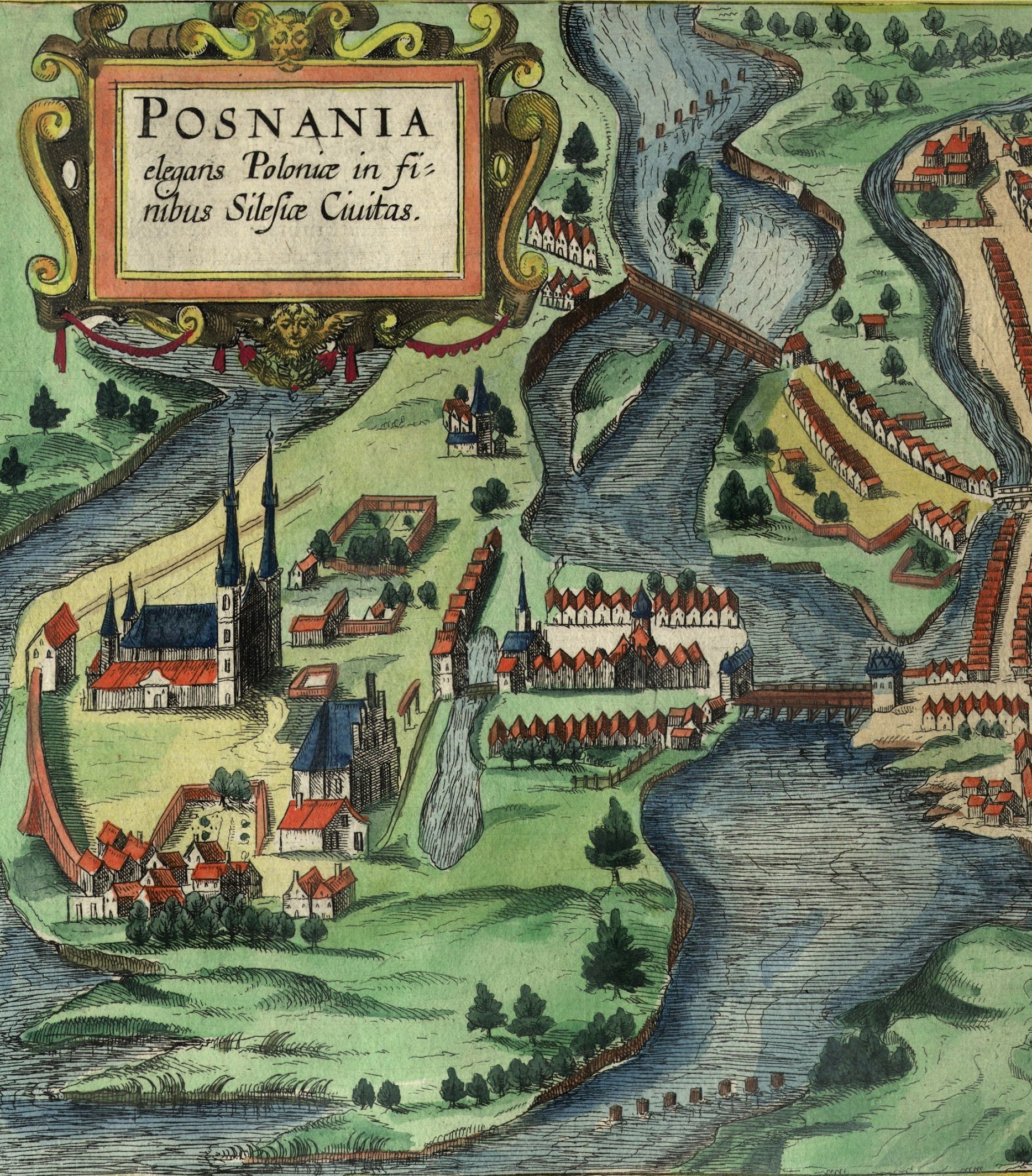
Bird's-eye view of Posnania (Poznań), from Braun & Hogenberg's Civitates Orbis Terrarum
Walled old town showing gates, grid-like streets, prominent cathedral spires and bridges across the River Warta.
1618 · Frans Hohenberg and Georg Braun · Wikimedia Commons
Public domain (plate dated 1618)
Castles of Poznań

More cities to explore
 PolandWrocławExplore it in 1500 · 1913
 GermanyBerlinExplore it in 1750 · 1871 · 1928
 PolandKrakówExplore it in 1400 · 1570 · 1900
 PolandWarsawExplore it in 1650 · 1775 · 1925
Castles of Europe · Landmarks of Europe · create your own reconstruction.