
Poland · Restored
Pieskowa Skała
Pieskowa Skała is a Renaissance castle built on a Jurassic limestone cliff over the Prądnik valley in southern Poland, part of the Trail of the Eagle's Nests. The present appearance reflects a 16th-century Mannerist reconstruction with later 17th-century bastion and baroque additions; it has been restored and operates as a historic site.
Its prime
1640
Today
Restored
As it stood in 1640
What Pieskowa Skała looked like in its prime.
Perched on a pale Jurassic limestone crag above the Prądnik valley, the castle presents a compact, trapezoid plan with two-storey arcaded facades around a courtyard, a converted medieval tower forming a double loggia richly worked in sgraffito, and a roofline of pitched roofs behind curtain walls. By 1640 low earthen-and-stone bastions with a baroque gate and a chapel punctuate the outer defences; masonry is local limestone and plastered sgraffito surfaces are visible on courtyardside elevations.
Its story
The story of Pieskowa Skała.
Peskenstein and the Castle of Casimir the Great
The rock above the Prądnik seems to have taken its name from an early owner: a document of 1306 names a castle Peskonis after a knight so called, the medieval diminutive of Piotr being Peszek, and by 1315 the Latin documents of King Władysław the Elbow-high record a castrum Peskenstein here. In the first half of the 14th century King Casimir III the Great built a castle on the site, one link in the chain of strongholds known as the Trail of the Eagle's Nests, which runs north-west from Kraków across the Polish Jura towards Częstochowa. It was laid out in two parts, a lower castle and an upper one, no longer standing, raised on the near-inaccessible rock called Dorotka.
The Szafrańce, 1377–1608
According to the 15th-century chronicler Jan Długosz, King Louis I of Hungary had the castle renovated and granted it in 1377 to Piotr Szafraniec of Łuczyce. Full ownership came in 1422, when Władysław Jagiełło rewarded the faithful service of Piotr Szafraniec, chamberlain of Kraków, at the Battle of Grunwald. Some later members of the family, who bore the Starykoń arms, turned to brigandage and used the castle as a base for raids on merchants travelling the Prądnik valley road between Kraków and Silesia. For that Krzysztof Szafraniec, great-grandson of the first owner, was beheaded at Wawel in 1484.
Between 1542 and 1544 Stanisław Szafraniec, the Calvinist voivode of Sandomierz, had the Gothic castle recast in Mannerist form by Niccolò Castiglione, working with Gabriel Słoński of Kraków. The medieval tower became a double loggia decorated in sgraffito, and between 1557 and 1578 the trapezoidal courtyard was ringed on its two upper storeys with arcades carrying twenty-one mascarons. Stanisław's son Jędrzej, the last Szafraniec owner, died childless in 1608.
Zebrzydowski Bastions, the Deluge and the Wielopolscy, 1608–1787
The estate was bought by Maciej Łubnicki and passed later to the Zebrzydowski family. In 1640 Michał Zebrzydowski added bastion fortifications with a baroque gate and a chapel; the arcaded risalit above the gateway is likewise a 17th-century addition. The castle was wrecked during the Swedish Deluge in 1655 and burned in 1718, a fire that led to its rebuilding, finished in 1768, as a seat of the Wielopolski family. In 1787 the Wielopolscy received King Stanisław August Poniatowski here.
The Mieroszewskis and the January Uprising, 1842–1863
In 1842 Count Jan Chrzciciel Mieroszewski, a Kraków politician and collector, bought Pieskowa Skała from the Wielopolscy and kept his library and his collection of antique gems in it. A further fire in 1850 destroyed the high castle, the oldest part of the complex. During the January Uprising, on 4 and 5 March 1863, insurgents under Marian Langiewicz fought two engagements with Russian troops at Pieskowa Skała and at nearby Skała; the defence of the castle itself was commanded by Aleksander Zdanowicz, and the Ukrainian revolutionary Andrij Potebnia, a colonel in the Russian army fighting on the Polish side, was killed. After the insurgents withdrew, the Russians occupied the castle and plundered it.
Dygasiński's Appeal and the Road to State Care, 1880s–1983
In the 1880s Sobiesław Mieroszewski, Jan's son, carried out repairs that added neo-Gothic detail, but his dissolute living squandered the family fortune and brought the sale of the castle to Dr Serafin Chmurski, who built villas at the foot of the rock in the hope of making Pieskowa Skała a summer resort. Chmurski's debts carried the estate in 1902 to the banking house Pilawitz, Wilczyński i Sp. and then towards auction. Adolf Dygasiński appealed in the Kurier Warszawski for the rescue of what he called the pearl of the Polish Renaissance, the only one of the Eagle's Nests still in good condition; the joint-stock society founded in answer bought the castle in 1903 for 60,000 roubles.
During the Second World War rooms in the castle were given over to an orphanage, which took in children largely from the eastern borderlands. The state took the castle over after the war and, following a thorough restoration between 1950 and 1963, it became a branch of the State Art Collections at Wawel, with a permanent display on changes of style in European art from the Middle Ages to the mid-19th century. Its crypts hold four Mannerist sarcophagi of the Sieniawski family by the Wrocław sculptor Jan Pfister, taken from the family mausoleum at Brzeżany in Podolia to Kraków during the Polish–Russian war of 1920. Registered as an immovable monument since 1983, the castle stands within the Ojców National Park.
Step inside
8 places to explore in 1640.
The record describes 8 distinct spots at Pieskowa Skała, including 3 interiors: trapezoid courtyard with two-storey arcades, double loggia (former medieval tower) with sgraffito, chapel (baroque addition). Create your own photoreal reconstruction and explore every one, more scenes means more rooms, more angles, and more of the place to stand in.
Build Your Own Castle
Recreate Pieskowa Skała with AI to explore it.
The artist rebuilds it as it stood in 1640, a photoreal reconstruction that belongs to you alone. Pay with coins, no subscription needed.
Recreate this castle →Defend this castle →Whose castle
Clans who held Pieskowa Skała.
The families that held Pieskowa Skała for a decade or more across its history, follow a name to its clan.
Szafraniec
Held by the Szafraniec family from the royal grant of 1422 until Jędrzej Szafraniec died childless in 1608.
Zebrzydowski
Purchased by the Zebrzydowski family after 1608.
Wielopolski
Seat of the Wielopolski family from the rebuilding after the 1718 fire; hosted King Stanisław August Poniatowski in 1787.
From the archive
Pieskowa Skała on paper: the measured plan and period views.
The survey plan and photographs below are the ground truth this page's reconstructions are checked against, drawn and photographed while the castle was still a working garrison. Every image is public-domain or openly licensed, with its source named.
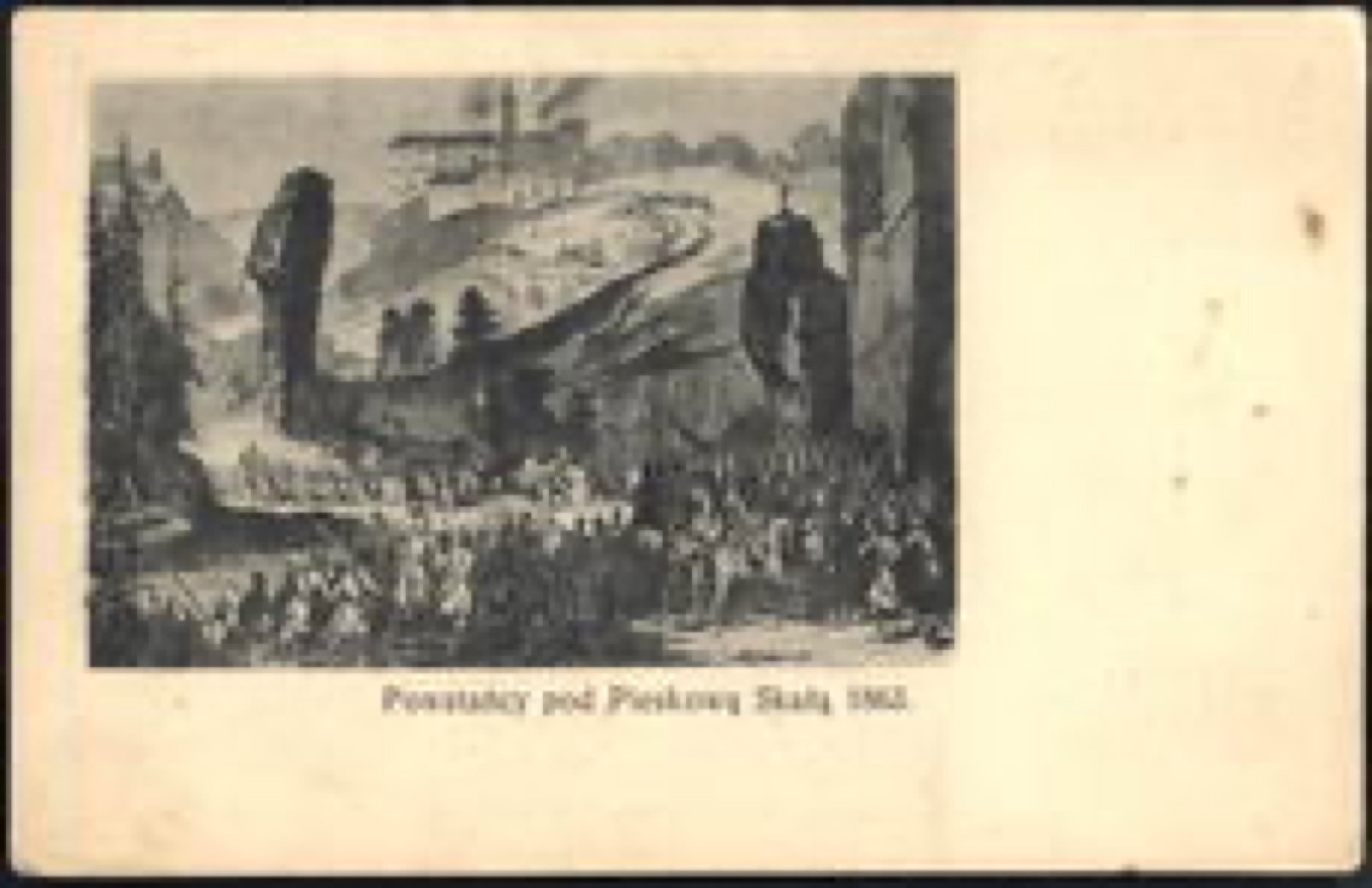
Insurgents at Pieskowa Skała 1863
1903 · Mazowsze Digital Library (via Europeana)
Public domain
Nearby


