
Portugal · Restored
Castle of Óbidos
Castelo de Óbidos
The Castle of Óbidos is a medieval hilltop fortress in Óbidos, Portugal, surrounded by extensive curtain walls, towers and an intramural town. Its fabric combines Romanesque, Gothic, Manueline and later interventions and it has been restored and adapted as a national monument and pousada (historic hotel).
First raised
1101
Its prime
1525
Today
Restored
As it stood in 1525
What Castle of Óbidos looked like in its prime.
Perched on a rocky hilltop, the trapezoidal castle rises above the town with long beige stone curtain walls punctuated by square merlons and crenellated parapets. A cluster of cylindrical and rectangular towers and a large rectangular keep anchor the silhouette, joined by a barbican and multiple gate openings; some semi-circular corbels and machicolations are visible. A U‑plan palace with red tile roofs sits against the inner wall, and the walls run down to cliffs on the west, with battlements and watchtowers along the ramparts.
Its story
The story of Castle of Óbidos.
Taken by a Ruse, 10 January 1148
The hilltop carried a Luso-Roman castro and a Roman oppidum long before any castle stood on it, most likely the Eburobrittium that Pliny the Elder placed between Collipo and Olisipo, and survey work near the settlement later turned up a forum and baths. Lusitanians held the site from the fourth century BC, Romans from the first century AD, Visigoths through the fifth and sixth. The fortifying of the town itself is credited to the Muslim occupation of the eighth century, and stretches of the wall still show Moorish workmanship.
Afonso Henriques (1112–85) came to Óbidos after Santarém and Lisbon had fallen in 1147, and met a defence that would not give way. The town was carried instead by a ruse, on 10 January 1148; the Cruzeiro da Memória marks the ground where the king is said to have camped before the assault. The castle appears in documents from 1153, but the Christian hold on it was not settled until the reign of Sancho I (1185–1211), when the works recorded in the inscription on the Torre do Facho were carried out and the town received its charter in 1195. The rebuilding of the walls under Sancho also turned the albarrã tower into a jail.
Urraca's Gift and the Loyalty of 1246
Sancho's son and successor Afonso II (1211–23) gave the town and its castle to his wife, Urraca, in 1210. A generation later Óbidos chose its side in a royal quarrel and paid for it in fighting: when Sancho II (1223–48) faced deposition, town and castle held for him and beat off the assaults of the forces of the Count of Bologna, the future Afonso III (1248–79), in 1246. The resistance earned Óbidos the epithet mui nobre e sempre leal, very noble and ever loyal, which it still carries on its municipal arms.
Queen Isabel's Dower and the Tower of 1375
Dinis (1279–1325) gave Óbidos to Queen Isabel as a wedding gift, during the nuptials the couple spent there, and from that point the town formed part of the dower of every queen of Portugal until 1834. Dinis had the keep raised in about 1325, restored and enlarged the old dungeon, and built the barbican beside the main gate. An inscription records a further tower put up in 1375, under Fernando (1367–83), which some have taken for a keep in its own right, though it lacks the massive base and raised entrance of the Dinis tower.
The Alcaide Who Chose Castile, 1383–1385
The succession crisis of 1383–1385 set the castle against the town it guarded. Its alcaide, against the wishes of the residents, declared for John I of Castile and for Beatriz, and held out against the forces of the Master of Avis. The matter was settled elsewhere. João Gonçalves, the alcaide, was killed in the fighting at Aljubarrota in 1385, and his son Vasco Gonçalves Teixeira handed Óbidos and its castle over to the Master: by then elected king, as John I, by the Cortes at Coimbra.
Queen Leonor, the Roliça Guns and the Pousada
Under John II (1481–95) the queen, Leonor, chose Óbidos to live in after the accidental death of her only son, Prince Afonso. The town's granite pillory carries the royal arms on one face and, on the other, Leonor's shrimp net, the queen's gift to Óbidos in memory of the fishermen's net in which her son's body was brought to her. Manuel I granted a fresh charter in 1513, and improvements to town and castle followed; in the sixteenth century the alcaide-mor João de Noronha rebuilt the Paços do Alcaide within the walls and worked on the walls themselves.
The Lisbon earthquake of 1755 did serious structural damage, and there was no money to make it good. In the Peninsular War the fortification fired the first artillery rounds of the Battle of Roliça in 1808, the engagement that handed Napoleon's troops their first defeat. The nineteenth century put the place to quieter work: the albarrã tower became a clock tower in 1842, and an exterior stair was built up to the D. Fernando tower in 1869.
Óbidos was classified a national monument in 1910. Consolidation, reconstruction and restoration began in 1932 under the Directorate-General for National Buildings and Monuments, and in 1948 the castelejo was adapted into a pousada on a design by João Filipe Vaz Martins. A government decree published on 5 January 1951 classified the castle and the whole walled town together as a national monument.
Step inside
12 places to explore in 1525.
The record describes 12 distinct spots at Castle of Óbidos, including 3 interiors: paço dos alcaides interior entrance and staircase, castle dungeons, church of santiago gallery and connecting passage. Create your own photoreal reconstruction and explore every one, more scenes means more rooms, more angles, and more of the place to stand in.
Build Your Own Castle
Recreate Castle of Óbidos with AI to explore it.
The artist rebuilds it as it stood in 1525, a photoreal reconstruction that belongs to you alone. Pay with coins, no subscription needed.
Recreate this castle →Defend this castle →From the archive
Castle of Óbidos on paper: the measured plan and period views.
The survey plan and photographs below are the ground truth this page's reconstructions are checked against, drawn and photographed while the castle was still a working garrison. Every image is public-domain or openly licensed, with its source named.
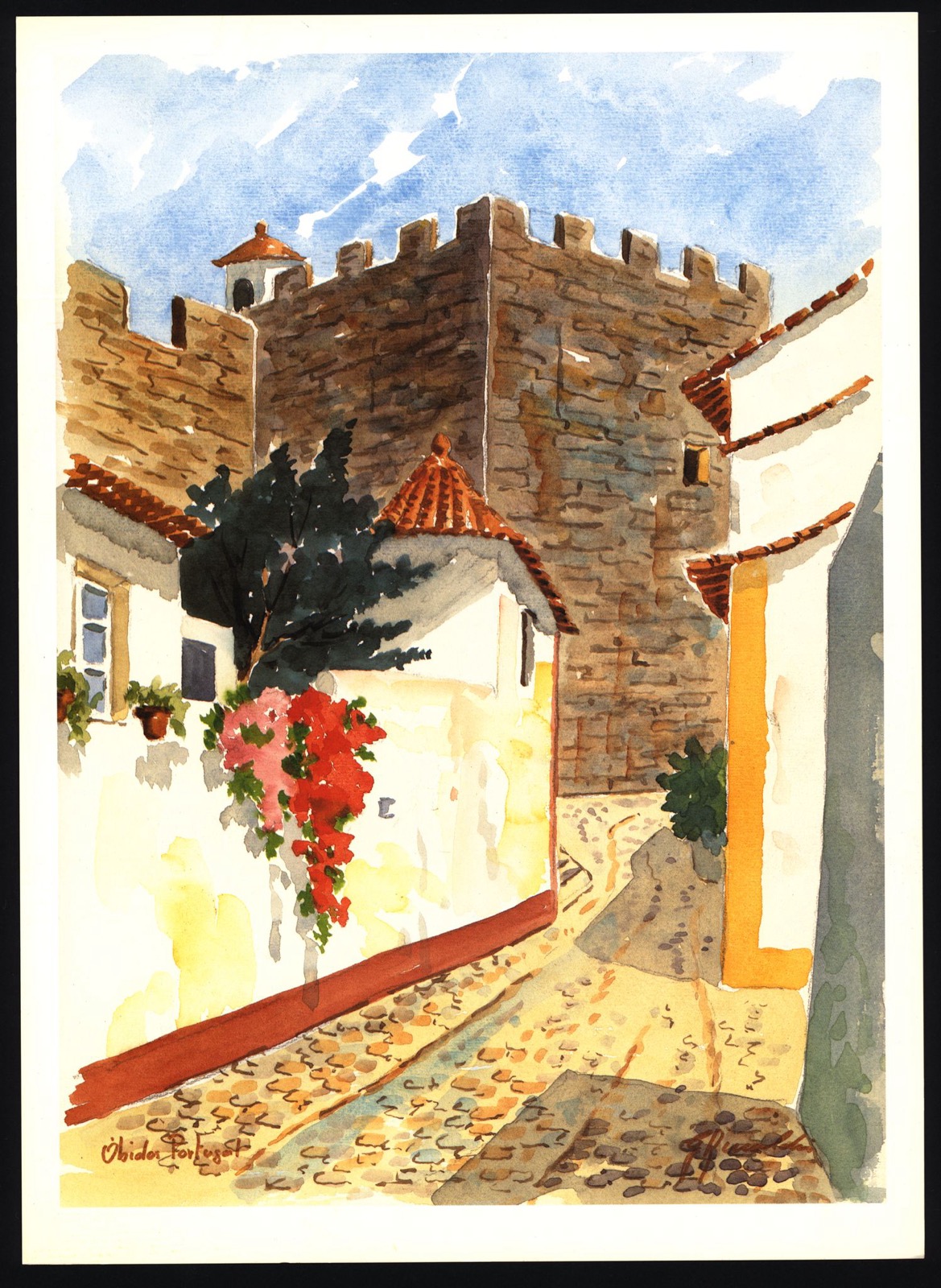
Óbidos
1989 · National Library of Portugal (via Europeana)
Public domain
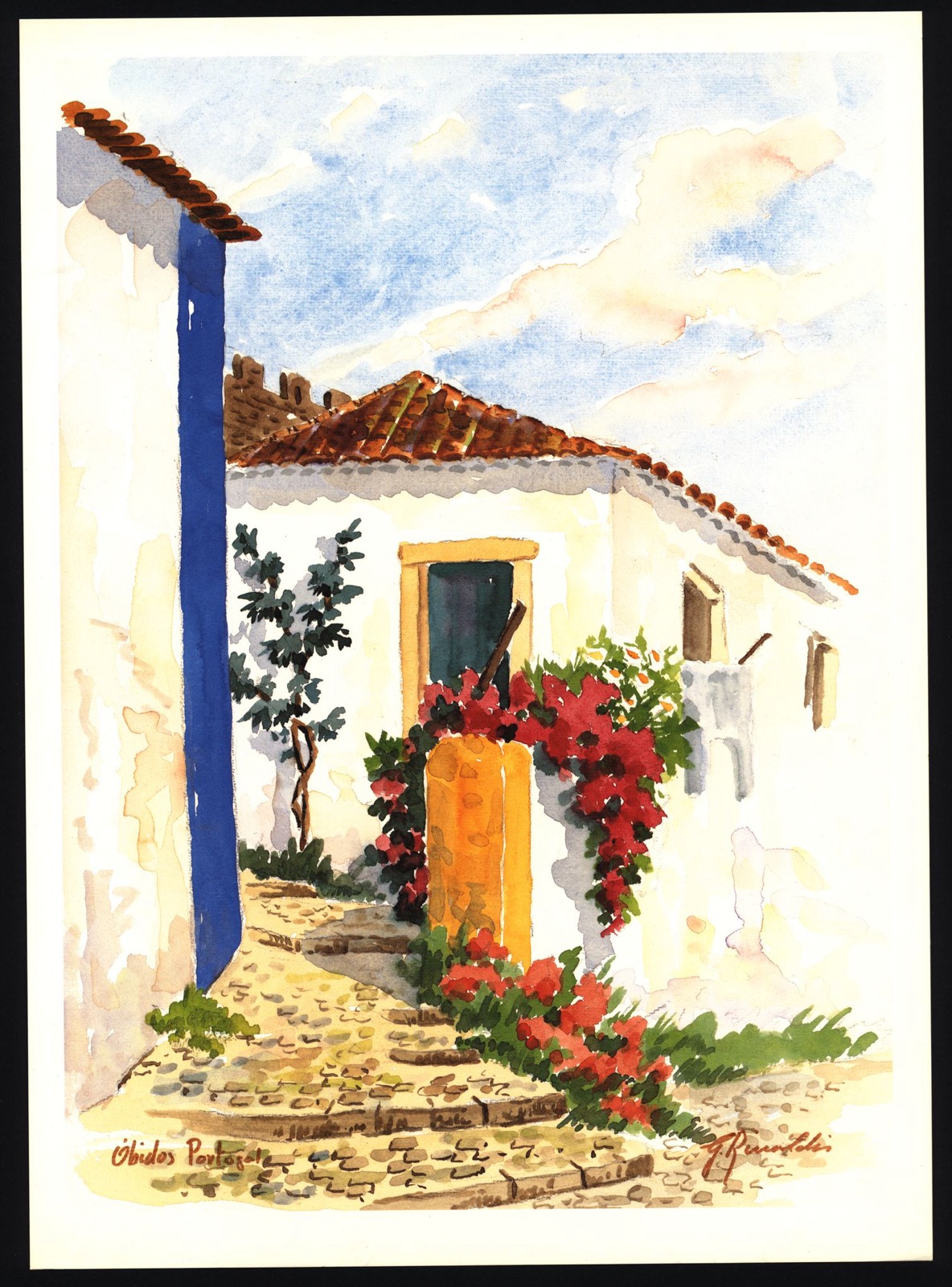
Óbidos
1989 · National Library of Portugal (via Europeana)
Public domain


