
Romania · Ruin
Poenari Castle
Cetatea Poenari
Poenari Castle is a ruined medieval citadel in Romania, famously associated with Vlad the Impaler. It stands on the rocky plateau of Mount Cetatea above the Argeș River canyon and today survives as fragmentary walls and towers accessible to visitors after a steep climb.
Its prime
1459
Today
Ruin
As it stood in 1459
What Poenari Castle looked like in its prime.
The fortress forms a long, linear citadel running along a narrow rocky crest, its lower masonry of pale grey rubble stone topped by a conspicuous band of red brick in the upper courses. The silhouette presents a larger, irregular keep at the left end and a rounded cylindrical tower at the right, joined by a continuous curtain wall that follows the cliff edge; the site sits on a steep, tree-covered precipice above a deep river canyon and is capped at the highest point by a single flagpole.
Its story
The story of Poenari Castle.
Castle Argeș and the Basarab Citadel
A stronghold held this peak above the Argeș canyon for two centuries before Vlad the Impaler took an interest in it. The Wallachians raised a castle near the spot at the beginning of the 13th century, known as Castle Argeș, and by the mid-14th century it had become the main citadel of the Basarab dynasty. Romanian tradition holds that the earliest work here, in the time of Negru Vodă, amounted to a single tower. Over the following decades both the name and the occupants changed several times, until the place was abandoned and left in ruins.
The mountain has long been linked, though never firmly, to the fighting Nicolae Iorga named the Battle of Posada, fought between 9 and 12 November 1330 and marking Wallachia's emancipation from the Hungarian crown. Charles Robert of Anjou had come to punish his former vassal Basarab I, who since 1327 had refused to pay his tribute, and was beaten as he withdrew. The Vienna Illuminated Chronicle records the defeat without naming the ground; a document of Sigismund of Luxembourg from 1395 places such a fight on the ridges of the mountains, at what ordinary local speech called a posada, among narrow passes and paths squeezed between great thickets. Posada is a common noun for a mountain pass, and which pass it was is not known.
Vlad the Impaler's Rebuilding, 1459
In 1459 Vlad the Impaler saw what a second castle on that rock could do for him, and rebuilt it with the labour of the Wallachian boyars he had arrested and driven up to the site. He rebuilt the former Castle Argeș on the left side of the river using stone from the older Castle Poenari, which stood on the right bank and somewhat lower, and the single tower of tradition grew towers, walls and outbuildings around it. The result was one of his main fortresses, a secondary residence held as a fortified post against the Ottomans, and a document issued by the Hungarian king Ladislaus V the Posthumous names the citadel.
Much of the defence was done by the ground itself. The citadel sits roughly 400 metres above the floor of the valley, elongated in plan, with five towers, four round and one prismatic, behind walls two to three metres thick.
Backwards Horseshoes and Nights in the Ruin
The story most often told of Poenari has Vlad pursued by Turkish troops and escaping into the citadel after shoeing his horses with the shoes reversed, so that the tracks he left behind pointed the wrong way.
Under communism the ruin gathered a second body of stories from foreign visitors who were sometimes allowed to spend a night inside it. One of them, the American writer Vincent Lee Hillyer, spent a night there in 1969 and afterwards published an account of cold, sleeplessness and unexplained bites that has been repeated in most popular writing about the ruin since.
Abandoned by the 17th Century, Shaken in 1913
The fortress remained in use for many years after Vlad's death in 1476, but was abandoned again in the first half of the 16th century and lay in ruins by the 17th.
On 13 January 1913 an earthquake set off a landslide that brought parts of the castle down into the river below. Further earthquakes in 1940 and 1977 caused more damage. The walls and towers were partly consolidated and still stand, and since 2009 the site has been administered by the Argeș County Museum; visitors reach it by climbing 1,480 concrete stairs.
The Carol Park Replica, 1906
In 1906 a smaller replica of Poenari was built in Carol Park in Bucharest for the Romanian General Exhibition, and it is one of the few structures from that exhibition still standing in the park. It now houses the National Office for the Cult of Heroes and opens to the public twice a year: on Heroes' Day, which in Romania falls on Ascension Day, and on the Romanian Army's national day, 25 October.
Step inside
6 places to explore in 1459.
The record describes 6 distinct spots at Poenari Castle, including the full exterior approach. Create your own photoreal reconstruction and explore every one, more scenes means more rooms, more angles, and more of the place to stand in.
Build Your Own Castle
Recreate Poenari Castle with AI to explore it.
The artist rebuilds it as it stood in 1459, a photoreal reconstruction that belongs to you alone. Pay with coins, no subscription needed.
Recreate this castle →Defend this castle →Whose castle
Clans who held Poenari Castle.
The families that held Poenari Castle for a decade or more across its history, follow a name to its clan.
Basarab
The earlier Castle Argeș, around the same location, served as the main citadel of the Basarab dynasty from the mid-14th century until its abandonment.
From the archive
Poenari Castle on paper: the measured plan and period views.
The survey plan and photographs below are the ground truth this page's reconstructions are checked against, drawn and photographed while the castle was still a working garrison. Every image is public-domain or openly licensed, with its source named.
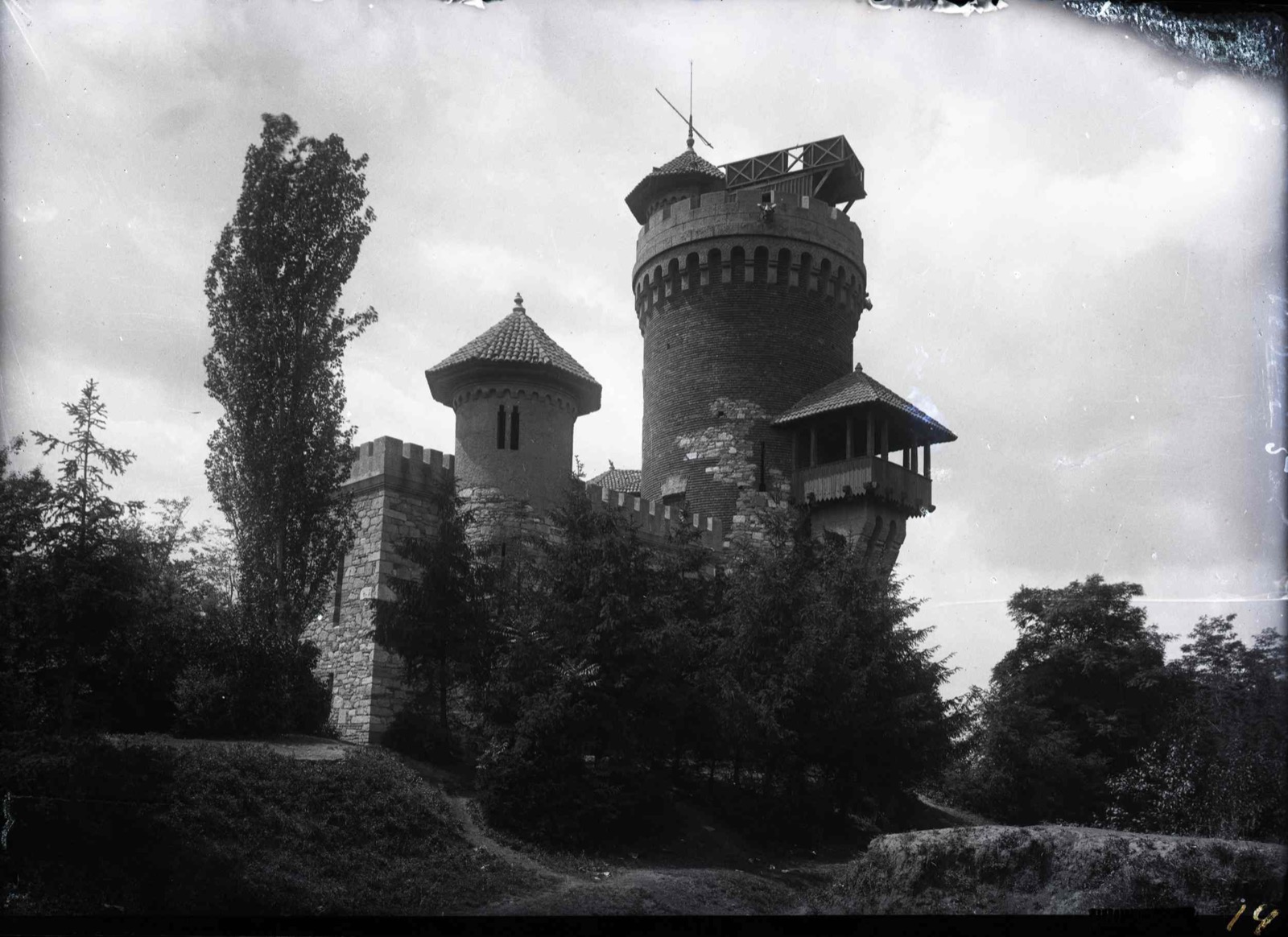
„Castelul lui Vlad Țepeș”, replică a Cetății Poenari (jud. Argeș), construit pentru Expoziția Generală Română
1921 · National Museum of Romanian History (via Europeana)
CC BY-SA


