Russia · Ruin
Balga castle
Burg Balga
Balga was a medieval Ordensburg of the Teutonic Knights on the shore of the Vistula Lagoon in present-day Kaliningrad Oblast, Russia. Built from 1239 and later the seat of a Komtur, it survives as extensive brick ruins on a wooded hill above the lagoon.
First raised
1250
Its prime
1350
Today
Ruin
As it stood in 1350
What Balga castle looked like in its prime.
A long, low red-brick curtain wall runs along the lagoon shore, pierced by a series of small rounded and slit windows and a few tall pointed-arch openings; a tall rectangular brick tower with a steep gabled roof and small arched attic windows anchors one end. The masonry is of medieval brick with horizontal string courses; behind the wall a wooded ridge rises. At prime the curtain and tower would have been continuous and roofed, the tower rising above the ramparts as a dominant vertical element.
Its story
The story of Balga castle.
Honeda and the Order's Conquest, 1237-1242
The hill above the Vistula Lagoon carried an Old Prussian fortress called Honeda, recorded also as Wuntenowe, from the Prussian wundan, meaning water. The name Balga comes from the Prussian balgnan, a saddle, probably a description of the shape of the ground. The Wettin margrave Henry III of Meissen besieged the Prussian fort without success on his Prussian Crusade of 1237. It fell two years later, in 1239, to a force of the Teutonic Order under Grand Marshal Dietrich von Bernheim, and Duke Otto I of Brunswick-Lüneburg helped the Knights hold what they had taken.
Building on the captured site began the same year. Balga was the oldest Ordensburg the Teutonic Order raised in the region that is now Kaliningrad Oblast, and it was placed there to control shipping on the Vistula Lagoon. With Duke Otto's assistance the Knights defeated the Old Prussians along the coastline of Warmia and Natangia. The subjugation of those pagan peoples brought Duke Świętopełk II of Pomerania into the field against the Order during the Prussian uprising of 1242, though he was in the end forced to abandon his part in it.
The Komturs of Balga, 1250-1499
From 1250 Balga was the administrative centre of the Kommende Balga and the seat of a Komtur of the Teutonic Knights, and the castle held a key place in the Order's conquest of Natangia and Warmia. It was a post that carried men upward: Winrich von Kniprode and Ulrich von Jungingen both governed at Balga before rising to Grand Master, the highest office in the Order.
After the Order's defeat at Grunwald in 1410, Balga did not surrender to the Polish king. In 1499 Grand Master Friedrich von Sachsen had the Kommende dissolved, and Balga ceased to be the centre of the Natangian commandery.
A Bishop's Residence and the Swedish Quarry, 1525-1736
Upon the Prussian Homage, Balga became part of the Polish Duchy of Prussia in 1525, and the castle became the residence of George of Polentz, Bishop of Samland. From about 1560 the fabric began to fall into ruin.
From 1627, during the Polish-Swedish War, parts of the castle were broken down at the behest of King Gustavus Adolphus of Sweden to supply building material for the star fort at Pillau, now Baltiysk, a strategically important port town the Swedes had occupied. The quarrying was made lawful by an order of King Frederick I in 1701, from which year Balga lay in the Kingdom of Prussia. The Baltic-speaking Prussians whose fortress had stood on the hill were by then assimilated by degrees, and a plague epidemic early in the eighteenth century dealt the final blow to what was left of them as a people. In 1736 the administration of the Amt Balga was granted to General Johann von Buddenbrock.
Steinbrecht's Excavation and the von Glasow Estate, 1772-1939
Balga belonged to the province of East Prussia between 1772 and 1829, and remained in East Prussia after the province separated again from West Prussia in 1878. From 1849 the estate belonged to the von Glasow family, who held it until 1945.
Antiquarian interest in the ruins grew through the nineteenth century. In 1887 the architect Conrad Steinbrecht excavated on the castle site and drew up the first detailed plans of it; his reconstruction placed the chapel in the south of the citadel, the refectory in the south-east and the chapter hall in the north-east. The tower was restored in 1929, and in 1939 a memorial stone was set up for the seven-hundredth anniversary of the castle.
The Heiligenbeil Fighting and After, 1945-2023
During the Second World War an Abwehr intelligence school was housed in the castle. In 1945 the ruins became the setting for the closing stage of the Heiligenbeil operation, one of the final actions fought between the German Wehrmacht and the Soviet Red Army as the Soviets advanced in the East Prussian Offensive. The German defenders destroyed numerous vehicles by sinking them in the lagoon beside the ruins, and the battle damaged the castle remains extensively.
At the Potsdam Conference the section of East Prussia containing Balga was allocated to the Soviet Union, and it was included in the area organised into the Kaliningrad Oblast of the Russian SFSR. The village that shared the castle's name was renamed Vesyoloye and is now abandoned. The citadel was lost altogether; the ruins of the forburg and of the church of St Nicholas survive, the church having been taken for brick by local people after the war. The ground around the castle drew grave robbers and treasure hunters hoping to dig up valuables left by the castle's earlier occupants and by the German and Soviet soldiers who died there.
The ruins are a protected cultural heritage site. In 2022 they were leased to investors, and on 29 April 2023 the castle was formally opened to visitors after landscaping and partial conservation work, with further restoration announced.
Step inside
7 places to explore in 1350.
The record describes 7 distinct spots at Balga castle, including 1 interior: komtur's residence / great hall. Create your own photoreal reconstruction and explore every one, more scenes means more rooms, more angles, and more of the place to stand in.
Build Your Own Castle
Recreate Balga castle with AI to explore it.
The artist rebuilds it as it stood in 1350, a photoreal reconstruction that belongs to you alone. Pay with coins, no subscription needed.
Recreate this castle →Defend this castle →From the archive
Balga castle on paper: the measured plan and period views.
The survey plan and photographs below are the ground truth this page's reconstructions are checked against, drawn and photographed while the castle was still a working garrison. Every image is public-domain or openly licensed, with its source named.
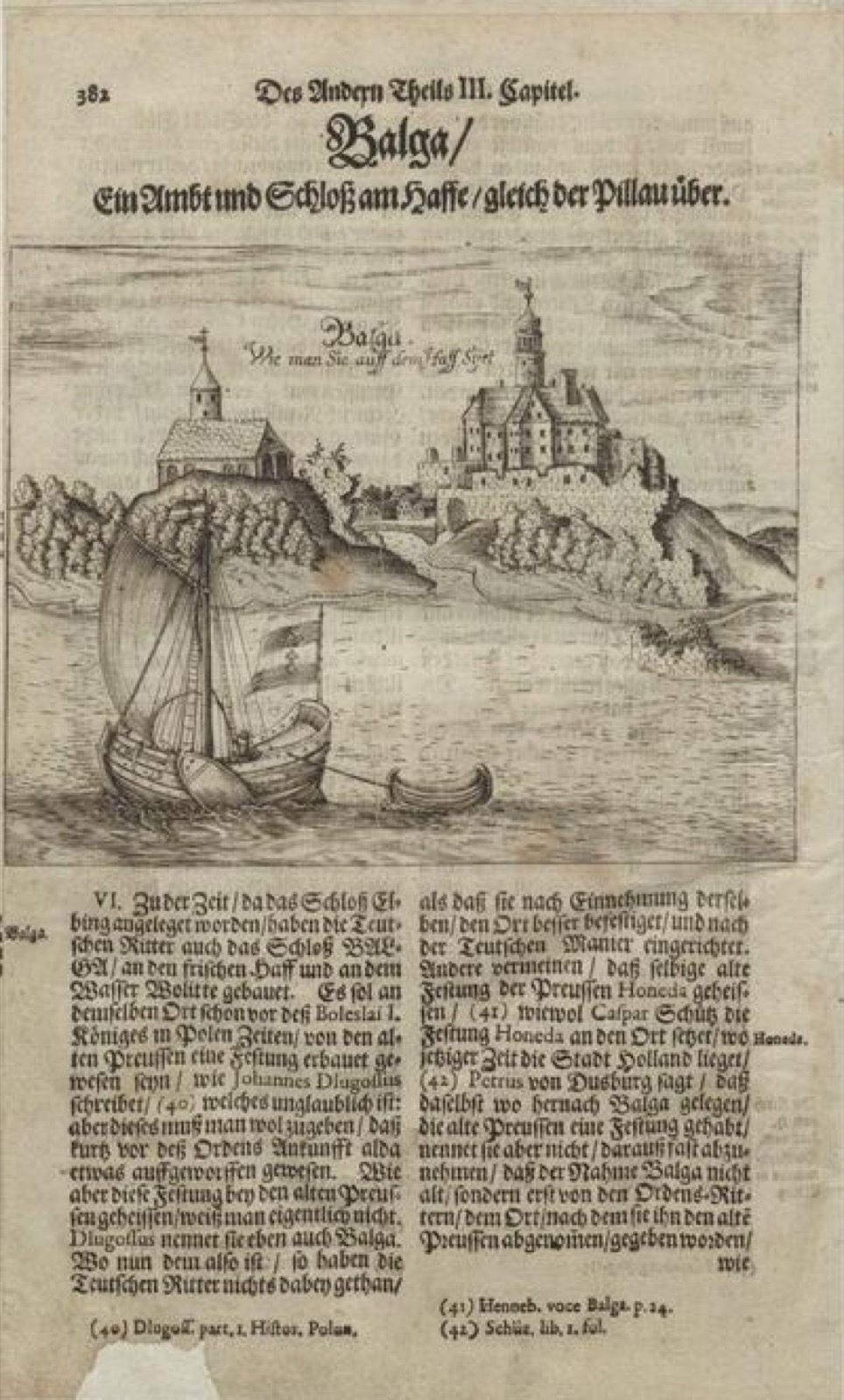
Balga (dawny średniowieczny zamek i osada krzyżacka)
1648 · Elbląska Digital Library (via Europeana)
Public domain
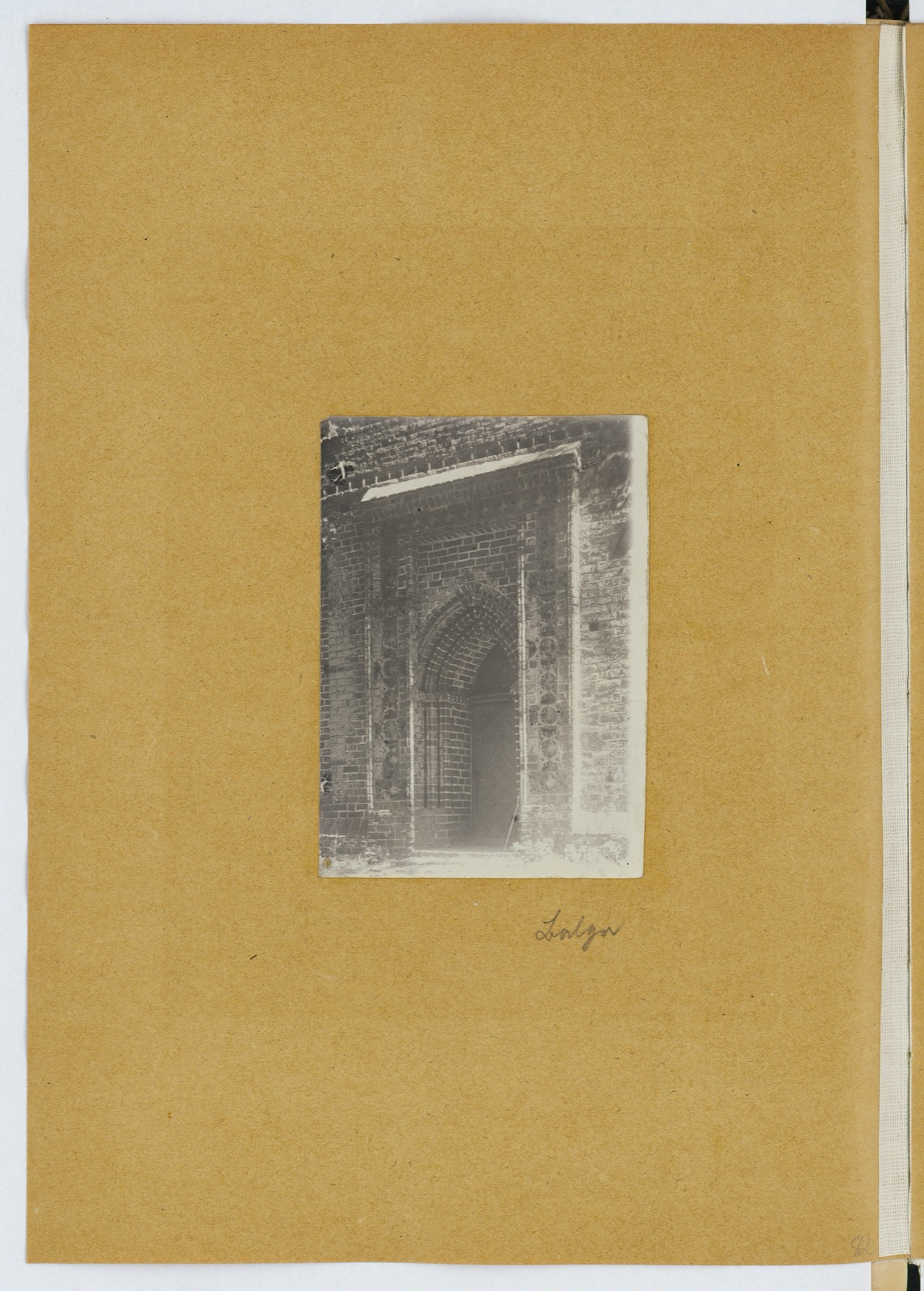
Burg, Balga: Ansicht Portal (aus: Skizzen- und Fotoalbum 20)
· Museum of Architecture at Berlin Institute of Technology (via Europeana)
CC0 (no rights reserved)