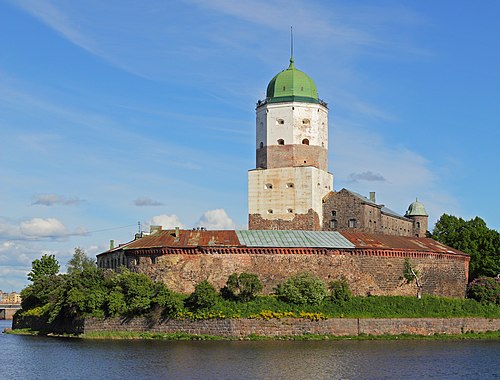
Russia · Demolished
Königsberg Castle
Königsberger Schloß
Königsberg Castle was the medieval and Early Modern residence of the Teutonic Order's grand masters and later the dukes and kings of Prussia in the centre of Königsberg (now Kaliningrad). Built from the 1250s and rebuilt and enlarged over centuries, it formed a large quadrangular complex with a very high Gothic tower, palace church and extensive state rooms and museums. The structure was heavily damaged in World War II and its remains were demolished in the postwar period.
First raised
1255
Its prime
1930
Today
Demolished
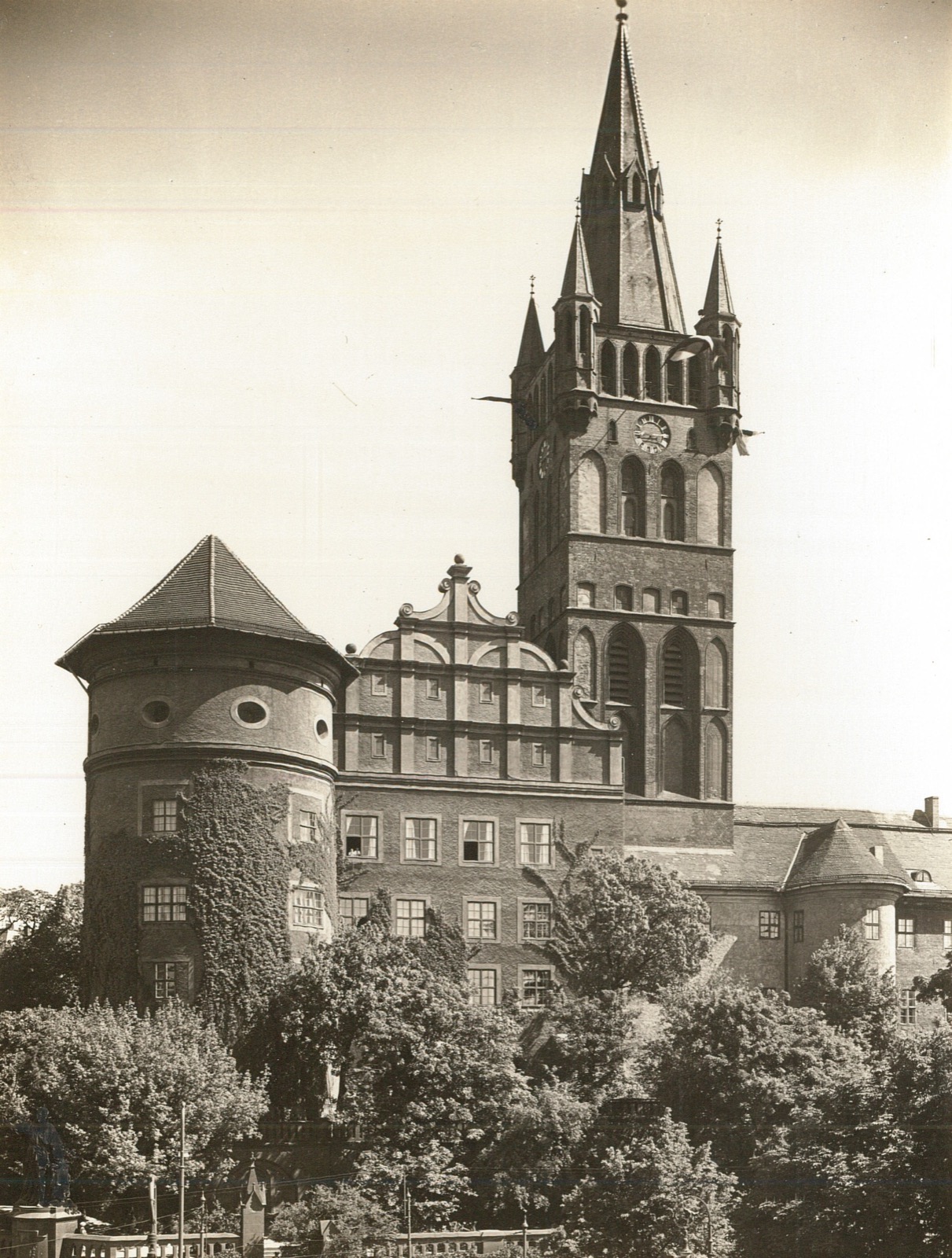
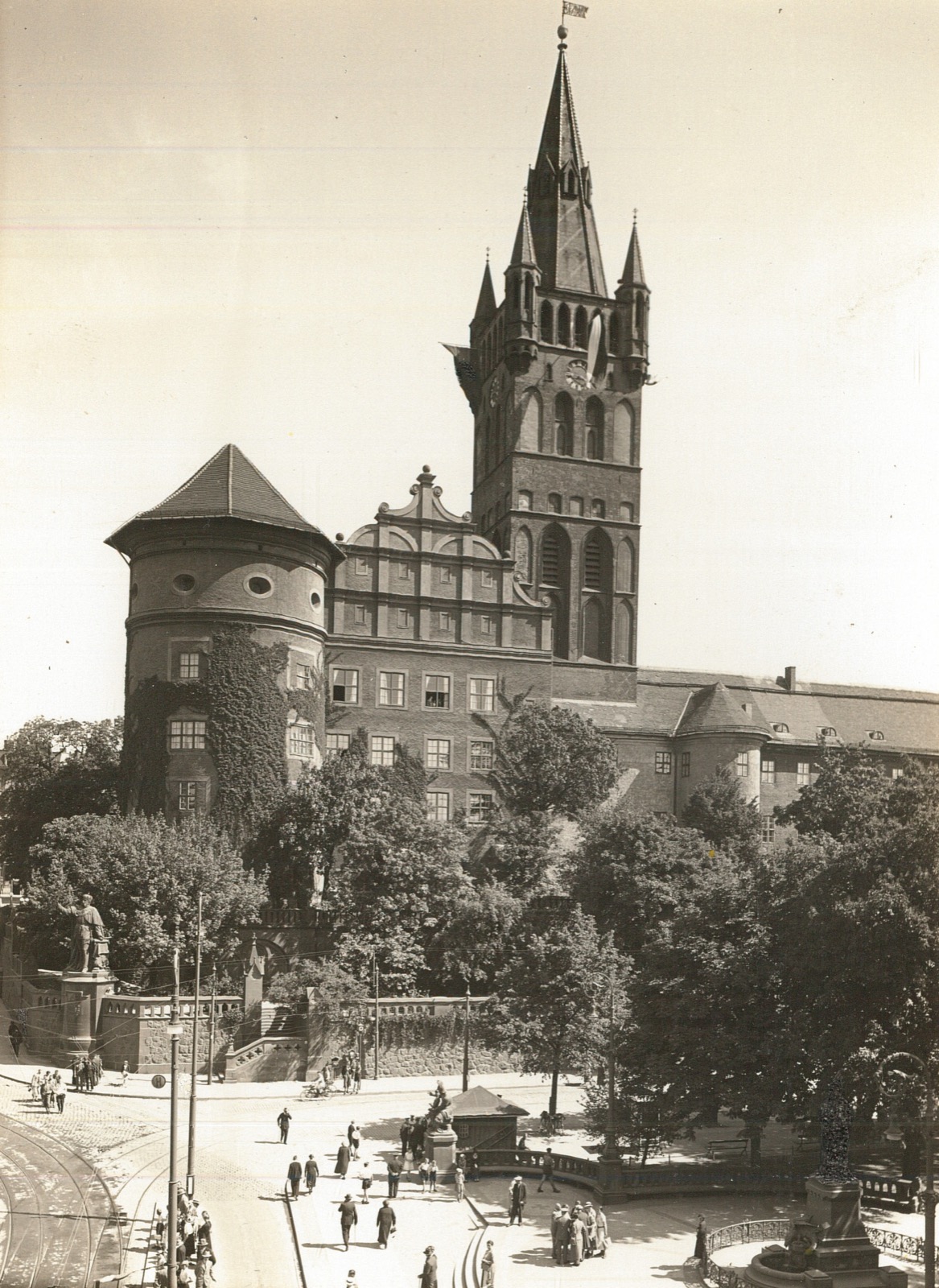
As it stood in 1930
What Königsberg Castle looked like in its prime.
A large quadrangular urban castle complex of mixed brick and masonry: a very tall red-brick Gothic clock tower with an open arcade and steep spire flanked by pinnacles; adjoining lower wings with stepped gables and rows of rectangular windows; a massive cylindrical drum tower with a conical tiled roof at the corner; continuous curtain walls on a raised terrace above a filled moat and civic square; tiled steep roofs, stone façades and a richly scaled medieval silhouette intact at its prime.
Its story
The story of Königsberg Castle.
Twangste, 1255: The Order Takes the Hill
North of the island of Kneiphof, where two arms of the Pregel met, a rounded hilltop rose some twenty metres above the valley. The Prussians called it Twangste and used it as a refuge and as the place where the villages around held their assemblies and their sacrifices. At the turn of 1254 and 1255 a crusading force gathered under Poppo von Osterna, grand master of the Teutonic Order, its most eminent members the margrave Otto III of Brandenburg and his brother-in-law Ottokar, king of Bohemia, who is credited with founding the castle; order and king chose Twangste as the point from which to hold conquered Sambia.
The first fort, laid out in January 1255 under Burkhard von Hornhausen as commander, was of timber and earthworks; two years later work began on an Ordensburg of brick and stone. Through the 13th century the place was attacked repeatedly by Prussians in revolt and by Lithuanian raiding parties. When the grand master moved his seat to Marienburg in 1309, Königsberg became the residence of the order's marshal, and in the 14th century the castle was the mustering point for campaigns into the Grand Duchy of Lithuania. The town that grew beneath the walls took its name.
A Double Ring of Walls and the Marshal's House
The main works formed a long rectangle running west to east across the plateau of the hill, defended by a double ring of stone walls with a parcham between them (the passage doubling as the burial ground of the knight-brothers), and carrying nine projecting towers and four corner towers, of which only the octagonal Haberturm lasted into modern times. The Schlossturm that crowned the whole went up at the end of the 14th century. When the marshal took up residence after 1309, a house for him and his clerks was raised over the great cellars, cellars that later held the Blutgericht, the wine tavern named after the medieval criminal court. The grand master moved into the same block in 1457; in the Prussian centuries it housed the high court, the budget ministry, the chamber of war and state domains, and the state archive.
From Grand Masters to Prussian Kings
From 1457 to 1525 the castle was the residence of the grand master of the Teutonic Order. In 1525 Albrecht of Brandenburg secularised the order's Prussian lands and it passed to the duke of Prussia. Its occupants thereafter were sovereigns rather than commanders: Władysław IV Vasa of Poland stayed here in 1635 as suzerain of Ducal Prussia; in January 1656 Charles X Gustav of Sweden and the elector Friedrich Wilhelm signed their alliance within these walls; in 1697 the elector Friedrich III received Peter I's Grand Embassy; and Stanisław Leszczyński lodged here from 1734 to 1736 during the War of the Polish Succession.
By then the building had lost its defensive function, but the Schlosskirche in the west wing, its walls and columns emblazoned with the arms of the Order of the Black Eagle, still saw two coronations: Frederick I as the first Prussian king in 1701, and in 1861 William I, later the first German emperor.
The Hall of Muscovites and the Prussia Collection
Above the palace church ran the Hall of Muscovites, some 83 metres long and 18 across, its span carried without a single pillar. A description of 1815 records a library beside the hall and a tower of 100 metres with 284 steps to the top; rebuilt in Gothic style in 1864–1866, the tower stood 84.5 metres. Twice a day a chorale sounded from it, at eleven in the morning and again at nine at night.
The Prussian Museum opened in the castle in 1844, and by the 20th century the north wing's Prussia collection held 240,000 exhibits, alongside holdings of the Königsberg state and university library and paintings by Lovis Corinth. The Hohenzollern apartments and the museum were open daily until the later part of the Second World War. Below, the Blutgericht sold wine, and a figure of Hans von Sagan turned as the castle's weathervane.
Burned Out in 1944, Blown Up Twenty Years On
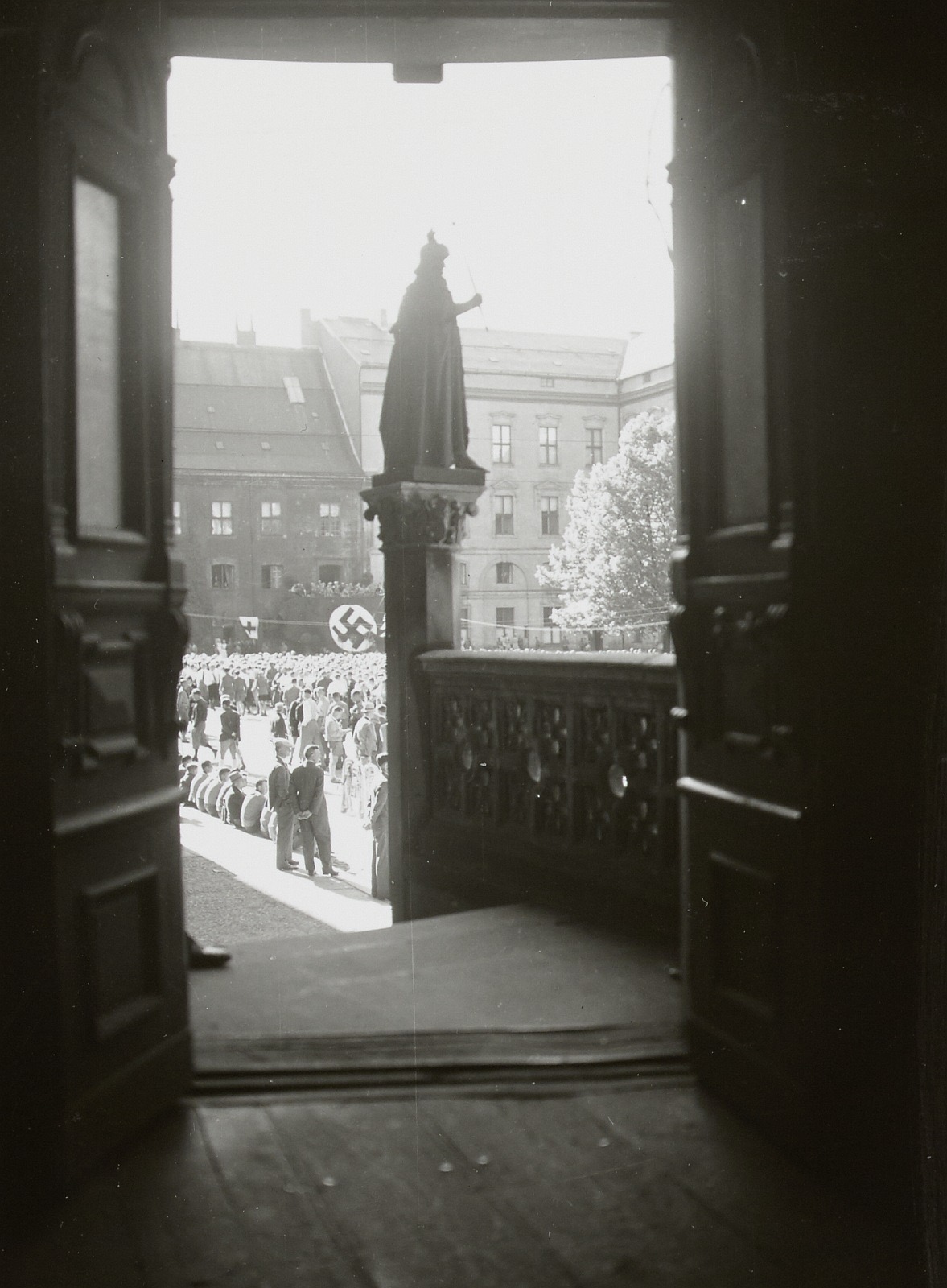
After 1933 the National Socialist leadership made heavy use of the castle as a symbol of the Prussian spirit; Hitler inspected it on 9 May 1933 and again on 18 March 1936 during a Reichstag election campaign, and the party's election staff sat here on 29 March, waiting for returns that gave the NSDAP list 99.8 per cent in the province. The Amber Room, stripped from the Catherine Palace at Tsarskoye Selo in 1941, was installed in one of the halls from 1942, and its traces were lost in 1945.
British bombing on the night of 29–30 August 1944 reduced the castle to a burned-out shell, but the thick outer walls held, through the raid, and through the Soviet artillery of the three-month siege that ended with the Battle of Königsberg in April 1945. The city became Kaliningrad in 1946. The main tower, by then unsafe, was blown up in 1953, and parts of the walls and towers still stood in ruin in 1956, until Nikolai Konovalov, first secretary of the regional party committee, ordered the remains blown up in 1967, the last of them cleared the following year. The wish to raise a wholly Soviet city on the site of the old German one is now taken as the reason; in 1969 the crown of the hill itself was cut away by several metres.
The House of Soviets, begun in 1970 over the castle's south-eastern range, sank into ground made unsound by the collapse of the castle's underground levels, stood unfinished for decades and was demolished in August 2024. Excavation of the cellars ran from 1993 to 2007, financed from 2001 by the magazine Der Spiegel, and turned up thousands of objects (among them an occult silver casket of medals and amulets found in June 2005), but not the Amber Room. Rebuilding the castle from nothing proved too great a task, so the plans were dropped and the central square cobbled over; in 2022 the exposed ruins were stabilised with bentonite matting and buried under sand.
Step inside
11 places to explore in 1930.
The record describes 11 distinct spots at Königsberg Castle, including 7 interiors: schloßkirche (palace church) interior, hall of muscovites (long pillar-free hall), prussia museum (north wing) galleries and more. Create your own photoreal reconstruction and explore every one, more scenes means more rooms, more angles, and more of the place to stand in.
Build Your Own Castle
Recreate Königsberg Castle with AI to explore it.
The artist rebuilds it as it stood in 1930, a photoreal reconstruction that belongs to you alone. Pay with coins, no subscription needed.
Recreate this castle →Defend this castle →From the archive
Königsberg Castle on paper: the measured plan and period views.
The survey plan and photographs below are the ground truth this page's reconstructions are checked against, drawn and photographed while the castle was still a working garrison. Every image is public-domain or openly licensed, with its source named.
Königsberg Castle
· Deutsche Fotothek (via Europeana)
CC BY-SA
Königsberg Castle
· Deutsche Fotothek (via Europeana)
CC BY-SA
Königsberger Schloss
1275 · Deutsche Fotothek (via Europeana)
Public domain