Russia · Restored
Vyborg Castle
Viipurin linna
Vyborg Castle is a medieval fortress on a small islet at the entrance to Vyborg Bay, originally built by the Swedes from 1293 and repeatedly altered in later centuries. Its dominant feature is the multi-stage tower of St. Olav surrounded by an irregular main ward and outer defensive works. Today the site houses the Vyborg Regional Museum and retains the restored silhouette formed by 19th-century conservation work.
First raised
1293
Its prime
1895
Today
Restored
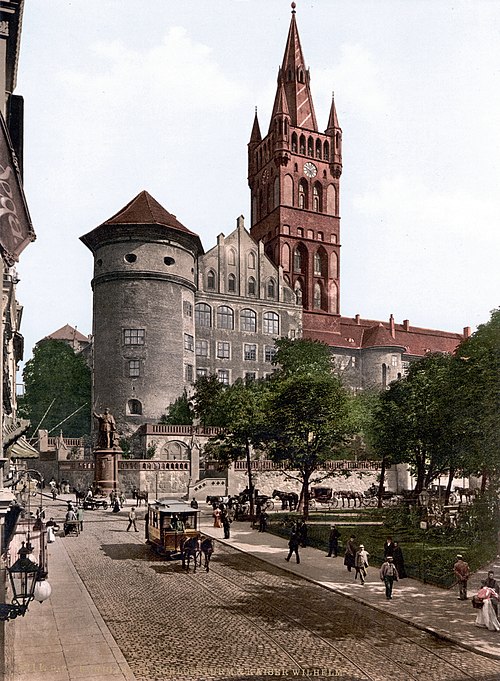
As it stood in 1895
What Vyborg Castle looked like in its prime.
Perched on a rocky islet, the castle presents an irregular four-cornered main ward ringed by thick red-brown granite curtain walls that follow the shoreline. The largest element is the multi-stage St. Olav tower: a broad stone base and midsection with a whitewashed upper stage capped by a conspicuous green, bulbous copper dome and a narrow observation gallery. Low outer bastions and attached roofed service buildings with metal roofs sit behind the waterfront parapet; slopes are planted with shrubs and trees.
Its story
The story of Vyborg Castle.
Torkel Knutsson's Island, 1293
Castle Island is a scrap of ground 170 metres by 122 at the innermost corner of the Gulf of Finland. Excavations in the 1980s found the oldest occupation layers in the Smith's Courtyard: a sand breastwork set with timber posts, charred building remains, and a bent sword dated between 1130 and 1200, traces of a Karelian stronghold the Swedes took and destroyed.
The castle that replaced it was begun in 1293 on the orders of Torkel Knutsson, Lord High Constable of Sweden, during the Third Swedish Crusade against Karelia, part of the long Swedish–Novgorodian wars. Knutsson chose the site to command the Bay of Vyborg and the river route running inland from it towards the waters of Lake Ladoga. The Swedes walled the high ground and raised a square stone tower in its centre, named for Olaf the Saint, with walls four metres thick.
Novgorod at the Walls, 1294–1323
Novgorod did not accept the loss of the Karelian lands. A Novgorodian force besieged Vyborg as early as 1294 and could not take it. In 1322 an army under Prince Yuri Danilovich stood a full month before the walls, stone-throwing engines and all, and withdrew. The Treaty of Nöteborg in 1323 fixed the border on the Sestra river and left part of the Karelian Isthmus, Vyborg with it, to Sweden.
A Margraviate on the Border
The castle and its huge fief became something close to an autonomous principality, known as a margraviate. Its governors, drawn from the kingdom's most powerful families, took the income of the county and ruled at a great distance from the capital. Bo Jonsson Grip held Viborg, then Christer Nilsson Vasa from 1417 to 1442, Karl Knutsson Bonde from 1442 to 1448 before he took the crown, Erik Axelsson Tott from 1457 to 1481, Knut Posse, Sten Sture the Elder between his regencies, Erik Bielke and Count John of Hoya.
They built. A chronicle credits Bonde with spending heavily on the fortress and ringing the island with a battlemented wall, forming its lower courtyard. Under Tott and Sten Sture the Elder, who succeeded him as governor, the castle gained its first round tower, the Paradise Tower; Tott alone then walled the town that had grown on the peninsula with nine towers, two bastions, a rampart and a water-filled ditch. The first mention of firearms anywhere in Finland concerns Viborg, in 1429, and in the late Middle Ages the castle's military standing was reckoned second only to that of fortified Stockholm.
The Viborg Blast, 1495, and the Vasa-Era Rebuilding
The Russians besieged the castle repeatedly through the Middle Ages, most famously in 1495, during the war of 1495–97, under governor Knut Posse. The defenders' situation looked hopeless until St Andrew's Day, 30 November, and the Viborg blast: a mysterious explosion after which the besiegers, believing they had seen a Saint Andrew's cross in the sky, took fright and drew off.
Gustav Vasa's visit in 1556 began a fresh round of building. In 1564 the main tower was carried up to seven storeys with an octagonal upper stage, brick appearing in the donjon masonry for the first time and gun embrasures cut through three metres of wall for all-round fire. Around 1600 the bridgehead works were rebuilt in stone and consolidated into the Governor's House. Then the border moved east, the danger from Russia receded, and through the 17th century the castle was left to decay.
Peter I's Siege, 1710, and the Long Afterlife
On 12 June 1710, after more than two months of siege and bombardment, the town fell to the troops of Peter I and the last Swedish commandant, Colonel Magnus Stiernstråle, surrendered. The battered castle was repaired, but between the Horned Fortress, built at the end of the 16th century, and the Anna fortifications added in the later 18th century, the town was now covered from the Swedish side by newer works, and the old castle was given over to quartering the garrison. In 1812 it passed into Finnish hands when the whole of Old Finland was attached to the autonomous Grand Duchy of Finland.
The vaults of the west wing partly collapsed in 1850, and the emergency work stopped when the Crimean War began. In 1856 an illumination lit in the dome of St Olaf's tower for the opening of the Saimaa Canal got out of hand and gutted it; the medieval castle then stood empty for thirty-five years. Its prison held the Decembrists Mukhanov, Annenkov, Mitkov and Lunin, and in 1860 the castle was formally declared unfit for defence. Alexander III ordered its repair in 1888, and the Military-Engineering Department rebuilt it between 1891 and 1894 under Colonel E. von Lesedow: the outline hardly changed, but the vaults gave way to beam ceilings. Viipuri was Finnish from 1917 to 1940 and again from 1941 to 1944; the town was annexed by the Soviet Union in 1944, and the army handed the castle over in 1964 for the museum that opened in 1970.
Step inside
7 places to explore in 1895.
The record describes 7 distinct spots at Vyborg Castle, including the full exterior approach. Create your own photoreal reconstruction and explore every one, more scenes means more rooms, more angles, and more of the place to stand in.
Build Your Own Castle
Recreate Vyborg Castle with AI to explore it.
The artist rebuilds it as it stood in 1895, a photoreal reconstruction that belongs to you alone. Pay with coins, no subscription needed.
Recreate this castle →Defend this castle →Whose castle
Clans who held Vyborg Castle.
The families that held Vyborg Castle for a decade or more across its history, follow a name to its clan.
Vasa
Christer Nilsson Vasa held Viborg as his fief, 1417–1442.
Tott
Eric Axelsson Tott held Viborg as his fief, 1457–1481.