
Scotland · Partial ruin
Hailes Castle
Hailes Castle is a medieval fortress on a promontory above the River Tyne in East Lothian, Scotland. Largely 14th century in origin with significant 15th- and 16th-century additions, its most prominent surviving element is a massive square West Tower (donjon) and the enclosing curtain wall; it is a scheduled monument in state guardianship.
Its prime
1548
Today
Partial ruin
As it stood in 1548
What Hailes Castle looked like in its prime.
Perched on a rocky river promontory above the River Tyne, the castle presents a long curtain wall of pinkish-brown sandstone pierced by rectangular window and arrow slits. A dominant square West Tower (donjon) of at least four storeys anchors the west end; a lower East Tower and a continuous north range link the keep to the curtain. In prime the ranges and towers would be roofed with pitched roofs, with intact battlements and a fortified gate at the approach from the river.
Its story
The story of Hailes Castle.
Hugo de Gourlay's Tower and the Hepburn Grant, before 1300–1371
Hailes was founded as a fortified tower house by Hugo de Gourlay before 1300, reckoned one of the oldest constructions of its kind in Scotland. It sits on a promontory of the River Tyne, blocking that strategic route and preying on the route to Edinburgh, and the superiority of its lands was held by the Earls of Dunbar and March.
The de Gourlays were a Northumbrian family. They supported the English in the Wars of Independence, and their land was forfeited by order of the Scottish Crown. Hailes Castle and its lands were then confirmed upon another Northumbrian, Sir Adam de Hepburn, dead before 1371, who in the reign of David II held a charter of Traprain and of Southalls and Northalls, since united and called Hailes, in Haddingtonshire, along with Mersingtoun, Cockburnspath and Rollanstoun in Berwickshire.
Hotspur, Archibald Dunbar and the Barony of Hailes, 1400–1507
In 1400 the castle withstood an attack by Harry Hotspur Percy, in league with the Earl of March; the attackers were afterwards defeated in a counter-attack led by Archibald, Master of Douglas. A successful attack by Archibald Dunbar in 1443 was followed by a massacre of the castle's inhabitants.
On 20 December 1451 Sir Patrick Hepburn, 1st Lord Hailes, had a Crown charter of the Lordship of Hailes and of the other lands his predecessors had held in heritage of the Earls of March, together with Prendergast above Ayton and further holdings in the sheriffdom of Berwick, and all rights in the lands forfeited by George Dunbar, Earl of March, the whole erected into a free barony to be called the Barony of Hailes. He was one of the conservators of truces with England in 1449, 1451–7 and 1459. He is thought to have extended the castle dramatically: a massive tower of at least four storeys west of the original work, and a lower tower to the east, forming a long north range above the Tyne. The thick curtain wall may date back to the 13th century. Following a visit to Whitekirk, James IV came to Hailes on 19 October 1507 and gave a 'drinksilver' tip to the masons at work on the building.
The Rough Wooing: Borthwick, Grey and Arran, 1547–1548
In July 1547 John Lord Borthwick was made keeper of the 'place and fortalice of Halis', undertaking to hold it 'surlie fra our auld ynemies of Ingland and all uthairis'. He agreed to render the house only to Regent Arran, and not to the Earl of Bothwell or to any of the Hepburn name; if the English came, Arran promised to send 24 horsemen to defend it.
After the battle of Pinkie, Lord Grey of Wilton occupied Hailes for the English, taking possession on 21 February 1548 and writing that 'the house is for the bigness of such excellent beauty within, as I have seldom seen any England except the King's Majesty's, and of very good strength'. Hugh Douglas of Longniddry became keeper in English pay. Arran retook the castle and slighted it by removing the iron gates, or yetts, in August 1548.
Bothwell, Mary and Cromwell, 1566–1650
James Hepburn, 4th Earl of Bothwell, gave the nearby property of Nether Hailes to his wife Jean Gordon in June 1566. He entertained Mary, Queen of Scots, at Hailes Castle in 1567, shortly before the battle of Carberry Hill. All his lands, Hailes among them, were later forfeited to the Scottish Crown. Oliver Cromwell partly slighted the building in 1650, after the battle of Dunbar.
Dalrymple Granary to Scheduled Monument, 1700–2024
Hailes later passed into the hands of the Stewarts, then the Setons, and finally, in 1700, the Dalrymple of Hailes family. By the mid-19th century the castle was in use as a granary, Sir David Dalrymple having taken advantage of the more settled times to move his family to the mansion of Newhailes.
Since 1926 the ruin has been held under a state-sponsored guardianship agreement, now under the auspices of Historic Environment Scotland, and it is a scheduled monument. The land next to the castle is open to the public without charge, though in 2020 the interior was closed off with high security fencing on safety grounds. The castle was put up for sale by auction in April 2024.
Step inside
9 places to explore in 1548.
The record describes 9 distinct spots at Hailes Castle, including 5 interiors: west tower, upper chamber, north range and inner courtyard, 15th-century chapel chamber and more. Create your own photoreal reconstruction and explore every one, more scenes means more rooms, more angles, and more of the place to stand in.
Build Your Own Castle
Recreate Hailes Castle with AI to explore it.
The artist rebuilds it as it stood in 1548, a photoreal reconstruction that belongs to you alone. Pay with coins, no subscription needed.
Recreate this castle →Defend this castle →Whose castle
Clans who held Hailes Castle.
The families that held Hailes Castle for a decade or more across its history, follow a name to its clan.
Gourlay
The de Gourlays, a Northumbrian family, built the central tower; their lands were forfeited for supporting the English in the Wars of Independence.
Hepburn
Held by the Hepburns during the most important centuries of the castle's existence; Sir Patrick Hepburn, 1st Lord Hailes, had a Crown charter of the Barony of Hailes in 1451.
Passed to the Stewarts after the Hepburns' era.
Seton
Held Hailes after the Stewarts, before the Dalrymples acquired it in 1700.
Dalrymple
Held by the Dalrymple of Hailes family from 1700.
From the archive
Hailes Castle on paper: the measured plan and period views.
The survey plan and photographs below are the ground truth this page's reconstructions are checked against, drawn and photographed while the castle was still a working garrison. Every image is public-domain or openly licensed, with its source named.
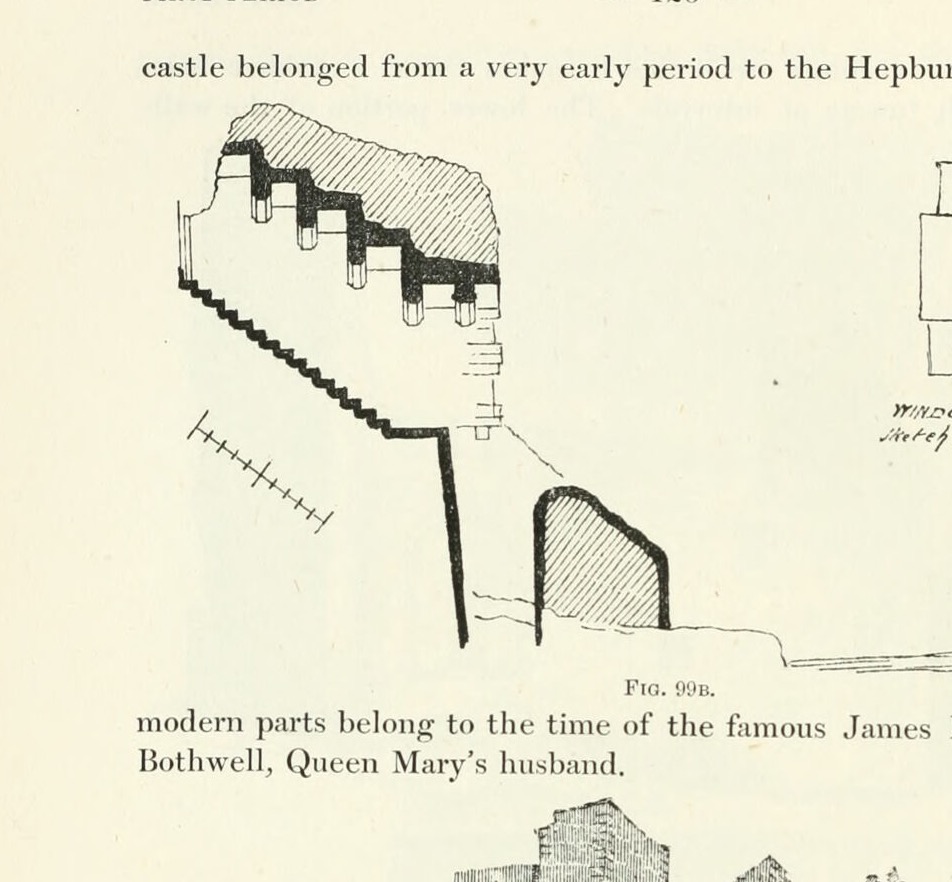
Fig. 99B.
1887 · MacGibbon & Ross, Castellated and Domestic Architecture of Scotland, vol. 1 (1887)
Public domain
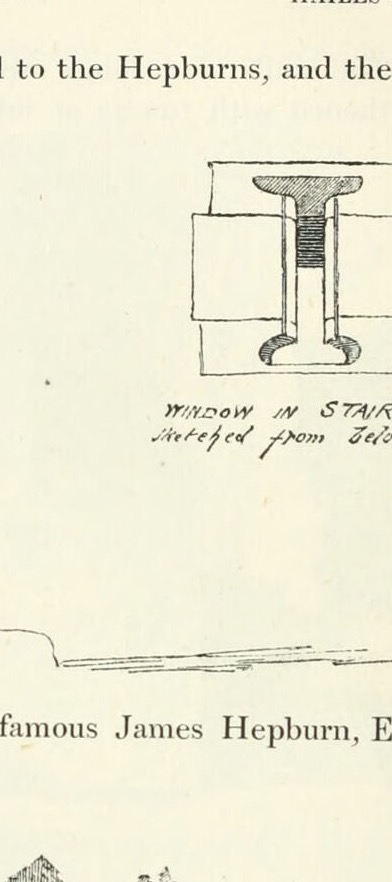
WINDOW IN STAIRCASE (sketched from below). Fig. 99B.
1887 · MacGibbon & Ross, Castellated and Domestic Architecture of Scotland, vol. 1 (1887)
Public domain
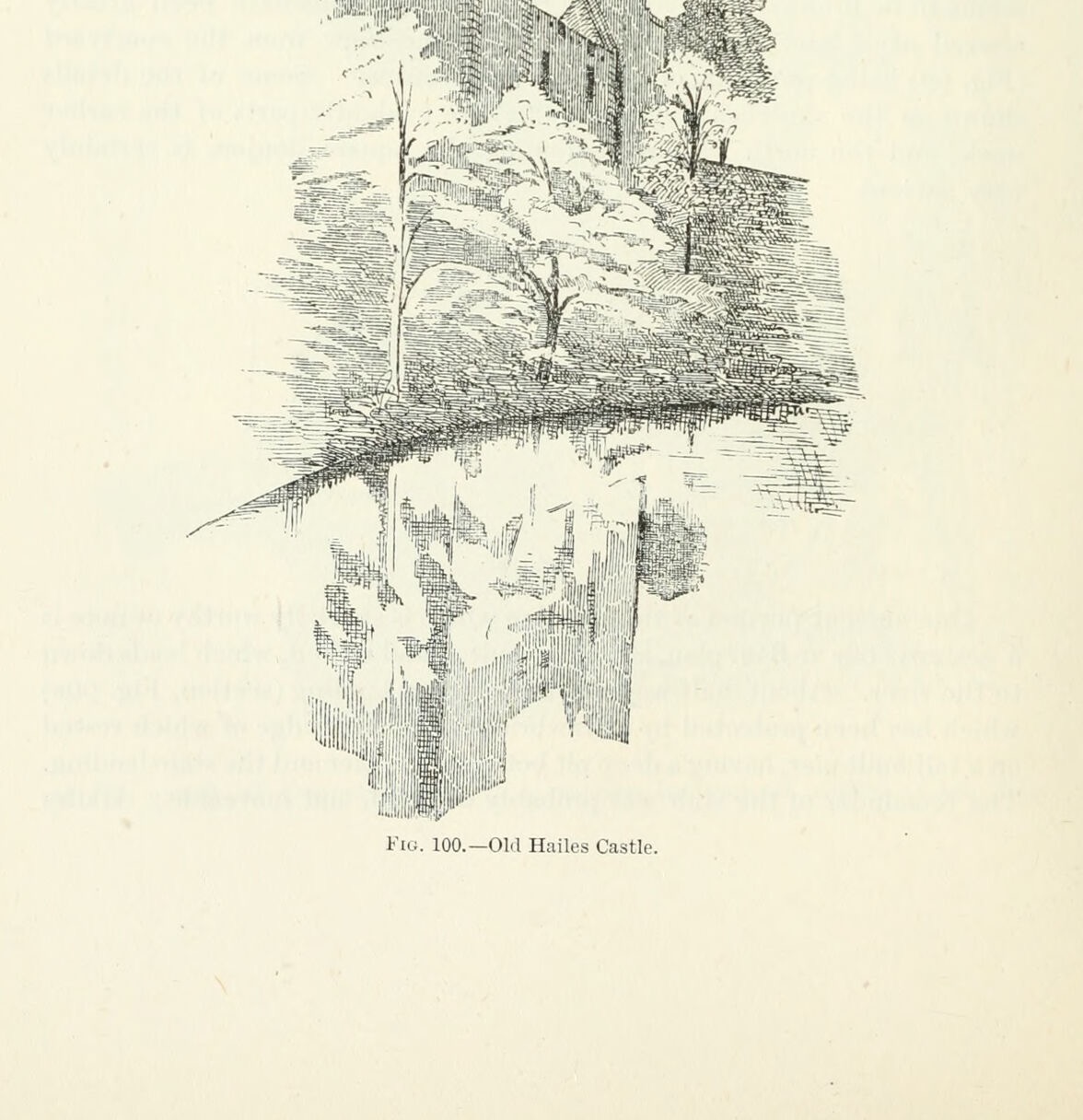
Fig. 100. Old Hailes Castle.
1887 · MacGibbon & Ross, Castellated and Domestic Architecture of Scotland, vol. 1 (1887)
Public domain
Nearby


