
Slovakia · Ruin
Beckov Castle
Beckov Castle is a medieval hilltop castle in western Slovakia, built on a steep limestone cliff above the Váh river and occupied from the medieval period until a destructive fire in 1729. Its present ruined silhouette preserves high curtain walls, a prominent multi-storey northern palace and the remains of chapels and service buildings. The site is a national cultural monument and was partially stabilised and renovated in the late 20th century.
First raised
1200
Its prime
1728
Today
Ruin
As it stood in 1728
What Beckov Castle looked like in its prime.
Perched on a steep pale limestone cliff, the castle forms an elongated complex of high curtain walls and terraces stepping up the rock. A three-storey northern palace with tall pointed Gothic windows dominates the uppermost rock; to its side are ruined halls and the chapel connected to the living quarters. A massive semi-circular cannon bastion projects from the middle slope. The lower ward is enclosed by fortified walls and gateworks leading down the approach road; roofs and timber fittings were present in the prime state.
Its story
The story of Beckov Castle.
Blundix on the Váh Cliff
The limestone crag above Beckov rises sixty metres, and archaeology on the rock traces settlement to around the turn of the era. The cliff commanded the river crossing on the boundary of the Trenčín and Nitra counties and served as a strategic outpost in the time of Great Moravia. A stone castle was raised there to guard the frontier of the Kingdom of Hungary (in the 12th century by some accounts, probably in the middle of the 13th by others), and consisted of a four-sided tower within a protective wall, to which a two-storey palace was joined.
Its original name was the Latin Blundix, from a Slavic root for wandering; Slovak historians connect the later name Beckov to bludinec, a word for a labyrinthine place. The Beckov story almost everyone in Slovakia knows is an acknowledged invention: the jester Becko, who asks his master Stibor for a castle on the hill within the year and leaves with his weight in gold on condition that the place carry his name. Stibor entered Hungarian royal service in the second half of the 14th century, when Beckov already stood, and becko is an old Hungarian word for a fool rather than the root of the castle's name.
Matthew Csák to Stibor of Stiboricz, 1300–1437
The castle became the property of Matthew III Csák at the turn of the 13th and 14th centuries and was fortified under his rule. After his death in 1321 it was run by castellans, and in 1379 Louis I of Hungary gave it to Miklós Bánffy as a reward for his service in the Balkans and Italy.
In 1388 Sigismund, King of Hungary, granted Beckov to Stibor of Stiboricz of the Clan of Ostoja, a lord of Polish origin who was among the king's most influential advisors and controlled a significant part of northern Hungary. Of the 31 castles he held, Stibor chose Beckov for his home. He rebuilt it in the Gothic style as the family seat, raising the towers and adding an upper palace with a knights' hall and a chapel, and brought in artists from Venetia, Poland, Germany and Bohemia; the chapel held a sculpted Black Madonna reckoned one of the most beautiful in Europe at the time. Stibor also fortified the town below and linked its walls to the castle's. The cruel Stibor of the legend is not the man of the record, who founded hospitals and monasteries and pleaded on behalf of criminals; medieval documents describe his son as a vicious man.
Stibor died in 1414 and his son, Stibor Stiboric of Beckov, inherited. Having no son of his own, he willed the property to his daughter Katarína, but the royal council ruled that she should receive only the customary quarter of her father's estate, paid out in cash. In 1437, one day before his own death, Sigismund gave the castle to Pál Bánffy, probably on the condition that he marry Katarína, which he did.
Mohács to the Last Bánffy, 1526–1646
After the Kingdom of Hungary was defeated by the Ottoman Empire at Mohács in 1526, the Bánffy family rebuilt Beckov as a Renaissance fortress and noble seat. With the Turkish danger pressing in the middle of the 16th century they fortified it again, raising the perimeter walls and building the great cannon bastion in the lower courtyard, keyed into the castle rock.
János Bánffy was killed fighting the Turks in 1595, and in 1599 the castle was successfully defended against a Tatar siege. Thanks to its high stone walls and the steep cliffs beneath them, Beckov was one of the few castles to withstand the attacks of Tatar and Turkish troops. The family held it until 1646, when its last member, Kristóf Bánffy, died.
Prison, Barracks and the Fire after 1646
Divided among the Bánffys' successors, who took less care over maintenance and repair, the castle slowly decayed and was gradually turned into a prison and barracks. Fire (dated 1729 by some accounts, 1727 by others) destroyed the roofs and the interiors, and Beckov has been an abandoned ruin ever since.
National Monument, Renovation and the Beckov Madonna
Beckov and its grounds are a national cultural monument. Its present appearance is the result of renovation in the last quarter of the 20th century and further work from 2002, including a campaign in 2010; the Stibor palaces, the chapel and the great cannon bastion are still unrestored. The site is open to the public from May to September, and the Beckov museum on the lower courtyard keeps the chapel portal with its tympanum of the Stibor arms. The Gothic Beckov Madonna is now at Koryčany in Moravia.
Beside the approach road lies a Jewish cemetery of more than a hundred tombstones, the oldest marked 1739–1749; the ground was acquired from Count Ján Esterházi in 1734, and the cemetery has been on the list of Slovak cultural monuments since 1991.
Step inside
10 places to explore in 1728.
The record describes 10 distinct spots at Beckov Castle, including 3 interiors: guard tower at the gateway, knights' hall (interior of the northern palace), stibor-era chapel and its portal. Create your own photoreal reconstruction and explore every one, more scenes means more rooms, more angles, and more of the place to stand in.
Build Your Own Castle
Recreate Beckov Castle with AI to explore it.
The artist rebuilds it as it stood in 1728, a photoreal reconstruction that belongs to you alone. Pay with coins, no subscription needed.
Recreate this castle →Defend this castle →Whose castle
Clans who held Beckov Castle.
The families that held Beckov Castle for a decade or more across its history, follow a name to its clan.
Stibor
Stibor of Stiboricz of the Clan of Ostoja received Beckov from King Sigismund in 1388, rebuilt it as his family's Gothic seat, and his son inherited it after his death in 1414.
Bánffy
The Bánffy family, first granted the castle in 1379 and rebuilding it as a Renaissance seat after 1526, held Beckov until Kristóf Bánffy's death in 1646.
From the archive
Beckov Castle on paper: the measured plan and period views.
The survey plan and photographs below are the ground truth this page's reconstructions are checked against, drawn and photographed while the castle was still a working garrison. Every image is public-domain or openly licensed, with its source named.
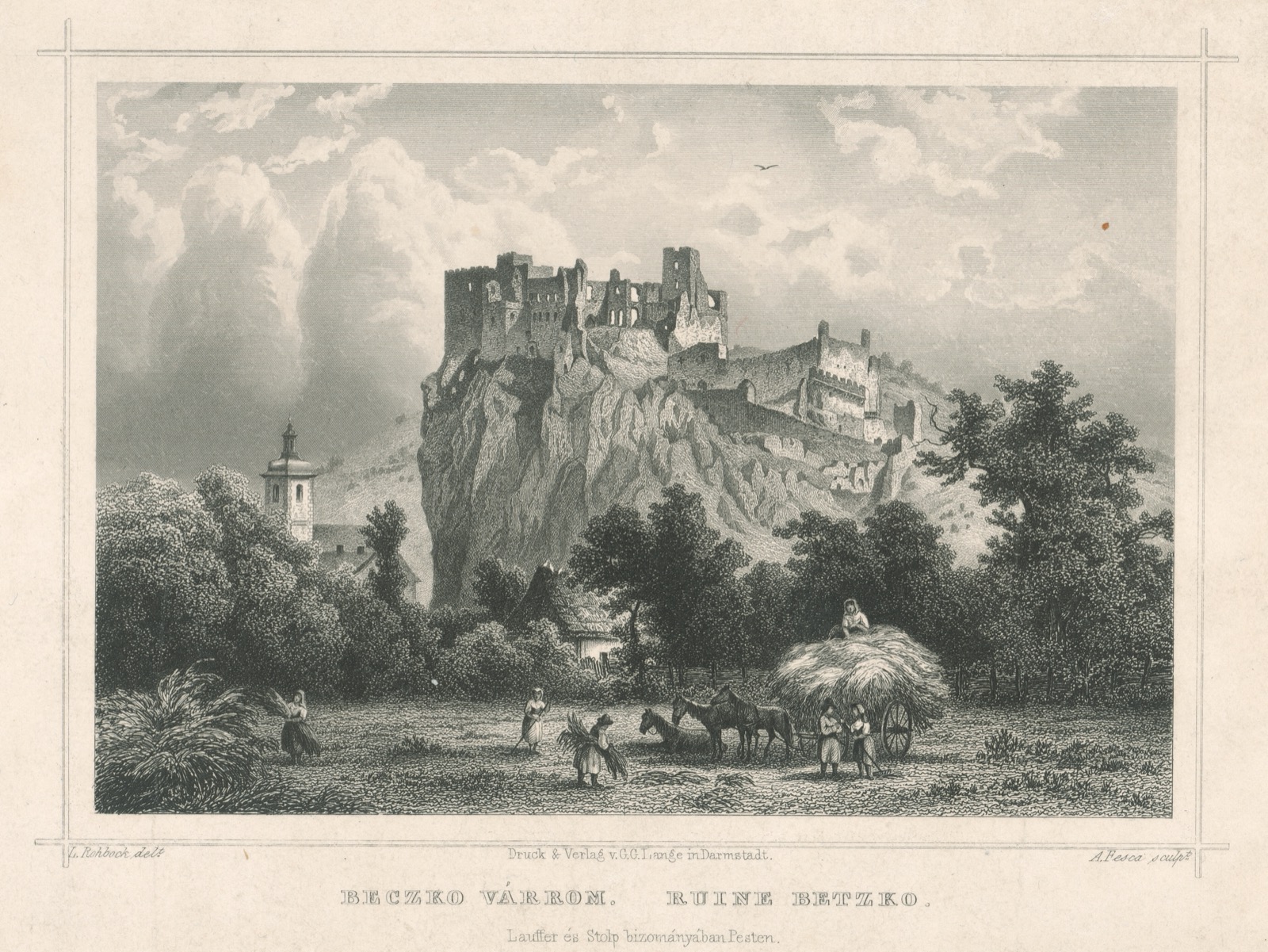
Hrad Beckov
1857 · Slovak national gallery (via Europeana)
Public domain
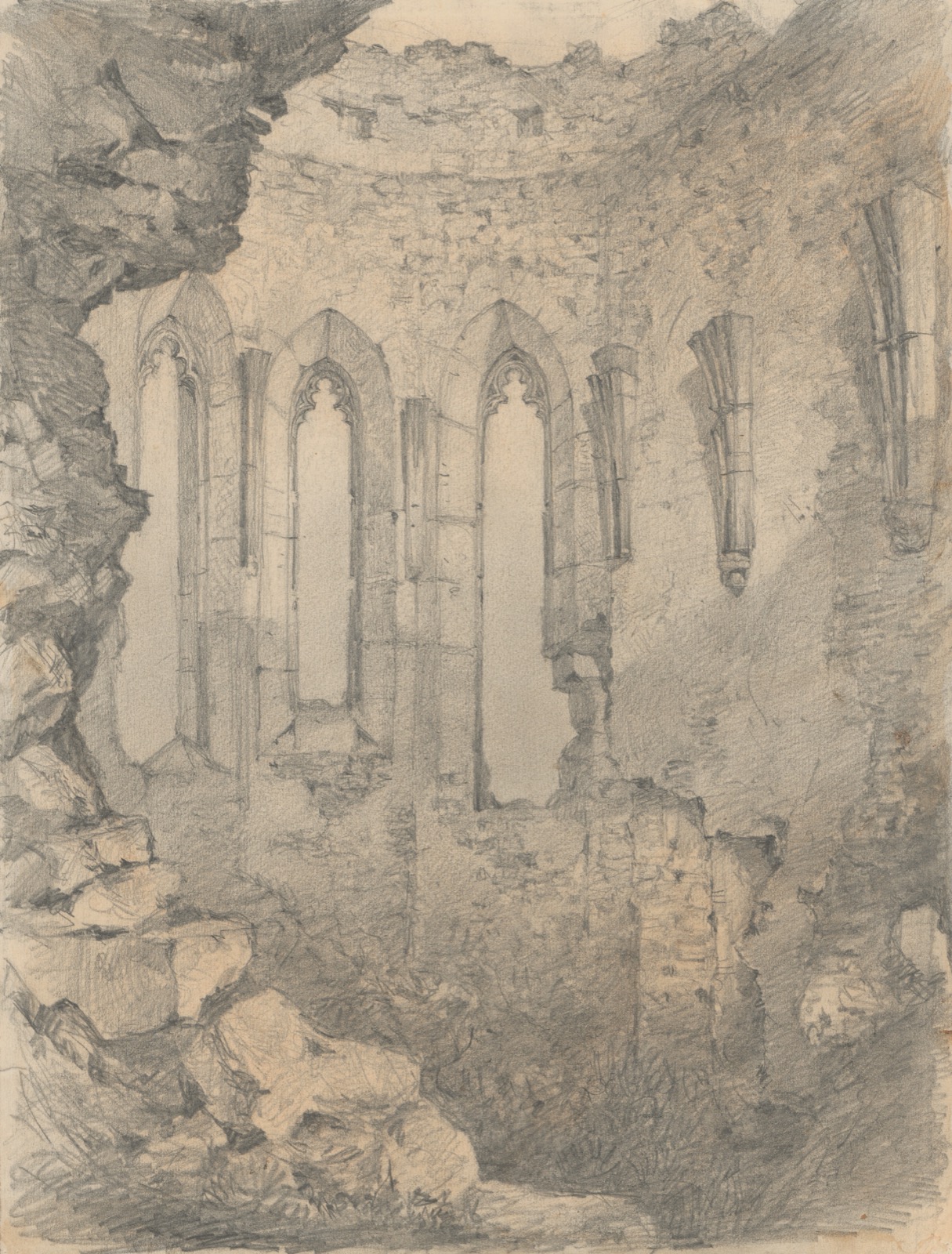
Ruiny hradu Beckov
· Slovak national gallery (via Europeana)
Public domain
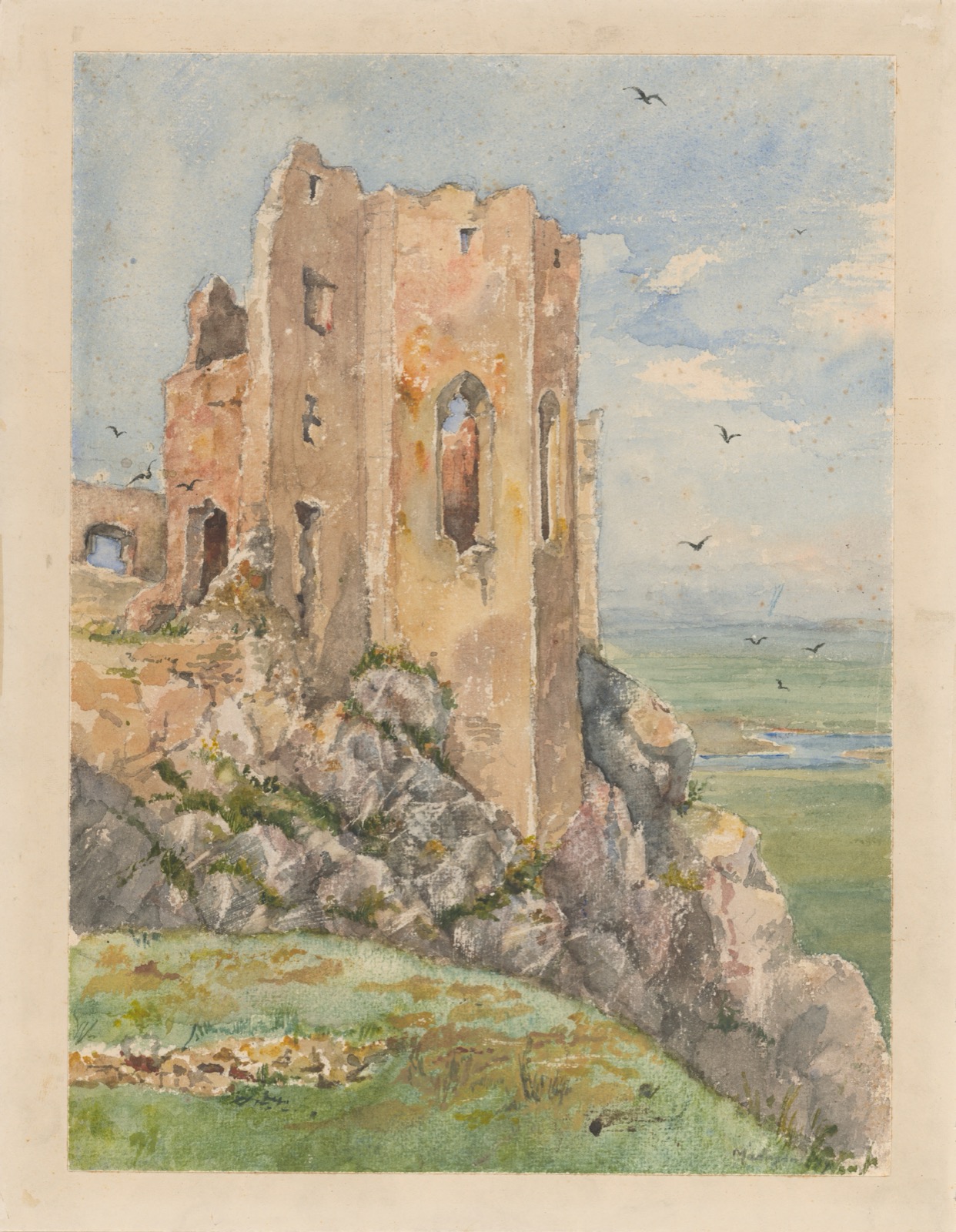
Zrúcanina hradu Beckov
· Slovak national gallery (via Europeana)
Public domain


