Clan Rising
Lietava Castle today

Slovakia · Ruin

Lietava Castle

Lietava Castle is an extensive medieval castle ruin on a limestone ridge in the Súľov Mountains of northern Slovakia, built after 1241 and expanded over centuries. It was rebuilt and fortified in a Gothic–Renaissance style by the Thurzó family in the 16th century and later abandoned in the 17th–18th centuries. Today it survives as a large ruin visited via a forest trail.

Photograph via Wikimedia Commons

First raised

1400

Its prime

1600

Today

Ruin

As it stood in 1600

What Lietava Castle looked like in its prime.

Perched on a serrated limestone ridge, the castle stretches along the rocky crest with long, irregular curtain walls punctuated by large rectangular window openings and ruinous gaps; prominent natural rock outcrops are integrated into the masonry. A tall, square multi-storey tower anchors one end of the silhouette. Stone is pale grey limestone; roofs and battlements are absent in the photo but in its prime the walls would have read as continuous, roofed ranges with regular window and portal rhythms.

Its story

The story of Lietava Castle.

Lietava Castle is an extensive castle ruin on a limestone ridge in the Súľov Mountains of northern Slovakia, between the villages of Lietava and Lietavská Svinná-Babkov in the Žilina District, known in older records as Litova, Letava, Lethowa and Zsolnalitva. Built after 1241, members of the Balas family are thought to have constructed its four-storey tower, expanded over the years by successive owners.

The castle changed hands several times until the 16th century, when the Thurzó family gained it and rebuilt and fortified it in a Gothic–Renaissance style. Abandoned in the 17th and 18th centuries, it survives today as one of Slovakia's largest ruins, reached by a forest trail.

Step inside

7 places to explore in 1600.

The record describes 7 distinct spots at Lietava Castle, including 2 interiors: great hall with grand fireplace (interior), castle archive room (interior). Create your own photoreal reconstruction and explore every one, more scenes means more rooms, more angles, and more of the place to stand in.

Approach from the village (exterior)West keep / four-storey tower (exterior)Curtain wall integrated with limestone outcrops (exterior)Gatehouse with Renaissance portal (exterior / threshold)Inner courtyard (exterior/interior space)Great hall with grand fireplace (interior)Castle archive room (interior)

Build Your Own Castle

Recreate Lietava Castle with AI to explore it.

The artist rebuilds it as it stood in 1600, a photoreal reconstruction that belongs to you alone. Pay with coins, no subscription needed.

Recreate this castle →

Castle Siege

Play Castle Siege at Lietava Castle.

A strategy game played on Lietava Castle’s real ground plan: the same surveyed walls shown in the archive below. Post your finite garrison on the battlements between assaults, then hold out as rams, siege towers, trebuchets and sappers arrive in ever-worse waves.

Sign in free to see the garrison muster. One castle costs 150 Clan Coins and is yours forever.

Sign in to take command →

See every castle’s leaderboard →

Whose castle

Clans who held Lietava Castle.

The families that held Lietava Castle for a decade or more across its history, follow a name to its clan.

  • Balas

    Members of the Balas family are thought to have built the castle's four-storey tower after 1241.

  • Thurzó

    Gained the castle in the 16th century and rebuilt it in Gothic–Renaissance style.

From the archive

Lietava Castle on paper: the measured plan and period views.

The survey plan and photographs below are the ground truth this page's reconstructions are checked against, drawn and photographed while the castle was still a working garrison. Every image is public-domain or openly licensed, with its source named.
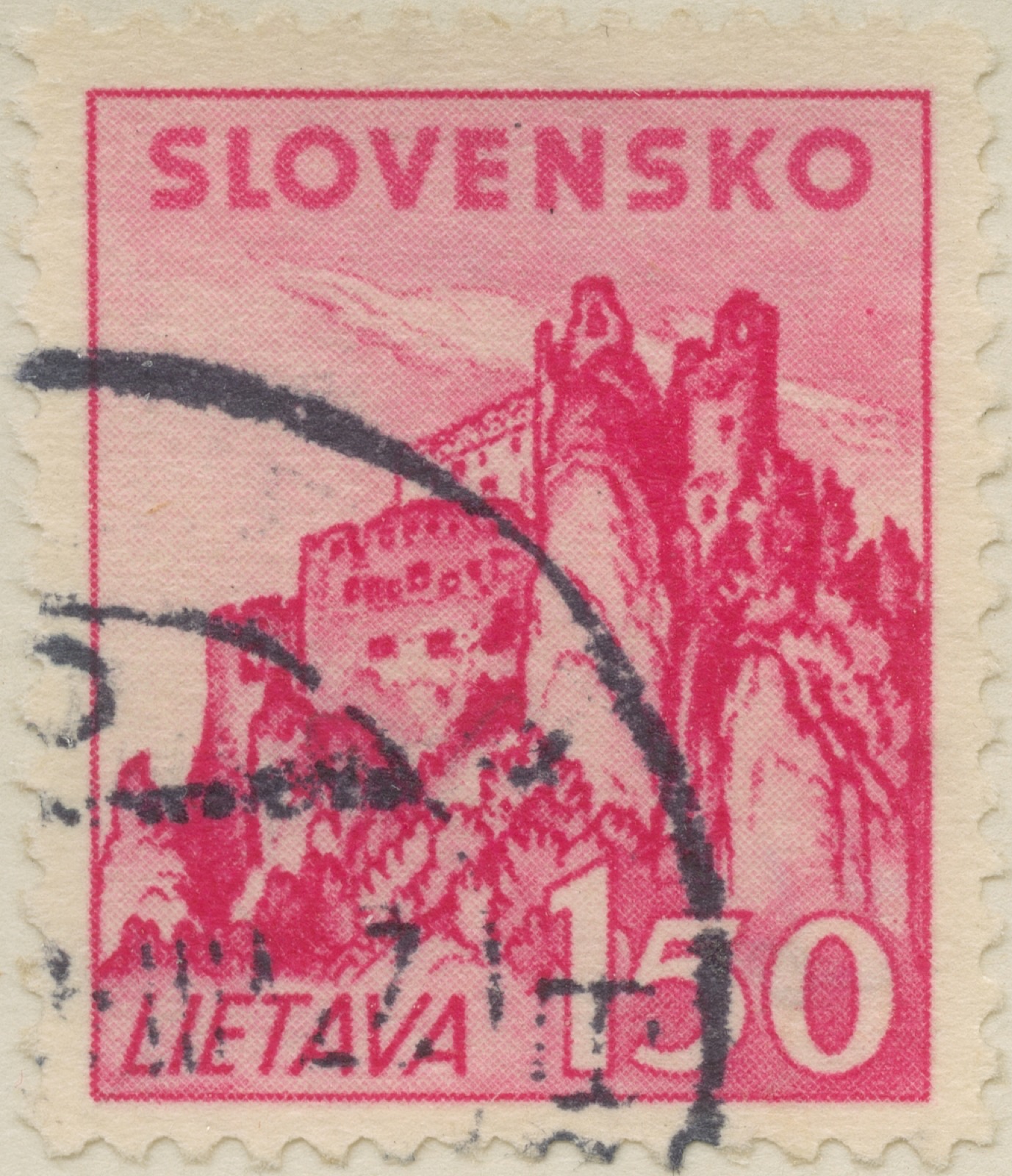
Frimärke ur Gösta Bodmans filatelistiska motivsamling, påbörjad 1950.
Frimärke från Slovakiet, 1941. Motiv av , Lietava Castle

Frimärke ur Gösta Bodmans filatelistiska motivsamling, påbörjad 1950. Frimärke från Slovakiet, 1941. Motiv av

· Swedish National Museum of Science and Technology (via Europeana)

Public domain

Questions about Lietava Castle

What is the history of Lietava Castle?

Lietava Castle was built after 1241, probably as an administrative and military centre beside the Amber Road. Members of the Balas family are thought to have built its four-storey tower, which later owners expanded. The Thurzó family gained it in the 16th century, rebuilding and fortifying it in the Gothic–Renaissance style. After disputes in the 17th century, it was abandoned.

What is inside Lietava Castle?

Inside Lietava Castle are the remains of a great hall with grand fireplaces and a former archive room. The castle also retains the interior remains of a Gothic chapel, including the starts of stone ribs and traces of plaster. Other surviving details include coats of arms, Renaissance portals, inscriptions, window openings and entrance openings.

Why was Lietava Castle built, and what was it used for?

Lietava Castle was built as an administrative and military centre in a strategic position beside the Amber Road. It was later expanded as a fortified stronghold, with a military garrison and additional defensive works. By 1530, 285 mercenaries were stationed there and made their own gunpowder; by 1604, the garrison had fallen to 12 soldiers.

Who owns Lietava Castle now?

Lietava Castle is now owned by the non-profit organisation Združenie na záchranu Lietavského hradu. The organisation takes care of the castle and oversees its conservation. It also operates an exhibition in part of the middle castle devoted to the castle’s history, owners and archaeological finds.

Where is Lietava Castle?

Lietava Castle is between the villages of Lietava and Lietavská Svinná-Babkov in the Žilina District, in the Súľov Mountains of northern Slovakia. It stands near the hill of Cibuľník, about 10 kilometres from the regional city of Žilina. The castle lies on the boundary between Lietava and Lietavská Svinná.

When was Lietava Castle built?

Lietava Castle was built in stages, beginning after 1241, while the site record gives 1400 as its first-raised year. Its origins therefore span the medieval period from the 13th to the 15th century, rather than a single securely established construction date. The castle was substantially rebuilt and fortified by the Thurzó family in the 16th century.

Was Lietava Castle ever attacked or besieged?

Lietava Castle was taken by Máté Csák III in the early 14th century. After his death in 1321, troops of King Charles Robert conquered the castle and returned it to the Balas family. The supplied accounts describe these changes of control, but do not identify them as named sieges or record how long the castle held out.

Which family or clan held Lietava Castle?

The Balas family is associated with the castle’s early construction: members of the family are thought to have built its four-storey tower after 1241. The Thurzó family gained Lietava Castle in the 16th century and rebuilt and fortified it in the Gothic–Renaissance style.

What did Lietava Castle look like in its prime?

In its prime, Lietava Castle stretched along a serrated pale-grey limestone ridge, with long irregular curtain walls and large rectangular window openings. Natural rock outcrops were incorporated into the masonry, while a tall square multi-storey tower anchored one end. Its Gothic–Renaissance character included regular window and portal rhythms, though the roofs and battlements no longer survive.

Is Lietava Castle still standing, or is it a ruin?

Lietava Castle is still standing as an extensive medieval ruin. Its walls survive to considerable height, with window and entrance openings, architectural details, Renaissance portals, defensive loopholes and parts of profiled surrounds. Conservation and partial restoration have been carried out since 2003, using sensitive stabilisation and conservation rather than rebuilding the castle as a complete structure.

Can you visit Lietava Castle?

Lietava Castle can be visited as a freely accessible ruin. It is reached by marked trails, including a blue waymarked trail from the village of Lietava that takes about 30 minutes. Some areas may be unavailable while repairs are under way, and the conservation organisation oversees the site.
All castles of Slovakia · Castles of Europe · the best castles in Europe · explore the finished reconstructions.