Clan Rising
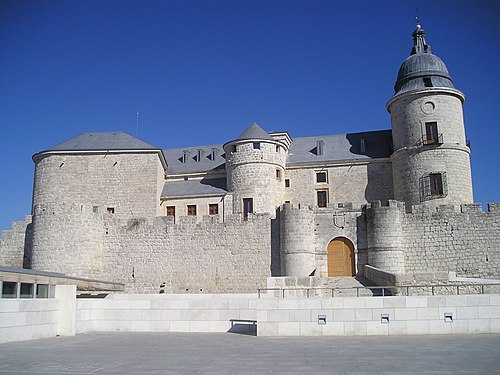
Castillo de los Duques de Alba today

Spain · Ruin

Castillo de los Duques de Alba

Castillo de los Duques de Alba is a medieval castle-palace in Alba de Tormes, Salamanca province, long associated with the House of Alba. The site dates from a 12th-century watchtower and was rebuilt and transformed into a Renaissance palace by the dukes; much of the complex was later destroyed and today only a tower and surrounding ruins remain.

Photograph via Wikimedia Commons

Its prime

1560

Today

Ruin

As it stood in 1560

What Castillo de los Duques de Alba looked like in its prime.

A massive cylindrical stone keep dominates the site, its drum-shaped tower rising from thick rubble-and-ashlar walls with broad rectangular buttresses and a low tiled roof; the masonry is warm pale-brown and grey mixed fieldstone with ashlar quoins. At its prime the tower joined continuous curtain walls and multiple subsidiary towers enclosing a central courtyard on a raised bank overlooking the river Tormes; foreground low outer walls and foundations ring the approach.

Its story

The story of Castillo de los Duques de Alba.

The castle-palace at Alba de Tormes began as a 12th-century watchtower and became the ancestral seat of the House of Alba. García Álvarez de Toledo, 1st Duke of Alba, rebuilt it as a fortress and private residence after the family took possession of the site.

Fernando Álvarez de Toledo, the 3rd Duke, turned the fortress into a true Renaissance palace, its sober exterior contrasting with rich interiors frescoed with the Battle of Mühlberg, where the duke had distinguished himself. During the Napoleonic Wars the castle was destroyed; only one tower survived, still owned by the Alba family, and the ruins around it are today open to the public.

Step inside

5 places to explore in 1560.

The record describes 5 distinct spots at Castillo de los Duques de Alba, including 1 interior: palace great hall with frescoes. Create your own photoreal reconstruction and explore every one, more scenes means more rooms, more angles, and more of the place to stand in.

Approach from the river bankBase of the great cylindrical keepEnclosed central courtyardPalace great hall with frescoesView from the town across the river

Build Your Own Castle

Recreate Castillo de los Duques de Alba with AI to explore it.

The artist rebuilds it as it stood in 1560, a photoreal reconstruction that belongs to you alone. Pay with coins, no subscription needed.

Recreate this castle →

Castle Siege

Play Castle Siege at Castillo de los Duques de Alba.

A strategy game played on Castillo de los Duques de Alba’s real ground plan: the same surveyed walls shown in the archive below. Post your finite garrison on the battlements between assaults, then hold out as rams, siege towers, trebuchets and sappers arrive in ever-worse waves.

Sign in free to see the garrison muster. One castle costs 150 Clan Coins and is yours forever.

Sign in to take command →

See every castle’s leaderboard →

Whose castle

Clans who held Castillo de los Duques de Alba.

The families that held Castillo de los Duques de Alba for a decade or more across its history, follow a name to its clan.

  • Álvarez de Toledo

    Ancestral seat of the Álvarez de Toledo Dukes of Alba; the surviving tower is still owned by the family.

From the archive

Castillo de los Duques de Alba on paper: the measured plan and period views.

The survey plan and photographs below are the ground truth this page's reconstructions are checked against, drawn and photographed while the castle was still a working garrison. Every image is public-domain or openly licensed, with its source named.

[Piedrahíta]: [Palacio de los Duques de Alba]., Castillo de los Duques de Alba

[Piedrahíta]: [Palacio de los Duques de Alba].

· Digital Library of Castilla y León (via Europeana)

CC0 (no rights reserved)

[Piedrahita]í: [vista panorámica de Piedrahíta con el Palacio de los Duques de Alba al fondo]., Castillo de los Duques de Alba

[Piedrahita]í: [vista panorámica de Piedrahíta con el Palacio de los Duques de Alba al fondo].

· Digital Library of Castilla y León (via Europeana)

CC0 (no rights reserved)
Questions about Castillo de los Duques de Alba

What is the history of Castillo de los Duques de Alba?

Castillo de los Duques de Alba began as a 12th-century watchtower overlooking the river Tormes. The House of Alba later took possession, and García Álvarez de Toledo, 1st Duke of Alba, rebuilt it as a fortress and private residence. Fernando Álvarez de Toledo, 3rd Duke of Alba, transformed it into a Renaissance palace before it was destroyed during the Napoleonic Wars.

Why was Castillo de los Duques de Alba built, and what was it used for?

Castillo de los Duques de Alba was built first as a watchtower and then used as a fortress and private residence. The House of Alba rebuilt and enlarged it, while Fernando Álvarez de Toledo, 3rd Duke of Alba, turned it into a Renaissance palace. Its great hall and other rooms displayed frescoes depicting the Battle of Mühlberg.

Where is Castillo de los Duques de Alba?

Castillo de los Duques de Alba is in Alba de Tormes, in Salamanca province. It stands beside the river Tormes, with views from the town across the river. Alba de Tormes is the nearest recognised town named in the castle’s location.

When was Castillo de los Duques de Alba built?

Castillo de los Duques de Alba was first raised in the 12th century, although its first recorded construction year is not given. It developed in stages: a watchtower came first, Sancho IV of Castile converted it into a castle in the 13th century, and the dukes later rebuilt it as a Renaissance palace.

Was Castillo de los Duques de Alba ever attacked or besieged?

Castillo de los Duques de Alba was attacked and occupied during the Peninsular War. Napoleonic troops took the castle in 1809, withdrew after the Battle of the Arapiles, and occupied it again after Spanish resistance from 14 to 24 November 1812. French forces dismantled it during their withdrawal in 1813.

Which family or clan held Castillo de los Duques de Alba?

The Álvarez de Toledo family held Castillo de los Duques de Alba. It became the ancestral seat of the Álvarez de Toledo Dukes of Alba, and the surviving tower is still owned by the family.

What did Castillo de los Duques de Alba look like in its prime?

In its prime, Castillo de los Duques de Alba had a massive cylindrical stone keep with thick rubble-and-ashlar walls, broad rectangular buttresses and a low tiled roof. Continuous curtain walls and several subsidiary towers enclosed a central courtyard on a raised bank above the river Tormes. The masonry combined warm pale-brown and grey fieldstone with ashlar quoins.

Is Castillo de los Duques de Alba still standing, or is it a ruin?

Castillo de los Duques de Alba is now a ruin, with only one of its six towers surviving. The surviving tower is the Torre del Homenaje, also called the Torre de la Armería, and archaeological excavations have exposed foundations and other remains of the former castle-palace. Restoration of the tower and frescoes began in 1960.

What is inside Castillo de los Duques de Alba, and what can you see there?

Inside Castillo de los Duques de Alba are a museum room, a fresco room and an exhibition room. The fresco room contains Renaissance paintings of the Battle of Mühlberg, made by Cristóbal Passini between 1567 and 1571, while the museum displays archaeological objects. A staircase leads to a viewing platform at the top of the tower.

Can you visit Castillo de los Duques de Alba?

Castillo de los Duques de Alba can be visited by the public. The surviving tower contains museum spaces, and the ruins outside include the remains uncovered by archaeological excavations begun in 1991. The site also has a viewing platform with panoramic views of the ruins, the town and the river Tormes.

Who owns Castillo de los Duques de Alba now?

Castillo de los Duques de Alba is owned by the Duke of Alba. The surviving tower is still owned by the Alba family, and the castle has the heritage designation bien de interés cultural.
All castles of Spain · Castles of Europe · the best castles in Europe · explore the finished reconstructions.