Clan Rising
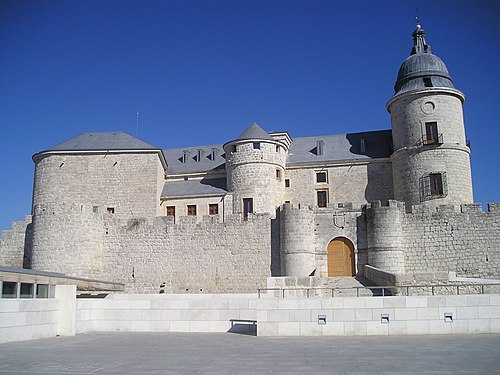
Castillo de San Cristóbal today

Spain · Demolished

Castillo de San Cristóbal

The Castle of San Cristóbal was the principal defensive fortification for Santa Cruz de Tenerife, first built from 1575 and brought into service in 1577. It was a square coastal fort with a rampart at each corner, demolished in 1928 and later rediscovered under the Plaza de España in 2006; its remains are displayed in an underground gallery and the site houses the historic 'El Tigre' cannon.

Photograph via Wikimedia Commons

First raised

1575

Its prime

1797

Today

Demolished

As it stood in 1797

What Castillo de San Cristóbal looked like in its prime.

A low, square coastal fort rising directly from a reef at Bias Díaz Cove with a rampart at each corner; thick curtain walls of large, squared dark volcanic ashlar blocks with gun embrasures set into them. The roofline is a flat battlemented parapet rather than tall towers, with cannons mounted on wooden carriages along the gun deck. The fort sits beside Santa Cruz harbour, built to present a compact, heavily armed silhouette to the sea.

Its story

The story of Castillo de San Cristóbal.

Construction of San Cristóbal began in 1575 under Governor Álvarez de Fonseca, and the fort entered service on 20 January 1577, the first fortification of significance on Tenerife and the main defensive work on Santa Cruz Bay. A square coastal fort with a rampart at each corner, it served as residence of the Captains General and Governors and as seat of the Military Government; the central Castle Street still carries its name.

Its museum houses the famous "Cañón Tigre", the cannon whose shot fractured Rear-Admiral Horatio Nelson's right arm in multiple places on 25 July 1797, the wound that cost him the arm.

The castle was demolished in 1928 to make way for the Plaza de España, its remains buried beneath the square until refurbishment works uncovered them on 28 June 2006. A few walls of the original building are now on display in a tunnel under the plaza.

Step inside

6 places to explore in 1797.

The record describes 6 distinct spots at Castillo de San Cristóbal, including 2 interiors: governor's quarters / military office, corner of original wall (site now under the plaza). Create your own photoreal reconstruction and explore every one, more scenes means more rooms, more angles, and more of the place to stand in.

Seaward approach from Bias Díaz CoveSeaward curtain wall (close-up)Corner rampart and embrasuresMain gun platform and deckGovernor's quarters / military officeCorner of original wall (site now under the plaza)

Build Your Own Castle

Recreate Castillo de San Cristóbal with AI to explore it.

The artist rebuilds it as it stood in 1797, a photoreal reconstruction that belongs to you alone. Pay with coins, no subscription needed.

Recreate this castle →Defend this castle →

From the archive

Castillo de San Cristóbal on paper: the measured plan and period views.

The survey plan and photographs below are the ground truth this page's reconstructions are checked against, drawn and photographed while the castle was still a working garrison. Every image is public-domain or openly licensed, with its source named.
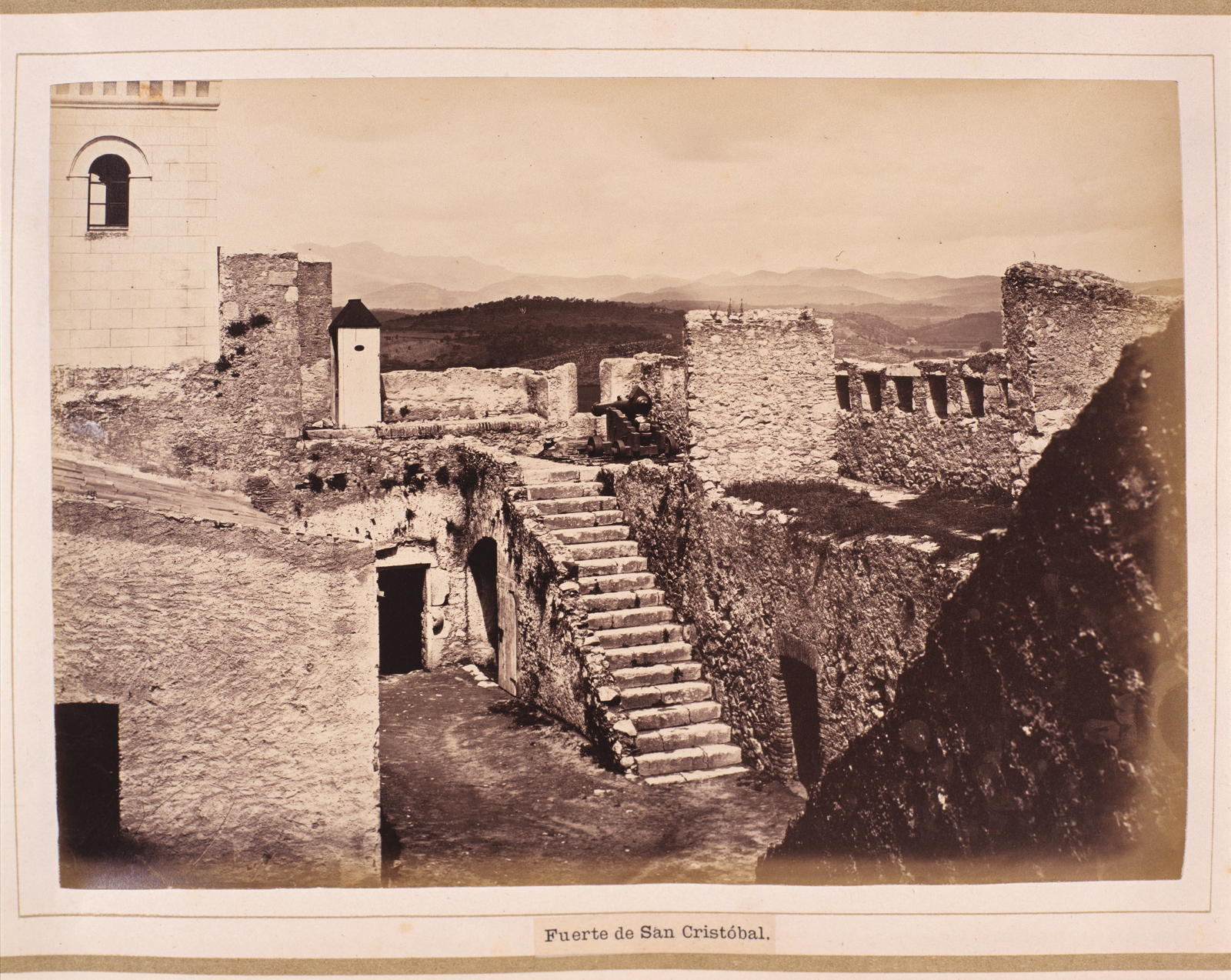
40. Fuerte de San Cristóbal, Castillo de San Cristóbal

40. Fuerte de San Cristóbal

-1877 · Ajuntament de Girona (via Europeana)

Public domain

Questions about Castillo de San Cristóbal

What is the history of Castillo de San Cristóbal?

Castillo de San Cristóbal was built in the 16th century as the principal defensive fortification for Santa Cruz and Santa Cruz Bay. Construction began in 1575 under Governor Álvarez de Fonseca, and it entered service on 20 January 1577. It later served as a residence for the Captains General and Governors and as the seat of the Military Government. It was demolished in 1928.

What is inside Castillo de San Cristóbal?

Inside Castillo de San Cristóbal, visitors can see preserved walls in an underground gallery beneath the Plaza de España, together with a small exhibition and the historic El Tigre cannon. The documented interior spaces include the Governor's quarters or military office and a corner of the original wall. The gallery also explains Tenerife's wider defensive system.

Who owns Castillo de San Cristóbal now?

Castillo de San Cristóbal is owned by Santa Cruz de Tenerife City Council. It also has the heritage designation bien de interés cultural. The surviving remains and exhibition are presented beneath the Plaza de España rather than as a privately occupied castle.

Why was Castillo de San Cristóbal built, and what was it used for?

Castillo de San Cristóbal was built as a defensive fortification for Santa Cruz and Santa Cruz Bay. It was the main defensive building in the bay and had artillery positioned there from 1577. Later, it also served as a residence for the Captains General and Governors and as the seat of the Military Government; today, its remains and El Tigre cannon form a museum display.

Where is Castillo de San Cristóbal?

Castillo de San Cristóbal is in Santa Cruz de Tenerife, on Tenerife in the Canary Islands. It stood on a reef in Bias Díaz Cove beside Santa Cruz harbour, and its surviving remains are beneath the Plaza de España. Santa Cruz de Tenerife is the administrative territory in which the castle is located.

When was Castillo de San Cristóbal built?

Castillo de San Cristóbal was first built in the 16th century, beginning in 1575. Construction started on 15 December 1575, and the fort entered service on 20 January 1577. It was a square coastal fort with a rampart at each corner.

Was Castillo de San Cristóbal ever attacked or besieged?

Castillo de San Cristóbal was involved in attacks by Blake on 30 April 1657, Jennings on 6 November 1706, and Nelson on 25 July 1797. The supplied accounts do not state whether the castle held or fell in these engagements. Nelson's attack is remembered because the castle's El Tigre cannon shot fractured his right arm in multiple places.

What did Castillo de San Cristóbal look like in its prime?

In its prime, Castillo de San Cristóbal was a low, square coastal fort rising directly from a reef at Bias Díaz Cove. Thick curtain walls of large, squared dark volcanic ashlar blocks enclosed it, with gun embrasures and a rampart at each corner. A flat, battlemented parapet and cannons on wooden carriages gave it a compact, heavily armed silhouette facing the sea.

Is Castillo de San Cristóbal still standing or is it a ruin?

Castillo de San Cristóbal is no longer standing as a complete fort: it was demolished in 1928. Only a few original walls survive, including part of the eastern fortification and a north-east bastion point, and these are preserved in an underground gallery beneath the Plaza de España. The surviving remains are displayed as a small museum exhibit.

Can you visit Castillo de San Cristóbal?

Yes, the surviving remains of Castillo de San Cristóbal can be visited in an underground gallery beneath the Plaza de España. The site includes a small exhibition and the El Tigre cannon, and the preserved walls are protected and integrated into the plaza. The complete fort was demolished in 1928, so the visit is to its archaeological remains and museum display.
All castles of Spain · Castles of Europe · the best castles in Europe · explore the finished reconstructions.