
Spain · Restored
Requesens Castle
Castillo de Requesens
Requesens Castle is a hilltop fortress in Catalonia overlooking the southern valleys of Mount Neulós and the Albera range. Largely rebuilt as a neo‑medieval summer residence between 1893 and 1899, the ensemble preserves multiple enclosures, towers, battlements and a chapel while retaining much granite masonry from the mountain. The site is visitable though some upper areas have restricted access for safety reasons.
Its prime
1899
Today
Restored
As it stood in 1899
What Requesens Castle looked like in its prime.
Perched on a wooded hill, the castle reads as a layered fortress of rough local granite with three enclosed baileys stepped up the slope. Long crenellated curtain walls link square and round towers, including a taller square keep-like tower rising above the rest. A lower cluster of service buildings and a small pitched-roof chapel sit against the slope; portals, visible machicolations and battlemented walkways define the roofline. The rebuilt exterior shows exposed grey granite and formal defensive silhouettes.
Its story
The story of Requesens Castle.
Requesens is first recorded in a grievance memorial from Count Ponç I of Empúries to his cousin, Count Gausfred II of Roussillon, around 1040–1071, controlling the passage into Spain below Mount Neulós. The lordship was confirmed to the Counts of Roussillon in a 1075 agreement between the counts, and control of the castle reaffirmed in further agreements of 1085 and 1121, held for them by a "castlà" who in the early 12th century was drawn from the count's own family.
The castle sat at the heart of the 12th-century feuds binding the Rocabertí viscounts of Peralada to the Counts of Roussillon against Empúries, the "war of Requesens" began with its capture by Count Ponç II of Empúries. After the Count of Barcelona seized Roussillon in 1172, the new lord, King Alfonso II, renounced his rights to Requesens in favour of the Count of Empúries, securing him full control; men surnamed Requesens then served as castellans or lords of the castle into the 13th century.
Between 1893 and 1899 the medieval fortress was largely rebuilt as a neo-medieval summer residence. The ensemble preserves multiple enclosures, towers, battlements and a chapel, retaining much granite masonry from the mountain itself, and the site can be visited today, though some upper areas are closed off for safety.
Step inside
9 places to explore in 1899.
The record describes 9 distinct spots at Requesens Castle, including 3 interiors: chapel of the virgin of providence (interior), service buildings: kitchens and stables (interior/exterior), great hall in the noble (upper) enclosure. Create your own photoreal reconstruction and explore every one, more scenes means more rooms, more angles, and more of the place to stand in.
Build Your Own Castle
Recreate Requesens Castle with AI to explore it.
The artist rebuilds it as it stood in 1899, a photoreal reconstruction that belongs to you alone. Pay with coins, no subscription needed.
Recreate this castle →Defend this castle →Whose castle
Clans who held Requesens Castle.
The families that held Requesens Castle for a decade or more across its history, follow a name to its clan.
Roussillon
The Counts of Roussillon held the lordship of Requesens, confirmed by agreements of 1075, 1085 and 1121, until the county was seized by Barcelona in 1172.
Empúries
The Counts of Empúries secured full control after 1172, when Alfonso II renounced his rights to Requesens in their favour.
Requesens
Men of the Requesens surname served as castellans or lords of the castle for the Count of Empúries in the late 12th and 13th centuries.
From the archive
Requesens Castle on paper: the measured plan and period views.
The survey plan and photographs below are the ground truth this page's reconstructions are checked against, drawn and photographed while the castle was still a working garrison. Every image is public-domain or openly licensed, with its source named.
![[Casament al Castell de Requesens], Requesens Castle](/heritage/requesens-castle/photo-euro-0.jpg)
[Casament al Castell de Requesens]
· Ajuntament de Girona (via Europeana)
Public domain
![[Casament al Castell de Requesens], Requesens Castle](/heritage/requesens-castle/photo-euro-1.jpg)
[Casament al Castell de Requesens]
· Ajuntament de Girona (via Europeana)
Public domain
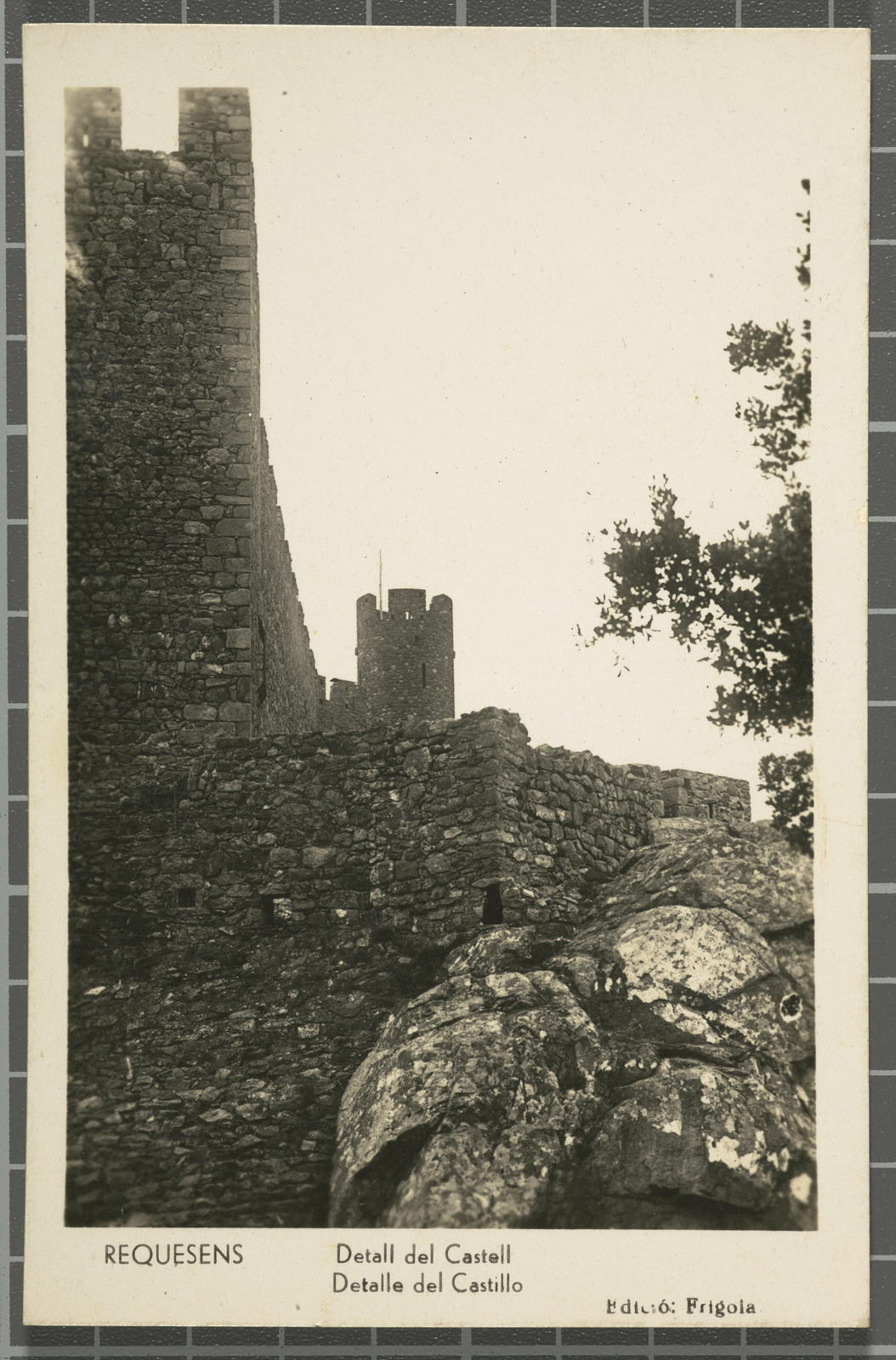
Requesens. Castle Detail. Castle Detalle
· Ajuntament de Girona (via Europeana)
Public domain


