
Sweden · Ruin
Stegeborg Castle
Stegeborg Castle is a medieval and Renaissance-era island fortress in St Anna parish, Söderköping, Östergötland, Sweden, built on an islet in a narrow sound of the Slätbaken bay. Originating with a 13th-century square brick tower, it was expanded with curtain walls, a western round tower and a north-wing castle church and was worked on through the late 16th century under John III. Much of the superstructure was demolished in the 18th century; substantial masonry and the round tower survive as ruins.
Its prime
1590
Today
Ruin
As it stood in 1590
What Stegeborg Castle looked like in its prime.
At its prime the castle sits compactly on a small, tree-covered islet in a narrow sound: a low, irregular stone curtain wall runs close to the shoreline, linking a tall cylindrical stone round tower on the western flank with an older, square brick tower at the southeast corner. A north wing containing the castle church projects from the wall; the base is made of large masonry with grassy slopes down to the water and timber pilings in the channel.
Its story
The story of Stegeborg Castle.
The Stäk, Skällsvik and King Birger, 1287–1320
Stegeborg sits on an island in a narrow sound at the bay of Slätbaken, on the water approach to Söderköping, and it was the channel that gave the place its name. The castle is recorded in 1310 as Stækaborg, from stäk, the mediaeval Swedish word for a stock or pile: the barriers of stakes driven into the water to stop or hinder shipping. Pilings found north of the island have been dated to the 11th century, and the oldest of the systems here to between the 7th and 9th. They were still in place into the 19th century, and vessels therefore had to pass the island on its southern side.
The castle's beginnings run through the farm at Skällsvik, attested in 1287 as a holding of Bengt Birgersson, bishop of Linköping, and kept by his successor Lars Albrektsson. Its position at the entrance to Söderköping, then one of the wealthiest cities in the kingdom, was plain to the guardianship governing for Birger Magnusson under the marshal Torgils Knutsson. By 1305 at the latest the bishop's farm had been sold to King Birger, and a castle was then built on the holm out in the sailing channel; what it looked like and how far it extended are not known. The oldest surviving part is a square brick tower in the south-east corner, with a simple fortified residence added in the 14th century and extended by a curtain wall to the west. Between 1310 and 1316 the king sent several letters from Stegeborg and may be assumed to have stayed there for long stretches.
After the Nyköping Banquet a rebellion broke out against King Birger. He left Stegeborg and sailed for Visby, setting his son Magnus Birgersson in command, and the siege that followed ran, in all probability, from Easter until the end of August 1318. Magnus was taken prisoner to Stockholm and sentenced to death in June 1320; he lies buried in Riddarholmskyrkan, beside King Magnus Ladulås. Erik's Chronicle has the castle pulled down after the capitulation.
Bishops, Pawn and Rebuilding, 1321–1363
Karl, bishop of Linköping, set out to recover Skällsvik for the diocese, and on 27 January 1321 he received the farm and the castle ruins as a gift from Duke Erik's widow Ingeborg Håkansdotter, then spent heavily on rebuilding the estate. It did not stay with the church: in 1332 the bishop was obliged to yield it to King Magnus in exchange for properties on Visingsö, probably for the site's strategic position and for the chance of taking toll from ships bound for Söderköping. An economic crisis forced the king to pawn the castle in 1336, to whom is not known, and by 1350 Skällsvik was church property once more.
During the dynastic conflict of the 1350s between King Magnus and Erik Magnusson, Skällvik manor was held by bishop Nils Markusson, who had taken Erik's side; in 1356 it was attacked and badly damaged, probably at the king's order. That Söderköping was attacked too when Duke Albert of Mecklenburg came against Sweden in 1363 indicates that his fleet had been able to pass Skällvik unhindered. What is certain is that the manor disappeared and that someone rebuilt Stegeborg on the holm in the channel. Albert, who rebuilt both Nyköping Castle and Stäkeholm, is one guess as to who.
The Kalmar Union Sheriffs, 1391–1487
By 1391 Stegeborg belonged to the Crown, and Margaret had appointed the Danish knight Evert Moltke as sheriff; the diocese complained that he forced the peasants to pay additional taxes despite crop failures. On Midsummer's Day 1394 the Victual Brothers attacked Söderköping in great force and appear to have passed Stegeborg without being stopped. Moltke was moved on and Esbjörn Kristiernsson Djäkn took his place, a man the Vadstena Abbey diary calls a disgusting tyrant. Jöns Finnsson, sheriff from 1414, had come from Västerås Castle, where the populace had complained of his abuses. At the end of the 1420s the post went to the Croatian count Ivan Anz Frankopan, who had accompanied King Erik to Jerusalem as his interpreter and whose name was swedified to Johan Vale or Johan Franco.
In the Engelbrekt rebellion Stegeborg was taken in 1434 after a short siege. Knut Bosson (Natt och Dag), bishop of Linköping, became steward, and after the Council of the Realm met at Söderköping in 1436 Nils Stensson (Natt och Dag) took over. Karl Knutsson (Bonde), regent from 1438, demanded that Nils yield the castle to him; Nils refused, and a siege began in February 1439. In July it was agreed that he would give it up voluntarily in September unless King Erik sent relief. Erik came that summer to summon the Privy Council, and his negotiators met Karl Knutsson at Arkösund without reaching agreement. In late August the king returned to Gotland, in the autumn the castle passed to the Privy Council, and Erengisle Nilsson the younger became sheriff.
Erengisle seems to have been friendly to the Union, but he was dismissed in 1463 when the king suspected him of sympathy for Karl Knutsson. The Oxenstierna family lost their standing in Sweden in 1467, and Ivar Axelsson (Tott) was appointed in their stead by his brother, then regent; his marriage to Karl Knutsson's daughter Magdalena carried him over to the party opposed to the Union, and by decision of the Privy Council on 25 May 1472 he held Stegeborg castle and county as a life fief. He kept his home at Visborg Castle on Gotland, but the major rebuilding at Stegeborg was his, among it a new curtain wall and the round tower still standing. He also owned seven vessels engaged in piracy on the Baltic, and conflict with the Privy Council over it could not be avoided; when discussion led nowhere, a military operation was launched against his castle. The siege began in February 1487, and on 14 May the castle's steward, Erland Kagge, was forced to capitulate.
From Gregers Matsson to the Stockholm Bloodbath, 1487–1520
On 3 September that same year the privy councillor and lawman Gregers Matsson (Lillie) was made captain of the castle, and the accounts from his time, covering 1487 to 1492, survive. Arvid Trolle, Nils Bosson (Sture) and Erik Turesson (Bielke) each held the command after him for a short spell. In the summer of 1499 King Hans granted the fief to Svante Nilsson (Sture), who had wanted to succeed his father Nils Bosson and been passed over by Sten Sture; the castle county had by then been reduced, and drew no more revenue from Söderköping and Norrköping. A rebellion against King Hans broke out in the summer of 1501, and in August three of the king's fourteen ships tried to enter Slätbaken and take Stegeborg, but the landing failed.
After Sten Sture's death Svante Nilsson was elected regent on 21 January 1504, and it was probably 1506 before Trotte Månsson (Eka) was appointed castle bailiff; he held the post, faithful to Svante, until his death in 1512. Holger Karlsson Gera took the fief in 1513, his wife a cousin of Archbishop Gustav Trolle, which was probably a burden to him in the Sture party. In June 1517 the Danish fleet managed to burn Söderköping despite Stegeborg blocking the entrance, though it had probably come in by the Bråviken and landed its force from there. Erik Ryning took command in 1518, and in the summer of 1520 he defeated a Danish force guarding the bishop's manor outside Linköping. Accusations from bishop Brask and from Nils Bosson (Grip) followed, and he was among those beheaded at the Stockholm Bloodbath in 1520.
From the Dacke Feud to the Heritage Board
During the Dacke Feud the castle was attacked but never captured, and it was refurbished in the 1540s, with Esbjörn Pedersson Lilliehöök as bailiff between 1555 and 1560. John III was born at Stegeborg on 21 December 1537 and raised there, and in 1578 he ordered the building work continued, which made the place a Renaissance palace more than a mediaeval castle; the work ran on until 1590. In his reign the round tower reached its present height, and a castle church was added to the north wing. Magdalena Svantesdotter Sture was born there in 1539, John's daughter Anna Vasa in 1568, Maria Eufrosyne of Zweibrücken in 1625 and Adolph John in 1629. Anna Vasa held the castle in fief until 1598, when she was forced to flee Sweden for Poland.
In 1622 the castle and some hundreds were granted to Gustav II Adolf's brother-in-law John Casimir of Pfalz-Zweibrücken on his marriage to the king's sister Katarina Vasa, and the grant was confirmed again by Queen Christina in 1651. John Casimir died in 1652; his eldest surviving son Karl Gustav succeeded his cousin Christina two years later as Charles X Gustav, and it was the younger brother, Adolph John, who lived at Stegeborg until his death in 1689, when the holding reverted to the crown. Until that year the castle had been the seat of local government for the Östergötland archipelago and the administrative centre of Stegeborg county. The governor of Östergötland then tried to keep it in serviceable condition but could not prevent its dilapidation. A commission inspected it in 1707, and the repairs it proposed would have been very expensive; the following year every wooden building on the island was auctioned off. In the 1720s the governor Erik Ehrenkrona proposed that three of the four ranges be demolished and the fourth re-equipped, but a further inspection in 1728 ended with his proposal rejected. In the summer of 1731 much of the castle was pulled down and the material used in Norrköping; the heavy masonry of the bottom storey saved what remained from being erased altogether.
The name went with the land rather than the stone. Jacob von Hökerstedt bought the southern royal demesne in 1731 and the property took the name Stegeborg; the von Schwerin family held it from 1739 to 1863. Stegeborg was protected in 1901. In 1938 the Swedish National Heritage Board was given a small sum to clear the site of trees and scrub, and the worst-damaged parts of the masonry were repaired; between 1948 and 1955 the board, helped by conscripts serving without arms, excavated the ruin, made good the worst of the damage and raised protective roofing over certain parts. The ruin is registered as an ancient monument, and the estate is privately held, carrying a substantial tourist business with a marina and a restaurant beside the ruin. An airfield has been laid out on the Skällsvik meadow where the Battle of Stegeborg was fought.
Step inside
7 places to explore in 1590.
The record describes 7 distinct spots at Stegeborg Castle, including 1 interior: interior of the castle church in the north wing. Create your own photoreal reconstruction and explore every one, more scenes means more rooms, more angles, and more of the place to stand in.
Build Your Own Castle
Recreate Stegeborg Castle with AI to explore it.
The artist rebuilds it as it stood in 1590, a photoreal reconstruction that belongs to you alone. Pay with coins, no subscription needed.
Recreate this castle →Defend this castle →Whose castle
Clans who held Stegeborg Castle.
The families that held Stegeborg Castle for a decade or more across its history, follow a name to its clan.
Vasa
Several of the Vasa kings lived at Stegeborg; John III's building works ran into the late 16th century.
From the archive
Stegeborg Castle on paper: the measured plan and period views.
The survey plan and photographs below are the ground truth this page's reconstructions are checked against, drawn and photographed while the castle was still a working garrison. Every image is public-domain or openly licensed, with its source named.
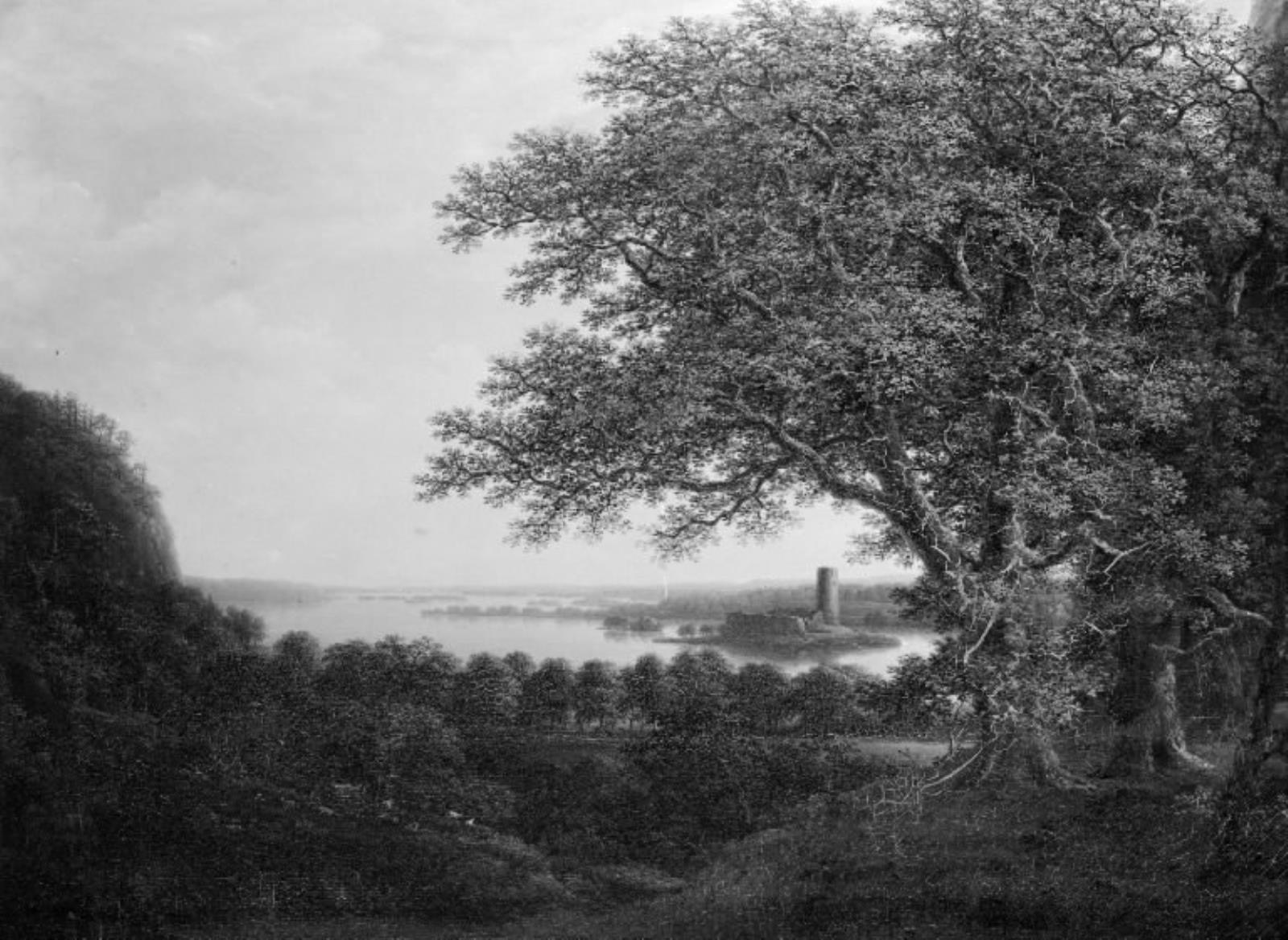
The Ruins of Stegeborg Castle near Vettern in Eastern Gotland
· National Gallery of Denmark (via Europeana)
Public domain


