
Switzerland · Restored
Chillon Castle
Château de Chillon
Chillon Castle is a medieval island fortress on a small limestone rock in Lake Geneva between Montreux and Villeneuve. Built and expanded from the 11th century onwards, it served as a residence, prison, and garrison and today is a restored historic monument and museum of regional significance.
First raised
1160
Its prime
1270
Today
Restored
Ranked among Europe’s castles
As it stood in 1270
What Chillon Castle looked like in its prime.
Perched on a steep oval limestone island, the castle rises directly from the water with thick pale stone curtain walls punctuated by narrow slit and mullioned windows. A tall square donjon with a steep pyramidal roof dominates a compact cluster of steeply pitched tiled roofs, small round turrets with conical caps, and stepped rooflines. The lower walls meet the lake edge; staircases and machicolation-like projections are visible along the battlements. The Alps form a high backdrop across the water.
Its story
The story of Chillon Castle.
The Narrows of Cluse and the Road to the Great St Bernard
Chillon stands on a steep-sided limestone island at the eastern end of Lake Geneva, the largest of the lake's seven, cut off from the shore by a ditch a few metres wide. Behind it the mountain leaves only a thin passage between Montreux and Villeneuve, known since the Middle Ages as the Cluse and named clusa de Chillon in thirteenth-century charters. A Roman road from Italy over the Great St Bernard ran through that gap, and the medieval pilgrim road to Rome, the Via Francigena, followed the same shore.
A square donjon was raised on the rock in the eleventh century to control the road from Burgundy to the Great St Bernard Pass; who ordered the work is still in question. The Rhône valley had been under the bishops of Sion since the Burgundian king Rudolf III granted Bishop Hugh comital rights in Valais in 999, and the first castle here was probably built at the bishop's direction.
Savoyard Castellans and the Rent of Six Pounds of Pepper
A charter of 1150, in which Count Humbert III granted the Cistercians of Hautcrêt free passage to Chillon, shows the castle already answering to the House of Savoy, and from the middle of the twelfth century the counts used it as a summer residence, keeping a fleet of ships on the lake. The lordship stayed layered: the first Savoyard castellan is named in 1198, and in 1233 Bishop Landri of Sion and the Savoyard noble Aymon put it in writing that Chillon was held of Sion as a fief, for which the castellans rendered six pounds of pepper a year.
Thomas I, pushing north of the lake into Vaud against the Duke of Zähringen, threw a second landward wall in front of the older enceinte. Peter II expanded the castle in 1248 and again in 1266–7 and about 1255 added three semicircular towers on the landward side; the distinctive windows are the work of Master James of Saint George, thought to have set similar ones into Harlech Castle in Wales later. The road toll taken here since the High Middle Ages was moved in the thirteenth century to the counts' new foundation just south of the rock, the ville neuve de Chillon that grew into Villeneuve.
François Bonivard in the Lakeside Vault, 1530–1536
The counts and dukes of Savoy kept prisoners at Chillon as well as a household. The best known was probably François Bonivard (1496–1570), prior of St Victor in Geneva and a historian, gaoled in 1530 for six years for backing the Reformation and Geneva's independence from Savoy. The pillar he was chained to stands in the prison vault on the lake side.
Byron visited in 1816 and made Bonivard the subject of The Prisoner of Chillon, and is said to have carved his own name on one of the dungeon pillars. The verses spread the castle's name through the nineteenth century, and Eugène Delacroix took his own Prisoner of Chillon from the poem, exhibiting it at the Salon of 1835.
Hans Franz Nägeli Before the Walls, 17 March 1536
From the fifteenth century the dukes of Savoy were increasingly at odds with Bern. Bernese and Fribourg troops moved against Chillon during the Burgundian Wars in 1475 and withdrew without result, but at the Peace of Fribourg in 1476 Savoy gave up the neighbouring lordship of Aigle, and Chillon became a frontier fortress facing a powerful neighbour.
The Reformation in Geneva gave Bern its next cause. In the campaign of 1536, with Duke Charles III under French attack, a Bernese force under Captain Hans Franz Nägeli overran Vaud, the Pays de Gex and the Chablais, and on 17 March drew up before Chillon alongside a fleet out of Geneva. The garrison did as the duke had ordered and fled across the lake into Faucigny with its commander, Antoine de Beaufort; the Bernese freed Bonivard and three other imprisoned Genevans. From 1536 to 1733 it was the seat of the Bernese bailiff of Vevey; the bailiwick then moved to Vevey itself and the island fell back to road fortress, magazine and prison.
Munitions Store to Albert Naef's Twenty Years
In 1798 the Vaudois drove out the Bernese authorities, declared the Lemanic Republic and invited in French troops to secure their autonomy from the other Swiss; the French, once installed, used Chillon as a munitions and weapons depot. The canton of Vaud has held it since 1803.
The restoration begun at the end of the nineteenth century was one of the first attempts to rebuild a monument from archaeology and archive rather than taste. Ernest Burnat began the survey; Albert Naef, who replaced him, gave twenty years to it, subordinating aesthetics to accuracy and marking replacement stonework with a cut inscription, a change of colour or a red line. Naef drafted the Vaud law on historic monuments of 1898, the first in Switzerland, and became the canton's first archaeologist under it.
Step inside
9 places to explore in 1270.
The record describes 9 distinct spots at Chillon Castle, including 5 interiors: great bernese kitchen / great room of the bailiff, camera domini (ducal chamber), one of the four great halls and more. Create your own photoreal reconstruction and explore every one, more scenes means more rooms, more angles, and more of the place to stand in.
Build Your Own Castle
Recreate Chillon Castle with AI to explore it.
The artist rebuilds it as it stood in 1270, a photoreal reconstruction that belongs to you alone. Pay with coins, no subscription needed.
Recreate this castle →Defend this castle →Whose castle
Clans who held Chillon Castle.
The families that held Chillon Castle for a decade or more across its history, follow a name to its clan.
Savoy
Summer residence of the Counts of Savoy from the 12th century until the Bernese took it in 1536.
From the archive
Chillon Castle on paper: the measured plan and period views.
The survey plan and photographs below are the ground truth this page's reconstructions are checked against, drawn and photographed while the castle was still a working garrison. Every image is public-domain or openly licensed, with its source named.
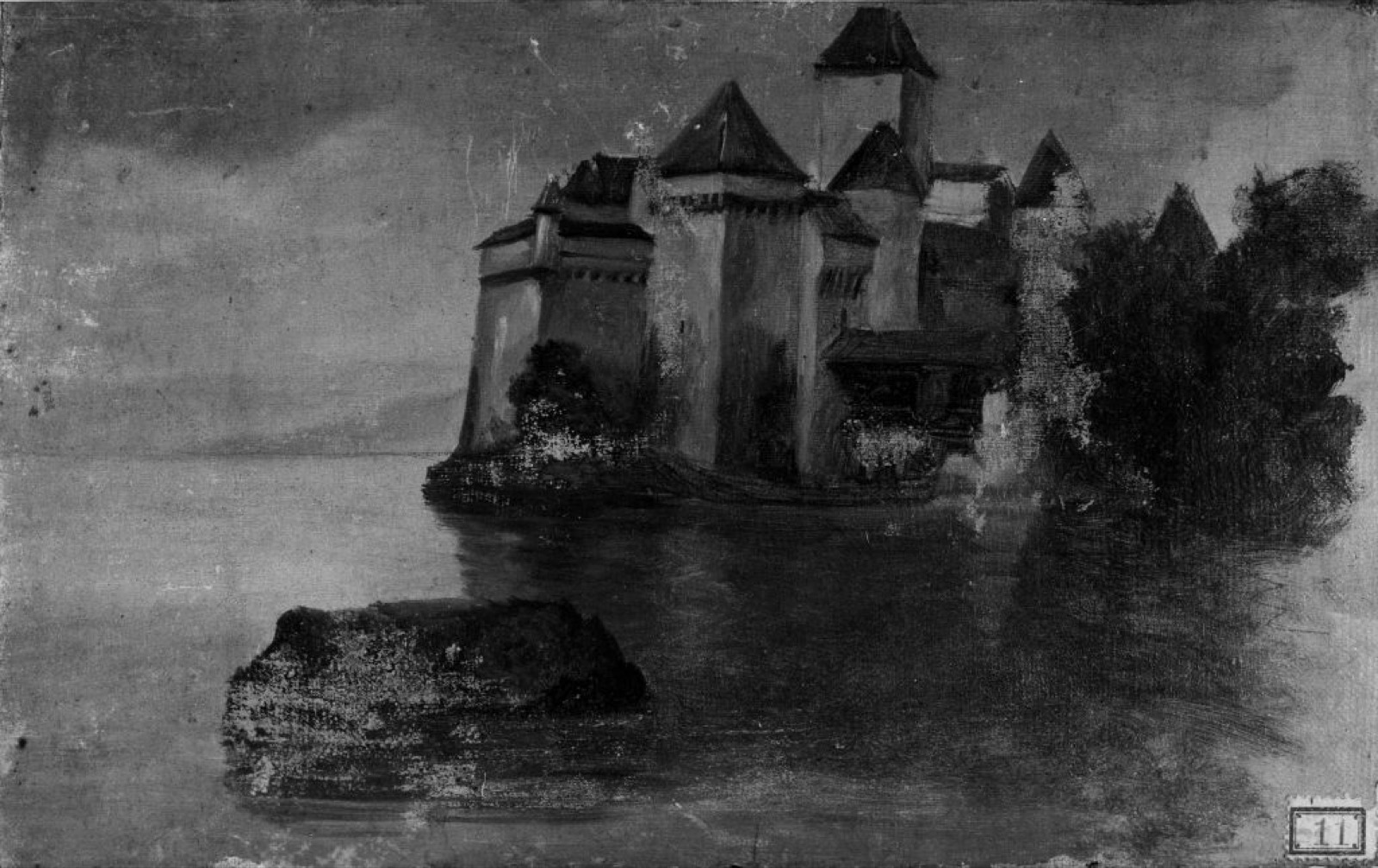
Castello di Chillon sul lago di Ginevra
· Turin Gallery for Modern and Contemporary Art (via Europeana)
CC BY
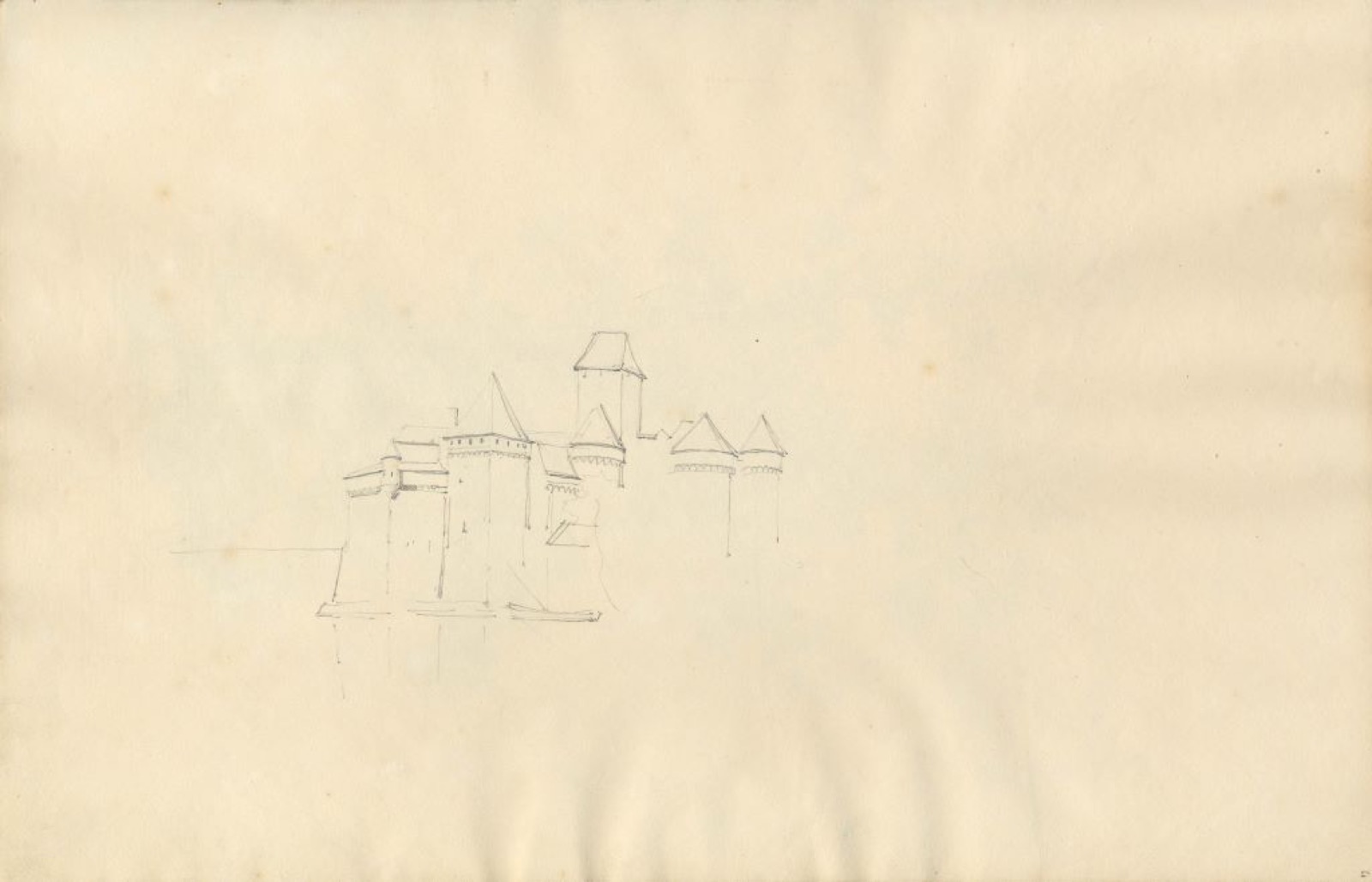
Castello di Chillon sul lago di Ginevra
· Turin Gallery for Modern and Contemporary Art (via Europeana)
CC BY
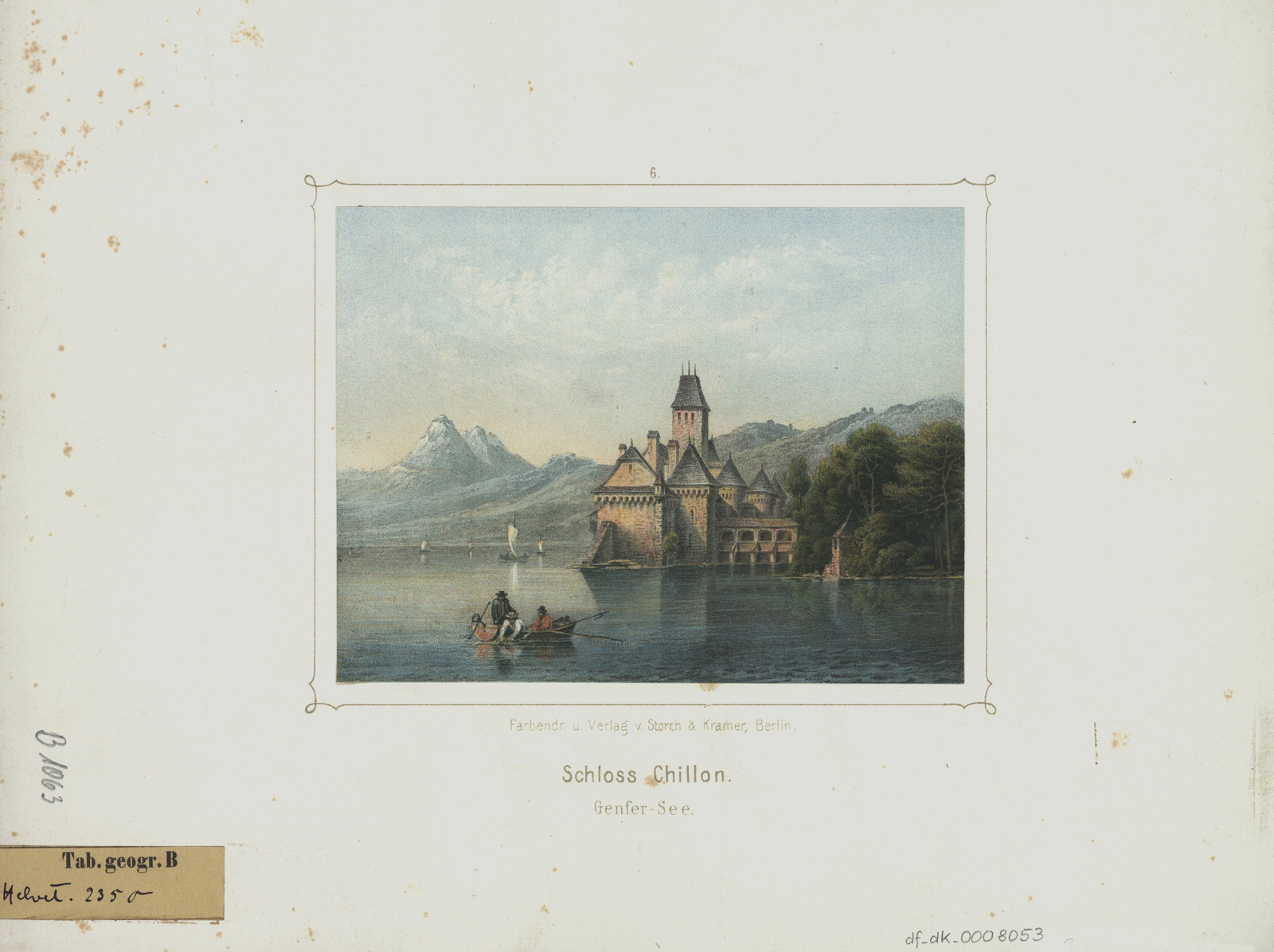
Ansicht von Schloss Chillon, Farbendruck, um 1870
· Deutsche Fotothek (via Europeana)
CC BY-SA


