Switzerland · Partial ruin
Habsburg Castle
Habsburg Castle is a medieval Swiss fortress near the Aar River in the canton of Aargau that became the original seat of the House of Habsburg. Built around 1020, its large and small towers and a 13th-century residential block survive while much of the eastern complex lies in ruin; parts now host a restaurant and a small exhibition.
First raised
1020
Its prime
1250
Today
Partial ruin
Ranked among Europe’s castles
As it stood in 1250
What Habsburg Castle looked like in its prime.
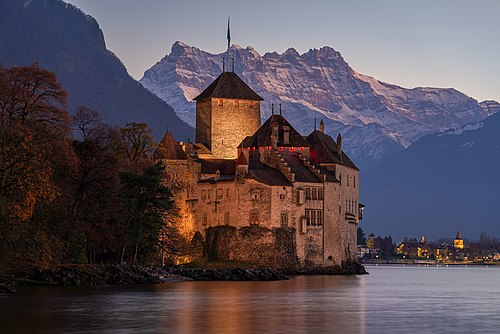
Perched on a wooded hill above the Aar plain with vineyards on the lower slopes, the castle presents a tall square keep with crenellated top attached directly to a multi-storey 13th-century residential block with a steep red-tile gabled roof and stepped gable end. Walls are light-grey coursed limestone/rubble with small grouped mullioned windows. At its prime the large and small towers, connected halls and curtain walls enclosed a complete fortified complex; eastern ranges now survive only as foundation traces.
Its story
The story of Habsburg Castle.
Guntram's Line and the Stone House on the Wülpelsberg
The Wülpelsberg had been in use long before any count claimed it: a small settlement in the Hallstatt period, then a Roman signal station manned from the camp at Vindonissa four kilometres away, holding the sight-line to the Bözberg pass and probably still working after the camp was given up in 101, and by the end of the third century a refuge for civilians from Alamannic raiders.
The house that later took the castle's name is traced in the Acta Murensia, written about 1160, to Guntram the Rich. A testament dated 1027 named Guntram's grandson, Bishop Werner of Strasbourg, as founder of the Habsburg, but the document proved to be a forgery made around 1085; it is now taken as certain that Werner's younger brother Radbot raised it around 1020, or in the decade after, two kilometres south of Altenburg, the small castle their father Lanzelin had built into the walls of a Roman fort on the Aare. The prompt was probably a feud with his next-younger brother Rudolf over the family property at Muri, which ended with the manor there destroyed; Radbot and his wife Ita of Lorraine founded Muri Abbey in 1027, likely in atonement. The castle was raised to open up land and to state a claim to lordship, not, as was long argued, as a military post on the Burgundian frontier.
The Hawk on the Wall, and Bishop Werner's Rebuke
The tale Ernst Ludwig Rochholz first wrote down in the middle of the 19th century has Radbot losing a hawk while hunting; his party climbed the thickly wooded Wülpelsberg after the bird, found it at the very top, and Radbot resolved to build his Habichtsburg there. The name is today derived from the Old High German habuh, hawk, though some have read it instead as a word for the ford below, a derivation now generally judged unlikely. Aegidius Tschudi rejected the hawk outright, pointing to a charter Bishop Werner sealed for the abbey of Muri in 1027 in which the place is called Habesburg and not Habichsburg.
A second story catches the castle's early poverty. Short of money for the work, Radbot asked his brother Werner for help; the bishop paid, then came to see what he had bought and found only a plain tower on the hill. He scolded him sharply, and Radbot promised that within one night the castle would have a strong wall. When Werner woke the next morning the slopes were camped with knights and their servants, come at his brother's call, Radbot explained: strong walls are only worth having if loyal and well-paid men stand behind them.
From Havichsberch to the Marchfeld
In 1108 the castle appeared in a charter as Havichsberch, and in the same year Radbot's grandson Otto II became the first of the line recorded as count of Habsburg. The family were landgraves in Upper Alsace and advocates of the see of Strasbourg, but in what is now Switzerland they stood at first in the shadow of stronger houses; loyal service to the Staufen and a web of marriages let them take up the Lenzburg comital rights when that line died out in 1173, and those of the southern Aargau around 1200.
When the Zähringer died out in 1218 and more land came in, the castle was too small and too plain for counts of that standing, and between 1220 and 1230 they moved out to nearby Brugg. Rudolf I was elected German king in 1273 and drew in the inheritance of the counts of Kyburg; five years later he beat the Bohemian king Ottokar II on the Marchfeld and took the duchies of Austria and Styria. The centre of Habsburg power moved to Vienna, and the holdings in Switzerland, Alsace and southern Germany became the Vorlande. The red lion on gold the counts carried from here stayed part of the Austrian arms to the end of the imperial period.
Front Castle and Rear Castle, 1050–1300
The stone house at the core of the front castle, dated to the middle decades of the 11th century, measured 18.5 by 13.2 metres and far exceeded the size of contemporary castle buildings in the surrounding country; walls 1.9 metres thick, now standing barely two metres high, mark it as a building meant for defence as much as for display. The last third of the 12th century brought a marked expansion: an east tower, an eastern curtain, a gate work and a north tower added to the stone house, a chapel and a draw well in the walled courtyard, and the Small Tower that began the rear castle. At the start of the 13th century the heavily fortified Great Tower went up beside it and, around 1300, the palas projecting south. The front castle had by then been left to decay, so a cross ditch was cut through the courtyard to hold the rear castle alone; what still stood of the older half was slighted around 1680 and the ground levelled in 1815.
Enfeoffed, Then Lost in April 1415
Once the counts had gone the castle was let out to ministerial families: the uninhabited front part to the lords of Wülpelsberg, the rear to the Schenken von Habsburg and the Truchsesse von Habsburg-Wildegg, who had long held the household offices here. The Wülpelsbergs died out around 1300 and their share passed to the knight Werner II von Wohlen of Brugg, whose grandson Henmann had bought up every remaining share by 1371. The woodland to the south and east was cleared during the 15th century, nearly half a millennium after the castle was built, and the hamlet of Habsburg grew there.
The quarrel between King Sigismund and Duke Frederick IV of Austria broke open in March 1415 at the Council of Constance, when Frederick helped the antipope John XXIII to escape. Sigismund called on the Confederates to seize Habsburg lands in the Empire's name, Bern took the western Aargau quickly, and Henmann von Wohlen capitulated at the end of April without a fight, keeping his holdings in return for acknowledging his new lords. For the Habsburgs, ruling by then from Vienna, the ancestral castle was gone for good.
It passed by sale to the city of Bern in 1457 and in 1469 to the abbey of Königsfelden, founded by the Habsburgs in memory of the murder of Albrecht I; when the Reformation closed the abbey in 1528 Bern's stewards kept a high watchman in the castle and a bailiff to work its fields and vineyards. The canton of Aargau has owned it since 1804, and the surviving rear castle was placed under cantonal monument protection in 1948.
Step inside
8 places to explore in 1250.
The record describes 8 distinct spots at Habsburg Castle, including 1 interior: palatial residence interior (hall / service space). Create your own photoreal reconstruction and explore every one, more scenes means more rooms, more angles, and more of the place to stand in.
Build Your Own Castle
Recreate Habsburg Castle with AI to explore it.
The artist rebuilds it as it stood in 1250, a photoreal reconstruction that belongs to you alone. Pay with coins, no subscription needed.
Recreate this castle →Defend this castle →Whose castle
Clans who held Habsburg Castle.
The families that held Habsburg Castle for a decade or more across its history, follow a name to its clan.
Habsburg
The original ancestral seat of the House of Habsburg, built c.1020 and held until 1415.
From the archive
Habsburg Castle on paper: the measured plan and period views.
The survey plan and photographs below are the ground truth this page's reconstructions are checked against, drawn and photographed while the castle was still a working garrison. Every image is public-domain or openly licensed, with its source named.
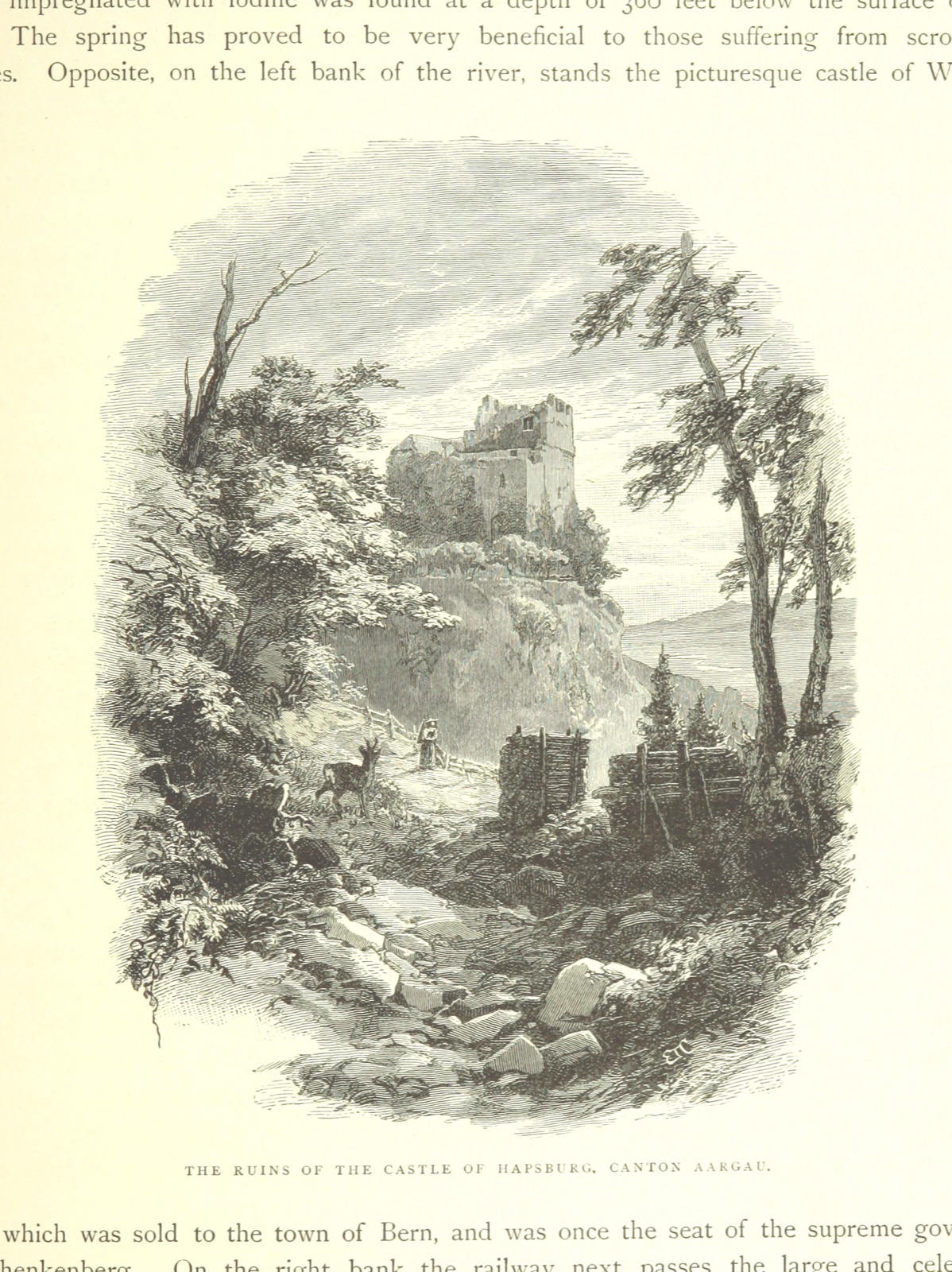
Habsburg Castle from "Switzerland: its scenery and people. Pictorially represented by ... Swiss and German art
1881 · The British Library (via Europeana)
Public domain