Ukraine · Restored
Olyka Castle
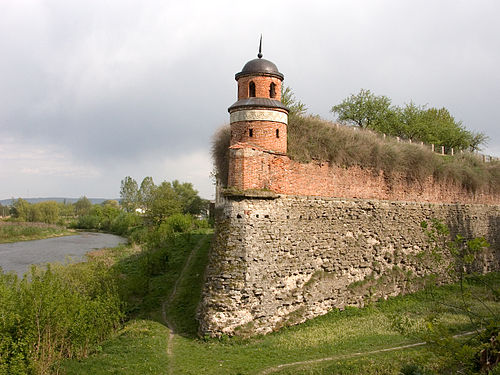
Olyka Castle is a large palazzo-in-fortezza built from 1554–1564 for the Radziwiłł family and later remodelled as a baroque residence. The almost-square fortress encloses a vast central courtyard and a three-storey southeastern palace wing beneath a red-tiled roof; it has been restored and is open to the public under the Volyn museum.
Its prime
1760
Today
Restored
As it stood in 1760
What Olyka Castle looked like in its prime.
An almost-regular square fortress with embanked corner bastions and a brick-stoned moat on three sides; three two-storey wings and one three-storey palace surround a very large central courtyard. Façades are smooth yellow plaster with white pilaster strips and regular rectangular windows; the palace has a red-tiled, steep baroque roof with small dormer openings. A baroque clock tower rises over the north-west gate; an open arcaded gallery with cross vaults and an Italian-style balcony face the courtyard.
Its story
The story of Olyka Castle.
Mikołaj the Black's Bastions and the Sieges, 1554–1648
Olyka Castle was raised between two rivers among flood waters by Prince Mikołaj Radziwiłł (1515–1565), called the Black, with the fortifier Jan Frankenstein working alongside him. The building years are given as 1554 to 1564 in some accounts and as beginning only in 1564 in others, on the later reckoning apparently unfinished when Mikołaj died in 1565; the work of strengthening and enlarging the castle continued after him. The Olyka estate passed to his youngest son, Stanisław Radziwiłł (1559–1599), and remained with a family that was among the most influential in the Polish–Lithuanian Commonwealth. The castle became the main seat of one of the three Radziwiłł branches; the two other senior branches were based at Nesvizh and Kletsk.
It was one of the first square bastion-type castles in the region, counted the first rectangular bastioned castle on the territory of modern Ukraine or, by other accounts, one of the first. Its dimensions reached roughly 100 by 120 metres, and it served as a model for similar castles and for smaller fortified works built in other towns. Biržai Castle in Lithuania, put up by Krzysztof Radziwiłł, nicknamed the Lightning, has much in common with it and was presumably modelled on Olyka. It is one of the largest aristocratic residences in Ukraine, with over two hundred rooms and a courtyard larger than the Piazza San Marco in Venice.
Between 1591 and 1648 the castle was besieged several times and was not captured, though it took damage. In 1640 the reconstruction of the castle was completed with the support of Prince Albrycht Stanisław Radziwiłł (1595–1656), who had further fortifications built, and a stone bridge replaced the old wooden one. The courtyard was built up on all sides, the south-eastern wing serving as the palace and the north-western carrying a two-storey clock tower in baroque style, with a richly decorated entrance gate on the town side and another opposite. Between 1635 and 1645 Albrycht also built nearby the Catholic collegiate church of the Holy Trinity, an elaborate baroque replica of Il Gesù in Rome; the Cossacks ravaged the church in 1648, and it was restored soon afterwards.
Swedish Soldiers, Baroque Rooms and the Second Partition, 1686–1793
In 1702, during the Great Northern War, Swedish soldiers ransacked the village of Olyka, but the castle itself stood. Changing tactics and innovations in military operations cost it its strategic importance during the eighteenth century, and it was used more and more as a palace than as a fortress. Prince Michał Kazimierz Radziwiłł (1702–1762) turned it into a magnificent baroque residence between 1737 and 1760: a third floor was added to the palace wing, the palace received a baroque-style roof, and the interior was renovated with new halls and rooms aligned in an enfilade.
The castle was described for the first time in 1686, a description that allows an appearance close to the original to be reconstructed; a second was drawn up in 1737 and is supplemented by an engraved plan of the eighteenth century. Stanisław Tomkowicz, who studied Olyka, held that the architectural ensemble of the Radziwiłłs' castle, defensive in origin, took its final form before 1793. After the Second Partition of Poland in that year, Olyka became part of the Russian Empire.
From Napoleon's Invasion to Janusz Radziwiłł's Departure, 1812–1939
In 1812, during Napoleon's invasion of Russia, the castle lodged a Russian military hospital, which remained there until 1837. From 1840 onwards no member of the Radziwiłł family lived at Olyka. The castle was abandoned to itself, decayed, and its interiors were destroyed, partly through fires. In 1883 Ferdynand Radziwiłł (1834–1926) began repair and refurbishment works that ran for thirty years, led by the architect Zygmunt Gorgolewski, who also designed the grand theatre in Lviv.
The palace rooms once held a large collection of art and furniture: portraits of the Radziwiłł princes, a portrait hall hung with forty or forty-two portraits of the Leszczyńskis, paintings of battle scenes and ceremonial occasions, alabaster coats of arms and stoves of Zhovkva tile moulded with eagles and military trophies. Portraits and other paintings together numbered as many as 152, and the castle also kept historical relics and documents. Staying with Prince Janusz in the second half of the 1930s, J. Hofman noted among the pieces a Ribera canvas of 1644, an inlaid buffet dated 1574, a triptych by a sixteenth-century Kraków master, a chest of medieval Gdańsk ironwork and a collection of old horse harness.
During the First World War the castle was severely damaged and precious furnishings and equipment were stolen. A further restoration was begun at the expense of its last owner, Janusz Radziwiłł (1880–1967), although he stayed mainly at his palace in Warsaw or at Nieborów, being closely involved in the politics of the Second Polish Republic, to which Olyka now belonged. At the start of the Second World War, in 1939, Prince Janusz left Olyka and never returned.
German Occupation and the Killings of 1941 and 1942
Nazi Germany occupied Poland and Olyka Castle was requisitioned by German forces. The castle became the site of the persecution of Olyka's Jews in the Holocaust. As part of the Einsatzgruppen action of August 1941, 720 Jews were murdered at the castle and nearby. In July 1942 several hundred more Jews were killed in the castle. Memorials outside Olyka mark the place of execution of more than 4,000 Jews in the summer of 1942, in and around the Olyka ghetto, the Radziwiłł fortress, Olyka Castle and the surrounding areas. A memorial to the murdered Jews of Olyka and the areas around it also stands in the Holon cemetery in Israel.
Stud Farm, Psychiatric Hospital and Museum, 1945–2021
In 1945 Olyka was no longer in Poland but had become part of the Soviet Union. The war had left the castle seriously damaged and destroyed once more: the palace and the other structures were completely burnt out and the roofs and ceilings collapsed, and only the walls, the vaults over the first floors and the brick-faced bastions remained intact. Of the art and furniture that had filled the palace rooms, nothing remained.
A state-owned horse stud farm was housed in some parts of the castle, and from the mid-1950s restoration work started again, the ruins being rebuilt for hospital use. Reconstruction was completed in 1967 and the castle became the Volyn psychiatric hospital, known in Soviet times as Volyn regional psychiatric hospital No. 2. In 1991, with the independence of Ukraine, Olyka changed statehood for the fourth time within the same century.
The psychiatric hospital remained until 1 July 2021, when the castle passed to the Volyn local history museum, which now holds it. The aim is to restore it, and the first money arrived in October 2021, ten million hryvnia from the state budget. The castle is already open to visitors.
Step inside
8 places to explore in 1760.
The record describes 8 distinct spots at Olyka Castle, including 2 interiors: open arcaded gallery with cross vaults, palace enfilade corridor of aligned rooms. Create your own photoreal reconstruction and explore every one, more scenes means more rooms, more angles, and more of the place to stand in.
Build Your Own Castle
Recreate Olyka Castle with AI to explore it.
The artist rebuilds it as it stood in 1760, a photoreal reconstruction that belongs to you alone. Pay with coins, no subscription needed.
Recreate this castle →Defend this castle →Whose castle
Clans who held Olyka Castle.
The families that held Olyka Castle for a decade or more across its history, follow a name to its clan.
Radziwiłł
Principal Volhynian seat of the Radziwiłłs from 1564; held for almost four hundred years until Janusz Radziwiłł lost it to confiscation in 1945.